

You may already know the outer forms of bhakti: a lamp before the deity, a familiar name on the lips, a devotional song, a temple visit, a pilgrimage. The harder question begins after the worship ends. When work becomes tedious, a family member tests your patience, or the mind feels spiritually dry, what keeps devotion from shrinking into an occasional mood?
Bhakti becomes a lived practice when remembrance crosses the threshold of the shrine and enters the next duty. You begin with a relationship, give that relationship a repeatable form, and let it correct how you act. Feeling has a place, but faithful return is what makes the path durable.
Choose a relationship you can keep returning to
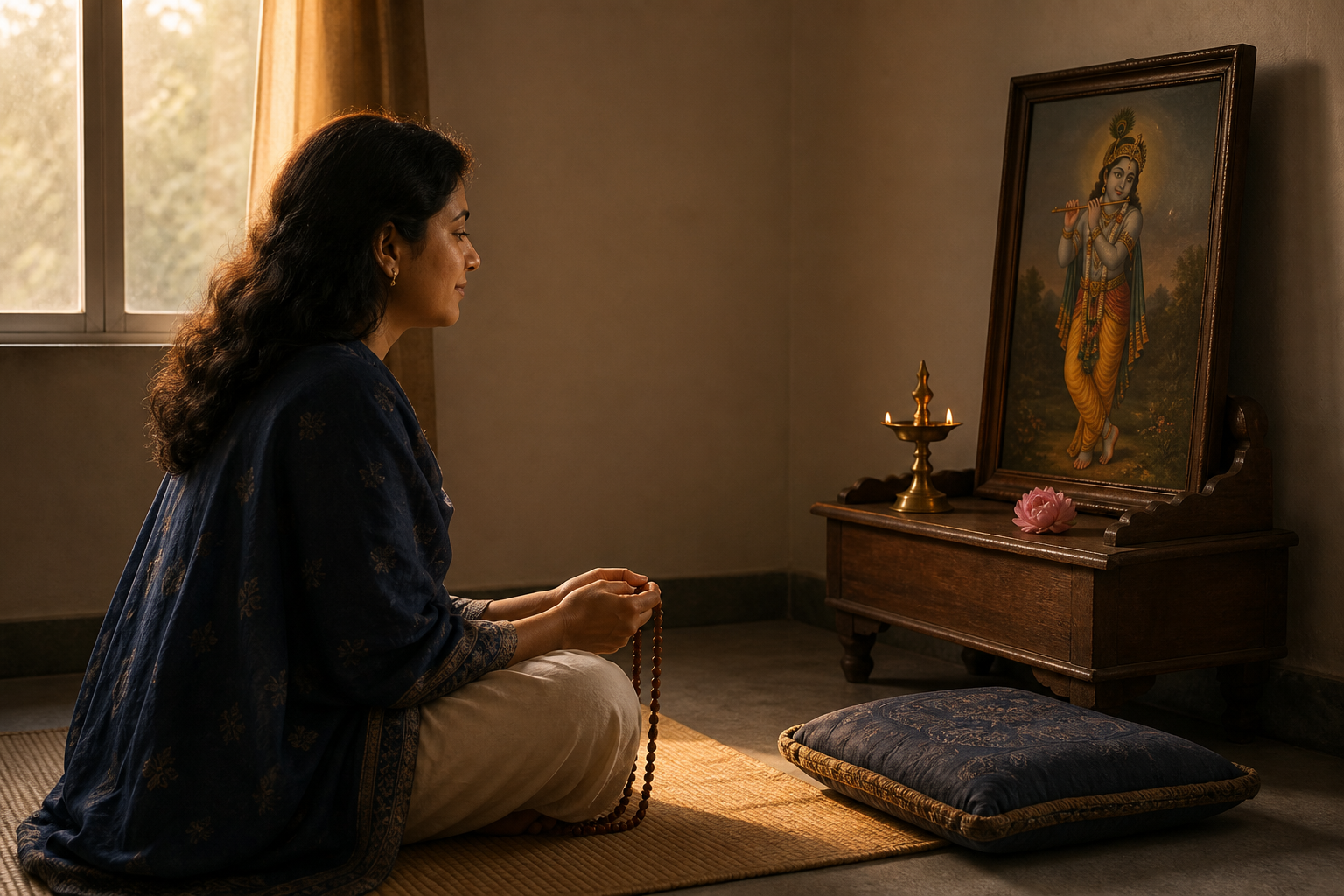
Bhakti is not the production of a permanently devotional mood. It is the repeated turning of attention, affection, and will toward the divine. Different sampradāyas explain that relationship in different theological language, so you need not flatten those differences into a single theory. Let your tradition teach you what devotion means while you concentrate on making it real in your day.
Your Iṣṭa is the cherished form through which this relationship becomes personal and addressable. The word is sometimes treated as though it means selecting a deity from a catalogue of preferences. In lived practice, the relationship may be received through family, temple, sampradāya, guru, sacred stories, or a reverence that has quietly become steady over time. It is often something you recognize before you can fully explain it.
Bhakti can first become visible through a grandparent’s nāmasmaraṇa, a devotee’s tears, or the unexpected joy of kīrtana. Such moments matter because they show devotion embodied in another life. They are invitations, not templates you must imitate exactly.
If you are unsure where to begin, use these criteria:
- Begin with what has already been entrusted to you. If your home has an established deity, name, stotra, or form of worship that awakens genuine reverence, start there before searching for novelty.
- Notice what produces steady regard rather than momentary fascination. A relationship that supports ordinary prayer is more useful than an experience you are constantly trying to recreate.
- Keep the practice coherent. Learning about other forms of the divine need not weaken your devotion, but endlessly changing your central name or method can prevent depth.
- Be honest about uncertainty. You can pray respectfully while understanding is still forming. Pretended certainty does not strengthen bhakti.
A vision, surge of emotion, or sudden sense of grace may deepen devotion. It cannot be made the entrance requirement. If you wait for an extraordinary experience before practising, you place your spiritual life under the control of a feeling you cannot command. Begin with the relationship you can sincerely acknowledge now.
Give remembrance a reliable place in your day

Nāmasmaraṇa is remembrance of the divine through the name. Kīrtana gives remembrance a sung and often communal form. These practices are accessible because they can move with you: the name does not have to remain inside a particular room, and a melody can recall the heart after attention has scattered.
The main difficulty is rarely a lack of possible practices. It is discontinuity. A demanding routine works for a few enthusiastic days and then disappears. A modest form attached to moments that already occur is more likely to become part of life.
Build your practice around stable transitions:
- Upon waking, remember before consuming. Before reaching for a screen or entering the day’s demands, turn to the name of your Iṣṭa. Let your first deliberate attention be devotional.
- During pūjā or ārati, listen as well as recite. Do not let the mouth race ahead while the mind treats the practice as a task to finish. Hear the name you are speaking.
- Carry remembrance into movement. Repeat the name inwardly while walking, waiting, preparing food, or doing familiar household work that does not require divided attention.
- Use the threshold before a difficult duty. Remember your Iṣṭa before sending a consequential message, beginning study, caring for someone, or entering a tense conversation.
- Close the day without turning devotion into strain. Return to the name before sleep, but do not treat sleep deprivation as a spiritual accomplishment.
The evocative image of nāmasmaraṇa becoming more compelling than sleep expresses absorption. It is not an instruction to neglect the body’s need for rest. The point is that remembrance becomes intimate enough to accompany the devotee into the quietest part of the day.
If your tradition gives you a particular mantra, method, or discipline, follow that framework. If it does not, avoid making the practice complicated merely to make it feel serious. Speak the familiar divine name with attention, pause long enough to receive its meaning, and take that remembrance into the next action.
Counting repetitions can support discipline where it belongs to your practice, but a count is not proof of devotion. The more revealing question is whether the name returns when pride, resentment, fear, or carelessness is about to govern your conduct.
Kīrtana offers something that solitary repetition cannot: shared rhythm, a common focus, and the experience of being carried when your own attention is weak. Join communal singing when it is available. At home, a familiar bhajan or abhanga can serve the same purpose on a smaller scale. Sing to address the divine, not to evaluate your own voice.
Make ordinary dharma the test of your devotion

Pilgrimage, temples, the homes of devotees, the presence of saints, and the singing of Viṭṭhala’s name can all awaken bhakti. Yet the decisive question is whether the divine is also encountered within the devotee’s everyday duties of dharma. Sacred places concentrate attention; daily conduct reveals what that attention has changed.
Use a simple movement of remembrance, offering, and examination:
- Remember before acting. Pause at the beginning of a duty and bring your Iṣṭa to mind. This interrupts the assumption that the action belongs entirely to your ego.
- Offer the quality of the action. Do the work carefully. Offering a task does not excuse laziness, avoidable mistakes, or broken promises.
- Examine what followed. Afterward, notice where vanity, irritation, dishonesty, or indifference took control. Bring the failure back into prayer and make the practical correction it requires.
This changes the way familiar situations are handled:
- In family life, devotion may mean listening without preparing a cutting reply, doing an unnoticed household task, or caring for someone without making your sacrifice the centre of the room.
- In work or study, it means accuracy, preparation, promise-keeping, and refusing to pass careless work to another person while calling the result an offering.
- In disagreement, it means stating what must be stated without using humiliation as a weapon.
- After causing harm, it means apologising, repairing what can be repaired, and changing the behaviour. More ritual cannot substitute for a correction you are avoiding.
This is also where sentimentality must end. Bhakti is not passivity before adharma. A demand to lie, conceal wrongdoing, abandon moral judgment, or tolerate abuse does not become dharma because it is wrapped in religious language. Devotion should make discernment more truthful, not easier to manipulate.
Ask yourself a sharper question than whether worship felt peaceful: Did remembrance change the next choice? If the answer is repeatedly no, do not discard worship. Connect it deliberately to one neglected duty. The correction may be less emotionally satisfying than another song, but it is often where devotion becomes credible.
Continue when tears, sweetness, and certainty disappear
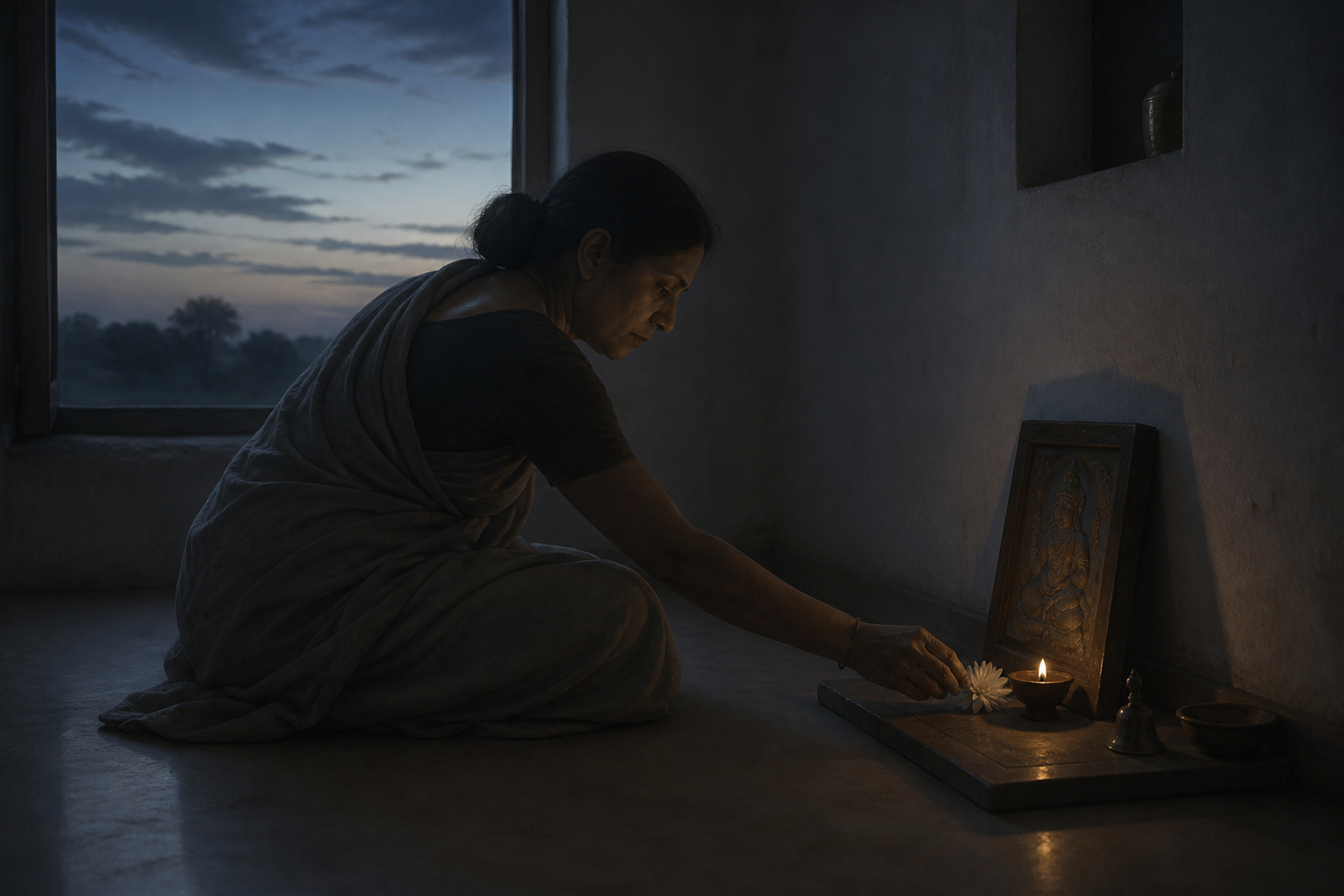
Tears while hearing of an Iṣṭa and an unnamed bliss during kīrtana are recognisable expressions of devotion. They are not an attendance register maintained by the divine. One person may weep easily, another may remain outwardly still, and the same devotee may pass through both conditions. Emotional intensity cannot be the sole measure of spiritual sincerity.
When feeling fades, respond without drama:
- Tell the truth in prayer. If you feel distracted, resistant, resentful, or empty, bring that condition into the relationship. Bhakti does not require flattering the divine with emotions you do not have.
- Preserve the established cue. Return at the same transition in your day even if the practice feels plain. Continuity keeps the doorway open.
- Reduce performance. Slow the name down, listen to it, and stop trying to reproduce yesterday’s feeling.
- Examine unfinished obligations. A restless conscience may need an apology, completed duty, or honest decision rather than a more elaborate ritual.
- Receive support from devotional company. Kīrtana, temple worship, and the presence of serious bhaktas can restore orientation when private effort has become enclosed within the self.
- Let grace remain grace. Welcome sweetness when it comes, but do not demand it as payment for practice.
When repetition becomes mechanical
Steadiness and mechanical repetition can look similar from outside. The difference is responsiveness. A steady practice can be quiet and emotionally undramatic, yet it still allows the name to correct attention and conduct. A mechanical practice is rushed merely to mark completion, resents interruption, and leaves the devotee unwilling to examine behaviour.
If you notice that deadness, do not immediately collect a new technique. During the next recitation, articulate the name clearly and listen. Recall whom you are addressing. Then connect the practice to a concrete act of dharma that you have been postponing. Attention and ethical response restore meaning more reliably than novelty.
The desire to solve the whole enigma of bhakti before becoming a bhakta reverses the order of learning. Some dimensions of devotion become intelligible only through devotion: remembering, singing, serving, failing, correcting, and returning. Understanding grows inside the relationship rather than entirely before it.
Key takeaways
- Begin with an Iṣṭa and devotional language you can approach sincerely; depth needs continuity more than novelty.
- Attach nāmasmaraṇa to transitions already present in your day, especially waking, worship, difficult duties, and rest.
- Use kīrtana, bhajan, or abhanga to support remembrance, but do not confuse emotional intensity with spiritual rank.
- Test devotion in speech, reliability, care, honesty, and the willingness to repair harm.
- When practice feels dry, preserve the relationship, simplify the form, and stop manufacturing emotion.
- Let pilgrimage, temple worship, and devotional company strengthen daily dharma rather than replace it.
At the next quiet transition in your day, turn toward the divine name you already trust. Then carry that remembrance into the duty immediately before you. That is enough to begin. The next sincere return is how bhakti becomes lived.
References
