
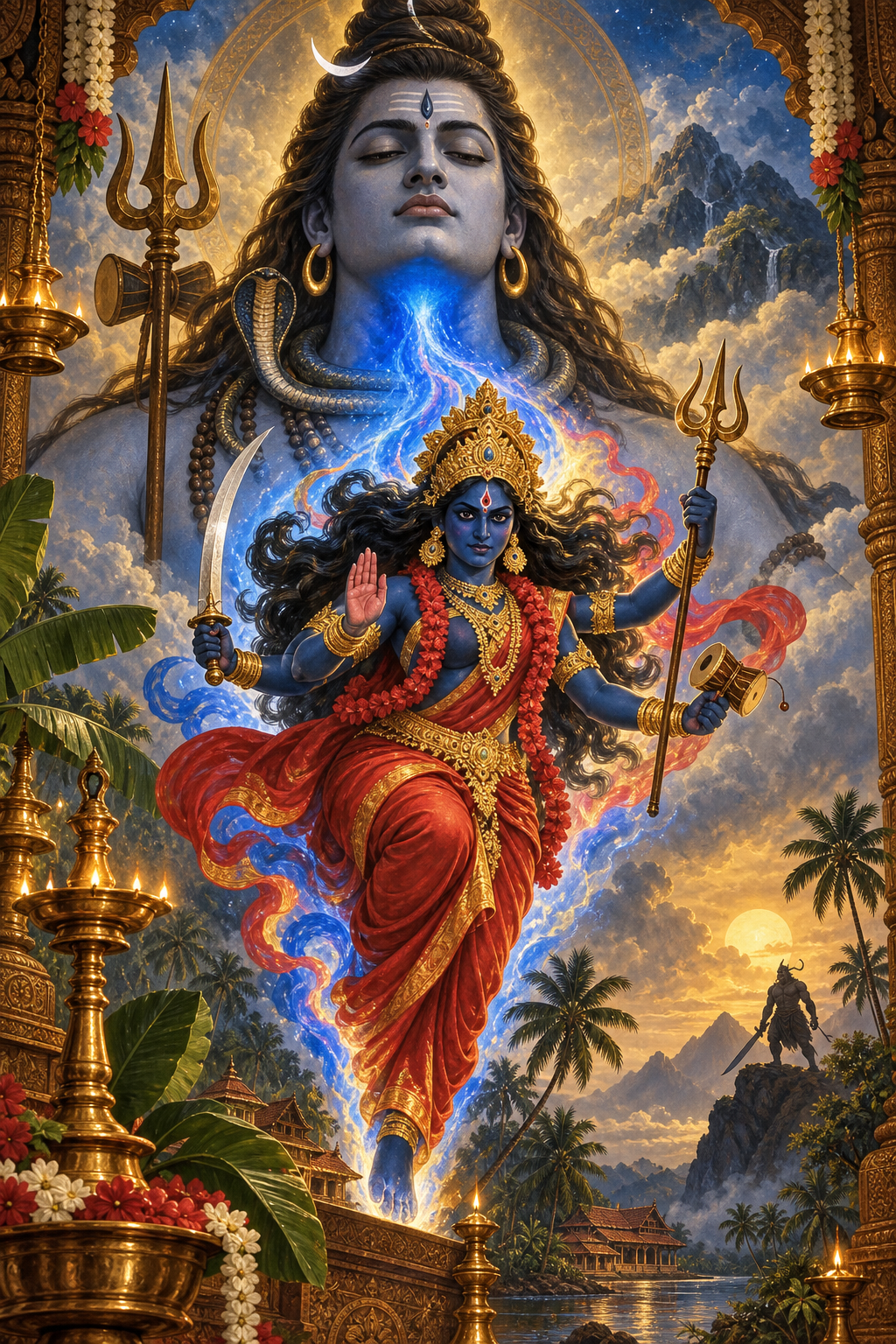
If you have encountered one telling in which Bhadrakali emerges from Shiva’s third eye and another in which she comes from his blue throat, you do not need to dismiss either one as a mistake. The useful question is narrower: which Kerala tradition are you hearing, and what does its chosen place of manifestation ask you to notice?
The distinction is clear. Most Kerala traditions place Bhadrakali’s emergence in Shiva’s third eye, while an alternative local tradition places it in his Halahala-stained blue throat. In both tellings, she manifests to destroy the demon Darika. The location changes; her purpose does not.
The short answer: a variant, not a correction
Three different questions often get collapsed into the vague question, Which story is correct? Separate them and the apparent contradiction becomes easier to handle.
- If you are asking for the more widespread Kerala account, the answer is the third-eye manifestation.
- If you are asking whether Kerala also preserves a blue-throat origin, the answer is yes.
- If you are asking which account every Hindu community must accept, these local traditions do not justify such a universal claim.
The blue-throat telling is therefore best described as an alternative Kerala origin tradition. It need not displace the third-eye account in order to matter. A tradition may preserve the same divine mission while varying the image through which that mission becomes manifest.
This is an important discipline when reading Hindu narratives. Difference does not automatically mean corruption, and popularity does not automatically make every other telling false. At the same time, plurality should not become an excuse for careless generalisation. A local account should be identified as local rather than presented as the single, uncontested Hindu version.
What the blue-throat origin actually claims
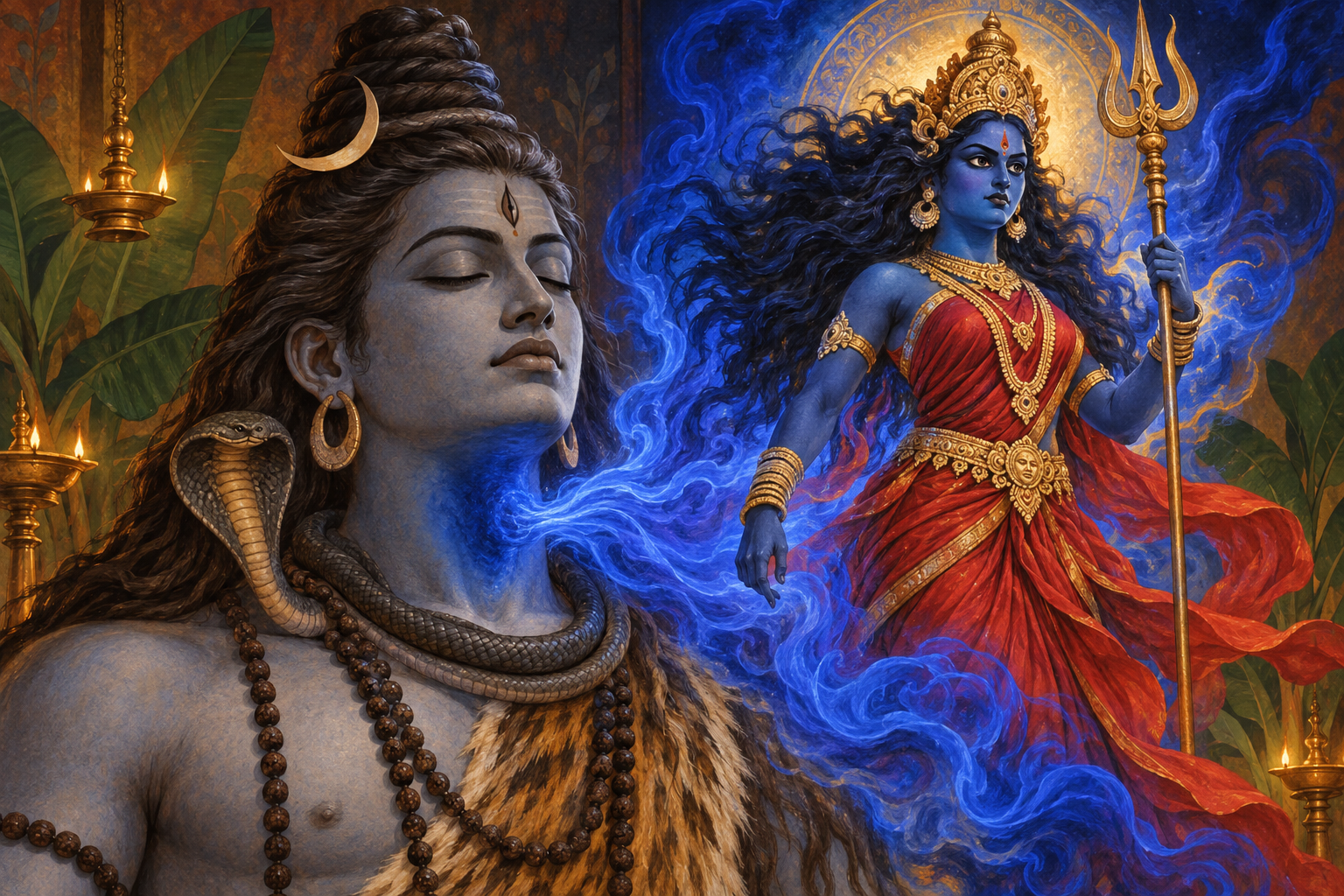
The core account can be stated in one careful sentence: In an alternative Kerala tradition, Bhadrakali manifests from Shiva’s blue throat, the place marked by the lethal Halahala poison, to slay Darika.
That sentence contains three elements you should preserve when retelling it:
- The divine manifestation: Bhadrakali emerges from Shiva.
- The distinctive location: she comes from his blue throat rather than his third eye.
- The immediate purpose: she manifests to destroy Darika.
The most common misreading is to turn from the blue throat into from the poison. Those are not identical claims. The tradition locates her manifestation in the part of Shiva marked by Halahala; it does not, merely by doing so, identify Bhadrakali with the poison itself. Nor does that one detail establish that she poisons Darika, carries Halahala as a weapon, or derives her nature from a harmful substance.
Keep the same boundary around other dramatic details. The origin statement does not by itself tell you about Darika’s powers, the sequence of battle, the weapons used, or the manner of his death. If a fuller retelling supplies those elements, verify them within that particular narrative line rather than assuming they follow automatically from the blue-throat motif.
Why the blue throat changes the story’s emphasis
A place of divine emergence is rarely a disposable detail. It shapes how you contemplate the manifestation, even when the story’s outcome remains the same.
The third eye directs attention toward concentrated perception and fierce divine force. The blue throat directs attention toward Shiva’s poison-marked body: the sign of a lethal danger borne without allowing that danger to define him. Bhadrakali’s appearance at that location can therefore be read as a movement from contained danger to purposeful divine action.
That is an interpretation, not an extra episode of the narrative. It helps to keep three layers separate:
- Narrative layer: Bhadrakali manifests from Shiva’s blue throat to slay Darika.
- Symbolic layer: the Halahala-marked throat invites contemplation of danger held in check and power directed toward a protective purpose.
- Doctrinal layer: claims about the precise metaphysical relationship between Shiva, Bhadrakali, and Halahala require more than the bare origin statement.
This separation prevents two opposite errors. The first is to drain the account of meaning and treat blue throat as nothing more than a change of scenery. The second is to build an elaborate theology out of an implication that the tradition itself has not explicitly stated.
A restrained devotional reading is still possible. Shiva bears the mark associated with a deadly force; Bhadrakali manifests from that marked place and confronts Darika. The image joins endurance with action. What is held within Shiva does not erupt as uncontrolled destruction. It becomes a directed response in the form of the goddess.
This reading also avoids reducing Bhadrakali to a mere extension without agency. Her point of emergence expresses intimacy with Shiva, while her mission gives her a distinct and active presence. The narrative’s centre of gravity moves quickly from where she comes from to what she does: she goes forth against Darika.
How to compare the two traditions responsibly
If you are teaching, writing, making a video, or simply explaining the tradition to your family, use a method that preserves both accuracy and plurality.
- State the shared core first. Bhadrakali manifests from Shiva for the destruction of Darika.
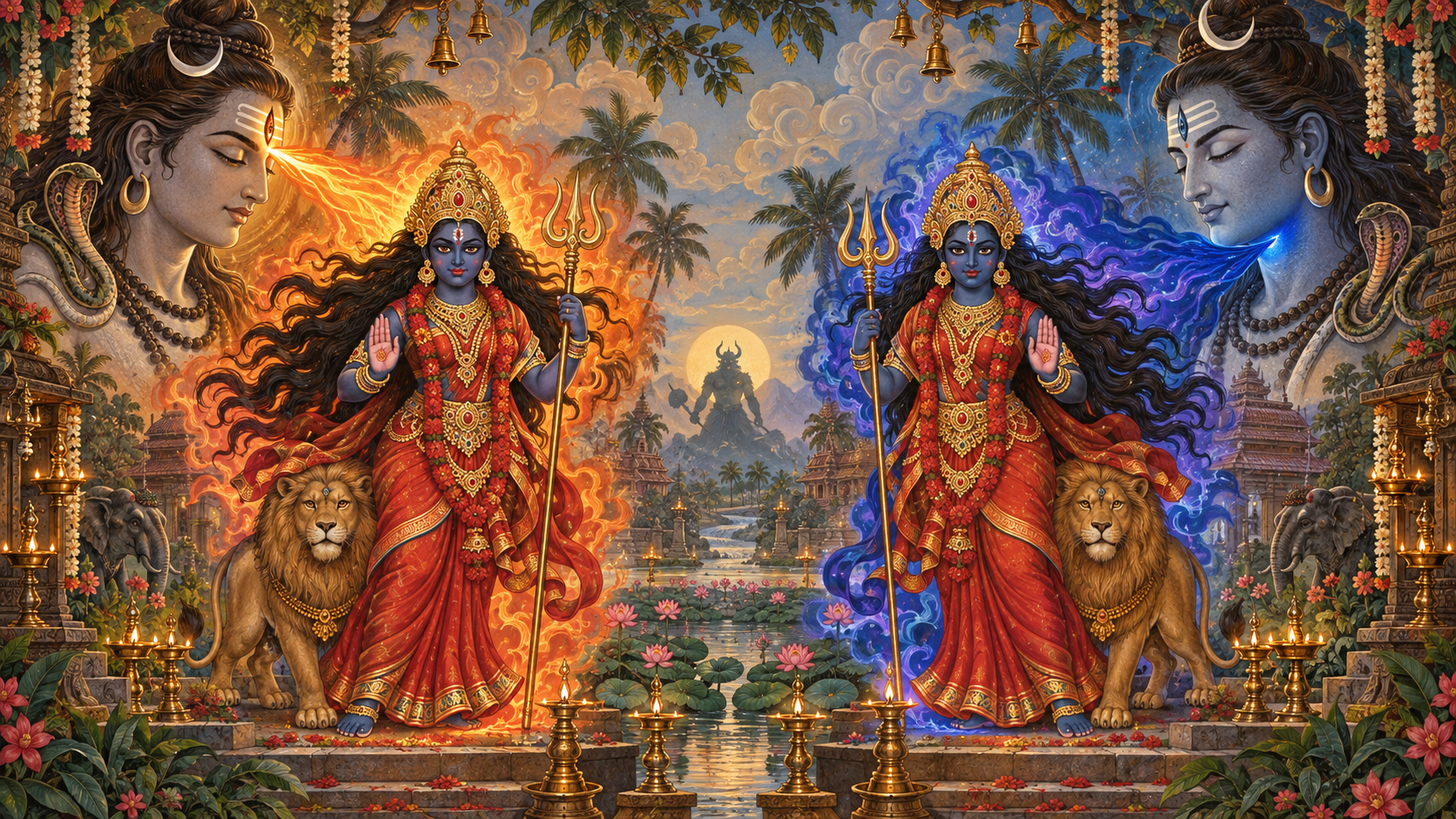
- Name the variable precisely. The more widespread Kerala account identifies the third eye; an alternative local account identifies the blue throat.
- Identify the scope. Say Kerala tradition or alternative Kerala tradition. Do not silently turn a regional account into a claim about every Hindu tradition.
- Separate narration from interpretation. Tell your reader what happens before explaining what the poison-marked throat may signify.
- Do not invent a hierarchy. More common does not necessarily mean more ancient, more authentic, or more spiritually valuable. Those conclusions need their own evidence.
When you hear the blue-throat account in a local setting, ask where that particular telling is preserved and how its custodians explain it. A temple community, devotional lineage, family tradition, or regional narrator may give the image a more specific meaning. Their explanation should take priority over a symbolism imposed from outside.
When no such context is available, modest wording is the safest wording. Say that the blue-throat account exists as an alternative local tradition. Do not label it the original version, the secret version, or the only correct version. Those phrases attract attention, but they claim more than the account establishes.
The same care applies to the third-eye telling. It should not be used to erase the blue-throat tradition merely because it is more familiar. The two accounts can be compared through their imagery without pretending that one is simply a damaged copy of the other.
Key takeaways
- Kerala’s more widespread tradition says Bhadrakali emerged from Shiva’s third eye to destroy Darika.
- An alternative local tradition says she manifested from Shiva’s blue throat, which was marked by Halahala.
- The blue-throat account does not necessarily mean that Bhadrakali was made from poison or identical with it.
- The two tellings share Bhadrakali’s mission against Darika but place different symbolic emphasis on her point of emergence.
- The most accurate label is alternative Kerala tradition, unless a specific community supplies a more exact identification.
The next time you encounter either version, identify the place of manifestation before declaring a contradiction. Preserve the shared mission, name the regional variation, and keep your symbolic reading visibly separate from the narrative itself. That small habit lets you honour Hindu plurality without sacrificing precision.
References

Leave a Reply
You must be logged in to post a comment.