
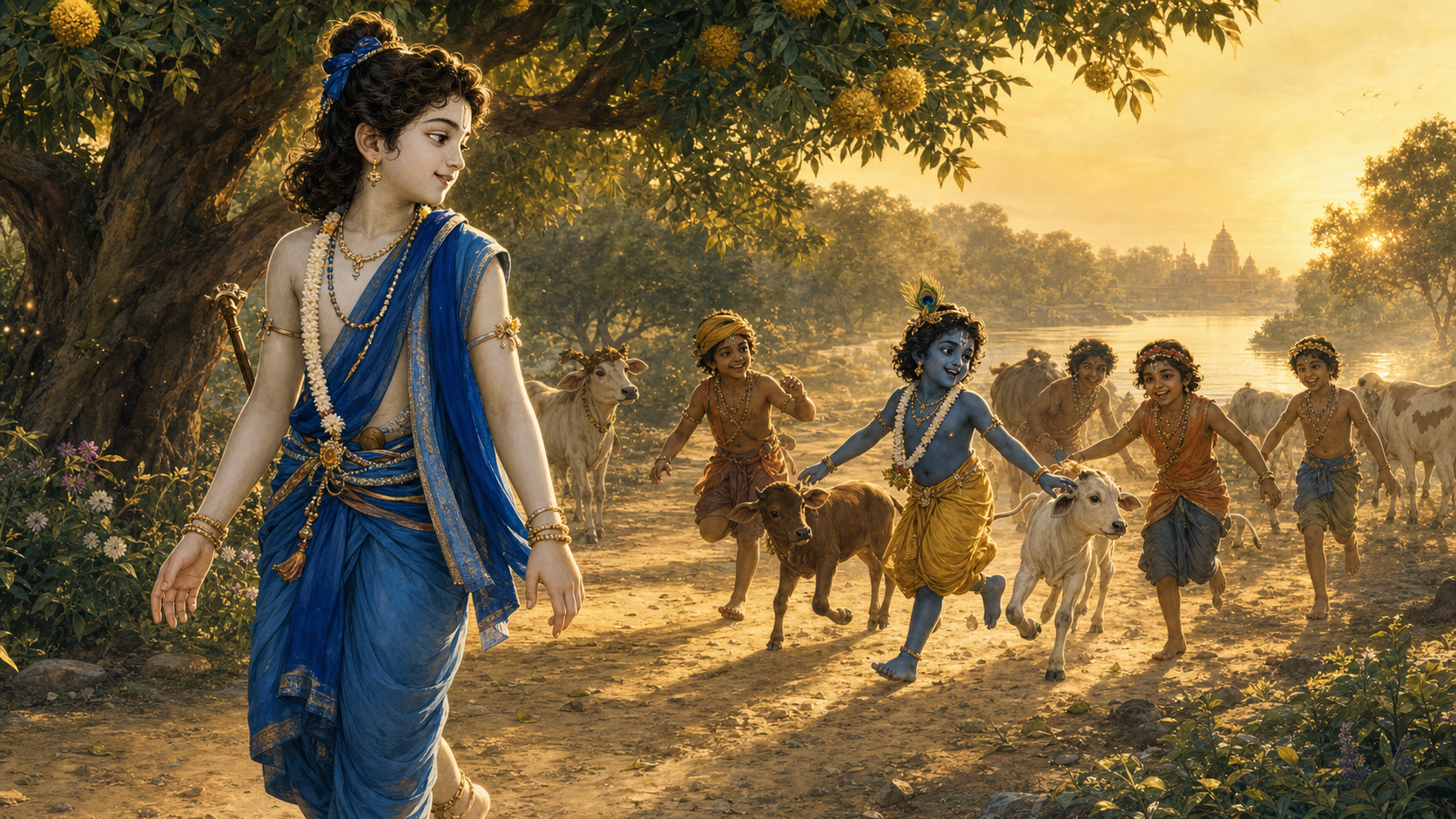
In the image of Luk Luk Dauji, a brother’s repeated glance carries an entire devotional vision. Balarama watches Krishna not from suspicion or a desire to control him, but from the alert tenderness of an elder sibling who remains present while the younger brother plays freely.
Read within Braj devotion, that small gesture connects several larger ideas: divine strength expressed as service, family affection treated as spiritual knowledge, sacred geography sustained through memory, and seeing transformed into a form of participation. The result is a portrait of Balarama in which power is most meaningful when it supports another.
A repeated glance becomes a devotional language
The DharmaRenaissance account presents Luk Luk Dauji as an affectionate image of Balarama looking toward Krishna again and again. It also treats the sound of “Luk Luk” as suggestive of repeated looking, peeking, or checking. The article does not establish a narrow linguistic origin for the phrase; instead, it places the expression within the spoken and emotional culture of Braj. That distinction matters. Its devotional significance rests less on a formal definition than on the relationship it makes immediately recognizable.
The name Dauji provides the key. According to the source, it is a familiar and reverential Braj form of address for Balarama as the elder brother. It conveys seniority without remoteness and responsibility without formality. Balarama is therefore encountered not only as a divine figure possessing immense strength, but as the family member who accompanies Krishna, shares his pastoral world, and keeps him within sight.
This changes the meaning of watchfulness. Surveillance seeks information or control; the gaze attributed to Dauji is interpreted as an act of care. It allows movement rather than preventing it. The elder brother does not end the younger brother’s play so that danger can be eliminated. He remains attentive within the play. Braj devotion turns that ordinary relational instinct into a theological proposition: love becomes dependable when it notices.
Strength is fulfilled when it takes the form of seva

The source situates Balarama within a broad Vaishnava understanding as Krishna’s elder brother, companion, protector, and an expansion of divine strength. It also notes his association with Sankarshana and with the supporting power through which Krishna’s pastimes unfold. Luk Luk Dauji brings these large theological claims down to the scale of a glance. Support is no longer merely a cosmic function; it becomes attention directed toward a particular beloved.
This synthesis helps resolve an apparent tension in Braj narratives. If Krishna is understood as the Supreme Lord, why should he need to be watched, fed, guided, or protected? The devotional answer is not that his divinity has been diminished. Rather, divine intimacy permits love to approach him through real relationships. Krishna can be cared for as a younger brother, while Balarama’s desire to care for him remains spiritually meaningful. The sweetness of the relationship depends upon allowing affection to operate fully instead of being cancelled by metaphysical rank.
Balarama’s familiar emblems of strength, including the plough and mace mentioned by the source, therefore reveal only part of his devotional character. Luk Luk Dauji supplies the complementary image. Force protects at moments of visible danger, but steady attention supports life between those moments. His seniority is expressed not by demanding deference from Krishna, but by remaining available to him. In this reading, seva is strength disciplined by affection.
Braj preserves relationship through place and darshan

The DharmaRenaissance article describes Braj as more than a geographical region associated with Krishna’s childhood and youth. For devotees, its groves, paths, ponds, and pastures form a living landscape of lila. Luk Luk Dauji belongs to this landscape because it shows how sacred memory can attach not only to a dramatic event, but also to a posture, a name, or a moment of looking.
This is one of the image’s most useful contributions to understanding Braj devotion. Sacred geography does not function only as a map of where major episodes are believed to have occurred. It also gathers the emotional textures through which those episodes are remembered. A place can preserve the feeling of companionship; a regional form of address can preserve familial closeness; a repeated glance can preserve the mood of protection. Landscape and relationship consequently reinforce one another.
The source further connects Dauji’s gaze with darshan, understood as an encounter in which seeing is reciprocal rather than merely observational. Luk Luk Dauji adds another layer to that pattern. Balarama looks lovingly toward Krishna, while devotees contemplate Balarama in the act of looking. Krishna remains the focus, but Dauji becomes a model for the quality of attention brought to that focus. Devotion is thereby presented not only as seeing a sacred form, but also as learning how to see: steadily, reverently, and without possessiveness.
The ethical boundary between protection and control
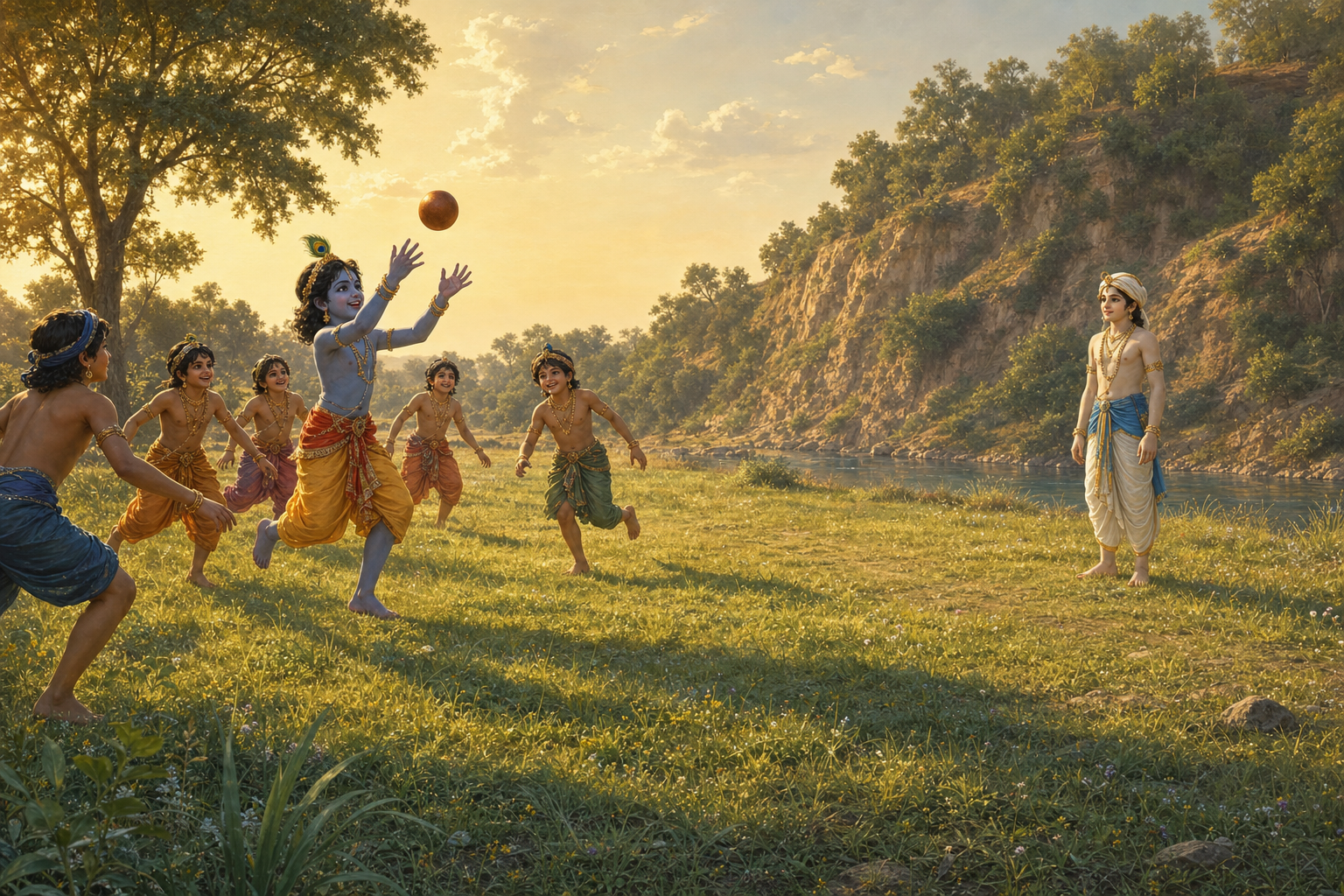
The elder-brother relationship gives Luk Luk Dauji an ethical reach beyond its narrative setting. The source characterizes the ideal elder sibling as one who guides without arrogance, protects without harshness, and accepts responsibility without losing affection. These qualities clarify why watchfulness can be praised in one context and resisted in another. Its moral character depends upon what the watcher seeks.
Protective attention remains oriented toward the other person’s welfare and preserves room for agency. Possessive attention is oriented toward the watcher’s fear, authority, or need to manage. Dauji’s gaze, as interpreted by the article, belongs to the first kind: it is present without becoming intrusive. His strength creates security rather than dependence, and his seniority becomes a reason to serve rather than a license to dominate.
This distinction makes the image relevant to families and communities without reducing it to a simple moral lesson. Luk Luk Dauji does not provide a formula for every relationship. It offers a devotional standard by which responsibility can be examined: whether attention helps another flourish, whether authority remains joined to tenderness, and whether protection responds to the beloved rather than to the protector’s desire for control.
Key takeaways
- Luk Luk Dauji is best approached as an image of repeated, affectionate attention rather than as a claim about divine anxiety.
- The familiar name Dauji makes Balarama’s elder-brother relationship central to the way his strength is understood in Braj.
- His gaze functions as seva: support becomes personal, attentive, and woven into Krishna’s freedom to play.
- Braj’s sacred geography preserves emotional gestures as well as celebrated events, allowing a glance to become part of devotional memory.
- The image distinguishes loving vigilance from possession by joining responsibility to restraint, tenderness, and respect for the beloved.
Future interpretations of Luk Luk Dauji can retain their depth by keeping these elements together: Balarama’s power, the intimacy of brotherhood, the devotional discipline of seeing, and the freedom protected by genuine care. Separated, they become abstractions; held together, they reveal why one quiet glance can carry so much of Braj’s relational theology.