Indilayappan is best approached as a devotional accent within the larger identity of Ayyappa. The name directs attention toward a compassionate guardian who receives distress, grants courage and leads the devotee back toward steadiness under dharma.
The significance of this epithet becomes clearer when theology, iconography and pilgrimage are read together. Refuge in Indilayappan is not presented as passive consolation: it is enacted through restraint, repetition, embodied offerings, mutual assistance and ethical conduct.
What the name Indilayappan adds to Ayyappa devotion
The source article treats the precise philology of Indilayappan cautiously, describing it as locally inflected rather than supplying a definitive derivation. Its meaning in devotional practice is clearer: the epithet foregrounds Ayyappa as a remover of hardship and a giver of fearlessness. This distinction matters because devotional usage can remain meaningful even when a name’s linguistic history has not been conclusively established.
Indilayappan also belongs to a wider family of Ayyappa names. According to the source, Dharma Sastha emphasizes ethical guidance; Hariharaputra expresses the union of Shiva and Vishnu through the Mohini narrative; and Manikanta recalls traditions associated with Pandalam. Indilayappan shifts the emphasis toward consolation and relief. These are complementary perspectives rather than competing identities: each name tells the devotee which dimension of the deity is being invoked.
This semantic caution prevents two common errors. Indilayappan need not be reduced to a dictionary formula, and the compassionate emphasis need not be separated from Dharma Sastha’s demand for disciplined conduct. Within the source’s presentation, relief is inseparable from the restoration of moral and psychological balance.
The protector and the ascetic belong to one image
The source situates Ayyappa between Shaiva and Vaishnava currents as Hariharaputra. That theological position does more than reconcile two affiliations. It presents dharma as spacious enough to sustain distinct forms of devotion while orienting them toward a shared discipline. The familiar invocation Swamiye Saranam Ayyappa gives this principle a communal form: different pilgrims voice the same act of refuge.
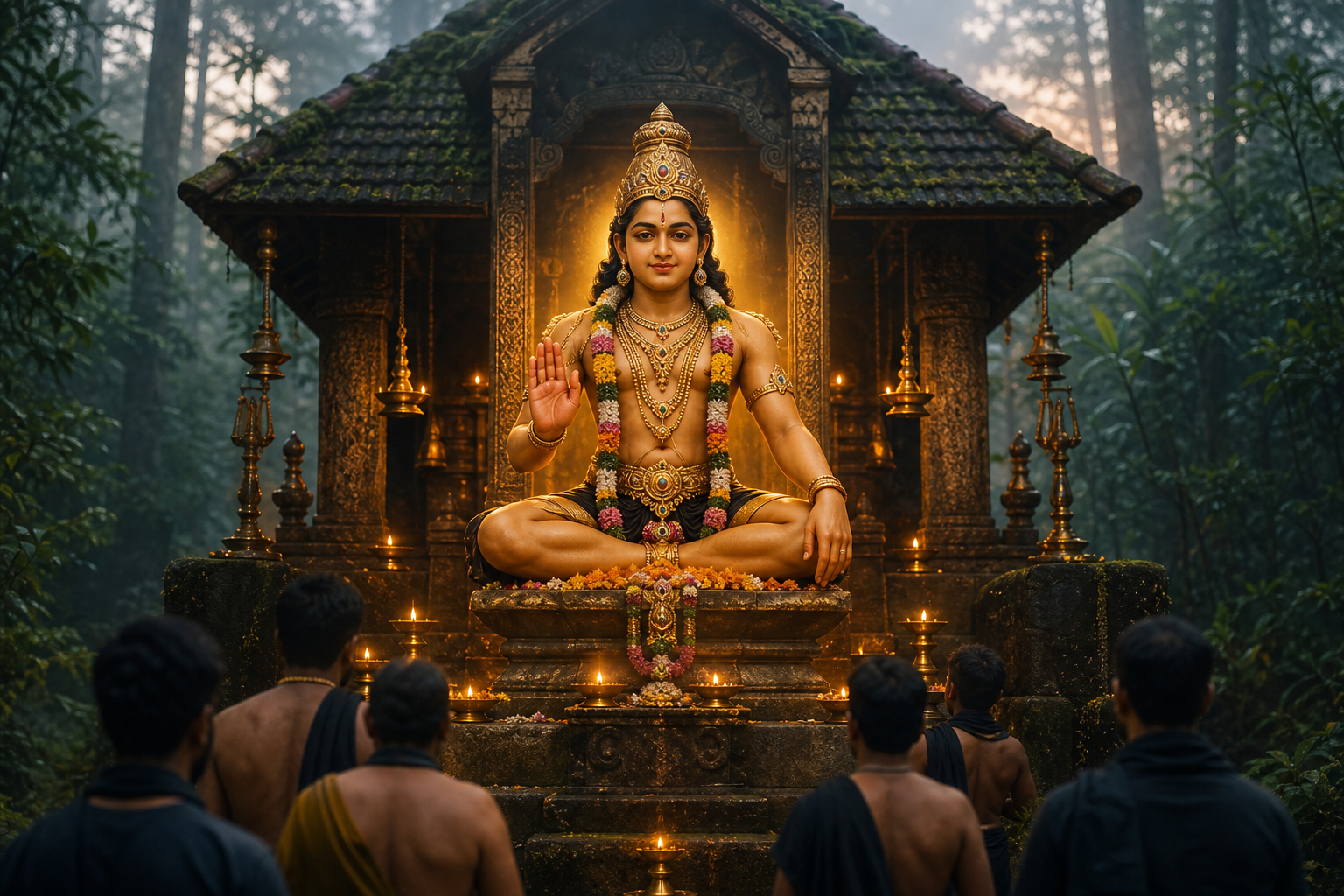
The reported iconography at Sabarimala reinforces the same balance. Ayyappa’s yogic posture and yogapatta signify inward restraint, while gestures associated with fearlessness and generosity turn that collected strength toward the devotee. Indilayappan can therefore be understood neither as an indulgent rescuer nor as a remote ascetic. Compassion is supported by discipline, and discipline is directed toward compassionate protection.
The source also places Sastha traditions within a long regional history. It refers to Puranic and epigraphic appearances of Sastha, scholarly attention to possible continuities with protective figures such as Ayyanar, and a medieval maturation of Sabarimala through local traditions, patronage and liturgical development. These points are presented as a broad historical account, not as a settled derivation of every element of contemporary Ayyappa worship. The safer conclusion is that the tradition developed through convergence while retaining both yogic and guardian dimensions.
How refuge is converted into an embodied discipline
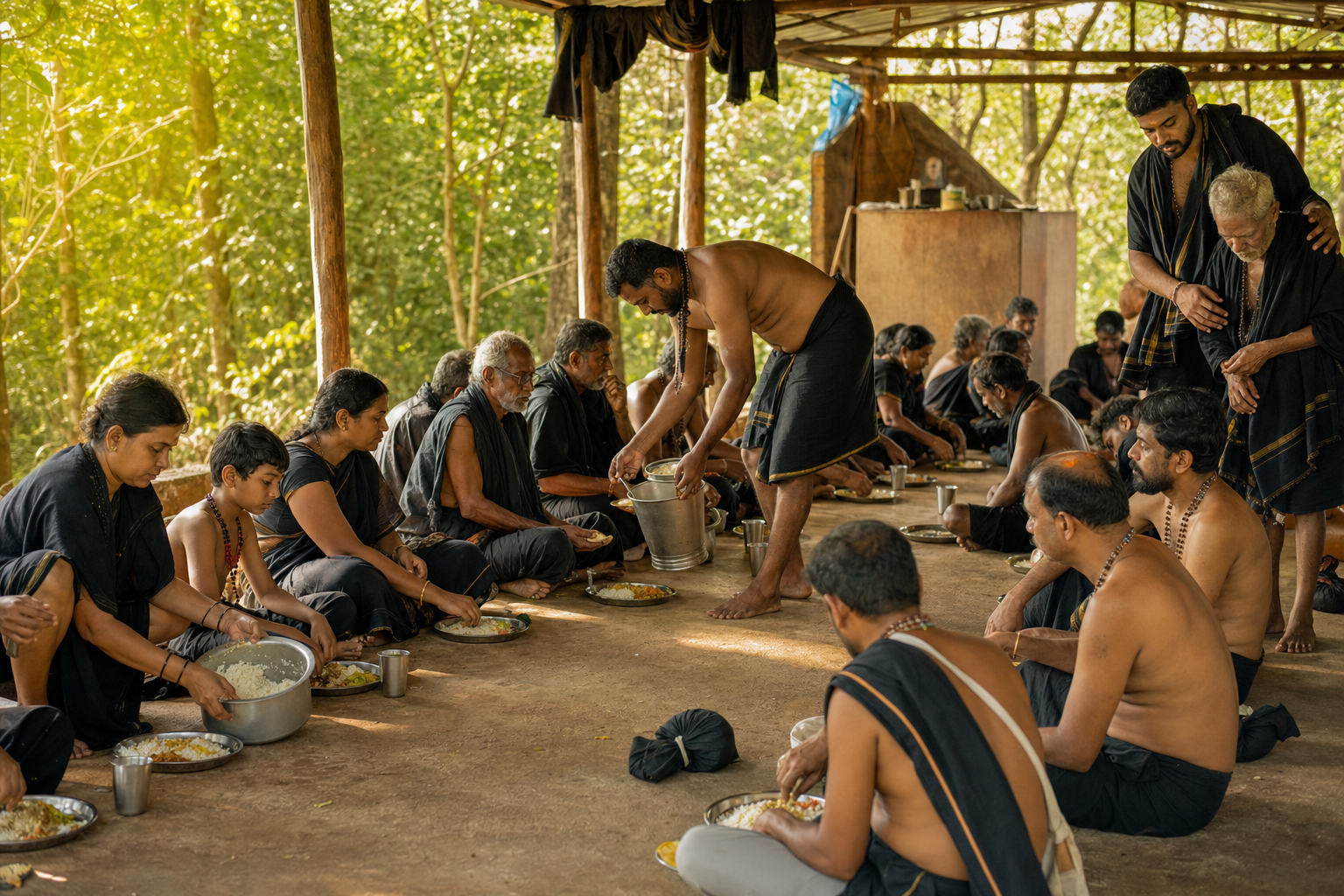
The source describes the Sabarimala pilgrimage as the practical expression of Indilayappan’s theology. Its reported 41-day vratham includes simplicity of dress, commonly black or blue, along with brahmacharya, vegetarian food, daily recitation and mindful behaviour. Each observance narrows distraction and makes refuge a pattern of conduct rather than a request voiced only at the shrine.
The Irumudi Kettu gives material form to this process. The source describes it as a twin-compartment bundle carried on the head, holding offerings while also symbolizing burdens entrusted to the deity. In neyyabhishekam, ghee transported in a coconut becomes an offering; Aravana Payasam expresses thanksgiving; and the ascent of the Pathinettam Padi, the 18 sacred steps, is interpreted as movement beyond the restrictions of ego toward dharma and refuge.
These actions create a sequence: the pilgrim simplifies life, carries an offering, accepts physical effort, approaches with others and finally receives darshan. The source’s language of ritual technology can be understood in this functional sense. Repeated prayer organizes attention; vows translate intention into habit; bodily effort gives surrender a physical cost; and group observance supplies accountability and support. This is an interpretation of ritual formation, not a clinical claim that pilgrimage substitutes for medical or psychological care.
Communal rites extend the sequence beyond the individual. The source associates Pettathullal at Erumely with an experience of solidarity across social boundaries, while the nightly Harivarasanam at Sannidhanam provides a contemplative close. It further presents shared vows as temporarily softening distinctions of profession, caste and wealth. That egalitarian aspiration is central to the ritual design, although an aspiration enacted in pilgrimage should not automatically be treated as proof that every social inequality disappears.
Key takeaways
- Indilayappan emphasizes Ayyappa’s compassionate response to distress, while the name Dharma Sastha keeps that compassion connected to ethical direction.
- The ascetic posture, protective gestures and Hariharaputra theology hold discipline, fearlessness and theological plurality together.
- The vratham, Irumudi Kettu, neyyabhishekam and sacred ascent turn refuge into repeated, embodied action.
- The pilgrimage’s promise of relief includes a social dimension: mutual assistance and shared observance are part of the spiritual practice.
Relief as ethical and communal reorientation
The strongest synthesis in the source is that distress is addressed at more than one level. The chant is said to steady breath and attention; the vow disciplines appetite and reaction; the journey interrupts habitual routines; and the group creates companionship. Darshan remains the devotional centre, but the path toward it already begins reshaping the conditions in which anxiety, isolation and impulsiveness can grow.
Compassion consequently carries obligations. The source connects Dharma Sastha with daya, ahimsa, dana and seva: compassion, non-violence, generosity and selfless service. It also identifies resonances with Buddhist karuna, Jain aparigraha and Sikh traditions of seva joined to remembrance. These comparisons are most useful as ethical parallels, not as claims that the traditions are historically identical or theologically interchangeable.
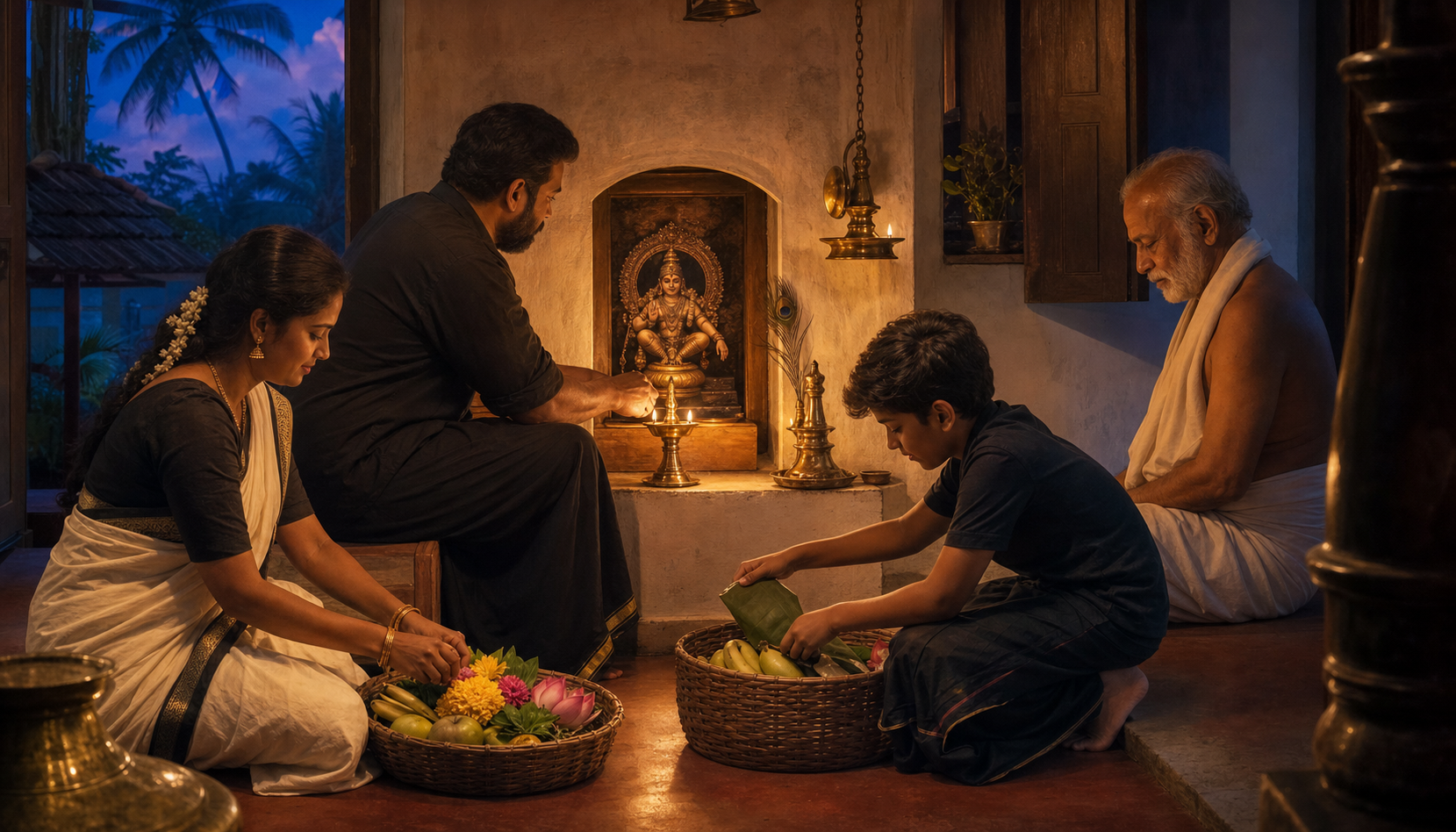
The same pattern continues outside the pilgrimage season. The source reports household practices such as lighting a lamp, reciting names and making simple offerings, with stories and songs carrying devotion between generations. It interprets Makarajyoti and Makaravilakku at Makara Sankranti as signs of renewal and discernment. In both domestic and festival settings, the crucial movement is from receiving consolation to practising hospitality, gratitude and mutual care.
Future interpretation of Indilayappan will be strongest when it preserves this balance: linguistic humility about the epithet, care in distinguishing spiritual formation from therapeutic proof, and close attention to how the pilgrimage’s ideal of equality is lived beyond the sacred hill. That approach allows a regional name of refuge to remain both theologically precise and ethically demanding.