
If loss has left you asking what loving service should look like, it is easy to reach for one incomplete answer. You may offer philosophy without listening, sympathy without direction, or money without knowing whether it will produce lasting good.
Srila Prabhupada demonstrated a more complete sequence: meet the person’s pain, speak spiritual truth without denying human nature, and connect generosity to a definite form of seva. That sequence gives you a practical way to comfort another person, examine your own desires, and use your resources responsibly.
Compassion begins with the person, not the project
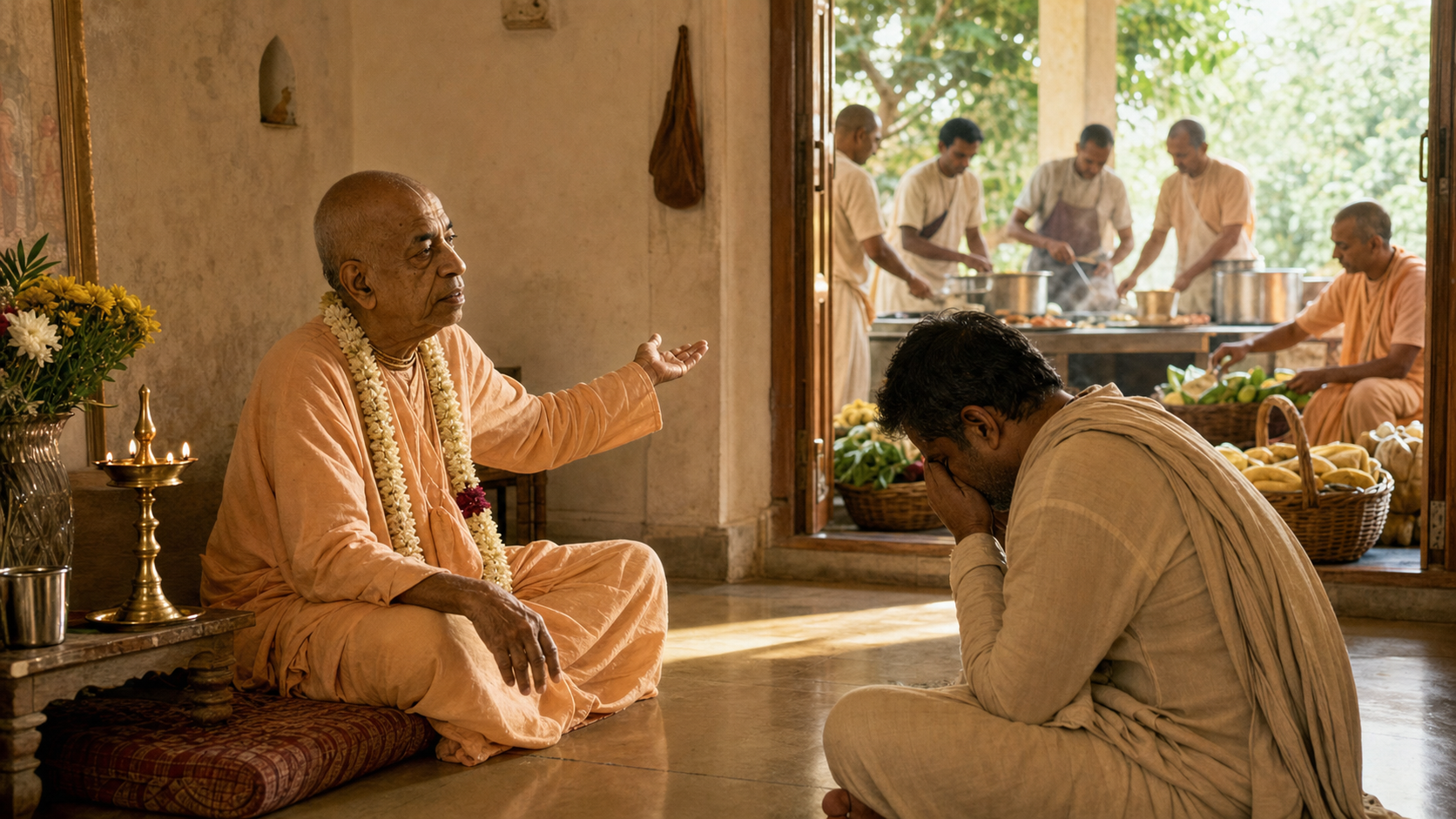
During a private meeting in 1977, a disciple named Lekhasravanti told Srila Prabhupada that both of her parents had been killed in a plane crash in 1970. His first response was consolation. Drawing on the Sanskrit teaching that the self does not die with the body, he assured her that her parents continued to exist somewhere.
The order matters. He did not begin by discussing what she could contribute, which role she should accept, or how her loss might benefit an institution. He first addressed the wound she had disclosed. Only then did the conversation move toward her future and her resources.
This gives you a simple discipline when someone is grieving: receive the person before interpreting the event. Let them describe what happened. Acknowledge the loss plainly. If they welcome a Dharmic frame, offer it as a source of steadiness rather than as a command to stop feeling sorrow.
Within Gaudiya Vaishnava theology, the Bhagavad-gita’s teaching about the enduring atman changes the meaning of death. Bodily separation is real and painful, but it is not the annihilation of the person. That conviction can protect grief from turning into metaphysical despair. It does not require anyone to pretend that separation no longer hurts.
A useful test is whether your words leave the grieving person more able to speak honestly. If a theological statement shuts down the conversation, it has probably been offered too quickly or too impersonally. Compassionate counsel makes room for questions, memory, prayer, silence, and practical help.
Spiritual companionship also has limits. If someone faces an immediate safety risk or asks for clinical help, seva includes helping them reach qualified medical or mental-health care. Philosophy and devotional practice can support a person, but they should not be presented as substitutes for necessary professional care.
Spiritual honesty is better than pious vagueness
Srila Prabhupada next asked Lekhasravanti whether she wanted to marry. She answered, "Whatever Krishna desires." He chuckled and replied, "Every girl wants to get married." The exchange was brief, but it exposed a familiar spiritual habit: using surrender-language to avoid naming a personal desire.
The usable principle is not that every woman wants marriage. A remark made to one disciple in a particular pastoral conversation should not be converted into a universal rule about women, vocation, or family life. The deeper lesson is that sound guidance responds to the actual person rather than to an idealized image of renunciation.
Desire does not become Dharmic merely because you admit it, but denial does not make you detached. First name the inclination. Then examine whether it can be ordered toward responsibility, devotion, and the well-being of others. That is more demanding than hiding behind a phrase about destiny.
- Name the desire: What do you want when no one is listening and there is no spiritual reputation to protect?
- Name the duty: Which responsibilities to family, community, health, livelihood, or spiritual practice would come with that choice?
- Test the direction: Would acting on the desire strengthen truthfulness and service, or feed avoidance, exploitation, and neglect?
- Seek specific counsel: Ask a trusted teacher about the concrete decision, not only whether you should "surrender more."
This is especially important when considering grihastha life. Household life is not a consolation prize for someone who failed at renunciation. It can become a serious field of bhakti through fidelity, hospitality, ethical earning, care for dependants, study, worship, and generosity. Renunciation is not genuine when it merely transfers your neglected responsibilities to somebody else.
Responsible dana gives seva a definite destination
Lekhasravanti had received approximately half a million dollars from a life-insurance policy left by her parents. Wanting to use part of what remained in Krishna’s service, she wrote a check for $50,000 during the meeting. Srila Prabhupada accepted the gift as Krishna’s mercy and directed it toward printing volumes of the Srimad-Bhagavatam.
The spiritual significance did not come from the amount alone. The gift had an intelligible purpose. It would help place a foundational Vaishnava text into people’s hands, support study, and carry the guru-shishya tradition beyond a single room or generation. Private wealth was connected to a durable form of public spiritual education.
This corrects two opposite mistakes. One treats money as inherently unspiritual and leaves its use outside serious moral reflection. The other assumes that any religious donation is automatically seva. Wealth becomes service only when intention, means, recipient, and use can withstand ethical examination.
Do not imitate the size or immediacy of Lekhasravanti’s gift. Imitate its clarity of purpose. Her decision does not establish a rule that a grieving person should donate an inheritance on the spot, or that generosity must be financially dramatic. A completed gift may be difficult or impossible to reverse, and no guru, relative, or institution should exploit bereavement to force a decision.
- Protect your duties first. Identify obligations to dependants and necessary expenses before deciding what is genuinely available to give.
- Write the purpose in one sentence. "Support dharma" is too broad. Name the text, meal service, educational program, temple need, relief effort, or other outcome.
- Examine the steward. Ask who controls the funds, how the proposed work will be carried out, and whether the organization can account for its use.
- Separate devotion from pressure. A request may be worthy, but urgency, guilt, status, or fear of displeasing a spiritual authority is not a sound basis for an irreversible financial choice.
- Obtain independent advice for a consequential gift. If the amount could materially affect your housing, health care, education, retirement, taxes, or dependants, speak with an appropriately qualified legal, tax, or financial professional before transferring it.
- Preserve the intended use. Keep a written record of any designation and ask how completion or impact will be reported.
Dana need not be large to be disciplined. A modest recurring contribution, a set of books placed where people will read them, time given to a study circle, or practical labor offered to a community may be more sustainable than a dramatic act that creates hardship afterward. The relevant question is not "Did I give enough to appear detached?" It is "Did I place a real resource in responsible service of a real good?"
Compassionate service joins feeling, truth, and usefulness
Consolation, realism, and generosity can look like three unrelated moments. In practice, they correct one another. Consolation without truth can become empty reassurance. Truth without tenderness can become cruelty. Generosity without discernment can become waste or manipulation. Compassionate seva holds all three together.
You can use this pattern whenever pain creates an impulse to act. Begin by asking what the person is actually carrying. Clarify which Dharmic principle applies. Then choose a service whose beneficiary, steward, and purpose are identifiable. This turns emotion into responsibility without treating emotion as a problem to be eliminated.
It also offers a disciplined way to honor someone who has died. You cannot reduce a relationship to a donation, and service does not purchase relief from grief. You can, however, let gratitude take a durable form: sponsor learning, feed others, preserve a sacred text, maintain a place of worship, or support a trustworthy community need. The action becomes an expression of memory rather than an attempt to erase sorrow.
For a continuing project, define three things before beginning: who will benefit, who will remain responsible after the initial enthusiasm fades, and what evidence will show that the work occurred. Those questions are as relevant to distributing scripture as they are to a community kitchen, scholarship, temple repair, or care initiative.
Shared Dharmic values do not require identical doctrines
Hindu, Buddhist, Jain, and Sikh traditions all give serious moral weight to generosity and service, but they do not explain the self, death, liberation, or religious authority in identical ways. Unity becomes more credible when these differences are respected rather than blurred.
Gaudiya Vaishnavism grounds Prabhupada’s consolation in the continuing reality of the atman and its relationship with Krishna. Buddhist traditions cultivate generosity and compassionate, skillful action within their own doctrinal frames. Jain practice joins dana to rigorous concern for ahimsa. Sikh discipline gives an important place to seva and dasvandh. The common ground lies in trained generosity and responsibility, not in pretending that every metaphysical teaching means the same thing.
When you work across Dharmic communities, start with the shared task and let each tradition explain its own reasons. A scripture initiative, meal program, relief effort, or educational gathering can be cooperative without demanding artificial theological agreement. Ask whether the work reduces suffering, strengthens virtue, treats recipients with dignity, and accounts honestly for the resources entrusted to it.
Key takeaways
- Meet grief with presence before offering interpretation, advice, or a request for service.
- Use spiritual teachings to give sorrow a larger frame, not to shame someone for continuing to feel it.
- Name human desires honestly, then test them against dharma and the responsibilities they create.
- Treat grihastha life as a field of disciplined bhakti rather than an inferior alternative to renunciation.
- Judge dana by freedom, purpose, stewardship, and consequences, not by the emotional drama or size of the gift.
- Build inter-Dharmic cooperation around compassion and accountable service while preserving real doctrinal distinctions.
Choose one concrete act now. If someone is grieving, give them a conversation in which they do not have to perform spiritual strength. If you are facing a life decision, replace vague surrender-language with the actual desire and duty involved. If you intend to give, write down the beneficiary, purpose, steward, and effect on your existing obligations before moving any money. That is where compassionate intention begins to become responsible seva.



References
