
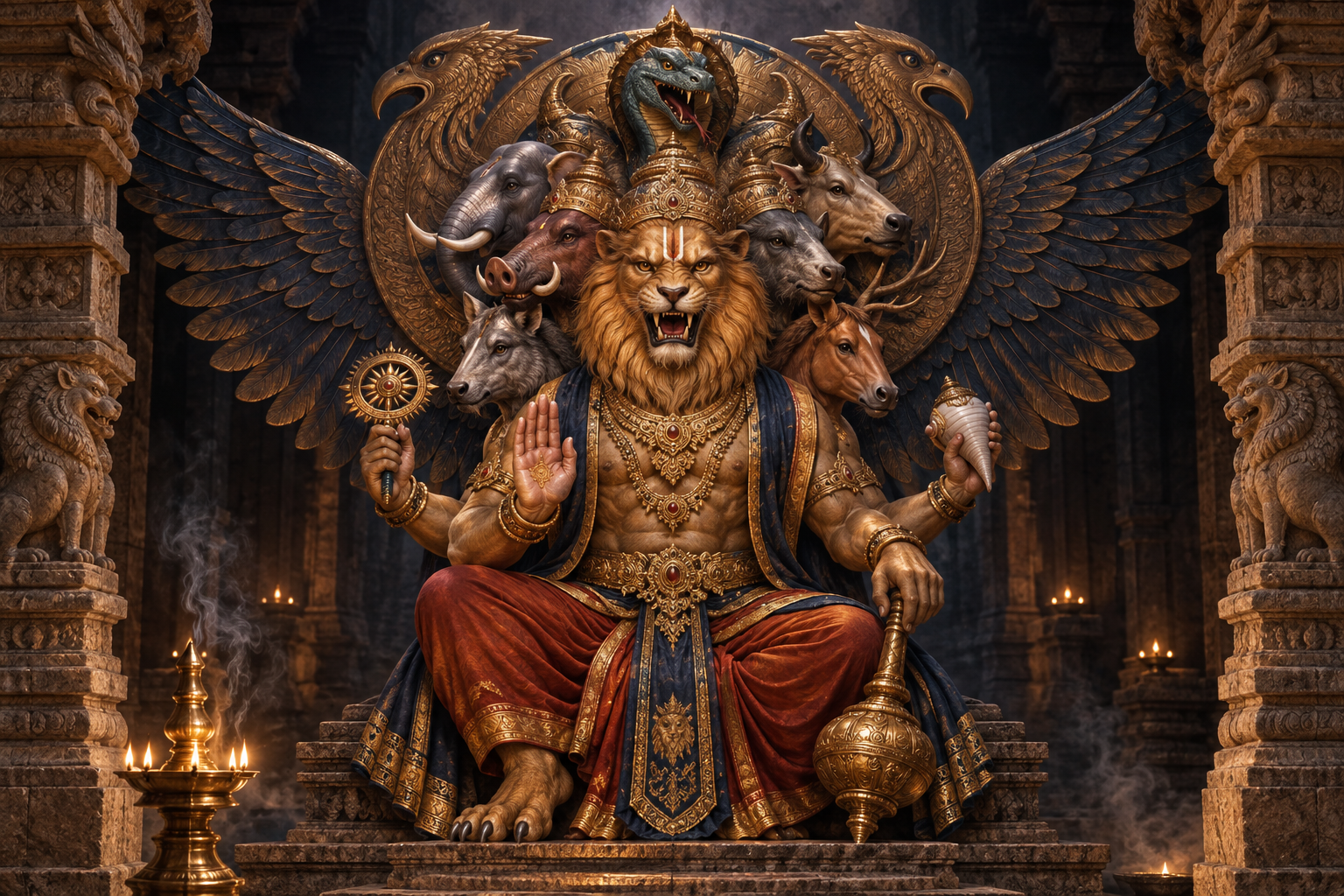
You may have seen an eight-faced Narasimha image, found a mantra bearing this long name, or encountered the form during a discussion about Shiva and Vishnu. Your immediate question is practical: What exactly are you looking at, and is this worship something you can undertake on your own?
Begin by separating three things: identity, sacred narrative, and ritual practice. The name identifies a form. The encounter with Sharabheshwara supplies its theological setting. Its sadhana belongs to a guarded ritual domain. Confusing these layers is how sincere curiosity turns into a mistaken identification or an improvised practice.
What the name establishes—and what it does not
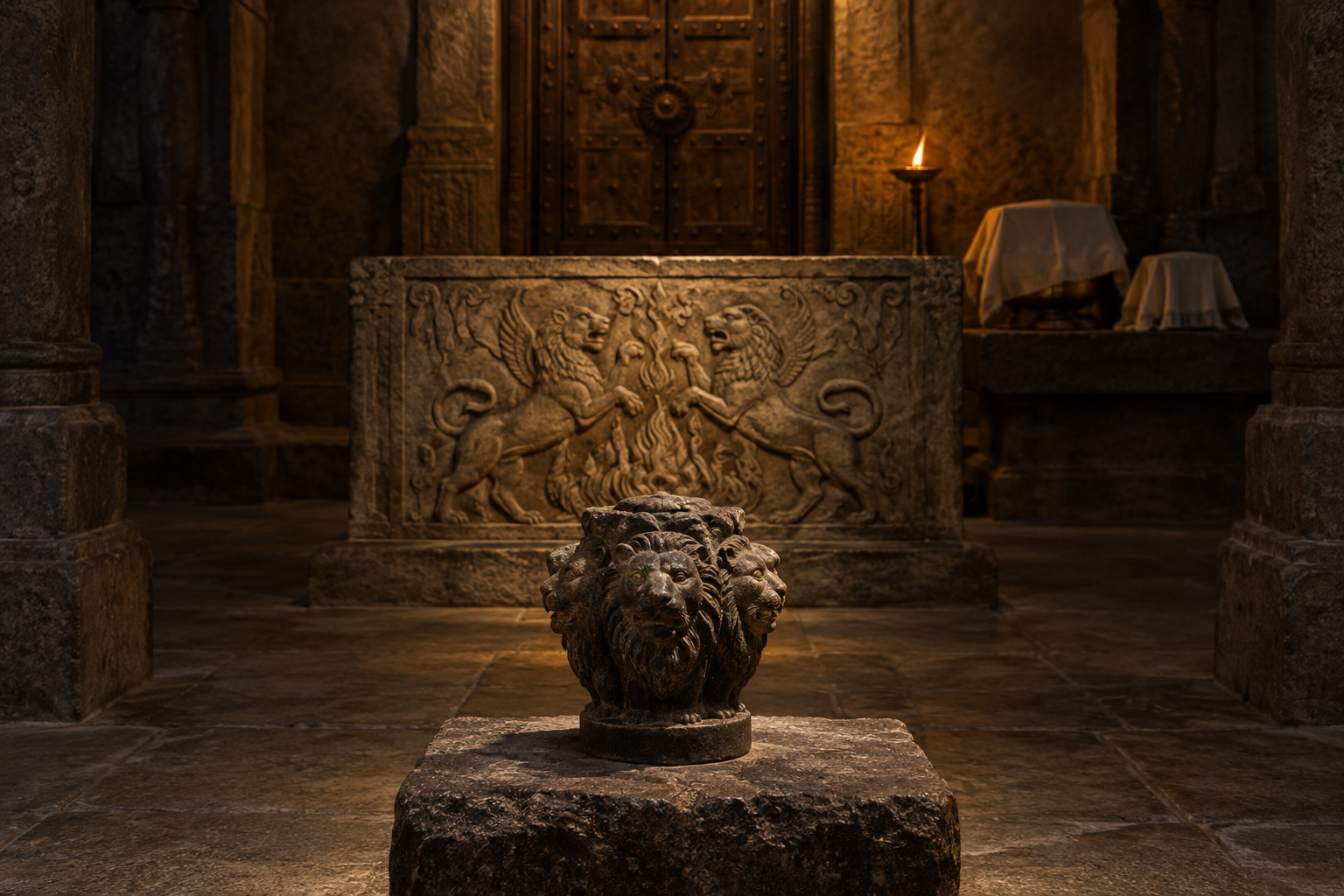
Ashtamukha means eight-faced. Narasimha is the man-lion form worshipped within Vaishnava traditions. The full name therefore directs you toward an eight-faced manifestation of Narasimha known as Ashtamukha Gandabherunda Narasimha.
That translation is a starting point, not a complete iconographic catalogue. The title by itself does not establish the identity, position, colour, weapon, or theological function of each face. A face-by-face explanation needs support from the relevant temple tradition, lineage teaching, inscription, or ritual text. If someone presents a detailed inventory without identifying any such basis, treat it as an interpretation rather than settled fact.
The same restraint applies to images. Multiple heads do not automatically make every fierce figure Ashtamukha Gandabherunda Narasimha. A photograph may omit part of a murti, a modern illustration may combine motifs, and an online caption may have travelled far from its original context. Keep the full compound name intact until a knowledgeable custodian explains the particular image before you.
This form is identified as one of the fiercest manifestations of Narasimha. Fierce, however, should not be confused with evil or spiritually uncontrolled. Within dharmic sacred imagery, a terrifying appearance can express protective force and the capacity to confront adharma. The useful question is not whether the form looks frightening, but what kind of divine power the tradition means that appearance to communicate.
The Sharabheshwara encounter belongs to a particular theological frame
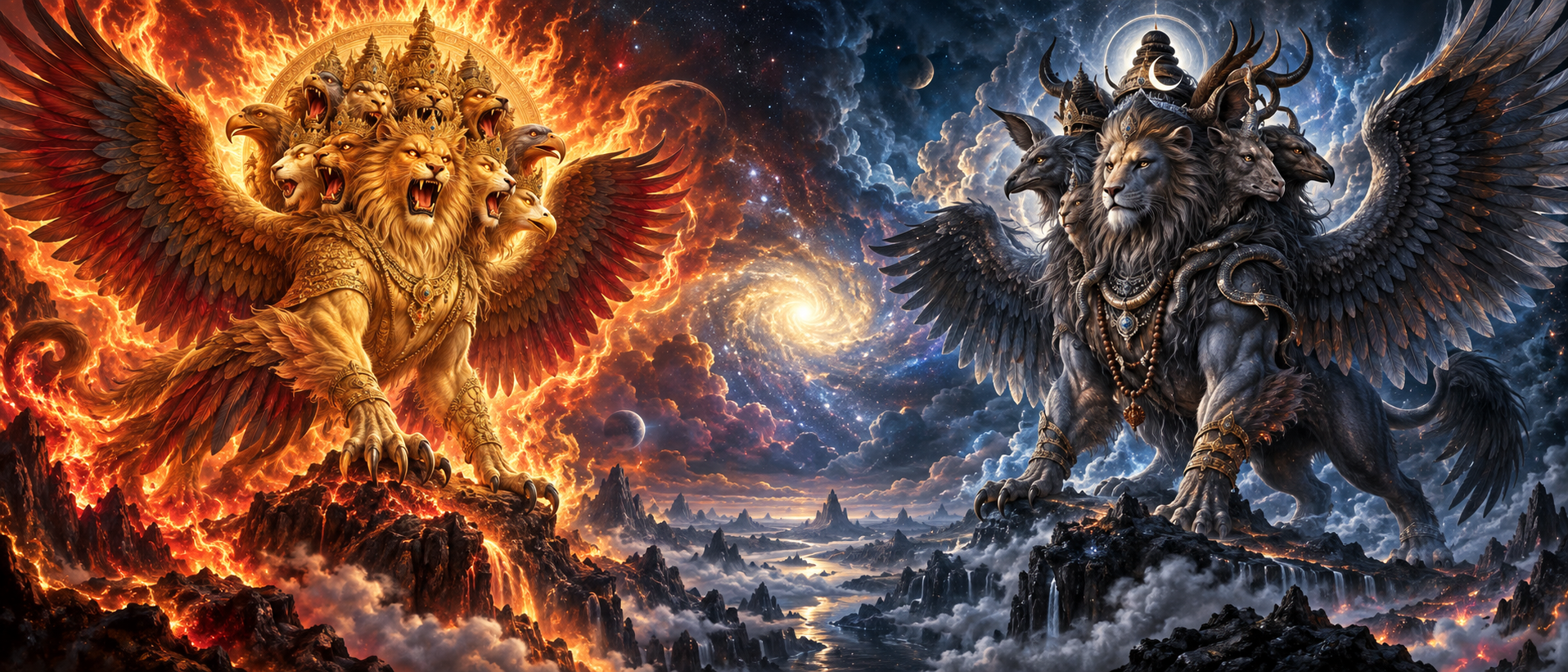
The Ashtamukha Gandabherunda Narasimha Kalpam places the form within a confrontation between Narasimha and Sharabheshwara, a form of Shiva. The eight-faced manifestation is associated with the point at which that conflict reaches its height.
This setting tells you why the form carries such intensified power. It also tells you to read the episode within its own sampradaya-shaped theological world. Hindu traditions do not always narrate the relationship between divine forms in one uniform way. A narrative preserved in one ritual setting should not be flattened into a universal chronology that every Shaiva and Vaishnava tradition must express identically.
Nor should the encounter be reduced to a scoreboard on which devotees declare Shiva or Vishnu defeated. That reading discards the ritual purpose of the narrative and replaces theology with rivalry. If you discuss this tradition publicly, identify the account precisely, acknowledge its Vaishnava setting, and avoid using it to belittle Shaiva worship. Respect for a fierce Vaishnava form does not require disrespect toward Shiva.
A better interpretive question is: Why does the narrative require an intensified manifestation at this moment? Here the placement is significant. The eight-faced form appears in relation to a divine confrontation at its most extreme point. You can recognise that meaning without inventing missing details or turning a sacred account into sectarian provocation.
Guarded sadhana is not an invitation to improvise
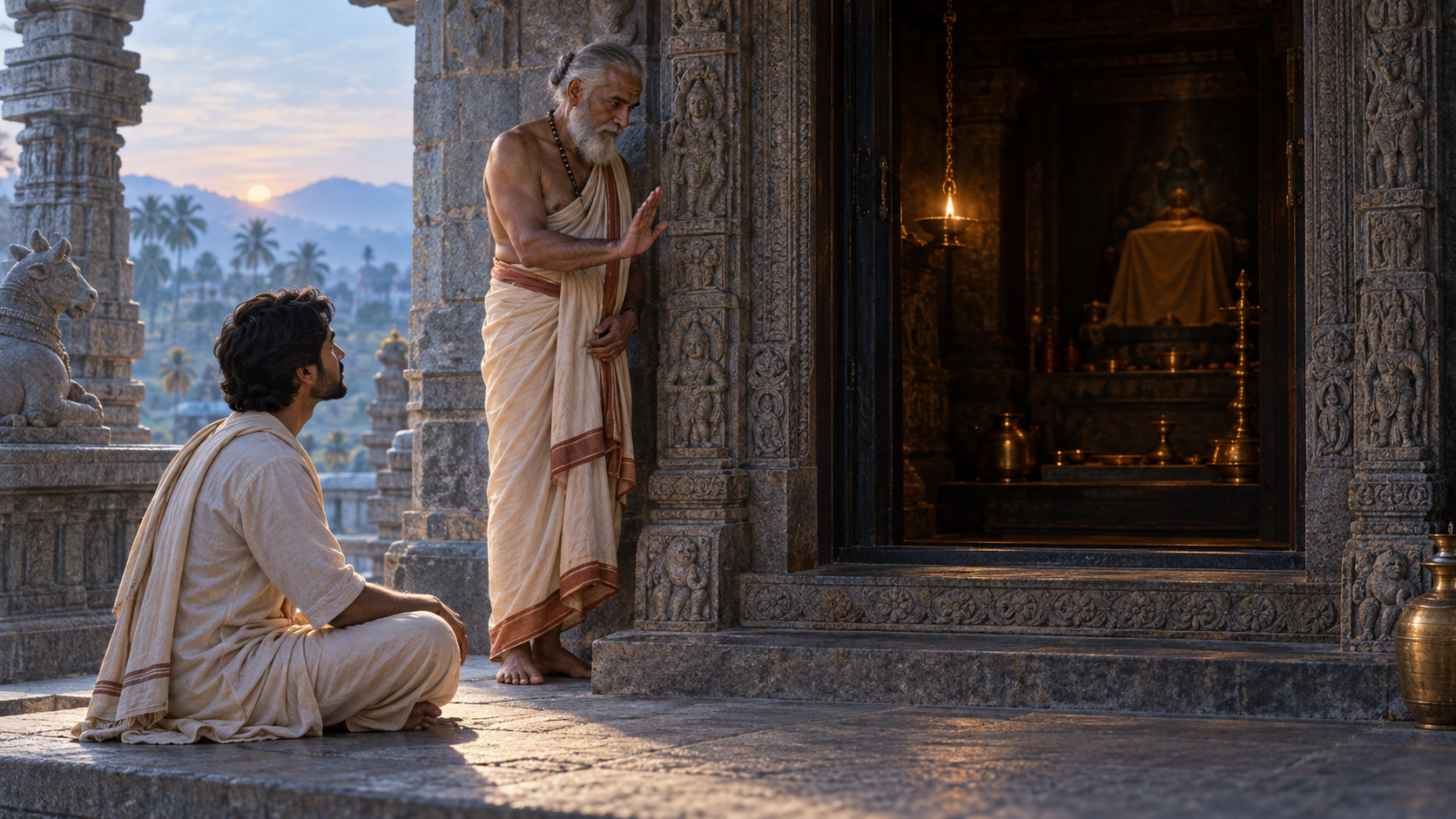
The worship of Ashtamukha Gandabherunda Narasimha is described as an especially secretive sadhana within Vaishnava Agama, Nigama, and Tantra Shastra frameworks. For you, the important word is not powerful but guarded. It marks a boundary around the method.
Learning the name of a deity, viewing a murti, hearing the sacred narrative, and performing a specialised tantric sadhana are not equivalent acts. Public knowledge about a form does not automatically make every mantra, diagram, visualisation, or ritual sequence associated with it a public practice.
In a rule-governed sadhana, elements such as pronunciation, sequence, visualisation, observances, ritual placement, and teacher correction may operate together. A mantra copied in isolation is therefore not necessarily a complete—or properly transmitted—practice. Secrecy should not be treated as a marketing superlative, a test of courage, or a challenge to obtain supposedly stronger spiritual techniques.
If you encounter a mantra, yantra, kavacha, or procedural instruction under this name, ask who transmits it and whether it is meant for public recitation. Ask whether initiation, permission, or preparatory disciplines are required. If no one can identify the temple, acharya, sampradaya, or textual context behind the instruction, do not assemble a practice from fragments found in different places.
This caution does not mean that merely seeing the form is forbidden, nor does it require fear that the deity will punish an innocent mistake. It means respecting the difference between devotion and technical ritual authority. A conservative devotional response is to offer namaskara, seek darshana where the form is publicly worshipped, and continue with familiar prayers already recognised in your household or community while you look for qualified guidance.
How to verify an image, teaching, or proposed practice
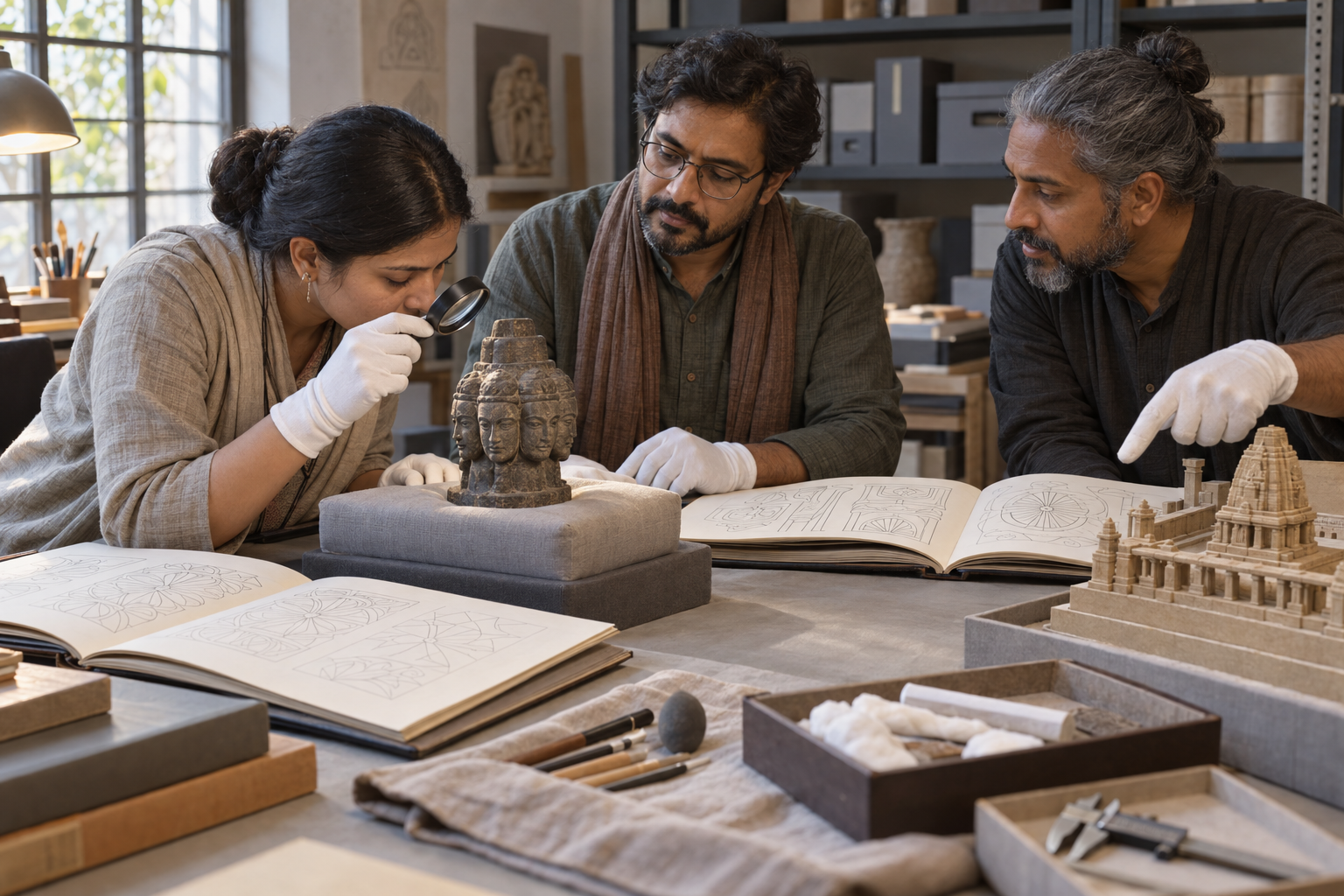
You do not need to become a specialist before asking sensible questions. You do need to preserve enough context for a specialist to give you a meaningful answer. Use this sequence:
- Record where you encountered it. Save the full caption, temple name, location, language, and any inscription visible with the image. A cropped picture without provenance is much harder to identify.
- Write the complete name exactly as given. Do not silently replace a local spelling or shorten the title to eight-faced Narasimha; the missing term may distinguish the form being discussed.
- Ask for the tradition behind the explanation. A useful answer should be able to name a temple, sampradaya, acharya, or text rather than relying only on visual resemblance.
- Separate description from permission. Someone may accurately explain the theology of the form without being authorised to transmit its specialised worship.
- Ask whether the material is public. Make the question specific: Is this prayer intended for everyone, or is it part of an initiated sadhana? Does the temple perform it publicly, or only within a restricted ritual setting?
- Accept an honest stopping point. If the ritual status cannot be verified, continue learning about the form without performing the uncertain procedure.
Be particularly cautious when an explanation promises immediate power, guaranteed protection, domination over opponents, or extraordinary results while providing no traceable ritual context. Fierce iconography is not evidence that a practice is a shortcut. Likewise, a teaching that uses the Sharabheshwara encounter mainly to insult Shiva or Shiva-bhaktas has already moved away from disciplined understanding and toward polemic.
A trustworthy teacher may also decline to provide technical details. In a guarded tradition, refusal can be evidence that the boundary is being taken seriously. You can still ask for public theology, temple history, iconographic identification, or a generally available form of Narasimha devotion.
Key takeaways
- Ashtamukha establishes that the form is eight-faced, but the name alone does not authenticate a particular image or supply a face-by-face inventory.
- The Sharabheshwara confrontation is the theological setting associated with this fierce form; it should not be turned into casual anti-Shaiva rivalry.
- Public information about the deity is different from permission to perform a guarded Vaishnava tantric sadhana.
- Before using any mantra or ritual procedure, verify its temple, lineage, or textual context and ask explicitly whether it is public or initiation-bound.
- If verification stops, let the ritual experiment stop too. Reverent learning and darshana remain valid ways to approach the tradition.
Your next step can be very simple. Carry the exact name and the original context to a knowledgeable Vaishnava priest or acharya, then ask two questions: Is this identification correct, and which forms of worship are public? Those answers will take you further than collecting another unexplained image or mantra.
References

Leave a Reply
You must be logged in to post a comment.