
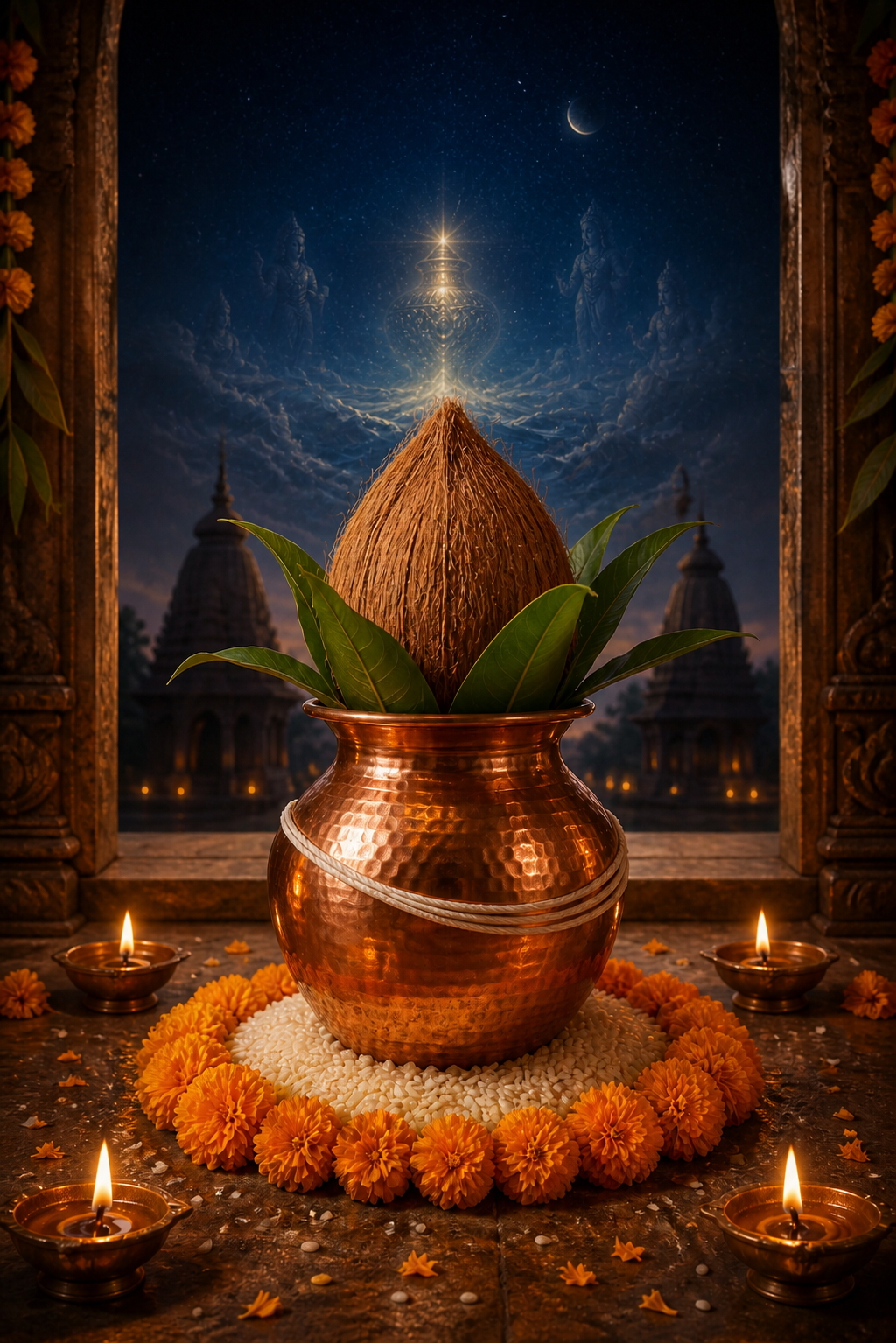
You may know how a kalasha looks: a water-filled pot, mango leaves opening around its mouth, and a coconut placed above them. The harder question is why this arrangement belongs at the beginning of a puja, wedding, housewarming, festival, or temple consecration.
The answer is not hidden in any one item. The kalasha works as a complete sacred form. Its vessel, water, leaves, coconut, placement, and consecration bring creation, divine presence, disciplined renewal, and the Amrita Kalasha of Samudra Manthan into one ritual image. Once you can read that image, the kalasha stops looking like ceremonial decoration and begins to tell you what the rite is meant to accomplish.
Why Samudra Manthan makes the vessel as important as the nectar

The Amrita Kalasha enters Hindu sacred memory through Samudra Manthan, the churning of the Ocean of Milk. Devas and asuras churned the ocean in search of amrita. At the decisive moment, Dhanvantari emerged bearing the vessel of nectar. Vishnu, appearing as Mohini, then protected its proper distribution.
This sequence gives the kalasha a more exact meaning than “a pot that brings good luck.” Amrita signifies immortality, but the narrative places the nectar within a struggle over order, entitlement, and right use. The vessel therefore points not only to life, but to life protected and directed by dharma. Mohini’s intervention makes discernment part of the symbolism: a precious power is auspicious only when it is handled justly.
That distinction matters when you explain the kalasha to a child, a guest, or someone returning to Hindu practice. A domestic kalasha is not a claim that ordinary water has become a chemical elixir of bodily immortality. Through consecration, it participates ritually in the meaning of the Amrita Kalasha: healing, continuity, knowledge, abundance, and the restoration of order.
It also explains why the kalasha appears at beginnings. A new home, marriage, festival observance, or consecrated space carries possibility, but possibility still needs direction. Placing the kalasha says that the beginning should be governed by dharma before activity gathers around it.
Read the kalasha from the earth upward
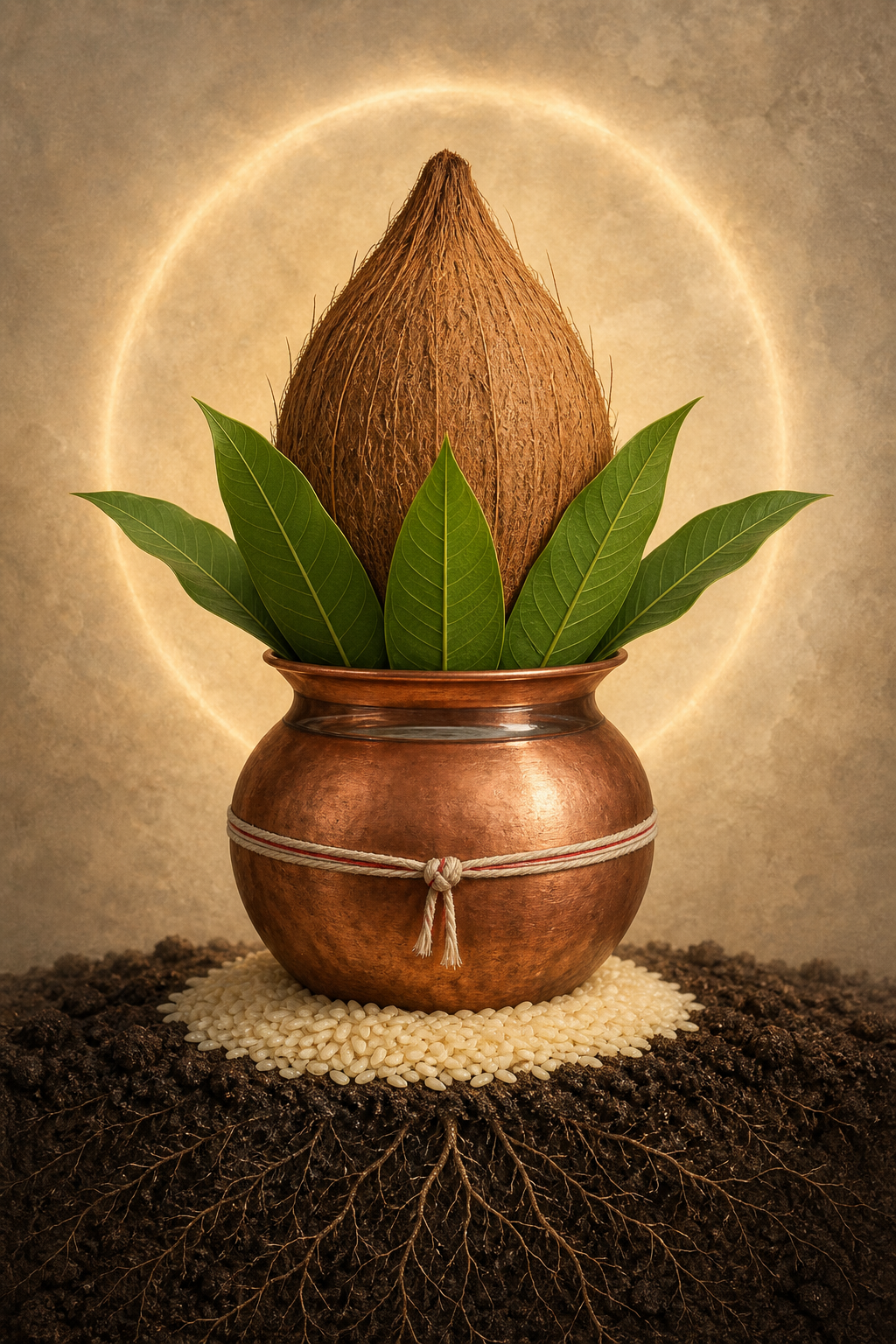
The most useful way to understand the ritual form is to read it from its base to its crown. Each part contributes a different dimension of life. None is a disposable accessory to the “main” object.
| Ritual element | Sacred correspondence | What it asks you to notice |
|---|---|---|
| Earthen vessel | Prithvi, the earth, and the womb of creation | Life requires a stable form capable of receiving and sustaining it. |
| Water within | Apah, the cosmic waters, with Varuna invited into the water | Potential becomes life-giving through purity, nourishment, and flow. |
| Mouth of the vessel | A place associated with the invited presence of Ganesha | A sacred beginning requires the removal of obstruction and right orientation. |
| Mango leaves | Prana and vegetation | Life is breathing, growing, and connected to the living world. |
| Coconut | Seed, mind, and fruition, with Devi invited into the crowning element | Inner potential must mature into conscious and fruitful action. |
The full arrangement resembles a world in miniature. Earth contains water. Water sustains vegetation. Vegetation opens toward seed and fruit. The ascending form moves from foundation to life, consciousness, and fulfillment. This is why the kalasha can be understood as a womb of creation and as an expression of Brahma’s srishti-shakti, the power by which ordered manifestation arises.
Brahma’s connection to the kalasha is therefore philosophical rather than merely decorative. The symbolism does not depend on adding an image of Brahma to the vessel. Creative power is already expressed by the relationship among receptacle, water, living leaves, and seed. Matter has been arranged so that it can hold life and become a seat of sacred presence.
That last phrase is important. A clean pot assembled attractively may resemble a kalasha, but ritual presence is not produced by appearance alone. Consecration, mantra, intention, and the particular sampradaya or family tradition turn the material arrangement into a temporary locus of divine presence. The symbolic map helps you understand a rite; it does not replace instructions from the priest, temple, or elder responsible for that rite.
What kalasha sthapana changes in a ritual space

Kalasha sthapana is an act of establishment. It marks a place as ordered for sacred work and gathers the intention of the observance into a visible center. During Navaratri, it gives the worship a consecrated focus. At weddings and griha-pravesha ceremonies, it places fertility, continuity, hospitality, and auspicious order before the social celebration. At an entrance or threshold, it signals that crossing into the space also means entering an environment governed by care and dharma.
The same principle operates on a larger scale in temple consecrations. During kumbhabhisheka or Brahmakalashabhisheka, sanctified pots hold water charged through mantra. That water is poured upon the deity and the temple superstructure, ritually conveying prana-shakti to the consecrated site. The vessel is not simply brought near the sacred center; it serves as a medium through which consecration reaches the temple.
Scale changes, but the ritual logic remains recognizable. A vessel receives. Mantra and invocation establish sacred presence. Water carries the consecratory action. The contents are then directed toward a person, deity, building, or shared observance. The kalasha joins containment and transmission: it holds sacred potential without treating that potential as something to be hoarded.
If you are preparing a household ceremony, settle four questions before arranging the visible elements:
- Which deity, festival, or life event is the kalasha being established for?
- Which materials and invocations does your family, temple, or sampradaya prescribe?
- Who will perform the establishment and guide the mantras?
- How should the sanctified water, leaves, coconut, and vessel be handled after the observance?
These questions prevent a common mistake: reproducing the photograph of a ritual while losing its sequence and purpose. There is no need to improvise details when traditions legitimately vary. Ask the officiating priest or a knowledgeable elder before the ceremony, especially about the invocation and the respectful use of the sanctified contents afterward.
A shared sacred-vessel motif does not erase distinct traditions
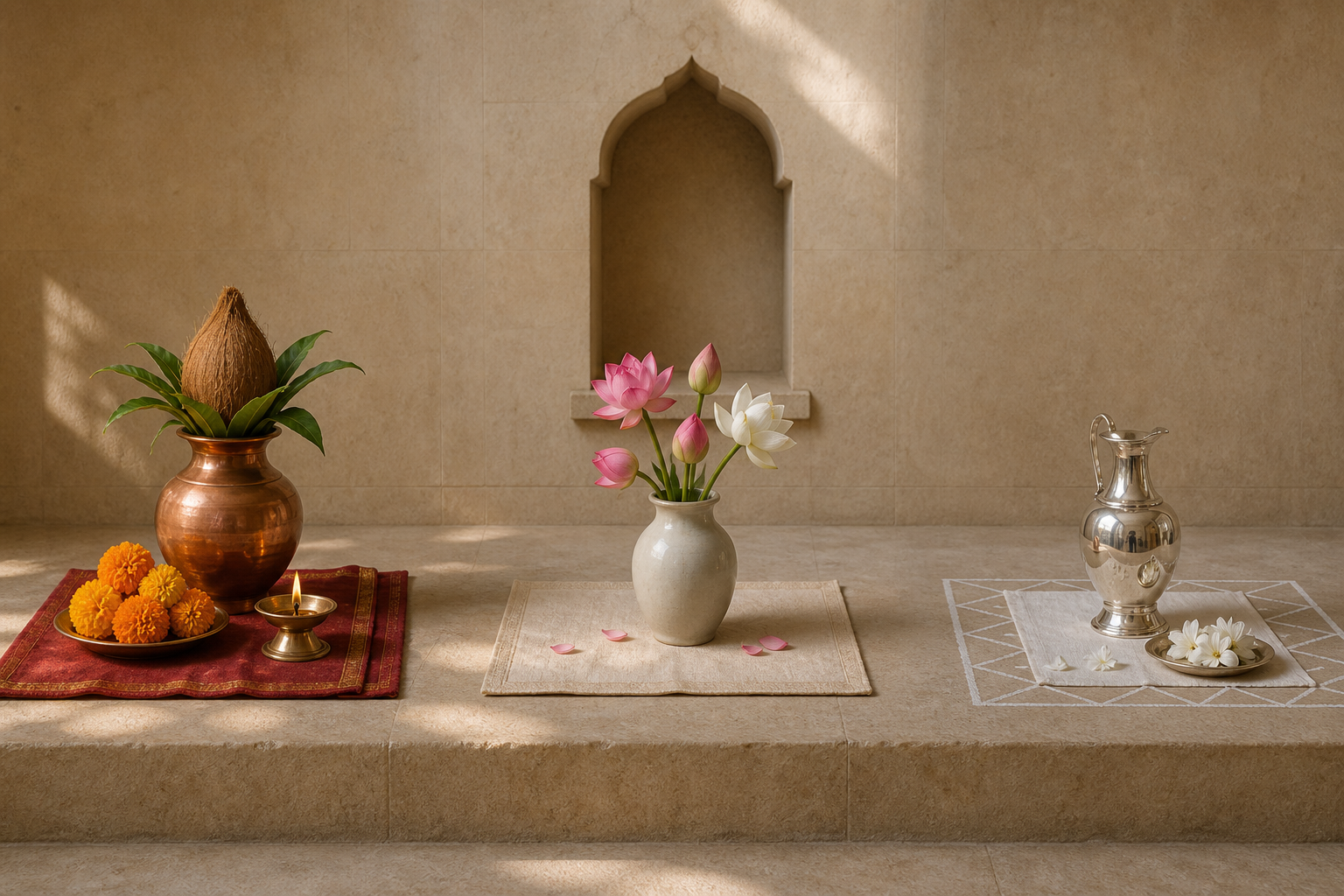
The sacred vessel has resonances across Dharmic traditions, but those resonances should be handled with precision. In Buddhism, the treasure vase or kumbha appears among the Ashtamangala and signifies inexhaustible blessings and longevity. Jain pratishtha and Panchakalyanaka observances employ pots of sanctified water as signs of purity and auspiciousness. In Sikh Amrit Sanchar, sanctified amrit is prepared in a steel bata for initiation into a disciplined life of courage and seva.
These are not interchangeable versions of a single ceremony. The objects, prayers, doctrines, authorities, and ritual purposes remain specific to their respective traditions. Calling every sacred vessel an “Amrita Kalasha” would blur precisely the differences that make each practice meaningful.
The more careful comparison begins with function. A vessel receives and preserves something life-renewing. Its contents become inseparable from purity, moral commitment, blessing, or initiation. The worshipper or initiate is then called to live differently. This shared pattern reveals a Dharmic grammar of renewal without forcing Hindu, Buddhist, Jain, and Sikh practices into theological sameness.
When you teach these connections, use each tradition’s own name first. Explain the Hindu kalasha through Samudra Manthan and consecrated presence; the Buddhist treasure vase through its place among the auspicious symbols; the Jain vessel through its consecratory setting; and the Sikh bata through Amrit Sanchar. Draw the ethical parallel only after those distinctions are clear. Respectful unity is strengthened by accuracy, not by flattening difference.
Key takeaways for the next time you encounter a kalasha
- See more than an auspicious ornament. The kalasha establishes a ritual center where creation, divine presence, and dharmic order meet.
- Remember the whole Samudra Manthan sequence. Dhanvantari’s nectar signifies life and healing, while Mohini’s intervention connects sacred abundance with discernment and right distribution.
- Read the form from base to crown. Earth, water, prana, vegetation, mind, seed, and fruition make the vessel a compact image of ordered creation.
- Distinguish symbolism from procedure. The symbolism can be explained broadly, but the mantras, materials, placement, and handling after the rite should follow the relevant tradition.
- Carry the meaning beyond the ceremony. Reverence for the water-filled vessel should sharpen your care for water, living resources, hospitality, moral discipline, and the well-being of the community.
At your next kalasha ritual, pause before the invocation and look at the arrangement from the earth upward. Then let the ceremony place a practical demand on you: protect what sustains life, use abundance responsibly, and direct every new beginning toward dharma. If you are organizing the rite, confirm its lineage-specific procedure in advance so that the outward beauty and the inner purpose remain joined.
References
