

If you are trying to understand why Utanka kept asking to give guru dakshina when his guru wanted nothing, the apparent contradiction is the point. Utanka was not bargaining over a price. He was trying to determine how a disciple should leave the teacher without treating transformative learning as though it had cost him nothing.
That distinction matters whenever you receive serious instruction from an acharya, mentor, elder, or spiritual guide. Gratitude is necessary, but gratitude alone does not tell you what to give, whether the recipient should accept it, or when your obligation has truly been fulfilled.
The question Utanka could not leave unanswered
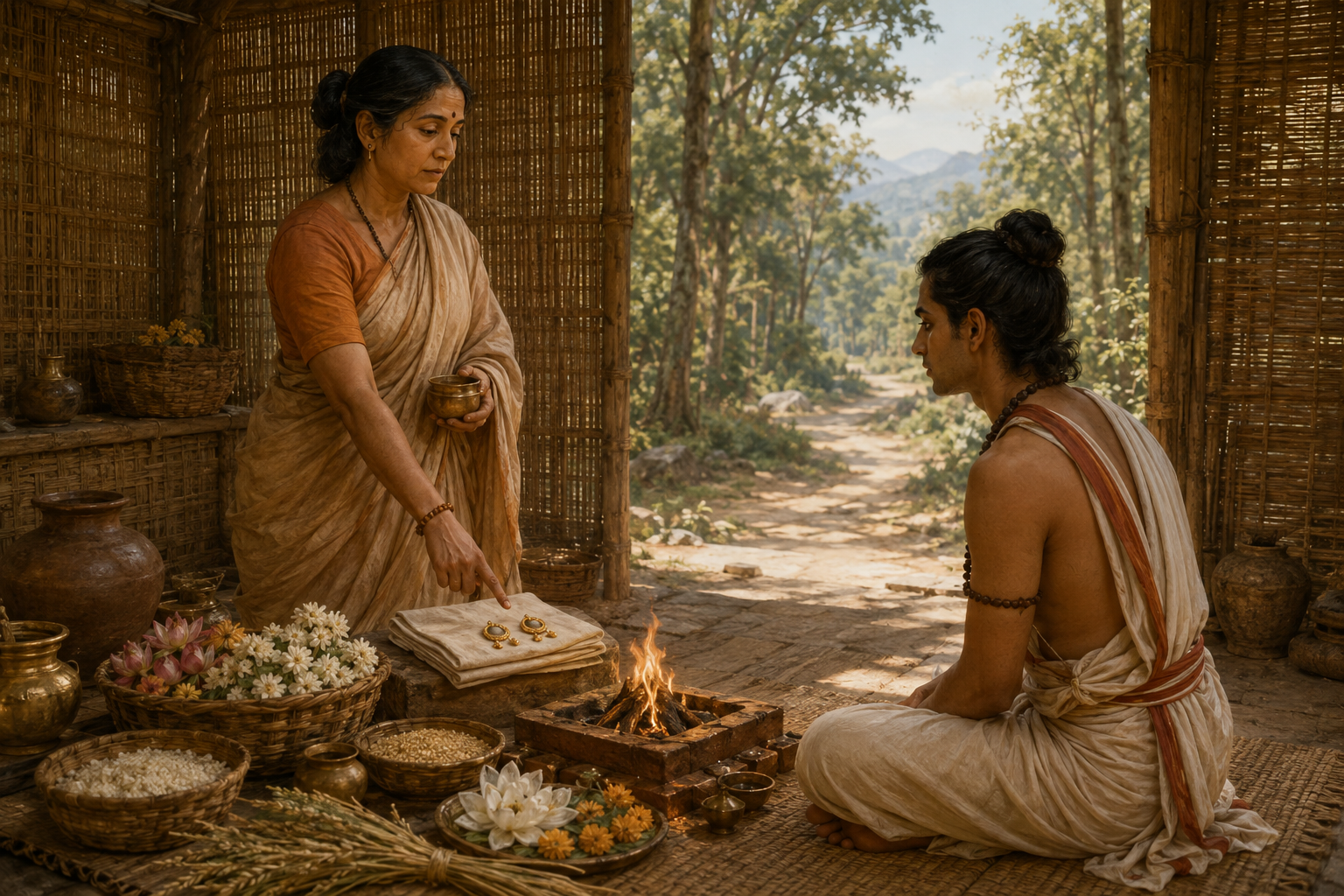
In the Poushya Parva of the Adi Parva, Utanka completes his discipleship under Rishi Veda, associated with Ayoda Dhaumya, and insists on offering guru dakshina even though his teacher initially wants nothing in return. The teacher’s refusal does not erase Utanka’s awareness that he has received something of consequence.
A shallow reading would turn this into a dispute over a present: the guru declines, the disciple persists, and one of them must therefore be mistaken. The deeper difficulty is that both responses express a dharmic concern. The guru does not reduce teaching to a commercial exchange. The disciple does not want to walk away as if the relationship carried no obligation.
Utanka’s insistence can therefore be read as a refusal to let the end of his formal study become a casual departure. He needs a recognizable act of completion. Without one, he fears that gratitude will remain only a feeling and that his debt to the teacher will remain morally unattended.
This is the first thing to notice in your own life: saying that you are grateful and accepting responsibility for what you received are not identical. Gratitude looks backward at the gift. Responsibility asks what you will now do because you received it.
Guru dakshina is not the price of knowledge
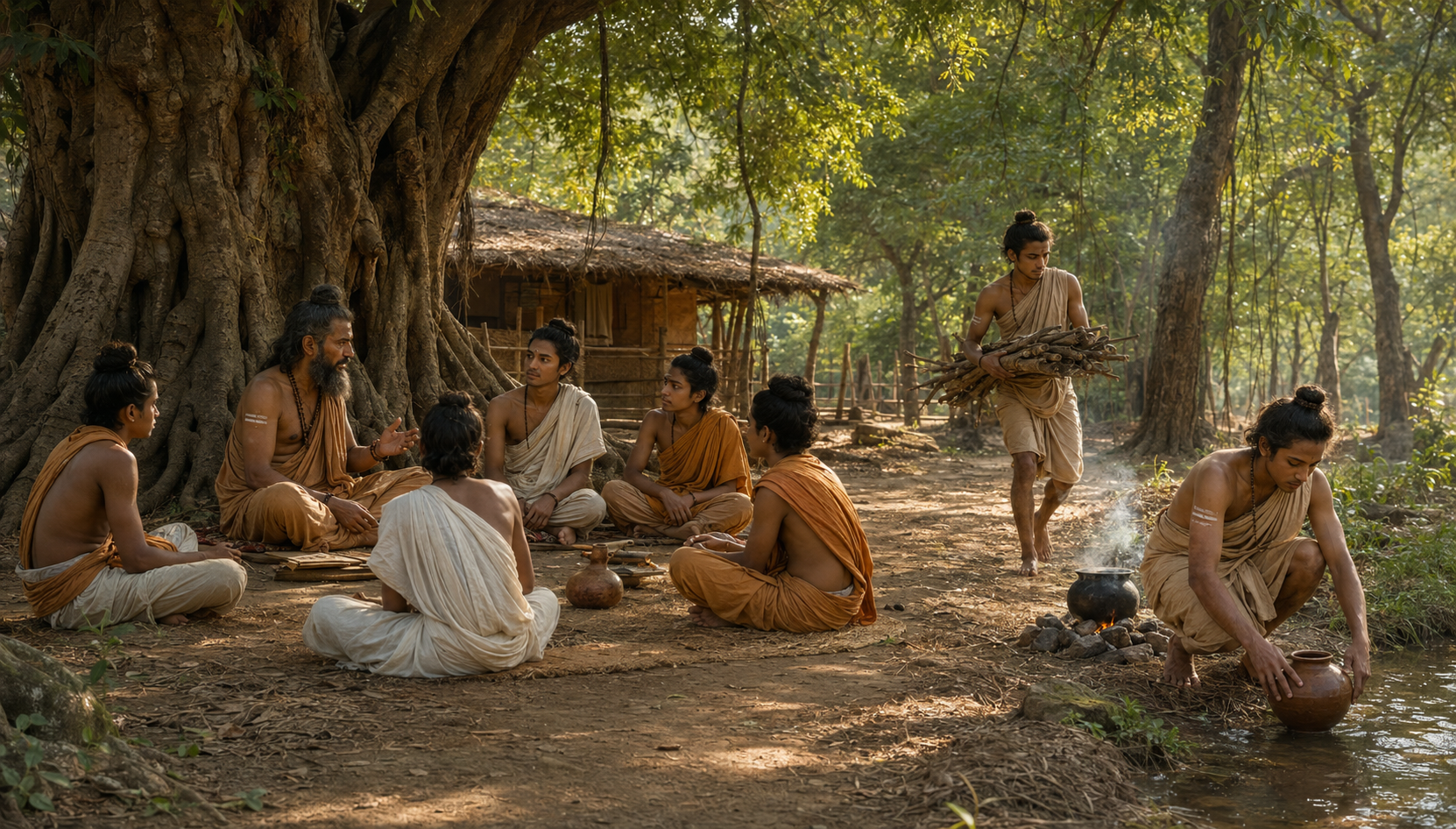
A fee and guru dakshina answer different questions. A fee asks what an agreed service costs. An ordinary gift may express affection or generosity. Guru dakshina asks how a disciple should acknowledge the teacher and bring a period of learning to a worthy completion.
- A fee establishes an exchange. Once the agreed amount is paid, each party can ordinarily regard the transaction as settled.
- A gift expresses the giver’s sentiment. It may be generous, but its form can still be chosen mainly around what the giver wants to offer.
- Guru dakshina recognizes a formative relationship. Its fitness depends not only on value but also on the teacher’s wishes, the disciple’s capacity, and the purpose served by the offering.
Knowledge cannot be returned to the teacher in the condition in which it was received. Once teaching has altered the disciple’s judgment and conduct, no object creates an equal exchange. A costly offering may still be spiritually empty, while a modest act may accurately express attention, humility, and commitment.
Utanka’s concern is therefore better understood as moral debt than financial shortfall. Moral debt does not mean permanent guilt or servility. It means refusing to imagine yourself as entirely self-made. Your learning has a lineage, and acknowledging that lineage protects you from confusing possession of knowledge with authorship of it.
Use three tests when deciding whether an offering resembles guru dakshina rather than payment or display:
- Recognition: Does the act identify what you actually received, or is it a generic gesture performed out of convention?
- Proportion: Does it fit your means and the relationship, or are you using expense and hardship to dramatize your devotion?
- Freedom: Can the teacher decline or redirect the offering without being pressured, embarrassed, or made responsible for your feelings?
If an offering fails the freedom test, its religious appearance cannot repair the problem. Dakshina should honor a relationship, not become a claim upon it.
Utanka’s insistence is not permission to ignore a refusal
The most tempting misreading is that persistence becomes pious whenever the disciple’s intention is sincere. That rule does not hold up. A disciple has a duty to remember what was received, but the recipient still has agency. You cannot honor a teacher by treating the teacher’s stated boundary as irrelevant.
This tension is what makes Utanka’s conduct worth contemplating. Obedience might appear to require immediate acceptance of the guru’s refusal. Gratitude seems to require some positive response. Dharma does not always remove one duty in favor of another; it can require you to hold both until you find an act that respects them together.
Separate persistence toward your duty from pressure upon another person. You may remain determined to repay what you have received without insisting that the teacher accept the particular object, money, service, or ceremony you selected. The first is steadiness. The second can become self-centeredness dressed as sacrifice.
This distinction is especially useful in modern settings. A teacher may decline a gift because of professional rules, personal boundaries, unequal finances, or a desire not to create further obligation. Do not evade such a refusal. Ask whether another form would be appropriate: disciplined practice, help with an approved task, support for future learners, or simply an honest acknowledgment. If the answer remains no, accept it.
Watch the question you are silently asking. “What can I give so that I feel complete?” centers the giver. “What response would honor the teaching without burdening the teacher?” centers the relationship. Utanka’s seriousness is worth retaining even when repeated insistence is not.
A practical way to offer guru dakshina today

You do not need to imitate the outward action of an epic character to learn from the character’s dharmic problem. Translate the principle into a process that preserves gratitude, proportion, and consent.
- Name what changed. Complete one precise sentence: “Because of this teaching, I now understand, practice, or avoid…” If you cannot name the change, you may be responding to status or emotion rather than to the teaching itself.
- Identify whom the offering should serve. It may be the teacher personally, a community the teacher supports, future students, or the discipline itself. Do not assume that the most direct transfer is automatically the most fitting one.
- Ask before choosing. A simple question is enough: “Would you accept guru dakshina, and what form would be appropriate?” Asking first prevents an expensive or public gesture from placing the teacher in an awkward position.
- Treat the answer as instruction. If a specific task or form is accepted, understand its scope before agreeing. If the teacher redirects you or declines, do not convert your gratitude into a contest of persistence.
- Choose something clean and proportionate. Do not borrow beyond your means, neglect a dependent, violate a rule, or create hardship merely to make the act look sacrificial. An offering that produces avoidable adharma elsewhere is poorly chosen.
- Attach no hidden claim. Dakshina does not purchase privileged access, praise, influence, initiation, friendship, or control over how the teacher uses the offering.
- Continue through conduct. Use the learning carefully, credit the lineage honestly, prepare seriously, and avoid misrepresenting what was taught. The ceremonial act may end, but the responsibility created by knowledge continues.
You can also test your intention with four short questions: Would you still make the offering if nobody saw it? Can the recipient freely refuse it? Does it serve the teaching rather than your image? Will it leave either person carrying an unwanted obligation? A clear answer to all four is more meaningful than the market value of the gift.
If your Sanskrit teacher declines money, for example, do not leave an envelope secretly or recruit others to pressure the teacher. Ask whether you can assist with class materials, support an approved educational effort, or demonstrate your gratitude through disciplined study. If an elder refuses a formal present, preserve and practice what the elder taught instead of turning the refusal into an argument.
The deepest repayment is not theatrical deprivation. It is becoming trustworthy with what you were taught. A student who gives lavishly but uses knowledge carelessly has not solved the problem Utanka recognized.
Key takeaways
- Utanka insists on guru dakshina because he does not want the completion of his studies to erase his obligation to the guru.
- Guru dakshina is not a purchase price that makes knowledge your private possession or settles every responsibility.
- A fitting offering recognizes what was received, remains proportionate to the disciple’s means, and leaves the teacher free to accept, redirect, or refuse it.
- Utanka’s interior seriousness is more important to imitate than repeated pressure upon a reluctant recipient.
- Your continuing use of the teaching – with discipline, accuracy, humility, and proper acknowledgment – is part of how gratitude becomes dharma.
Before your next period of serious learning ends, do not rush to buy an impressive object. Name what the teaching changed, ask what response would be fitting, and listen to the answer. Then let your conduct carry the gratitude that no single gift can exhaust.
References
