
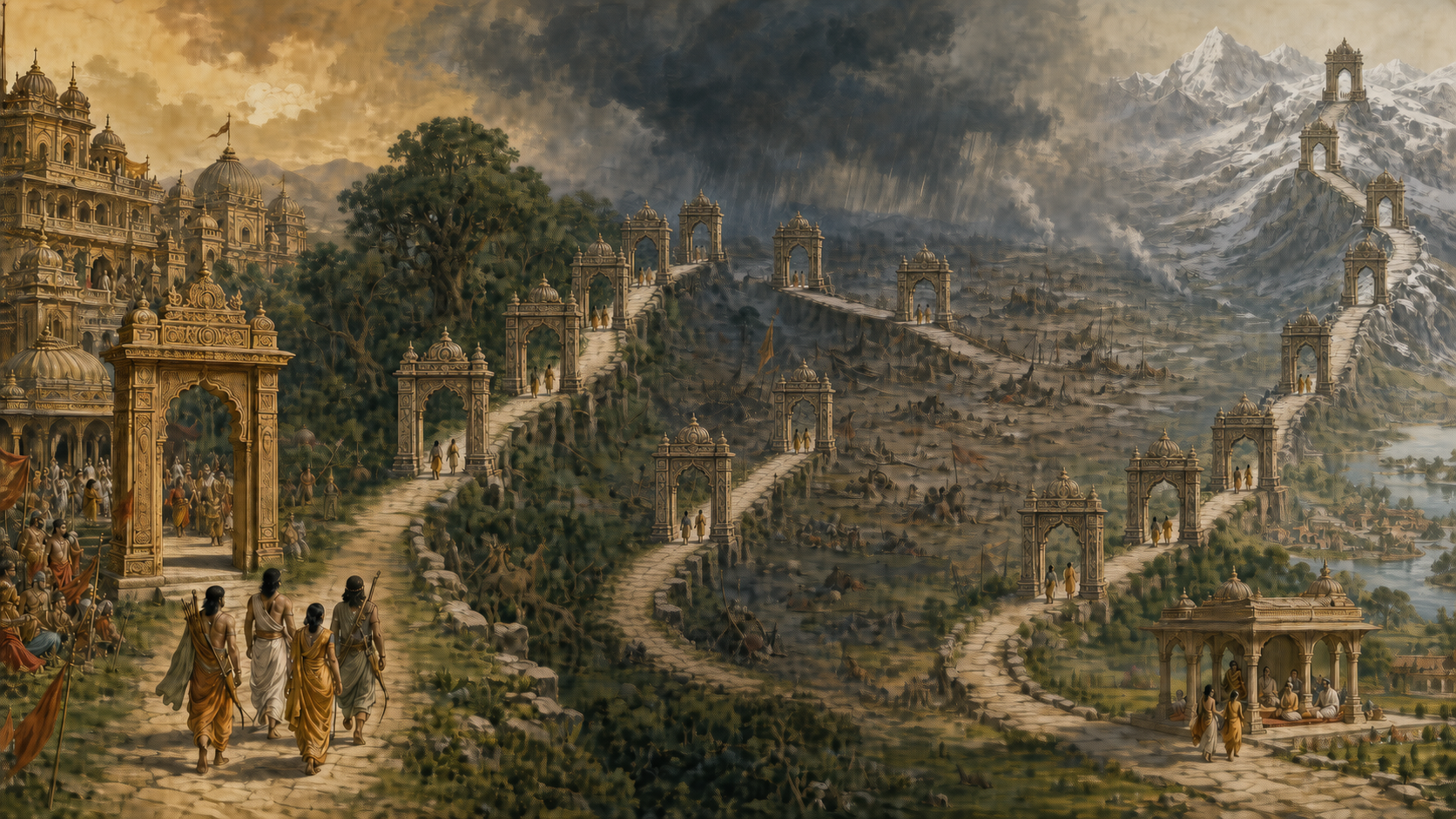
You may know the dice game, the Bhagavad Gita, the battle at Kurukshetra, and the Pandavas’ final journey, yet still find the Mahabharata too vast to hold together. The eighteen Parvas solve that problem. They give you a route through the epic: from inherited disorder to public crisis, from war to moral reckoning, and from restored sovereignty to renunciation.
Read the Parvas as a sequence rather than eighteen containers of episodes. Their order tells you what creates conflict, what violence cannot repair, why victory must submit to ethical scrutiny, and why even righteous rule eventually has to be relinquished.
Eighteen signals wholeness, not a secret numerical code
The recurrence of eighteen is too prominent to ignore: the Mahabharata has eighteen Parvas, the war lasts eighteen days, the armies total eighteen akshauhinis, and the Bhagavad Gita contains eighteen chapters. The repetition invites symbolic reading, but it should not be turned into a rigid claim that one numerical formula explains every part of the epic.
One traditional interpretation joins eightfold prakriti to the ten indriyas. The eight comprise earth, water, fire, air, space, mind, intellect, and ego. The ten faculties comprise five cognitive senses and five capacities of action. Eighteen can therefore represent the field in which embodied life unfolds: material nature, inward faculties, perception, and action.
This reading gives you a practical interpretive rule. Whenever the Mahabharata moves between family feeling, political judgment, bodily action, and spiritual discernment, do not split those domains apart. Dharma has to govern the whole person. A ruler with sound policy but uncontrolled ego remains dangerous; a warrior with courage but clouded judgment remains vulnerable; a renunciant ideal that ignores social duty remains incomplete.
The wider dharmic world often uses eighteen in the same contemplative manner, though not with one uniform meaning. Hindu enumerations include eighteen Mahapuranas, traditions of eighteen Shakti Peethas, and eighteen vidyasthanas formed from fourteen vidyas and four upavedas. Buddhism maps experienced reality through eighteen dhatus and, in East Asian lineages, venerates Eighteen Arhats. Jain teaching identifies eighteen papa-sthanas, or sources of demerit. These systems should not be collapsed into a single doctrine. Their shared feature is methodological: a number can help the mind survey an entire moral, experiential, or sacred field.
The word parva can mean a joint. That image is more useful than treating a Parva as a modern chapter. A joint connects parts and permits movement. In the same way, each Parva changes the ethical position of the whole narrative. When you study a transition, ask two questions: what has become impossible after this point, and what new responsibility has appeared?
The four movements reveal the epic’s moral direction
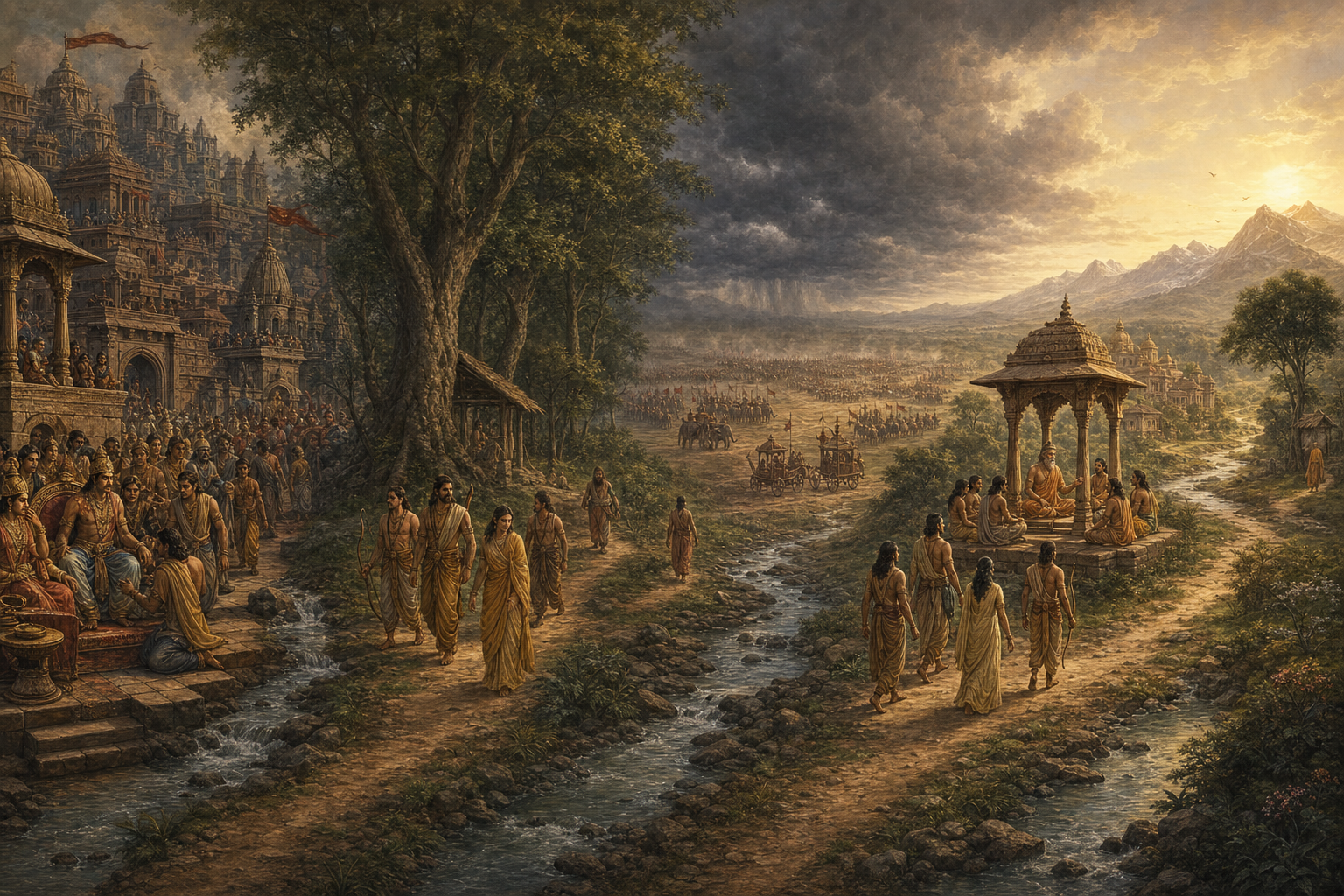
The easiest way to remember all eighteen Parvas is to group them into four movements. This is not merely a memory aid. Each movement changes the kind of question the epic asks of you.
| Movement | Parvas | Narrative work | Question for the reader |
|---|---|---|---|
| Origins, disorder, and attempted prevention | Adi, Sabha, Vana, Virata, Udyoga | Forms the dynastic world, exposes its failures, disciplines the exiled Pandavas, and exhausts diplomacy | How does private vice acquire public power? |
| War and moral fracture | Bhishma, Drona, Karna, Shalya, Sauptika | Places duty, loyalty, command, morale, rage, and the cost of violence under pressure | What remains of righteousness when every available action carries a cost? |
| Grief, governance, and ethical reconstruction | Stri, Shanti, Anushasana | Makes suffering audible and turns from conquest to rule, restraint, justice, and discipline | What must power learn from those who paid for its victory? |
| Consolidation, withdrawal, dissolution, and ascent | Ashvamedhika, Ashramavasika, Mausala, Mahaprasthanika, Svargarohana | Restores order, then progressively releases household, dynasty, kingdom, and earthly possession | Can you perform responsibility fully without mistaking possession for permanence? |
The first five Parvas show that wars begin long before weapons are raised. Genealogy, rivalry, courtly display, gambling, exile, concealed endurance, and failed negotiation form one chain. Udyoga belongs in this first movement because diplomacy is not a decorative prelude to an inevitable battle. It is the final test of whether pride, partiality, and bad judgment can still yield to truth, restraint, and public welfare.
The next five Parvas strip away any temptation to romanticize conflict. Bhishma, Drona, Karna, and Shalya are not interchangeable commanders. Their successive prominence allows the epic to examine different combinations of authority, loyalty, skill, persuasion, oath, and inner division. Sauptika then shows rage surviving beyond the ordered battlefield. The war may have reached its military conclusion, but violence continues to act through wounded minds.
The three-Parva reckoning is the structural center of the epic’s ethical argument, even though it comes after the apparent climax. Stri gives grief a public voice. Shanti asks how shattered order can be governed. Anushasana asks how norms become sustained conduct. Only after this work does the final movement begin, moving from royal consolidation toward withdrawal and release.
You can use this four-part pattern to diagnose any serious conflict in your own reading of public life: causes, confrontation, reckoning, and relinquishment. If an account ends at confrontation, it is incomplete. If it celebrates victory without listening to grief, rebuilding institutions, or restraining the victors, it has stopped before the Mahabharata’s most demanding work begins.
The decisive ethical turn comes after the battlefield
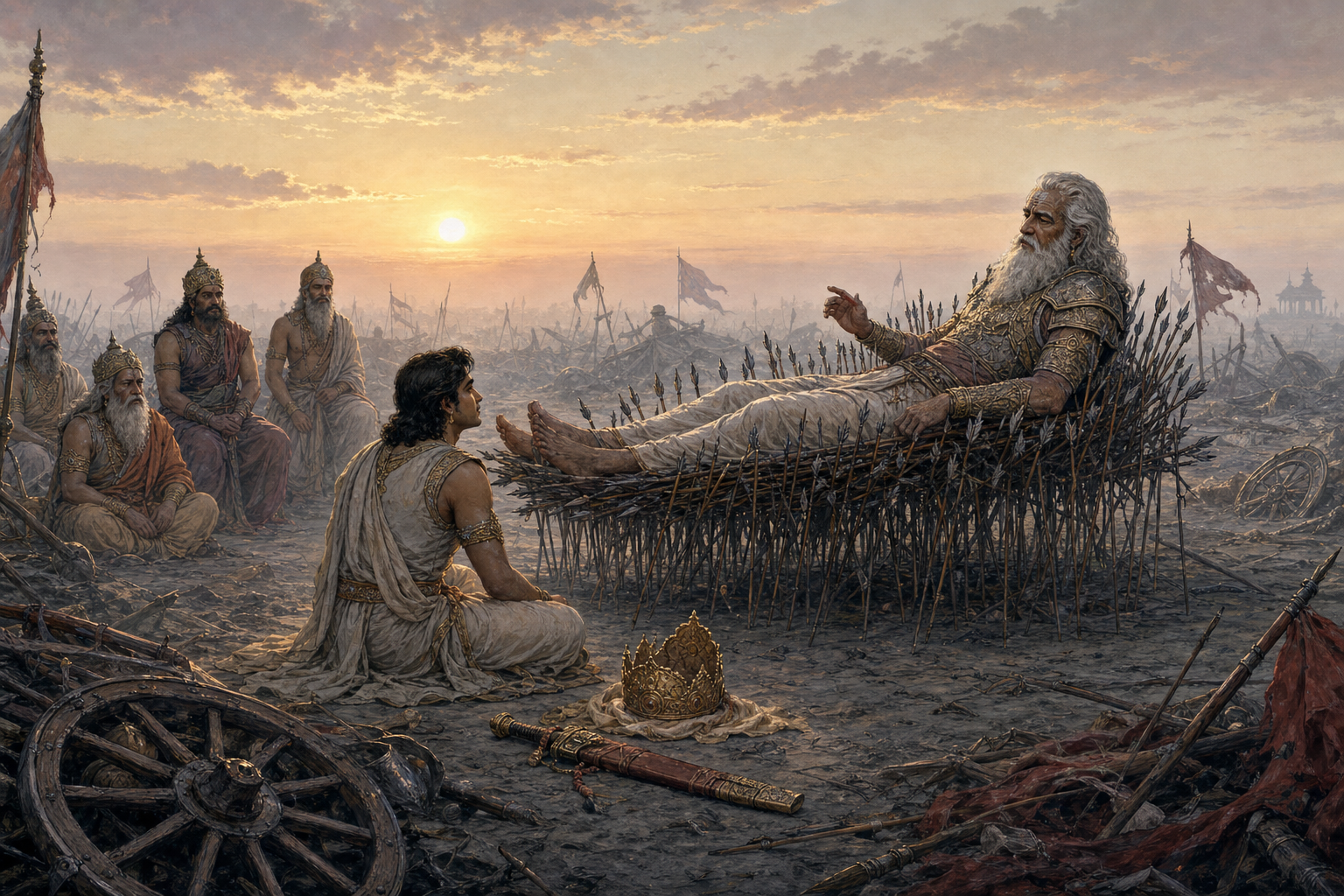
Modern retellings naturally concentrate on the war. The Mahabharata’s architecture refuses to let the battlefield have the final word. Its most extended deliberations appear in Shanti and Anushasana, after the kingdom has been won. That placement makes a severe point: the ability to defeat an opponent does not prove the ability to rule justly.
Stri Parva prepares this turn by centering lament. The sorrow of women is not an emotional interval between military history and political instruction. It changes the moral evidence before the rulers. Casualties become relationships; policy becomes bereavement; glory is confronted by the people required to live with its consequences. If power cannot hear the wounded, it cannot understand what it has done.
Shanti Parva then treats peace as strenuous construction rather than the mere absence of fighting. Its discussions of rajadharma, apaddharma, and mokshadharma address ordinary rule, duty under emergency, and the pursuit of liberation. Governance is examined through such matters as taxation, justice, protection of the vulnerable, and the ruler’s own discipline. Anushasana extends the work through instruction on vows, gifts, truth, ahimsa, and contemplative practice.
Do not flatten these teachings into a modern policy manual with direct one-to-one answers for every institution. Their more durable use is to expose the dependencies of legitimate power. Public order depends on personal restraint; justice depends on hearing suffering; emergency action remains answerable to dharma; and material restoration is insufficient without moral repair.
When you examine a political decision, institutional conflict, or leadership failure through this sequence, conduct the reckoning in the same order:
- Begin with the Stri question: whose suffering is absent from the official account?
- Move to the Shanti question: what form of order could protect the vulnerable and prevent repetition?
- Apply the Anushasana question: what disciplines, duties, and restraints must become regular conduct rather than temporary promises?
- Only then ask whether authority has truly been restored. Control without accountability is not the peace envisioned by this architecture.
This is why the postwar Parvas are not an appendix. They are the test of whether the lessons of war have entered character, law, and public duty.
What each Parva contributes to the complete map
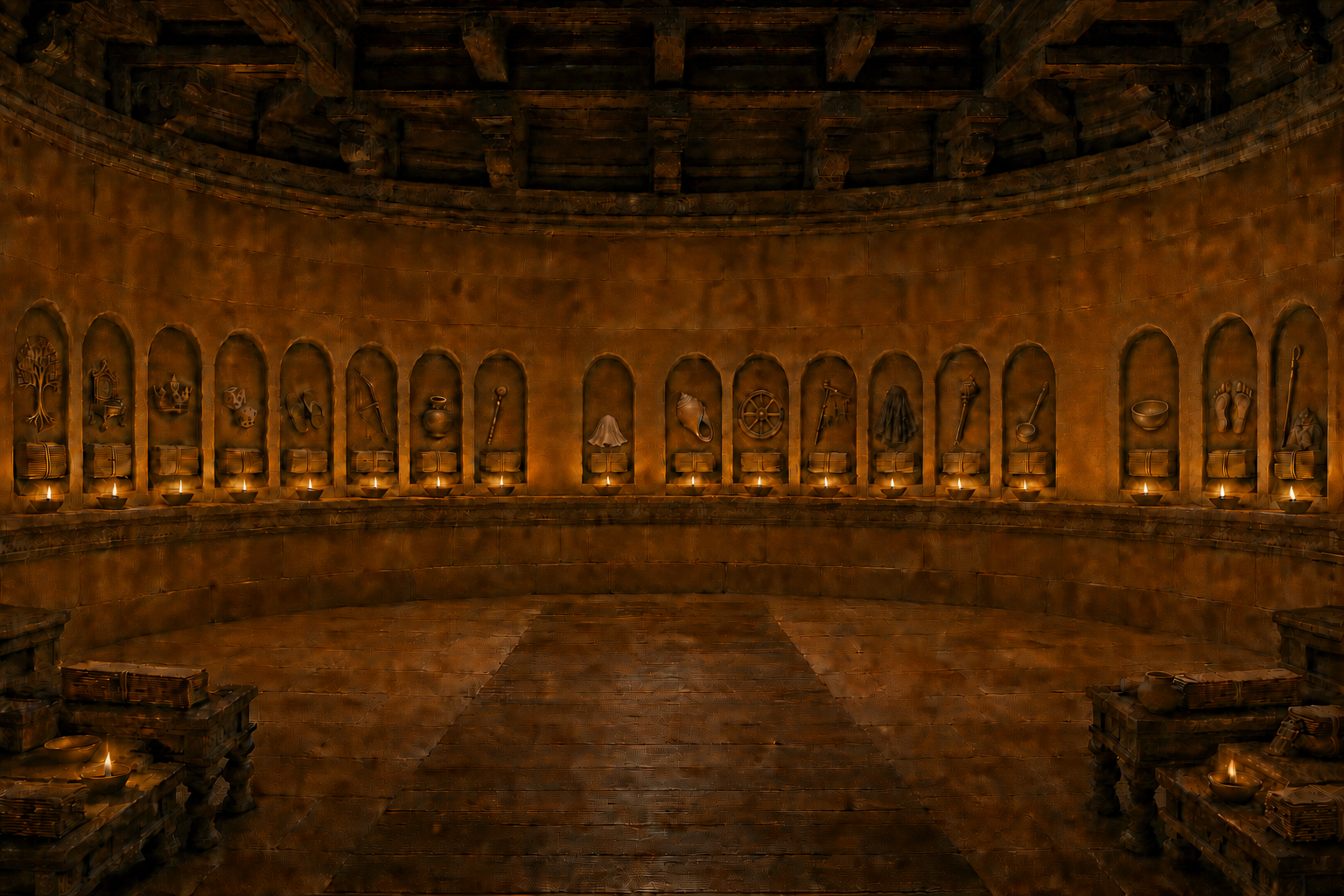
A useful Parva guide should do more than match names to episodes. The following sequence identifies the moral movement you can watch for while reading.
- Adi Parva: inheritance. Origins, genealogies, vows, and earlier choices establish the field into which later generations are born. Read it to notice how inherited obligations can guide people but also bind them to conflicts they did not create.
- Sabha Parva: power made public. The assembly gives ambition, comparison, humiliation, and deception an institutional setting. Watch how personal weakness becomes a political catastrophe when a court fails to restrain it.
- Vana Parva: formation through loss. Exile removes the Pandavas from royal possession without removing their responsibilities. Read it as a long education in endurance, reflection, and preparation rather than a pause in the main action.
- Virata Parva: identity under concealment. Disguise tests whether discipline survives when status and recognition disappear. The practical question is simple: who are you when you cannot rely on your title?
- Udyoga Parva: the burden of prevention. Negotiation, counsel, Vidura-niti, and the Sanatsujatiya place political ethics beside metaphysical discernment. Notice how many opportunities for restraint exist before conflict becomes unavoidable, and how pride or partiality closes them.
- Bhishma Parva: action under moral pressure. The Bhagavad Gita appears here because the crisis is not merely whether Arjuna can fight. It is whether action can be joined to clear discernment and freedom from possessive attachment. Karma, bhakti, and jnana work as completing paths rather than isolated techniques.
- Drona Parva: capacity without resolution. Skill and authority intensify the conflict but cannot resolve its moral contradictions. Read for the difference between being able to perform an action and being rightly aligned in performing it.
- Karna Parva: the tragedy of loyalty. Karna’s commitments reveal how admirable qualities can become destructive when attached to an adharmic cause. Loyalty therefore requires judgment; its intensity does not make its object righteous.
- Shalya Parva: speech, morale, and fragmentation. Persuasion and the management of resolve become part of warfare. Notice how conflict is shaped not only by weapons but also by words, confidence, and divided intention.
- Sauptika Parva: violence after limits collapse. Rage moves beyond the constraints associated with open battle. Read it as a warning that an official ending does not end the passions cultivated by conflict.
- Stri Parva: consequence becomes audible. Lament forces the narrative to dwell with bereavement. Do not hurry through it to reach philosophical instruction; the instruction that follows must be heard in the presence of this grief.
- Shanti Parva: rebuilding under dharma. Rajadharma, apaddharma, and mokshadharma broaden the question from winning a kingdom to governing conduct, crisis, and the inner life. Peace now requires justice, restraint, knowledge, and protection.
- Anushasana Parva: principle becomes discipline. Teachings on dana, ahimsa, satya, vows, and conduct show that moral order has to be practiced repeatedly. A society cannot live indefinitely on the insight produced by one crisis.
- Ashvamedhika Parva: consolidation without finality. Ritual and royal restoration re-establish political order. Its position reminds you that renewed sovereignty is a stage of responsibility, not the epic’s ultimate destination.
- Ashramavasika Parva: withdrawal from the royal household. The older generation moves toward the quieting of worldly roles. Read it for the difficult transition from directing events to releasing one’s claim upon them.
- Mausala Parva: the dissolution of power. The destruction of the Yadavas prevents the reader from imagining that one victorious lineage has escaped impermanence. No political arrangement, however closely connected to sacred history, becomes permanent possession.
- Mahaprasthanika Parva: relinquishment enacted. The great departure turns renunciation into movement. Kingdom and royal identity are left behind; the final journey cannot be made by enlarging what one owns.
- Svargarohana Parva: ascent beyond worldly settlement. The epic closes with the final ascent. Its structural function is to carry the reader beyond dynasty, office, victory, and loss toward the horizon of liberation.
The progression also clarifies the purusharthas. Artha and kama remain present throughout worldly life, but they must be ordered by dharma. The closing Parvas gradually shift attention toward moksha. The Mahabharata does not demand that social responsibility be abandoned at the beginning; it shows duty being fulfilled, judged, and eventually relinquished in the proper sequence.
Turn the architecture into a disciplined reading practice

You do not need to master every genealogy or debate before the structure becomes useful. Read in four passes, and give each pass a distinct question.
- Adi through Udyoga: trace escalation. Mark each point where restraint, honest counsel, or impartial judgment might have altered the course. This keeps you from treating Kurukshetra as an inexplicable eruption.
- Bhishma through Sauptika: examine constrained action. Track who acts from discernment, oath, loyalty, command, anger, or despair. Avoid sorting everyone too quickly into pure heroes and villains; the war Parvas work by exposing costly mixtures of virtue and error.
- Stri through Anushasana: study the conditions of repair. Read lament before governance. Then distinguish emergency duty from ordinary rule, and distinguish public justice from the ruler’s personal discipline.
- Ashvamedhika through Svargarohana: watch possession loosen. Note the sequence: restoration, withdrawal, dynastic dissolution, departure, and ascent. The ending does not reject responsible action; it refuses to turn the fruits of action into permanent identity.
If you participate in parayana, temple discourse, or household study, the Parva divisions can also set the rhythm of reflection. At the end of each section, record three things: the dominant human weakness, the form of dharma required in response, and the consequence of accepting or refusing that demand. Over time, this creates a moral map rather than a collection of memorable stories.
Comparative dharmic reading can deepen the exercise when distinctions are preserved. The Buddhist eighteen dhatus can prompt attention to the field of perception. The Jain eighteen papa-sthanas can prompt an audit of conduct and demerit. The Sikh sant-sipahi ideal can illuminate the relation between inward discipline and responsible strength. These are resonances, not claims that Buddhism, Jainism, Sikhism, and the Mahabharata teach identical systems.
Key takeaways
- The number eighteen points toward completeness, but no single calculation exhausts the meaning of the Parvas.
- The sequence moves through four ethical stages: the growth of disorder, the cost of conflict, the work of reckoning, and the release of worldly possession.
- Udyoga must be read before the war because prevention, counsel, and failed diplomacy belong to the moral history of violence.
- Stri, Shanti, and Anushasana prevent victory from becoming self-justifying; grief, governance, and disciplined conduct determine whether peace is real.
- The final five Parvas place political restoration inside a larger movement toward impermanence, renunciation, and moksha.
For your next reading, choose one joint rather than one famous episode: Sabha to Vana, Udyoga to Bhishma, Sauptika to Stri, or Ashramavasika to Mausala. Ask what the transition takes away, what it makes visible, and what duty now becomes unavoidable. Once you begin reading those turns carefully, the eighteen Parvas stop looking like a table of contents and begin functioning as a map of dharma.