
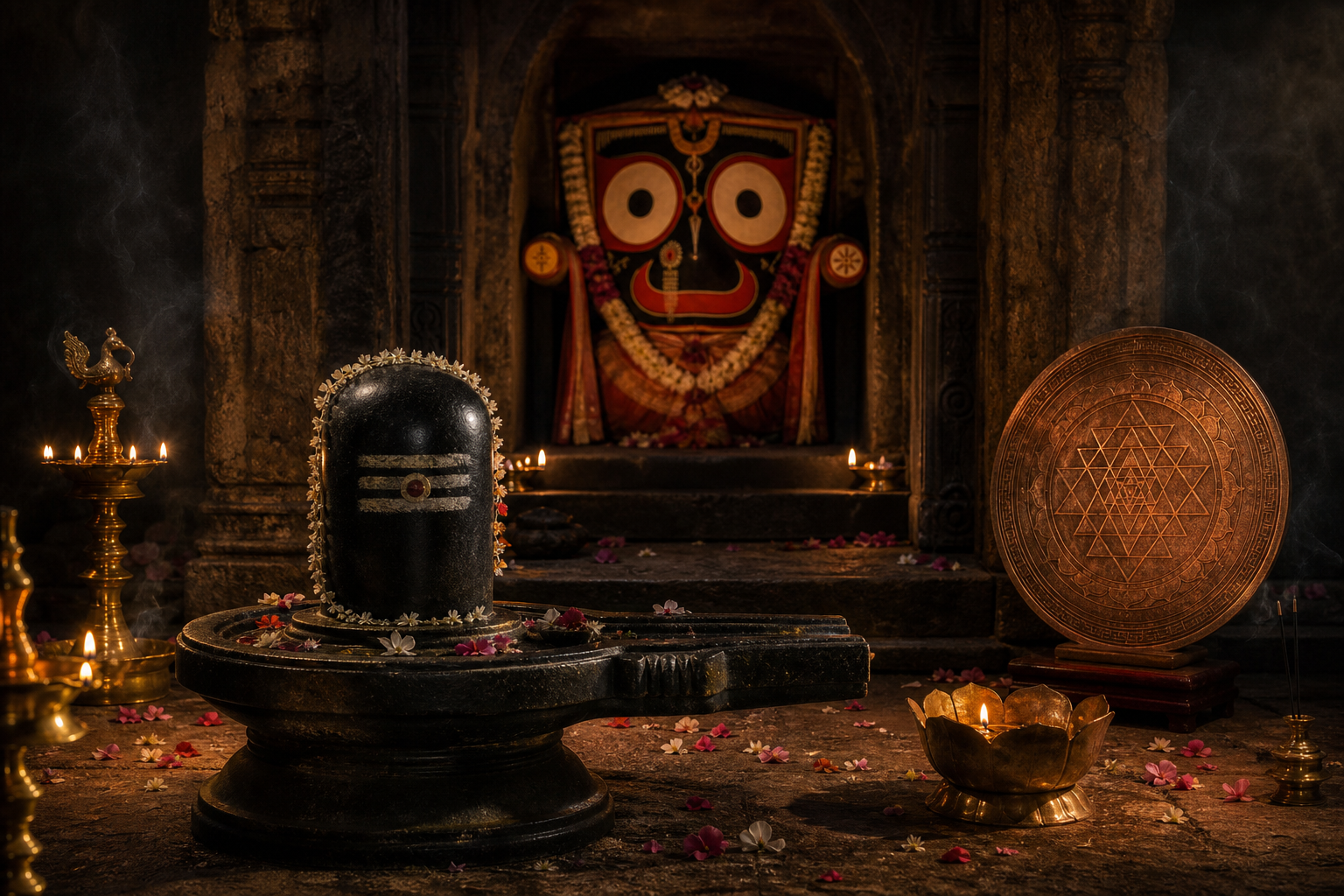
If you have stood before Jagannātha’s immense eyes, a Śiva liṅga, or the intersecting triangles of a Śrī Cakra and wondered what was missing, resist the urge to complete the image in your imagination. First ask whether it was ever meant to behave like a portrait.
You will read a Hindu sacred image more accurately when you ask four practical questions: What reality does this form point toward? Which signs carry its meaning? What relationship does it invite? Is its unusual appearance intentional, ritual, or the result of damage? Those questions turn apparent incompleteness into a doorway to darśana.
Begin with pūrṇa, not portraiture
A portrait is usually judged by resemblance. A sacred image has a different task. It must make an inexhaustible reality approachable without pretending that stone, metal, paint, or geometry can contain that reality completely.
The key distinction is between tattva, the reality or principle being disclosed, and rūpa, the particular form through which it is approached. The divine can be understood as pūrṇa in tattva while every visible rūpa remains conditioned by material, scale, place, artistic convention, and the capacity of the human senses. A form can therefore be complete for worship without being an exhaustive picture of the divine.
pūrṇam adaḥ pūrṇam idam pūrṇāt pūrṇam udacyate, pūrṇasya pūrṇam ādāya pūrṇam evāvaśiṣyate.
Iśa Upaniṣad invocation
Here, fullness is not the result of assembling enough visible parts. It is a fullness from which fullness can appear without diminishing its source. This is why a small household mūrti need not be considered a smaller portion of divinity, and why a non-figurative sign need not be considered spiritually inferior to a detailed sculpture.
The Upaniṣadic discipline of neti neti, “not this, not this,” guards against confusing any description with the whole truth. The Kena Upaniṣad likewise directs attention toward that which speech cannot express but by which speech becomes possible. Applied to sacred art, the lesson is precise: do not mistake the image for an inventory of everything the divine is. Let it disclose without demanding that it exhaust.
This does not make form disposable. The Bhagavad-Gītā’s discussion in 12.1–5 recognizes both qualified and unqualified contemplation, often described as saguṇa and nirguṇa, while acknowledging the difficulty of approaching the unmanifest directly. In 7.21, devotion directed toward a chosen divine form is affirmed rather than dismissed. Hindu schools interpret the metaphysics of form in different ways, but the practical correction remains useful: a sacred form is neither an exhaustive container nor a meaningless prop.
When you encounter an unfamiliar icon, replace “Does this look like a real body?” with “What truth has this tradition chosen to make visible?” That change of question is the first step toward reading the image on its own terms.
Read the image as a visual grammar
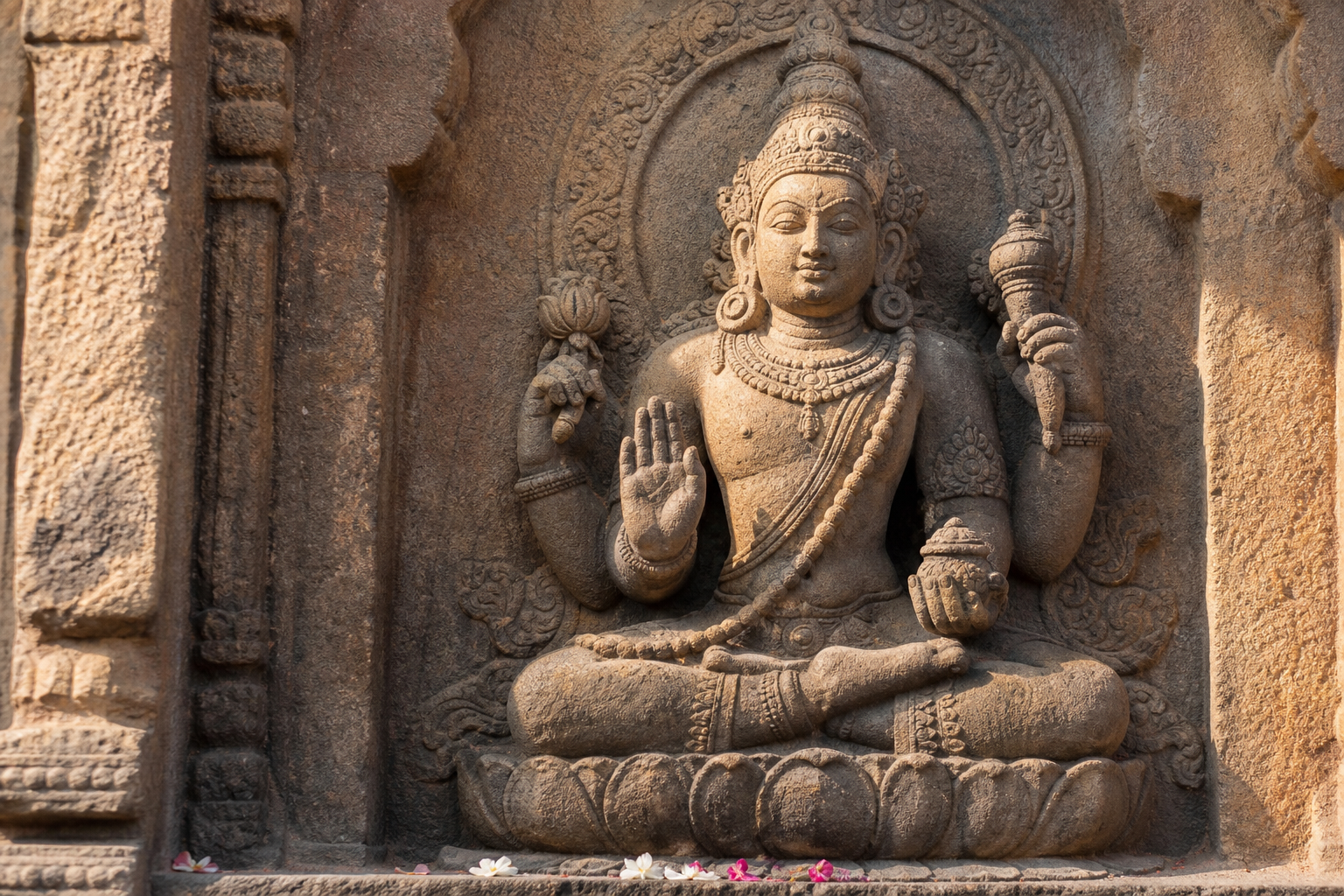
Hindu iconography communicates through concentrated signs. An extra arm, a distinctive object, a hand gesture, a geometric enclosure, or an unusual proportion can do the work that a paragraph would do in another medium. Anatomical naturalism is only one possible artistic value, and often it is not the governing one.
| What you notice | An unhelpful first question | A better question |
|---|---|---|
| Multiple arms or heads | Could such a body exist biologically? | Which powers, activities, directions, or perspectives are being shown at once? |
| A trident, discus, conch, mace, or vīṇā | Why is the figure carrying an accessory? | Which cosmic role, virtue, energy, or identity does the attribute establish? |
| Abhaya or varada mudrā | Is the hand anatomically realistic? | What relationship is being offered: freedom from fear, generosity, refuge, or grace? |
| An aniconic or natural form | Where are the face and limbs? | How does this sign direct attention beyond portraiture? |
| A geometric form | Why is there no divine body? | Which relationships, levels, energies, or cosmological principles have been condensed into geometry? |
| Idealized proportions | Why does the body differ from ordinary anatomy? | How do proportion, mood, and radiance communicate the nature of the presence? |
Multiple limbs are therefore not an unsuccessful attempt at human anatomy. They make simultaneity visible. A human body can perform only a limited number of actions at once; the icon can display protection, blessing, mastery, and cosmic function in a single field of vision. The image is semantically dense even where it is physically improbable.
The same principle governs the Śiva liṅga. Liṅga means a mark or sign. If you approach it as an unfinished statue, you begin with the wrong category. Its restraint is the point: a concentrated sign turns the mind beyond facial likeness while still giving worship a material centre. The naturally occurring Śālagrāma and Bāṇa-liṅga make the distinction even sharper. Their lack of carved anatomy does not leave them waiting for completion.
The Śrī Cakra works through another visual language. Its completeness lies in ordered geometry rather than bodily description. Jagannātha’s rounded arms, enormous eyes, and schematic body likewise establish an intentional form whose force does not depend upon portrait-like realism. Treating either as a preliminary sketch would erase the very choices that make it recognizable and ritually meaningful.
Nor is stylization an excuse for arbitrariness. Textual traditions of art and architecture—including the Mānasāra, Mayamata, Śilpa Prakāśa, Bṛhat Saṁhitā, and the Chitrasūtra of the Viṣṇudharmottara Purāṇa—organize sacred representation through systems of proportion, measurement, expressive mood, and radiance. Terms such as tālamāna, aṅgula, pramāṇa, bhāva, and śobhā point to a disciplined visual grammar. The result may depart from an ordinary human body precisely because its aim is to reveal a more-than-ordinary presence.
A five-step method for your next encounter
- Name the setting. A consecrated temple mūrti, a household image, an illustrated manuscript, and a museum fragment do not have identical functions.
- Identify the visual mode. Is the form anthropomorphic, aniconic, natural, or geometric? Do not judge one mode by the expectations of another.
- Inventory the deliberate signs. Look at mudrās, attributes, heads, arms, posture, vehicle, enclosure, and direction of gaze before concentrating on anatomy.
- Notice what the form emphasizes. Ask whether protection, sovereignty, serenity, energy, accessibility, transcendence, or cosmic order has been brought forward.
- Ask what practice surrounds it. Mantra, pūjā, procession, meditation, temple movement, and darśana may supply dimensions of meaning that a detached photograph cannot show.
Use this sequence before searching for a defect. It keeps you from calling a symbol unfinished merely because you have not yet learned its grammar.
Ritual and temple space change what “finished” means
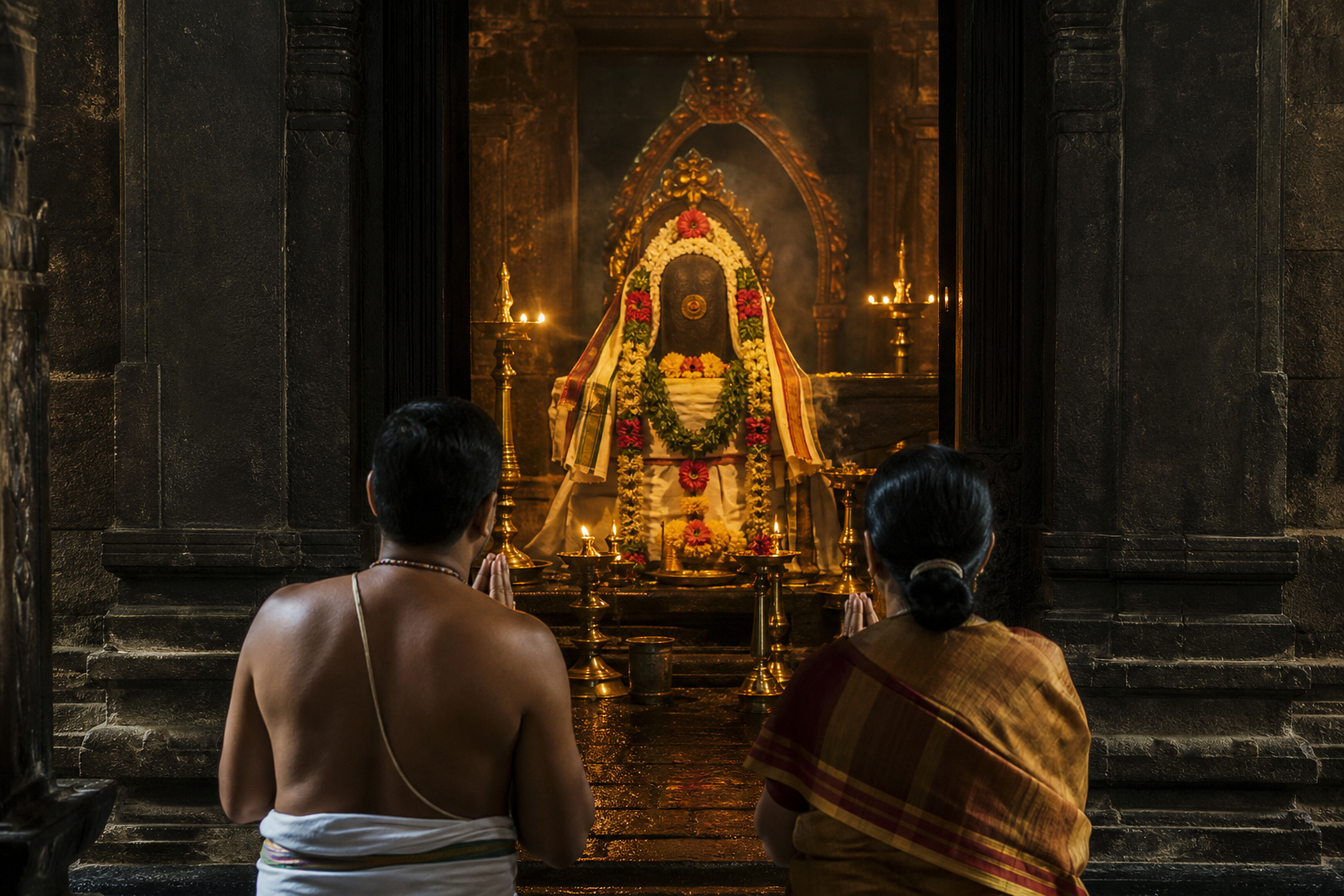
A sacred image is not understood only through its visible surface. Ritual establishes a relationship between presence, community, place, and form. That relationship matters when deciding whether a mūrti is complete in the sense that worshippers actually use the word.
Through prāṇa-pratiṣṭhā, a prepared mūrti is consecrated for divine encounter. It may then be understood as an arcāvatāra, a form in which the divine consents to become approachable in worship. Rites may include netronmīlana, the opening of the eyes. This does not mean that the sculptor forgot a final physical component. It inaugurates a mode of presence.
This gives you a firm distinction to remember: craftsmanship prepares matter, while consecration establishes liturgical status. Neither can be reduced to the other. A beautifully carved but unconsecrated museum object and a ritually installed mūrti may look similar, yet they do not occupy the same place in a community’s practice. Conversely, a simple or aniconic form can be fully adequate for worship when its tradition recognizes and consecrates it as such.
Darśana is therefore not merely an art-viewing exercise. You are not only checking how much information the object contains. You are entering an encounter shaped by gaze, mantra, offering, memory, and attention. What appears visually sparse can be ritually abundant because the devotee participates in its meaning.
Classical Indian accounts of rasa and dhvani help explain the artistic mechanism. Meaning can be suggested rather than exhaustively stated. A form that leaves interpretive room calls forth memory, emotion, teaching, and contemplative attention. Modern ideas about perceptual closure offer a limited parallel: the mind actively organizes partial cues into a meaningful whole. That cognitive observation can illuminate the experience, but it should not be mistaken for the theological reason a mūrti is sacred.
Temple architecture enlarges the image’s field of meaning. The prabhāmaṇḍala encircling Śiva Naṭarāja, the movement from gopura toward garbhagṛha, and the ordered layers of a mandala plan guide attention through space. Lamp light, incense, music, recitation, and procession make the encounter multisensory. If you isolate the icon from that environment, you may be examining only one sentence from a larger sacred composition.
When you visit a temple, observe the route as well as the mūrti. Notice what becomes darker, quieter, narrower, or more concentrated as you approach the sanctum. Watch how the hands and eyes of the form address worshippers. Let local practice tell you how the image is encountered; do not substitute a museum habit of detached inspection for the temple’s own ritual logic.
Separate chosen abstraction from actual damage
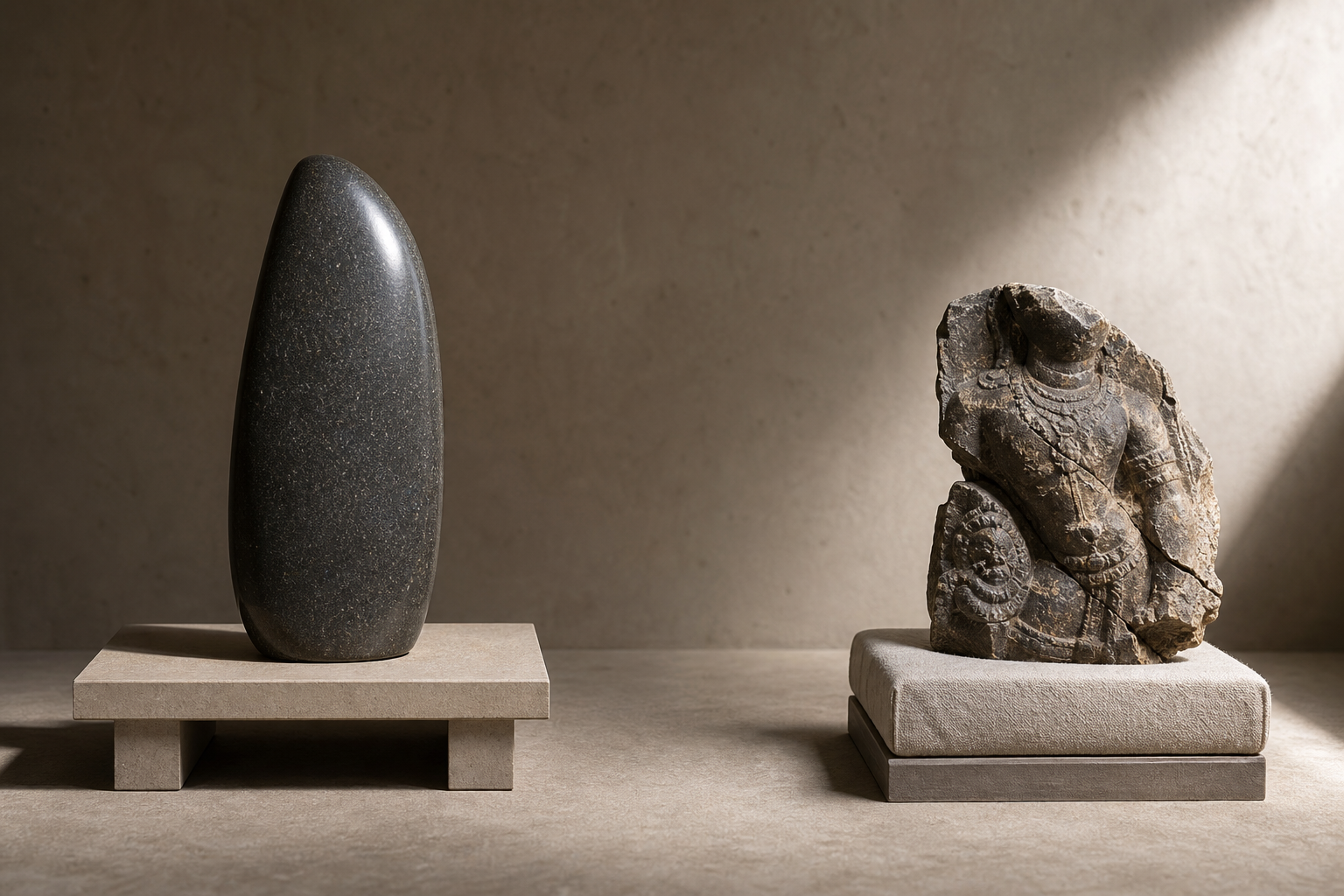
Not every irregular image is intentionally incomplete, and metaphysical language should never be used to deny visible destruction. Sacred images can lose limbs, attributes, surface detail, or structural integrity through age, environment, accident, or human violence. A historical fragment and a canonically aniconic form are different things, even if both can direct thought beyond their material limits.
Use three separate labels rather than forcing every case into one explanation:
- Intentional non-naturalism: The form follows an established symbolic, geometric, natural, or schematic convention. A Śrī Cakra, Śālagrāma, Bāṇa-liṅga, Śiva liṅga, or Jagannātha image belongs here.
- Material fragmentation: A once-present feature has been lost through deterioration, impact, removal, or violence. The remaining object may retain historical, emotional, and theological significance, but the loss should still be named honestly.
- Ritual condition: A tradition determines whether a damaged consecrated image remains suitable for formal worship, requires repair under prescribed conditions, or should be ritually retired. Visual guesswork alone cannot settle that question.
Context is the decisive evidence. In a temple, ask a priest, custodian, or knowledgeable member of the community how the form is identified and treated. In a museum, check whether the label describes a fragment, records a missing attribute, or identifies an aniconic type. If you are looking at a photograph, remember that cropping, angle, coverings, garlands, and low light can conceal parts that are physically present.
Regional variation also prevents quick judgments. Chola bronze, Hoysala stone, and Oḍiśā carving do not express divine form in an identical dialect. Proportion, ornament, movement, and emphasis change across place and lineage. Difference from the version familiar to you is not evidence of error.
The safest practical rule is simple: do not call an unfamiliar form unfinished until you have identified its iconographic type, ritual setting, and physical history. At the same time, do not romanticize a broken surface as deliberate symbolism when evidence of damage is present. Hindu thought can affirm metaphysical fullness without pretending that material loss never occurred.
Carry the insight across Dharmic traditions carefully
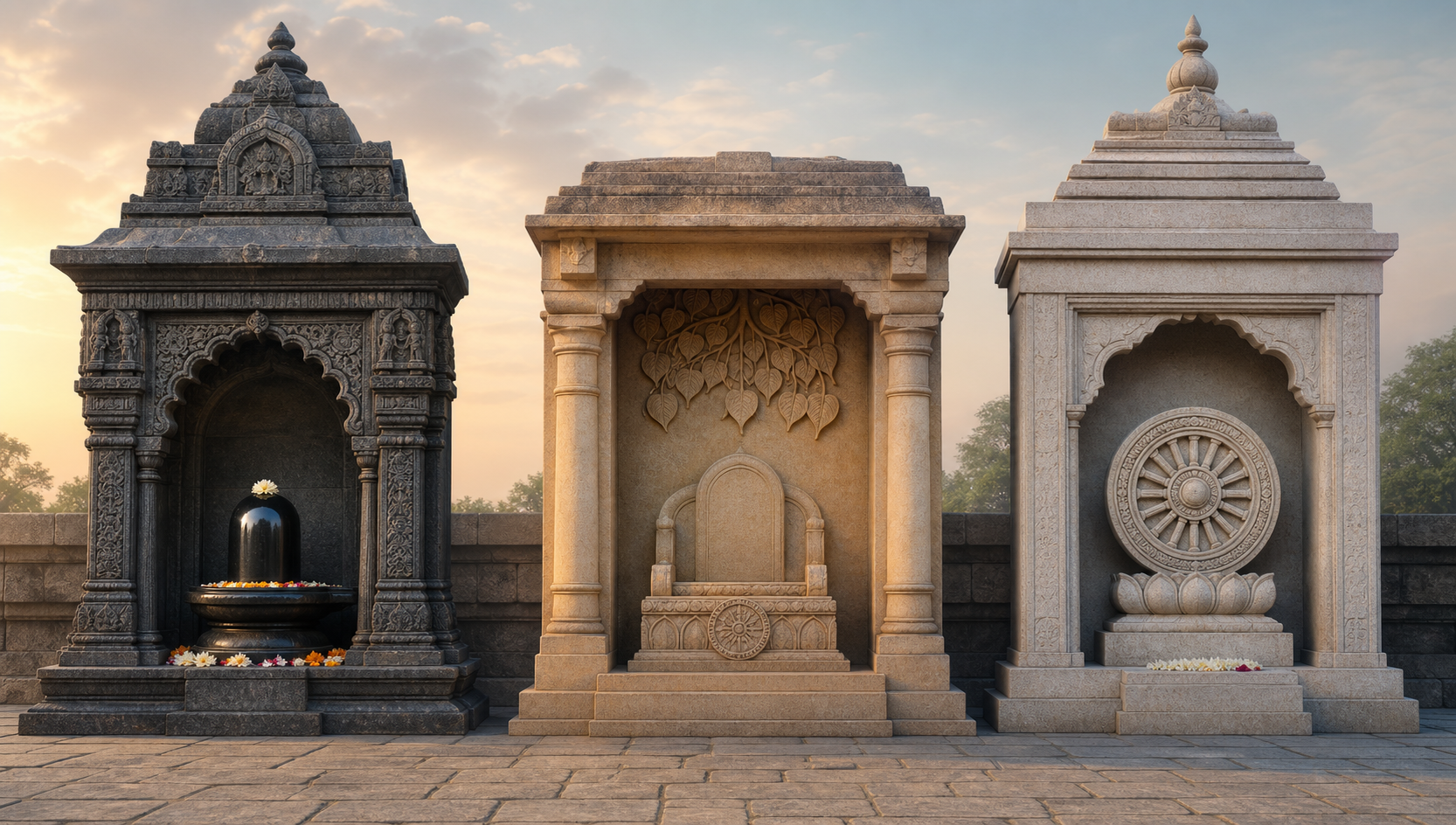
Hinduism contains its own disciplined plurality. Pañcāyatana worship and Iṣṭa-devatā practice allow unity to be approached through distinct forms rather than requiring every devotee to use one image. The Ṛgvedic expression ekam sat viprā bahudhā vadanti gives this plurality a memorable frame: reality is one, while the wise speak of it in many ways. It should not be turned into a claim that all forms, doctrines, or practices are interchangeable.
A comparable humility before what cannot be enclosed appears elsewhere in the Dharmic family, but each tradition applies it differently. Early Buddhist art could signify the Buddha through the Bodhi tree, an empty throne, or the Dharma wheel; later Buddhist traditions also developed rich anthropomorphic imagery. Jaina images of the Tīrthaṅkaras use disciplined serenity and standardization to foreground meditative equipoise rather than individual portraiture. Sikh tradition centres Śabad as Guru and uses Ik Onkar to direct attention toward Akal Purakh rather than developing a Hindu-style mūrti tradition.
The resemblance lies in restraint before the real, not in identical theology. Buddhism’s account of Dharma, Jain anekāntavāda, Sikh devotion to the unrepresentable Akal Purakh, and Hindu approaches to saguṇa and nirguṇa should be named in their own languages. Saying “these traditions all know that one picture cannot circumscribe truth” creates room for dialogue. Saying “they are all secretly the same” erases the very plurality you are trying to honour.
Key takeaways
- A Hindu sacred image is complete when it successfully discloses and supports encounter with its divine principle; exhaustive physical description is not the standard.
- Multiple limbs, attributes, mudrās, idealized proportions, natural objects, and geometry are forms of visual language, not failed anatomy.
- Prāṇa-pratiṣṭhā and darśana add ritual and relational dimensions that cannot be judged from appearance alone.
- Canonical abstraction, historical fragmentation, and ritual suitability are three different questions. Identify which one you are asking.
- Other Dharmic traditions also preserve humility before realities that cannot be captured by a single form, but their doctrines and practices should not be collapsed into one system.
The next time a sacred image looks incomplete, do not begin by supplying what you think is absent. Ask what has been concentrated into the form, what kind of attention it requests, and whether its appearance comes from canon, ritual, regional style, or damage. That is how an object that first seemed deficient can become a threshold to the infinite.