
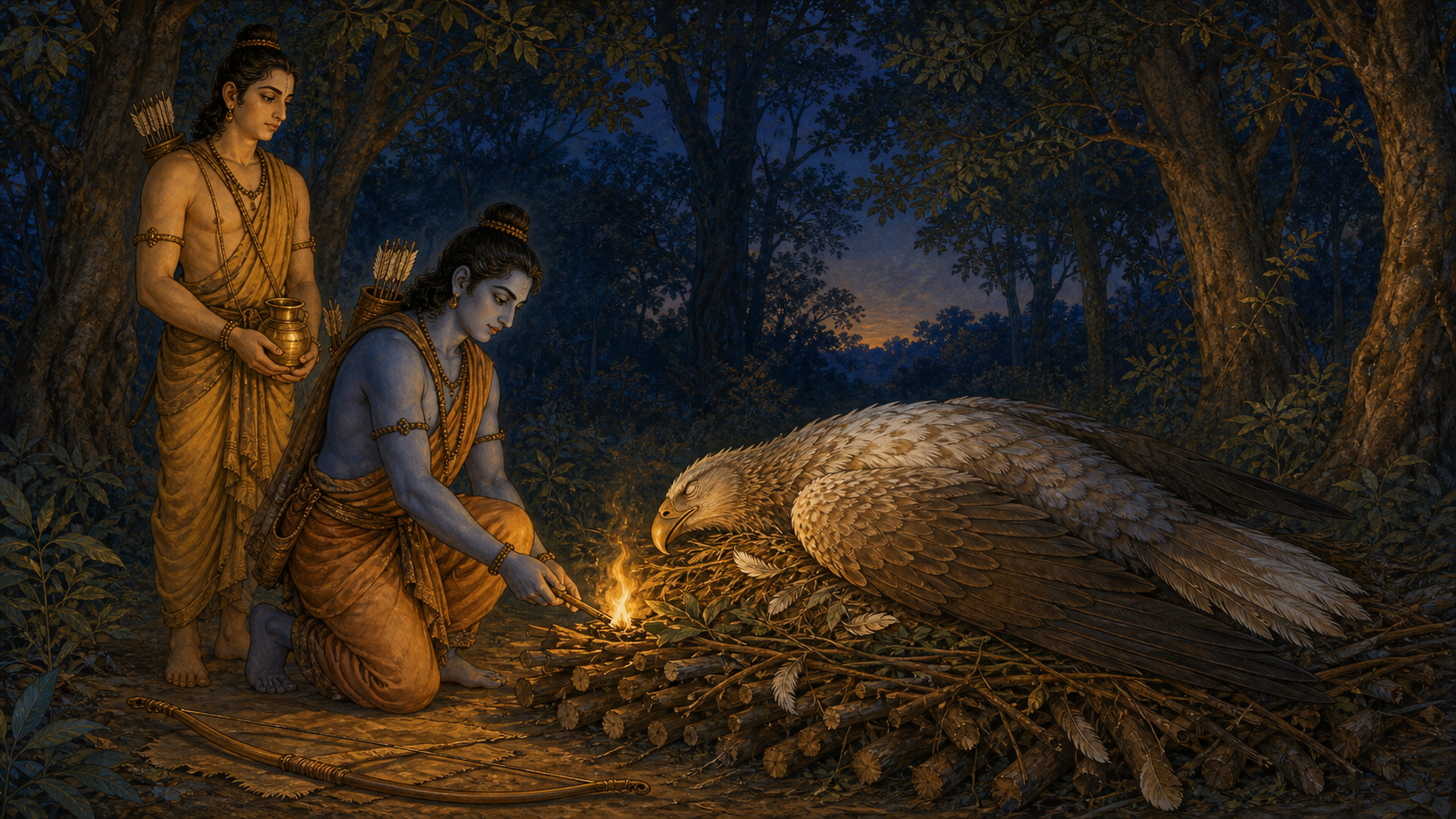
If you have heard the northern Kerala question, “Was Rama wrong to cremate Jatayu?”, you may feel pulled between two sound intuitions. One says that sacred rites have boundaries and should not be altered by emotion. The other says that leaving Jatayu without the honor due to a fallen protector would itself be a failure of dharma.
On the ethical logic of the Ramayana, Rama’s act is not a careless breach. It is a disciplined response to an exceptional sacrifice. Understanding why will help you distinguish living dharma from both rigid rule-following and convenient rule-breaking.
The ritual objection deserves a serious answer
The objection begins with maryada: the boundaries that keep conduct, relationships, and rites in their proper form. In many Dharmashastra-informed customs, formal cremation rites belong to the human sphere, while animals return to the natural order appropriate to their own embodiment. If that distinction matters, cremating a bird can appear improper.
It would be too easy to dismiss this concern by saying that Rama is divine and therefore whatever he does is automatically beyond examination. The Ramayana repeatedly invites ethical reflection through difficult choices. The better question is not whether Rama can ignore a rule, but whether the ordinary classification captures everything morally relevant about Jatayu.
A ritual boundary is not meaningless merely because compassion enters the case. Boundaries preserve order, prevent arbitrary improvisation, and connect an individual act to a living community. Yet a boundary becomes mechanical when we apply it without asking what good it serves. You should therefore keep both questions in view: What does the customary distinction protect, and what would its unthinking application do in this particular case?
Jatayu’s conduct changes the moral character of the case
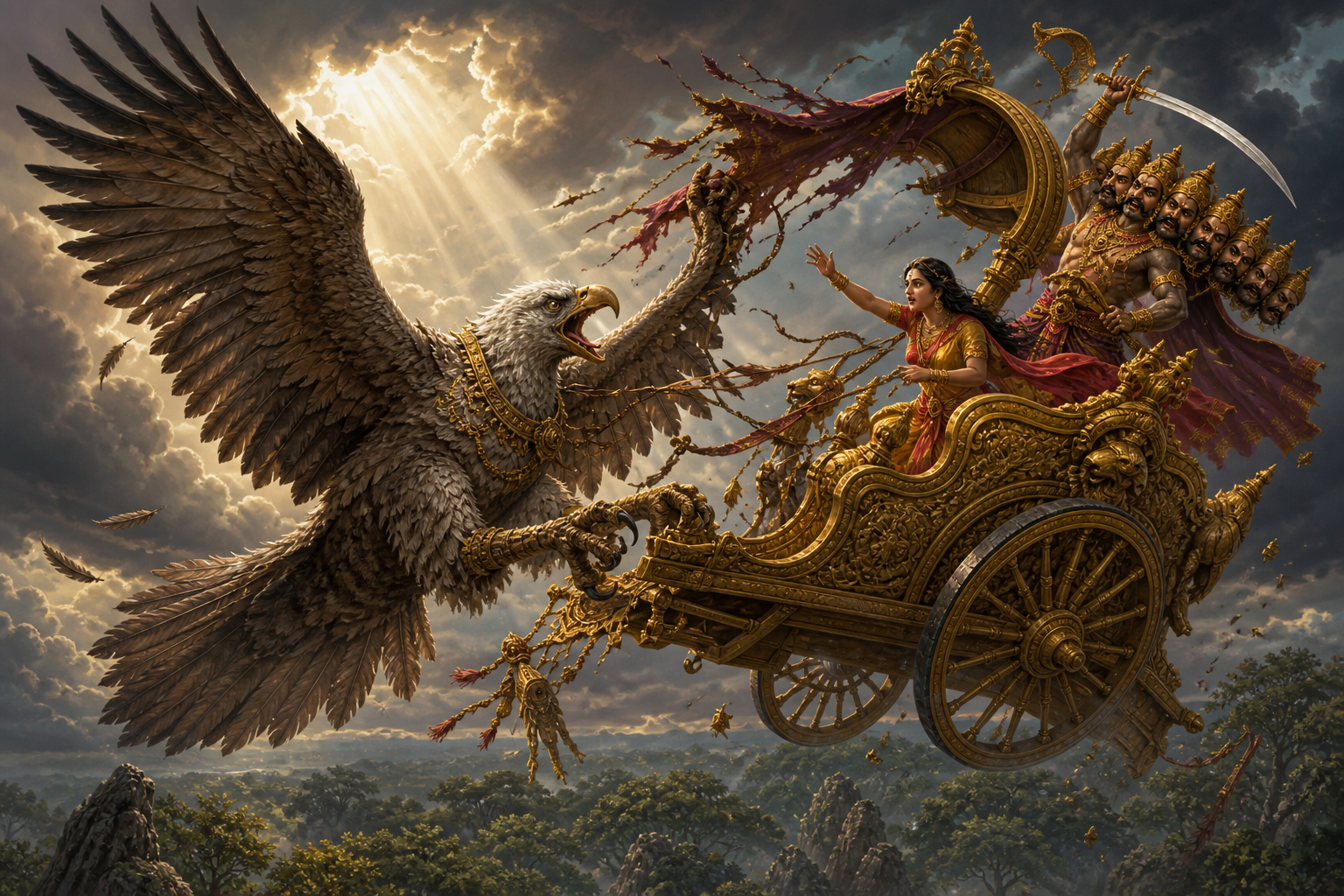
Jatayu is an aged vulture-king, but species alone does not explain his place in the episode. He confronts Ravana to protect Sita, accepts mortal danger when retreat would be easier, and falls while attempting to stop an act of adharma. His moral significance comes from what he freely does: he protects the vulnerable at the cost of his own life.
Rama’s response confirms that this conduct has created a relationship of obligation. Upon finding Jatayu mortally wounded, Rama mourns him, regards him with the affection due to a father, and performs antyeshti. The rite therefore answers more than death. It acknowledges courage, kinship, and a debt that cannot be repaid in ordinary terms.
This is the crucial distinction: Rama does not conduct the rites because biological categories have ceased to matter. He conducts them because Jatayu’s sacrifice has made a merely taxonomic judgment morally insufficient. To call him only “a bird” at that moment would ignore the protector, elder, and father-figure standing before Rama.
Nor does the episode establish a general command to perform human funeral rites for every animal. That conclusion would erase the very features that make Jatayu’s case exceptional. The act is proportionate to a particular deed and relationship. It honors extraordinary dharma without pretending that ordinary distinctions never apply.
Rama fulfills the purpose of the rite rather than discarding it

Antyeshti is not only a physical method of handling a body. It is an act through which the living recognize the deceased, accept responsibility, and discharge a final duty. In Jatayu’s case, those purposes converge. Rama has received the loyalty of a protector, the care of an elder, and the sacrifice of someone he treats as kin. Performing the rites is the fitting response to that moral reality.
The relevant dharmic ideas reinforce one another. Rina names the debt created by what has been received. Daya refuses to make suffering invisible. Maryada demands disciplined conduct rather than impulse. Dharma asks for the right action in the whole situation. Rama’s decision does not simply choose compassion over order; it allows compassion, gratitude, relationship, and ritual purpose to determine how order should be applied.
This matters because “higher dharma” can become a dangerous slogan when it means “the rule does not suit me.” Rama’s act has the opposite structure. It does not secure comfort, advantage, or exemption for himself. It places a duty upon him. He stops his own urgent search, grieves, and performs what he understands to be a son’s final obligation. A claimed exception is more credible when it increases your responsibility instead of reducing it.
The wider Dharmic family offers ethical resonances without requiring us to flatten distinct traditions into one doctrine. Buddhist karuna directs attention toward compassion, Jain ahimsa widens moral concern for living beings, and Sikh seva joins service to dignity. These parallels do not decide a Hindu ritual question by themselves. They do help you notice a shared refusal to treat outward category as the sole measure of moral worth.
Use a four-question dharma test when rules and compassion collide

You may never face a decision resembling Jatayu’s cremation in outward form. You will, however, face moments when a family custom, institutional rule, or community expectation seems to conflict with gratitude or humane responsibility. Before invoking either “the rule” or “compassion,” work through four questions in order.
- Name the norm precisely. Do not argue against a vague idea of tradition. State what the norm ordinarily requires, whom it applies to, and what boundary it preserves. In Jatayu’s case, the issue is the customary distinction between human funerary rites and the natural order followed for animals.
- Identify the good behind the norm. Ask whether it protects reverence, social order, ritual continuity, responsibility, or something else. This prevents you from treating inherited form as empty while also preventing form from becoming an end in itself.
- Identify the morally decisive difference. Sympathy alone is not enough. Name the deed, relationship, sacrifice, or obligation that makes ordinary treatment inadequate. For Jatayu, the decisive facts are his defense of Sita, his mortal sacrifice, and Rama’s recognition of him as a father-figure.
- Choose the narrowest accountable response. An exception should honor the unusual duty without casually abolishing the norm. Ask whether your decision serves another being, whether it costs you something, and whether you could explain it openly to people who take the tradition seriously.
This sequence guards against two opposite mistakes. Ritual legalism sees the category but not the person, deed, or relationship. Sentimental improvisation sees the feeling but not the discipline that keeps an exception from becoming self-serving. Dharmic judgment requires you to see both.
One further check is especially useful: ask whether you would accept the same reasoning when it benefits someone else. If your principle works only when it excuses you, it is probably rationalization. Rama’s reasoning passes that test because his response gives honor to Jatayu and imposes duty upon Rama.
Key takeaways
- The objection to Jatayu’s cremation is serious because dharma includes ritual form and customary boundaries, not intention alone.
- Jatayu’s species does not exhaust his moral identity. His defense of Sita, sacrifice, and relationship to Rama are essential facts.
- Rama acts as one discharging a filial debt, not as one seeking freedom from an inconvenient rule.
- The episode creates no blanket rule for animal cremation; it presents a proportionate response to an exceptional case.
- When compassion seems to conflict with convention, define the norm, recover its purpose, name the decisive difference, and choose a narrow response you can defend openly.
When your next difficult decision places a rule on one side and a living obligation on the other, resist the rush to choose a slogan. Write down the four answers first. If your proposed action preserves the norm’s purpose, recognizes a morally decisive relationship, serves someone beyond yourself, and increases rather than evades your duty, you will be reasoning in the direction illuminated by Rama’s final service to Jatayu.
References
