

You may have a stack of spiritual books and a sincere wish to share them, yet still hesitate when another person comes near. What should you say? Which book should you offer? How do you avoid turning seva into a sales pitch?
Treating book distribution as sankirtana answers those questions. Your task is not to force a dramatic result from a brief encounter. It is to create a dignified doorway through which someone can hear about Krsna, encounter dharmic wisdom, and continue at a pace that is genuinely their own.
What makes the exchange sankirtana rather than a transaction
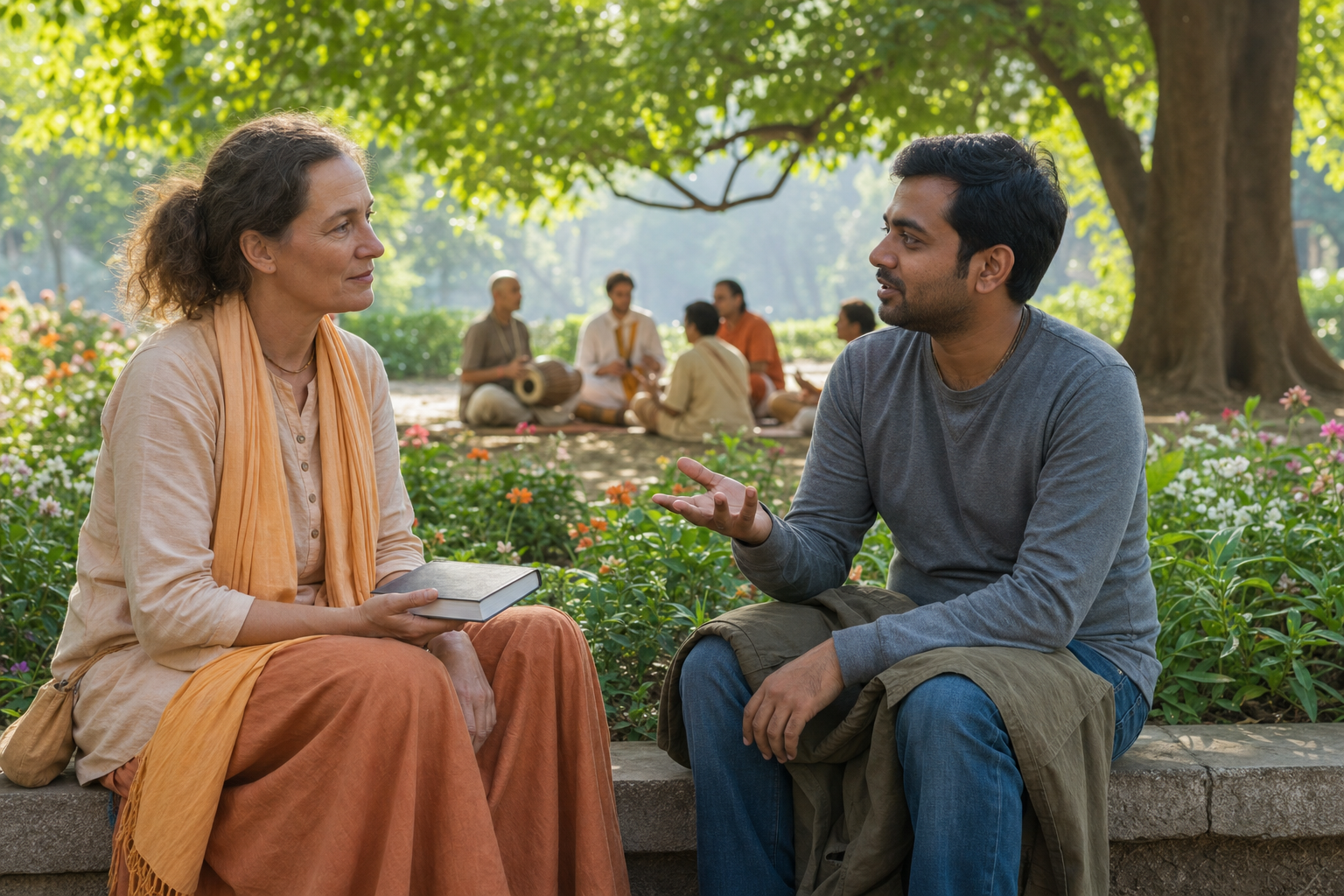
Sankirtana is the glorification of Krsna. It includes personal or collective recitation of the Hare Krsna mantra, as well as reading and discussing the pastimes of the Lord and His devotees. Book distribution belongs within that practice when its intention, subject and manner remain devotional.
This changes how you see everyone involved. The book is not merely stock. The person in front of you is not a prospect. The conversation is not a contest that you win by overcoming objections. You are placing an opportunity for hearing, remembrance and reflection within another person’s reach.
Use three questions to test the character of an encounter:
- Is Krsna still at the centre? The conversation should direct attention toward divine names, teachings, pastimes or devotional life, not toward your own cleverness.
- Can the person decline freely? Respect is part of the offering. Pressure may move a book, but it closes the inward space in which a person could receive it.
- Have you offered a way to engage? A suitable starting passage, a question to consider, a discussion invitation or a temple connection turns possession of the book into a possible practice of reading and hearing.
If one of these elements disappears, pause and reset. Speak less. Listen more closely. Return to the purpose of the service.
Practical matters may still arise, but they should remain secondary and transparent. Do not let logistics dominate the encounter or let the apparent value of a contribution determine how much care you show. The spiritual importance of the exchange lies in the opportunity to encounter Krsna-katha, not in the visible size of the transaction.
Prepare a book, a question and a next step

Good preparation does not mean memorising a lecture. It means knowing what you are offering well enough to connect a particular person with an appropriate entrance into it. Before you distribute, prepare the book, the conversation and the path that can follow.
- Read the book yourself. You do not need an answer to every philosophical question, but you should be able to state its central invitation plainly. Identify a passage you can recommend to someone opening it for the first time.
- Know what kind of reader it serves. Distinguish an introductory book from a sustained philosophical treatment or a collection centred on divine pastimes. Do not hand someone the most demanding option simply because it is the one you want to distribute.
- Prepare one honest opening sentence. For example: We are sharing books that introduce Krsna consciousness and the practice of bringing spiritual remembrance into daily life. Would you like to see one?
- Prepare one sorting question. Ask whether the person is more interested in spiritual practice, philosophy or sacred narratives. Their answer helps you choose a book and prevents you from delivering an irrelevant speech.
- Know the next available step. This may be a reading discussion, a temple programme, an opportunity to chant, or a meal where prasadam is shared. Offer only what actually exists and explain it simply.
- Rehearse a graceful ending. A calm Thank you for your time is enough when someone declines. The ability to release the outcome protects both the other person’s dignity and your own devotional intention.
The common preparation error is to focus on what you will say while ignoring what the reader will do after receiving the book. Reverse that emphasis. Decide what first action would make the book approachable: opening a particular section, reading a short passage, writing down one question, or joining a discussion. Then shape your introduction around that action.
Use a conversation that leaves room for the person

A useful sankirtana conversation has a simple movement: permission, attention, connection, invitation and release. Each part matters. Skipping permission makes the approach intrusive; skipping attention makes it generic; skipping the invitation leaves the book without a path into the reader’s life.
- Ask for a moment rather than taking it. A brief request such as May we show you a book on Krsna consciousness? establishes consent immediately.
- Name the offering without exaggeration. Say what the book contains and whom it may interest. Avoid promising that it will instantly solve grief, confusion or personal difficulty.
- Ask and listen. If the person mentions an interest or concern, do not rush to turn every word into a prepared pitch. First understand whether the book actually meets what they are seeking.
- Connect one feature to one stated interest. If someone wants philosophy, point toward the philosophical discussion. If sacred narratives interest them, explain that the book invites contemplation of the Lord and His devotees. One relevant connection is more useful than a catalogue of claims.
- Offer a concrete first step. Show where to begin, mention a discussion they can join, or explain how they can visit the local temple. Then let them decide.
Someone may eventually find clarity, solace or motivation to live with greater integrity and compassion through such reading. Those are possible fruits of a sincere encounter, not guaranteed outcomes to use as selling points. Let the teaching work through the reader’s own attention and freedom.
If a person disagrees, resist the urge to turn the pavement into a debating hall. Ask what seems unconvincing. Answer only what you understand, and say plainly when you do not know. You can still offer the book as a chance to examine the teaching directly. Intellectual honesty gives the encounter more strength than a hurried answer invented to preserve appearances.
The same care is needed when speaking with Buddhists, Jains, Sikhs or followers of other Hindu sampradayas. Dharmic traditions can recognise shared commitments to knowledge, generosity, disciplined practice and service without pretending that every doctrine is identical. The hospitality expressed through Sikh langar, Buddhist dana and Hindu annadana offers a point of resonance. Use that resonance to open respectful dialogue, not to erase real distinctions or claim another tradition as a version of your own.
Complete the service after the book changes hands

The physical handoff is not the completion of sankirtana. It is the beginning of a quieter phase in which the reader can encounter the teaching privately. A spiritual book creates an intimate doorway into the philosophy and pastimes of Krsna, allowing reflection to continue without the time pressure of the original conversation.
Before parting, help the recipient cross the small gap between accepting a book and actually opening it:
- Point to a suitable place to begin instead of assuming the first page suits every reader.
- Invite the person to note one question or one passage that stands out.
- Provide an optional way to join a reading discussion or ask a later question.
- If appropriate, invite them to a temple for study, worship, chanting or prasadam.
- Make follow-up voluntary. Do not add someone to a message list or repeatedly contact them without clear permission.
Temples give this follow-through a home. They sustain places for study, worship and community participation, while the sharing of prasadam expresses a wider culture of hospitality and service. Present the temple as an open next step, not as an obligation attached to receiving the book. Prasadam is hospitality offered in devotion, not bait for attendance.
You can also review your own service without reducing it to a count of books. Quantity can show how widely you reached, but it cannot tell you whether the encounter retained the spirit of sankirtana. At the end of a distribution period, ask:
- Did people have a real opportunity to accept or decline?
- Did we listen before deciding which book or explanation was suitable?
- Did each recipient receive a clear starting point for reading?
- Did interested readers receive an optional route toward discussion, temple life or prasadam?
- Did our conduct display the patience, truthfulness and compassion the books invite people to cultivate?
These questions reveal where the practice needs correction. If people often accept but seem unsure what they received, improve the explanation. If conversations become arguments, shorten the pitch and ask better questions. If books leave your hands but no one knows where to continue, strengthen the connection between distribution and community.
Key takeaways
- Book distribution becomes sankirtana when it glorifies Krsna through devotional intention, truthful speech and respect for the recipient.
- Prepare one appropriate book, one clear description, one sincere question and one available next step before approaching anyone.
- Ask permission, listen for the person’s actual interest, make one relevant connection and allow an unpressured decision.
- Never promise a spiritual result. Offer access to the teaching and let reading, reflection and grace unfold at the recipient’s pace.
- Treat the handoff as the beginning of service by suggesting where to read and offering an optional path to discussion, temple participation or prasadam.
- Evaluate more than volume. Consent, suitability, follow-through and the quality of your conduct show whether distribution is retaining its devotional purpose.
For your next outing, choose one title and write a single sentence explaining why a new reader might open it. Mark a suitable starting passage, confirm one genuine follow-up opportunity, and practise accepting a refusal without resistance.
Afterward, review one conversation closely and change one part of your approach. That small discipline keeps book distribution connected to hearing, remembrance, service and community. The book then travels as more than an object: it carries an invitation to meet Krsna through attentive reading.
References
