
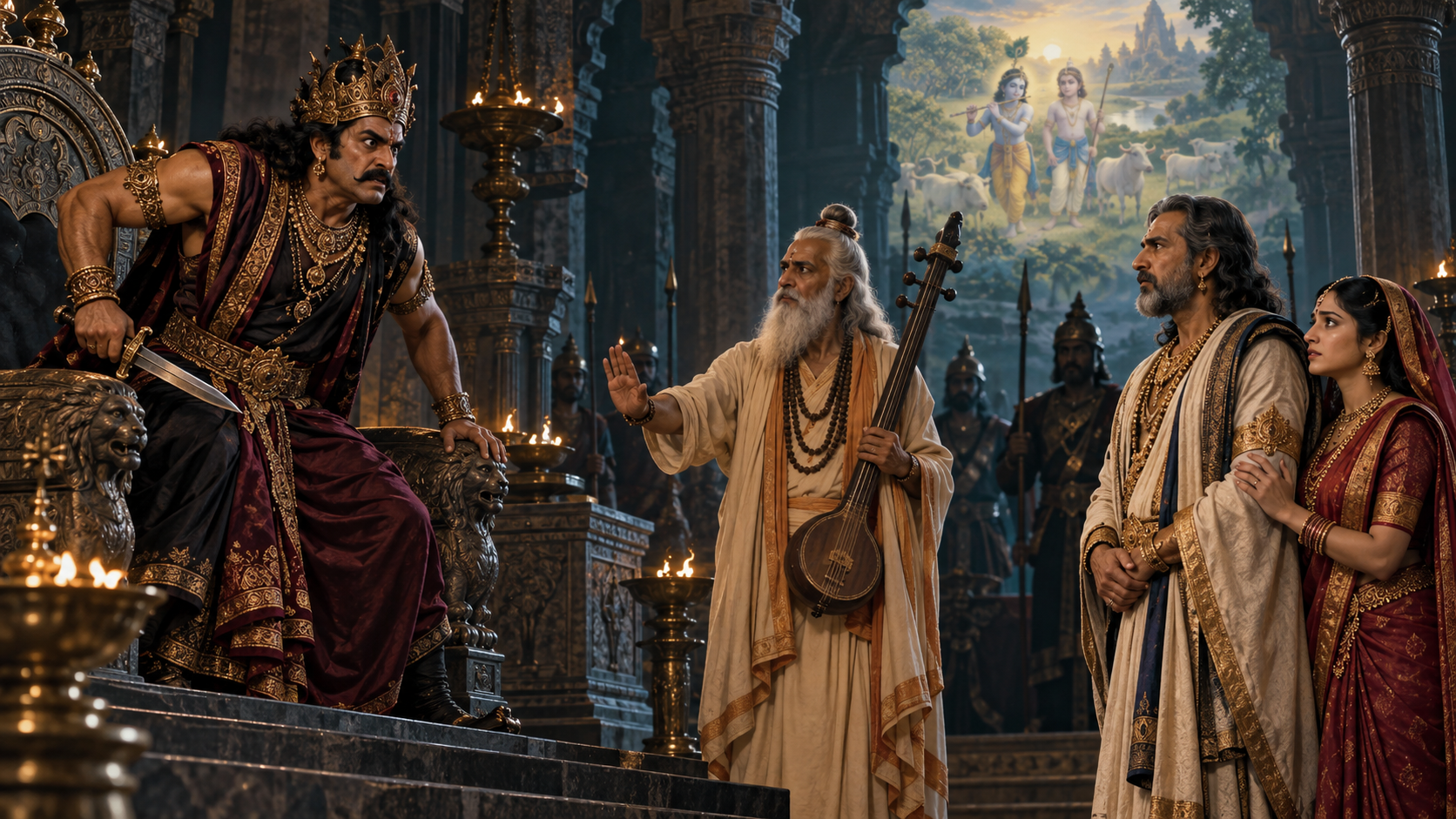
If you remember only that Kamsa became frightened when Krishna’s identity was disclosed, you miss the most revealing part of his response. His first impulse was not to examine the truth, confront Krishna, or reconsider his own conduct. He reached for violence against Vasudeva, the person he blamed for keeping the truth from him.
That detail turns a familiar episode into a precise study of adharma. Kamsa receives information that is substantially correct, believes it enough to act on it, and still moves farther from wisdom. If you want to understand the passage, watch what happens between recognition and response.
Key takeaways for reading Kamsa’s response
- Narada’s disclosure identifies Krishna as Devaki’s son and connects him directly to the danger Kamsa has been trying to prevent. It is more than a general announcement that Krishna is extraordinary.
- The immediate response in the sequence centered on Srimad Bhagavatam 10.36.18 is Kamsa’s attempt to turn his anger against Vasudeva.
- Kamsa’s reaction is not simple disbelief. He accepts the disclosure as operationally true but interprets it entirely through fear, possession, and self-preservation.
- When immediate violence is restrained, Kamsa does not repent. His fear becomes more deliberate and organized.
- The practical question for you is not merely whether you know something true, but what desire governs your response after you know it.
What Narada actually reveals to Kamsa
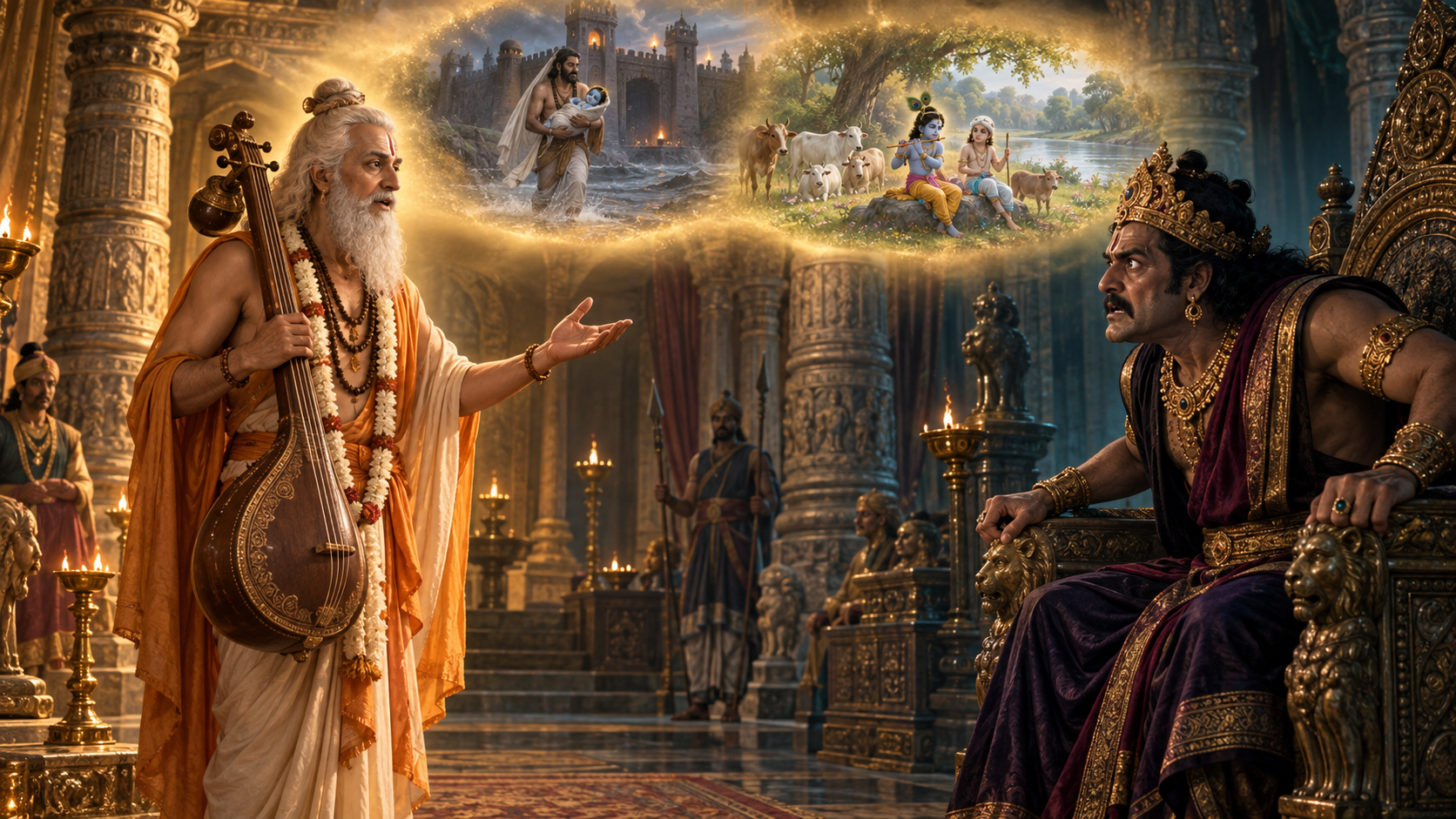
The phrase “Krishna’s revealed identity” needs a careful definition. Narada is not simply telling Kamsa that a powerful cowherd boy lives in Vraja. Kamsa already has ample reason to regard events there as dangerous. Nor is this moment presented as a devotional vision in which Kamsa beholds Krishna’s divine nature and surrenders.
The decisive disclosure concerns Krishna’s concealed birth and his relationship to the prophecy haunting Kamsa. Krishna is Devaki’s son, while Balarama is associated with Rohini; Vasudeva had acted to protect the children by placing them beyond Kamsa’s immediate reach. The boy Kamsa might have dismissed as someone else’s child is therefore the very person around whom his fear has revolved.
This distinction matters because Kamsa’s problem is no longer uncertainty about where the threat lies. Narada removes the mistaken identification on which Kamsa’s sense of security depended. Krishna is not an unrelated village prodigy. The danger Kamsa thought he had defeated has been growing outside his control.
Kamsa then directs his rage toward Vasudeva. That is psychologically and morally exact. Rather than face the person whose coming has been foretold, he first attacks the person he believes deceived him. The bearer of responsibility is replaced by an available target.
Narada restrains that immediate attack by keeping Kamsa’s attention on Krishna and Balarama as the decisive figures. Yet restraint is not repentance. Kamsa does not interpret the interruption as an opportunity to step back. Devaki and Vasudeva are subjected again to his coercive power, and he turns toward a broader plan against the two brothers.
Keep those stages separate when you read the episode: disclosure, rage against Vasudeva, restraint, renewed oppression, and calculated escalation. If they are compressed into “Kamsa learned the truth and became angry,” the passage loses its moral anatomy.
Correct information does not produce right vision
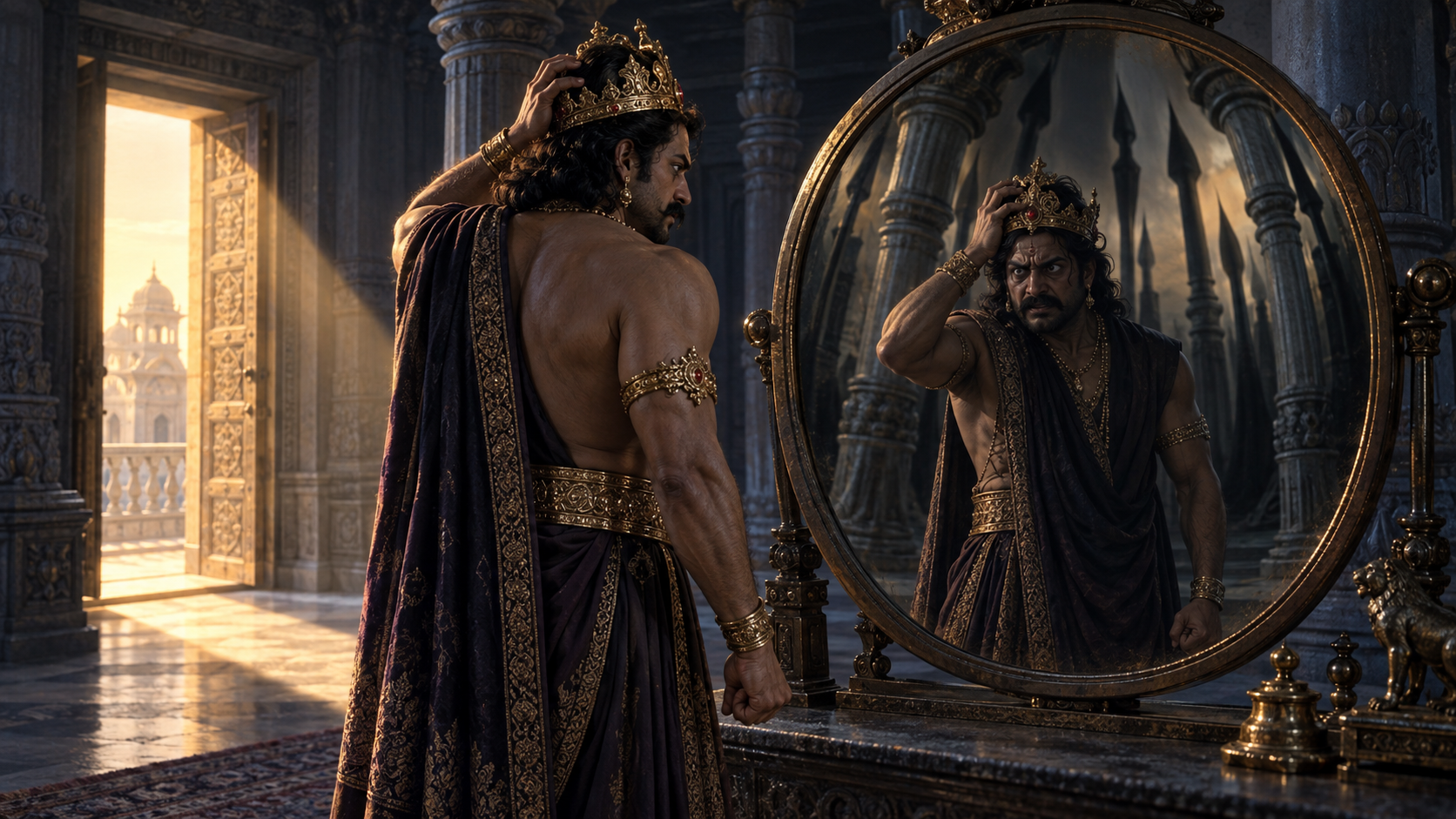
Kamsa is not an ordinary skeptic waiting for better evidence. He takes Narada’s disclosure seriously enough to change his conduct. In that limited sense, he believes. What he lacks is the inner disposition that would allow the truth to correct him.
This gives you a useful distinction: factual recognition and spiritual realization are not the same achievement. A person may identify Krishna correctly, repeat the correct genealogy, understand the prophecy, and even anticipate divine power. None of that by itself is bhakti. Devotion begins when the self stops treating Bhagavan as an object to manage for its own purposes.
Kamsa receives every fact through one governing commitment: he must preserve himself, his rule, and his control. Once that commitment remains unquestioned, new knowledge can only serve it. The disclosure does not open him to dharma; it improves his identification of the enemy.
That is why the episode should not be reduced to the reassuring claim that knowledge always dispels fear. Knowledge can dispel a mistaken fear when the underlying attachment is examined. It can also make fear more focused when the attachment remains sovereign. Kamsa loses one illusion but retains the deeper one: that violence and control can defeat the destiny produced by his own adharma.
You can test the distinction in a direct way. After learning an unwelcome truth, ask what changed first: your conduct or your strategy of self-protection? If you merely found a new person to blame, a better argument to defend yourself, or a more efficient means of control, information has entered the mind without transforming the will.
How Kamsa turns fear into a system of control
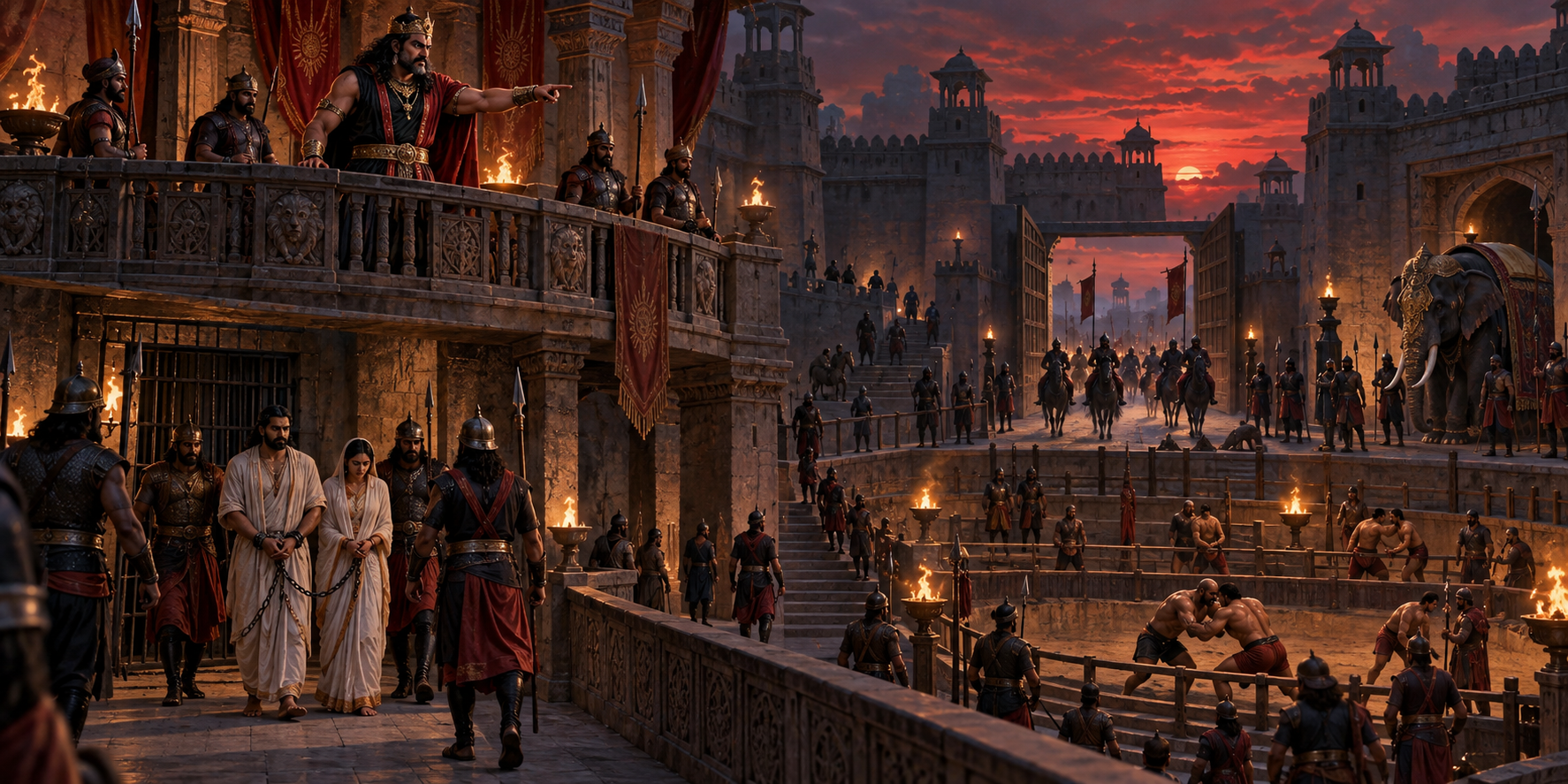
Kamsa’s drawn weapon reveals the raw impulse. What follows reveals something more dangerous: anger can become administration. When Narada prevents the immediate killing of Vasudeva, the violent intention does not disappear. It changes form.
The wider movement of the narrative shows Kamsa relying on confinement, delegated attackers, powerful wrestlers, an elephant, and a public occasion designed to bring Krishna and Balarama onto ground he believes he controls. A direct outburst expands into a coordinated arrangement. Each element serves the same purpose: eliminate uncertainty by controlling people, place, movement, and timing.
- He punishes the protector. Vasudeva and Devaki are accessible, so they bear the force of Kamsa’s frustration even though killing them cannot erase Krishna’s existence.
- He outsources violence. Agents and planned confrontations allow his fear to operate through other bodies.
- He chooses controlled terrain. Drawing the brothers toward Mathura appears safer than waiting for events to unfold beyond his reach.
- He gives private fear a public structure. Courtly authority, spectacle, and organized force make personal terror look like statecraft.
This progression is one reason the passage speaks beyond the psychology of a single tyrant. Adharma is not confined to moments of uncontrolled passion. It can become procedural, delegated, and outwardly orderly. A plan does not become righteous merely because it is calmer than the rage that produced it.
At the same time, the episode should not become a casual label for people you dislike. Calling every opponent a Kamsa lets the story feed the very habit it exposes: turning moral discomfort into an enemy figure. Use the pattern diagnostically. Look for the movement from fear to blame, from blame to coercion, and from coercion to a system that hides personal attachment behind an official purpose.
Read the episode as a mirror without flattening it
A spiritual application becomes useful only when it preserves the actual shape of the narrative. Kamsa is an oppressive ruler attempting lethal violence. Your ordinary anxiety, defensiveness, or reluctance is not morally equivalent to his conduct. The comparison belongs at the level of the inner mechanism, not the scale of the offence.
Four common readings obscure that mechanism.
- “Kamsa simply did not believe Narada.” His rapid change of action indicates the opposite. He believes the disclosure enough to retaliate and reorganize his plans. His failure lies in how he receives the truth.
- “Fear made Kamsa do it.” Fear explains pressure; it does not erase agency. Prophecy does not place the sword in his hand or require him to imprison innocent people. He repeatedly chooses coercion as his answer.
- “Narada carelessly endangered everyone.” Within the Vaishnava understanding of the lila, Narada’s intervention brings a concealed conflict toward its divinely governed resolution. That narrative role is not a general license for you to expose a vulnerable person to a violent aggressor.
- “The lesson is merely to control anger.” A calmer Kamsa would still be Kamsa if self-preservation remained his highest principle. The deeper issue is the attachment directing both his anger and his planning.
For personal reflection, begin with one unwelcome truth you already recognize. Do not choose an abstract doctrine. Choose something with a visible consequence: an apology you owe, a duty you have delayed, a dishonest advantage you are protecting, or a habit you keep defending after admitting its harm.
- State the truth without your defence. Write one sentence describing what happened or what dharma requires. Leave out every clause beginning with “but.”
- Name the person you are tempted to punish. Notice whether you are angry at a messenger, witness, or protector because that person made avoidance harder.
- Identify your control strategy. It may be intimidation, delay, selective silence, reputation management, or recruiting others into your version of events.
- Choose the opposite action. Release the pressure placed on the wrong person, accept the relevant consequence, and perform the neglected duty in a concrete form.
The point is not to manufacture guilt. It is to detect the moment when truth becomes material for a more sophisticated defence of the ego. Kamsa’s response is memorable because he does not lack warning, evidence, or intelligence. He lacks the willingness to let truth dethrone the desire that governs him.
When an unwelcome fact reaches you, pause before deciding who must be blamed or controlled. Name the attachment the fact threatens, then take one dharmic action that attachment has been postponing. That small interval between revelation and response is where Kamsa’s path can still be refused.
References

Leave a Reply
You must be logged in to post a comment.