
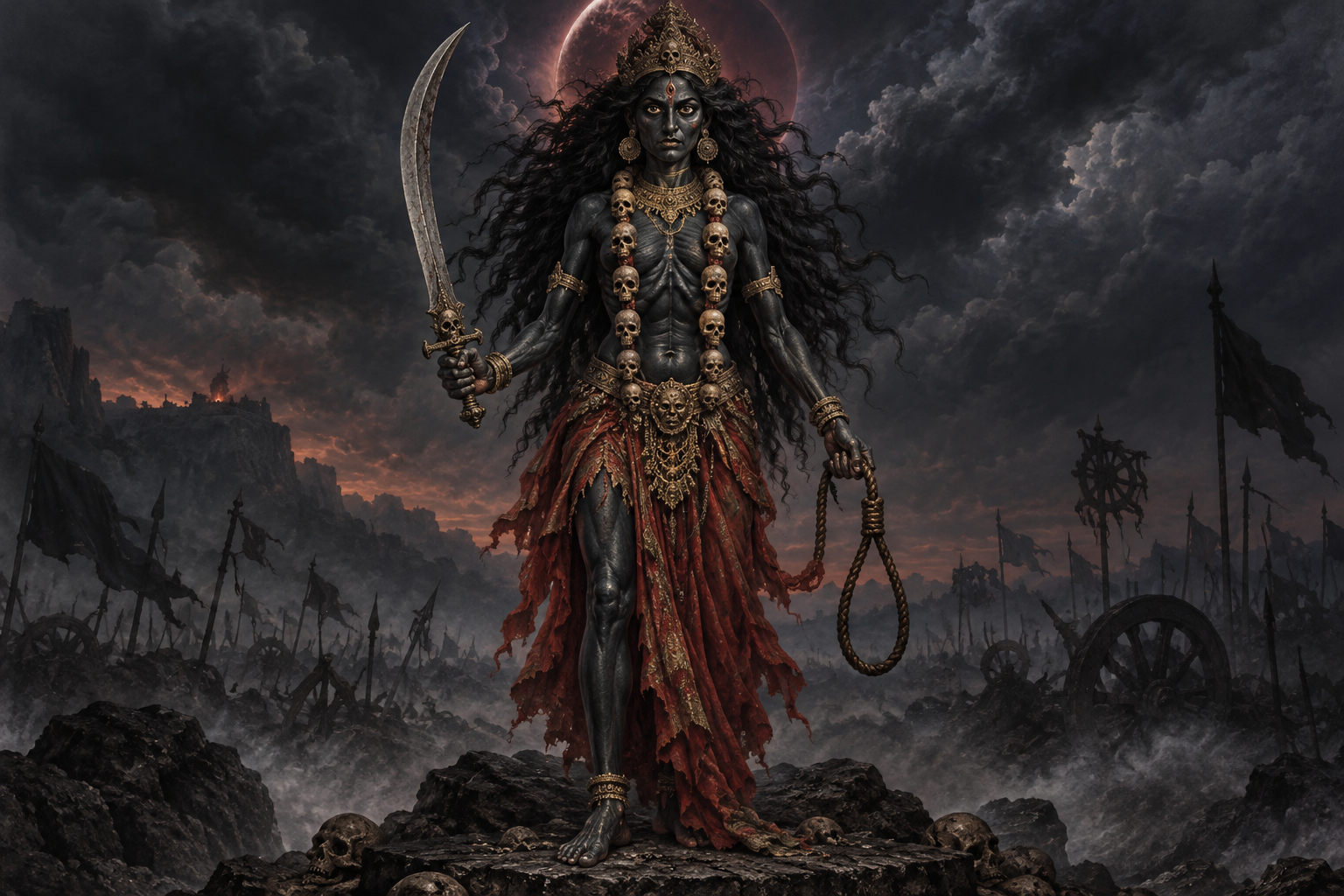
You may have paused before an image of Chamunda and wondered why a mother goddess would be shown with an emaciated body, a terrifying face, and weapons. If you read those features only as ugliness, death, or evil, the image becomes either repellent or merely exotic.
A better reading begins with a practical rule: do not interpret Chamunda’s body apart from her action. Her skeletal appearance, dark form, sword, noose, and emergence from Durga belong to one visual statement. Together, they present divine power at the point where ordinary images of nourishment, beauty, and safety are no longer adequate.
Begin with Chamunda’s emergence, not her appearance
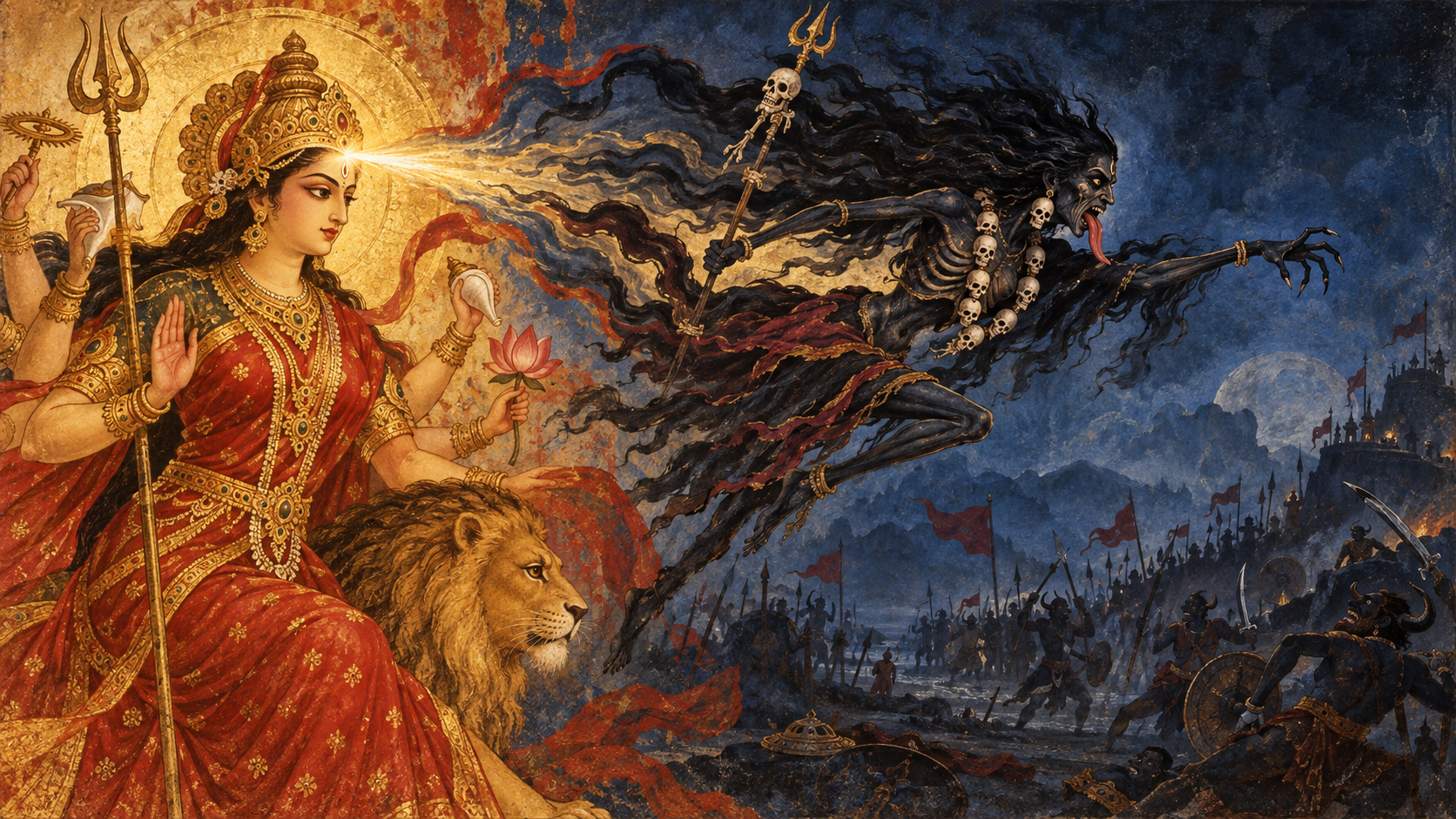
The Devi Mahatmya, which forms part of the Markandeya Purana, places Chamunda within a battle involving Chanda and Munda. She emerges directly from the forehead of Durga. That narrative placement determines how you should read everything that follows.
Chamunda is not introduced as a hostile power confronting the Devi from outside. She proceeds from Durga. Her terrifying manifestation therefore belongs to the Devi’s own power. The contrast between majestic Durga and skeletal Chamunda is not a contest between a good goddess and an evil one. It shows that the one Devi can assume the form required by the moment.
The location of her emergence matters as visual theology. A figure issuing from Durga’s forehead can be read as concentrated intention becoming active form. You need not force the forehead into a rigid symbolic formula. Its most immediate function is to establish continuity: Chamunda’s ferocity is neither accidental nor independent of Durga.
This corrects one of the most common mistakes in viewing fierce Hindu iconography. A frightening appearance is not, by itself, evidence of adharma. Ask where the figure comes from, what she is doing, and whom she confronts. In Chamunda’s case, the narrative answers those questions before her emaciated body is interpreted.
The skeletal body expresses hunger without weakness
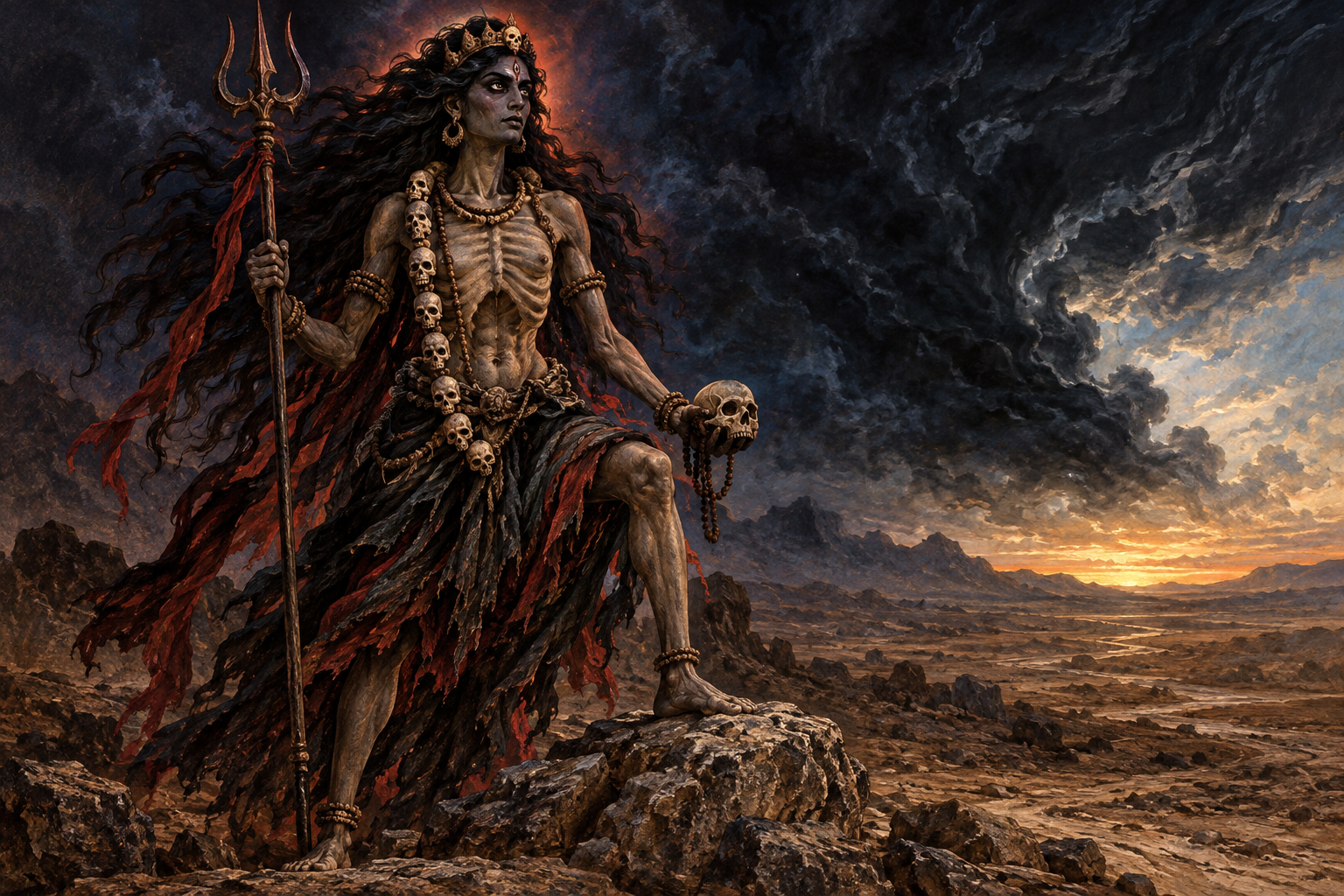
The phrase “starving form” can mislead a modern viewer. In ordinary life, starvation means involuntary deprivation and physical weakness. Chamunda’s iconographic emaciation does not function as a medical portrait. She is armed and active. Her skeletal appearance must therefore be read as deliberate theological exaggeration, not as evidence that she lacks power.
One useful interpretive key is the eternal hunger of Prakriti. Here, Prakriti is nature understood as the ceaseless power through which forms arise, change, consume, and pass away. No individual form brings that movement to a final rest. The world continues to generate needs, bodies, desires, conflicts, and transformations.
Chamunda’s body makes that principle visible. A conventionally well-fed body might suggest fullness, completion, or settled abundance. Her body refuses that reassurance. Even when reduced to its starkest frame, hunger remains. The image tells you that the appetite at work is larger than one creature’s need for food. It belongs to manifested existence itself.
This is why “skeletal mother” is not a contradiction to be repaired. Motherhood presents nature as the giver of form and sustenance. The skeleton presents the same nature without the comforting surface of fullness. Read together, the two poles prevent a sentimental account of the Devi. Nature nourishes life, but nature is not exhausted by the gentle experiences through which human beings prefer to encounter it.
You should also resist reducing the image to a simple message that everything dies. Mortality is part of what an exposed frame can evoke, but Chamunda is not a passive corpse. She appears, carries weapons, and enters a conflict. The more precise insight is that what looks depleted can still be an overwhelming agent. Her form separates divine capacity from bodily abundance.
The sword, noose, and darkness complete the visual argument
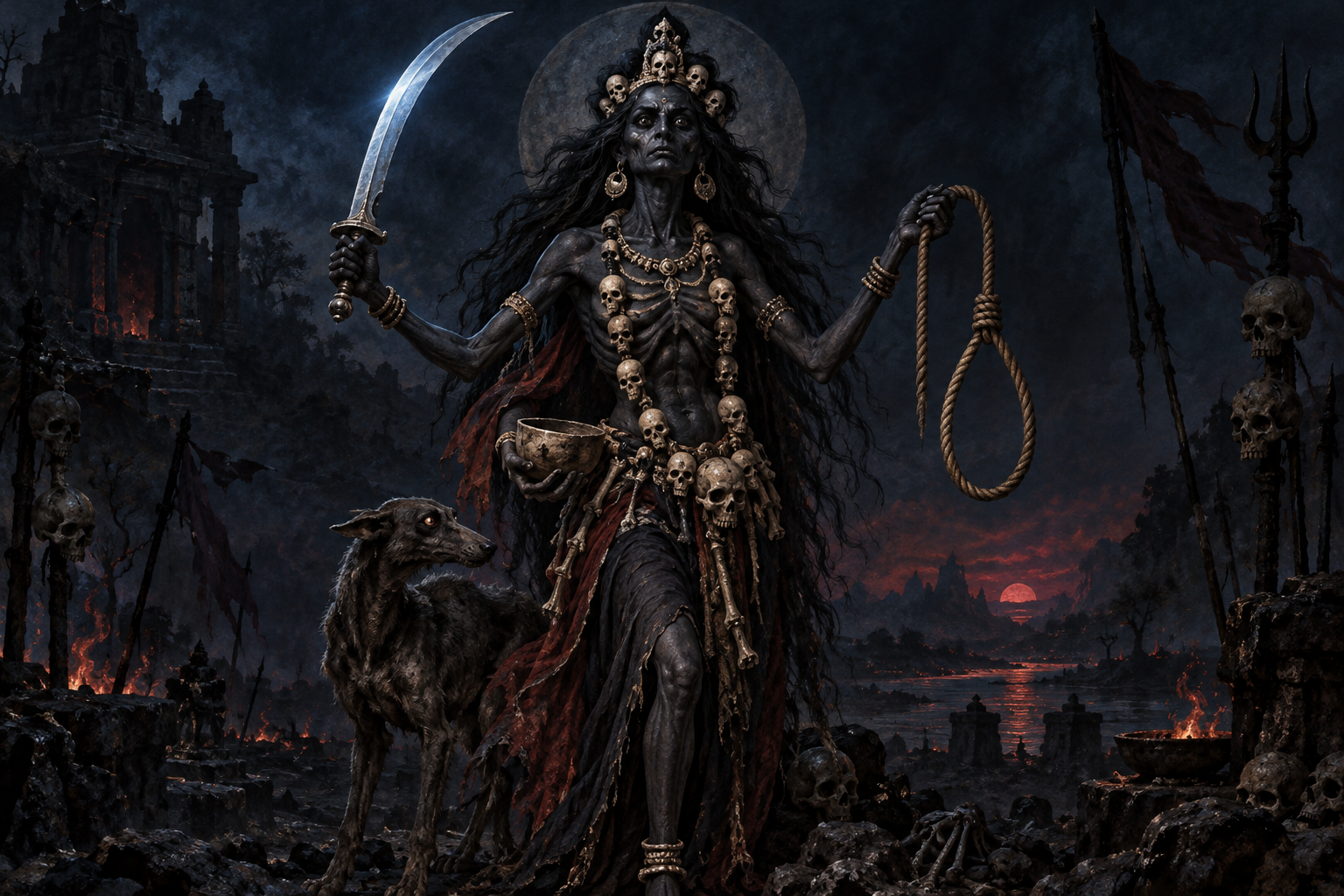
Chamunda is described as dark and terrifying, carrying a sword and a noose. These details keep her skeletal form from being mistaken for helplessness. The body may look stripped of ordinary vitality, but the goddess remains equipped to act.
At the level of visual grammar, the sword and noose suggest different movements. A sword cuts, divides, and brings something to an end. A noose catches, binds, or prevents escape. You do not need to assign each object one universal meaning in every image. Start with what each implement visibly does. Chamunda’s power can sever, and it can seize.
The combination is more instructive than either weapon alone. Cutting without restraint could suggest uncontrolled destruction. Binding without cutting could suggest endless containment. Chamunda carries the capacity for both decisive separation and capture. In the battle setting, that makes her fearsome appearance purposeful rather than decorative.
Her darkness should be read with the same care. A dark form is not a Western moral color code in which light automatically means goodness and darkness means evil. Here it intensifies an already fierce manifestation and denies the viewer the ease of a bright, reassuring appearance. The correct question is not whether the color makes her sinister. It is what the complete image requires you to face.
That complete image is a goddess who cannot be domesticated into prettiness. The skeletal body removes softness, the terrifying expression prevents casual familiarity, the sword threatens separation, and the noose denies escape. Yet all of this remains continuous with Durga. The fear produced by the image is directed toward recognition: divine order includes powers that the human preference for pleasant forms cannot contain.
How to examine a Chamunda image without overreading it
When you encounter a sculpture, painting, or shrine image identified as Chamunda, begin with the narrative anchor. Recall her emergence from Durga during the conflict involving Chanda and Munda. This immediately prevents the fierce figure from being detached from the larger reality of the Devi.
Next, distinguish condition from capacity. Ask what the body seems to say, and then compare that impression with what the figure is doing. Chamunda appears emaciated, but she is armed and active. The tension between those facts is the point. If your interpretation makes her merely weak, you have ignored half the image.
Then read the attributes as actions before treating them as abstract symbols. What can a sword do? What can a noose do? This approach keeps your interpretation grounded in the visible image. It also protects you from repeating a memorized symbolic equation that may not fit the particular representation before you.
After that, consider the emotional effect without making emotion the final meaning. If the form unsettles you, notice exactly why. Is it the exposed frame, the darkness, the weapons, or the collision between motherhood and terror? Your reaction is useful evidence about how the icon works, but it is not yet an interpretation. Return from the reaction to the narrative and attributes.
Finally, separate what the image clearly supports from what you are importing into it. Different representations may add further attributes, and not every local or artistic variation should be forced into one fixed code. The most secure reading starts with features actually present: origin, posture, action, body, weapons, and context. Build outward only when a relevant textual or temple tradition gives you grounds to do so.
This method is especially helpful when explaining Chamunda to someone who sees only horror. Do not begin by demanding that the person call the image beautiful. Show how the apparently weak body acts with force, how the fierce goddess emerges from Durga, and how hunger can represent the ceaseless movement of Prakriti. Understanding can precede aesthetic comfort.
Key takeaways
- Chamunda’s terrifying form belongs to the Devi’s power because she emerges from Durga in the Devi Mahatmya’s battle narrative.
- Her skeletal appearance signifies an inexhaustible hunger associated with Prakriti, not simple bodily weakness or a literal endorsement of deprivation.
- The sword and noose make her an active power: visually, one can sever while the other can bind or seize.
- Her darkness and emaciation should not be converted into a simplistic good-versus-evil color code.
- To read an image responsibly, connect body, action, attributes, and narrative context before assigning isolated symbolic meanings.
The next time you stand before Chamunda, let the unsettling details remain unsettling. Then look past the first recoil. Trace her back to Durga, notice that the skeletal body still acts, and read each weapon by what it enables her to do. That movement from reaction to attentive seeing is where the icon begins to teach.
References

Leave a Reply
You must be logged in to post a comment.