

You have a clear responsibility. Then an urgent signal arrives, another person makes a compelling demand, and remaining at your post suddenly looks uncaring. If you move, however, you may expose the very person or institution entrusted to you.
This is where leadership stops being a matter of good intentions. You need to identify which duty governs the moment, test whether the apparent emergency is credible, and choose without losing sight of the people who will bear the consequences.
Your first duty is the responsibility entrusted to you

Lakshmana’s ordeal in the Golden Deer episode begins with a defined charge. Sri Rama entrusts him with Sita’s protection, but Maricha, disguised as the deer, draws Rama away and imitates his cry of distress. Lakshmana must either remain with the person placed in his care or respond to what sounds like his brother in danger.
The choice is difficult because both claims are morally serious. Protecting Sita expresses svadharma, the duty arising from Lakshmana’s particular role and commitment. Responding to Rama appears to express loyalty, courage, and maryada, or honorable conduct. The conflict is not duty against selfishness. It is one duty against another, with deception controlling the information available.
That distinction matters whenever you lead. A role creates a duty that cannot be displaced merely because another request feels more urgent. A caregiver cannot leave a dependent person unattended simply because a forceful caller demands immediate help. A manager responsible for a critical handoff cannot abandon it because a senior colleague labels another task urgent. A public official cannot redirect protection from a vulnerable group solely in response to an unverified alarm.
Start by stating the entrusted duty without vague language: who or what has been placed in your care, what protection you promised, and when that responsibility ends. If you cannot name those elements before a crisis, the loudest demand will usually define your conduct during it.
This does not mean that the original instruction must always prevail. A credible and imminent threat can change the hierarchy of obligations. The important point is that a new claim must earn that priority. Urgency alone does not prove that it has.
Put discernment between the alarm and your action

Maricha’s deception turns Lakshmana’s dilemma into a lesson about viveka, or discernment. The cry sounds morally compelling precisely because it is designed to bypass reflection. If Lakshmana treats the sound itself as proof, the deceiver controls both the signal and the response.
Modern leaders face the same structure whenever an adversary, rumor, internal rival, or frightened group can provoke action by creating apparent urgency. The details differ, but the ethical vulnerability is constant: a leader who reacts without testing a claim can be maneuvered into abandoning a more important responsibility.
Before you move, ask what is actually known. Is the signal direct or relayed? Does it fit other available evidence? Can anyone confirm it? What harm would a short verification cause? Who becomes unprotected if you respond? Who benefits from drawing you away? These questions are not excuses for paralysis. They are safeguards against allowing fear to make the decision.
When verification is impossible, compare the irreversible harms. A delay that causes inconvenience is not equal to leaving a vulnerable person exposed. A reputational embarrassment is not equal to a preventable loss of life. The morally weightier consequence should receive priority, especially when the people at risk cannot protect themselves.
The motif of the Lakshmana Rekha offers another practical insight. A protective boundary appears in some later retellings, although it is not emphasized in every recension. Its value for leadership does not depend on treating it as a feature of every Ramayana tradition. The boundary represents an attempt to preserve protection while answering a competing demand.
Your equivalent may be a designated deputy, an escalation channel, a temporary access restriction, a check-in procedure, or a rule that prevents one person from leaving a critical function unattended. A boundary is useful only if the people affected understand it before the emergency. An improvised rule announced during a crisis will often look arbitrary and may fail when trust is already strained.
Discernment also prevents a false choice between compassion and discipline. Buddhist thought joins karuna with prajna, Jain thought emphasizes apramada or vigilance in weighing harm, and the Sikh sant-sipahi ideal joins service with steadfast responsibility. These are distinct teachings, not interchangeable labels for a single doctrine. Yet each challenges the idea that sincere concern is enough. Care must be accompanied by clear perception and dependable action.
Power is justified by the life it protects and renews
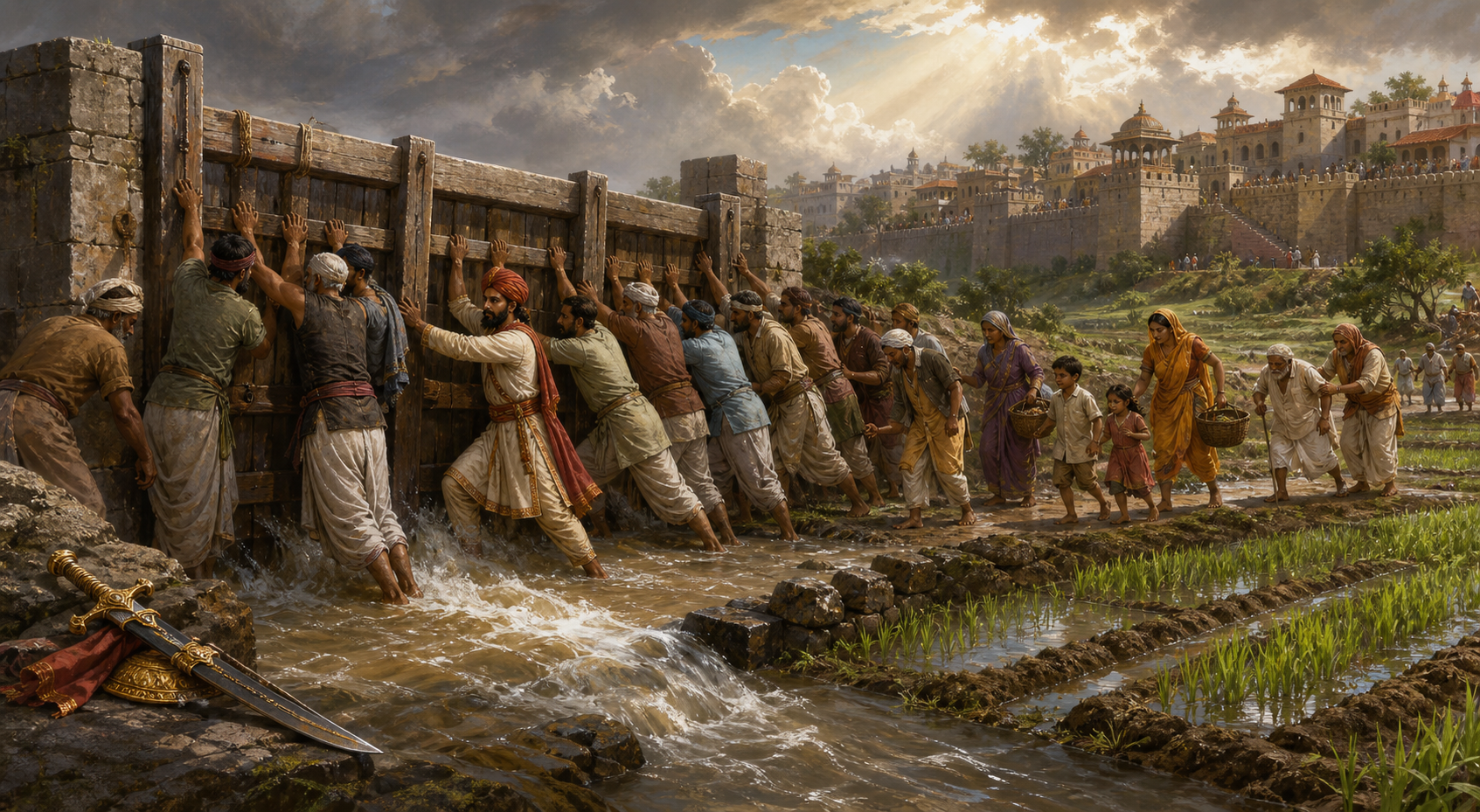
Lakshmana’s dilemma concerns a decision under pressure. Prithu’s kingship brings the same ethical question to the scale of governance: what is power for?
In the Brahma Purana’s account, Vena’s unrighteous rule damages social and cosmic order, and the Earth withholds her bounty. Sages intervene, and Prithu arises from Vena’s line to restore dharma. Earth, personified as a cow, yields her abundance only after Prithu assures her protection.
The image changes the meaning of sovereignty. Earth is not an inert possession from which a ruler may take without limit. Her abundance depends on a relationship of protection, restraint, order, and reciprocity. Prithu may exercise authority, but that authority is bound to the welfare of the land and the beings who depend on it.
The account explains the name Prithvi through Prithu and associates his rule with leveling land, supporting agriculture and irrigation, establishing fair measures, and restoring righteous conduct. Prosperity does not appear as a prize for possessing the throne. It follows the work of making collective life secure, productive, and just.
This gives you a demanding test for leadership. Do not ask only whether an organization, community, or nation is producing more. Ask what makes that production possible and whether those conditions are being renewed. A leader can exhaust people while meeting targets, consume natural capacity while reporting growth, or weaken institutions while claiming short-term success. The numbers may rise while the foundations of future welfare deteriorate.
Stewardship therefore requires attention to three things. First, protect the underlying source of abundance rather than treating it as expendable. Second, establish fair rules so that access does not depend solely on proximity to power. Third, maintain the shared conditions that allow others to flourish: reliable systems, usable land, clear measures, and accountable conduct.
This is neither passive environmental sentiment nor permission for unchecked extraction. Prithu is firm, and Earth is protected. Dharmic leadership holds those elements together. Authority must be capable of action, but action remains legitimate only while it serves life, law, and the larger order on which ruler and ruled both depend.
Use this decision rule when duties collide

Sacred narratives do not provide a mechanical formula for every workplace, family, or public crisis. The following method is a practical Dharmic synthesis, not a claim that every tradition ranks duties in an identical way. Its purpose is to stop urgency, status, or emotion from silently choosing for you.
- State the entrusted duty. Name the person, institution, function, or living system placed in your care. Define what you promised to protect and the condition under which that responsibility may be transferred.
- Describe the competing claim without its emotional packaging. Replace phrases such as “drop everything” with the actual event being alleged, the available evidence, and the harm expected if you wait.
- Rank vulnerability and irreversibility. Give greater weight to people who cannot protect themselves and to harms that cannot readily be repaired. Do not confuse the most powerful claimant with the most vulnerable stakeholder.
- Look for a bridge action. Verify the message, delegate the response, summon assistance, establish a temporary boundary, or transfer your original charge to a competent person. Many supposed either-or choices persist only because no one has designed a handoff.
- Choose openly and remain accountable. Record the reasons available at the time, communicate who is still responsible for the original duty, and set a point for reassessment. Afterward, examine both the result and the quality of the reasoning.
The final step protects against two opposite mistakes. A good outcome does not make reckless reasoning wise; luck may have concealed the danger. A painful outcome does not automatically prove moral failure; a conscientious decision can still end badly when information is incomplete or deception succeeds. Accountability requires examining intention, evidence, foreseeable consequences, and the precautions actually taken.
Use the method before a crisis as well as during one. Write down the signals that would justify leaving your primary post. Name the person authorized to take over. Decide how an emergency will be verified. Identify which harm your team must never leave without protection. Preparation turns a noble intention into a dependable practice.
Key takeaways for your next difficult decision
- Your primary duty begins with the person or system explicitly entrusted to you, not with whoever makes the loudest demand.
- An urgent signal tells you that time may matter; it does not by itself prove that the claim is true or that your current duty has been displaced.
- When certainty is unavailable, prioritize the most vulnerable and minimize the harm that would be hardest to reverse.
- Boundaries, deputies, verification procedures, and clear handoffs allow you to answer a new duty without silently abandoning the first.
- Leadership is stewardship when power protects and renews the human, institutional, and natural conditions from which prosperity comes.
- Judge a decision by its intention, evidence, precautions, and foreseeable consequences, not only by whether events happened to end well.
Before pressure arrives, choose a responsibility you currently hold and make its ethical structure visible. Write down the entrusted duty, the threshold that would justify an override, the backup who can accept a handoff, and the irreversible harm you are trying to prevent. Share that understanding with the people affected. When the alarm eventually sounds, you will still need courage, but you will not have to invent your dharma in the middle of the crisis.
References
- DharmaRenaissance Blog — Lakshmana’s Impossible Choice: Duty, Honor, and Dharma in Ramayana’s Golden Deer Episode
- Hindu Pad — Prithu Chakravarthi: The Legendary Sovereign Who Made Earth ‘Prithvi’ and Renewed Dharma
