

You can know that your family, institution or political camp deserves some loyalty and still know that one of its demands is wrong. The hardest question comes after you object: if the group continues on the same course, what does your duty require then?
Vikarna makes that question impossible to evade. He speaks for dharma when Draupadi is humiliated, yet later fights for Duryodhana at Kurukshetra. His life helps you distinguish conscience from loyalty, dissent from refusal, and respect for a person from approval of that person’s cause.
Vikarna must be judged by two choices, not one
During the dice-game crisis, Draupadi asks whether Yudhishthira possessed the right to stake her. Powerful men fail to give her the protection or answer that justice demands. Vikarna, a son of Dhritarashtra and therefore a member of the very house benefiting from her degradation, defends the legitimacy of her question and challenges the conduct of the assembly.
That intervention matters for three reasons. Vikarna recognizes Draupadi as a moral reasoner, not an object transferred between men. He places dharma above the emotional comfort of his brothers. He also destroys the excuse that no one inside the Kaurava household could recognize the wrong. The truth was visible from within the implicated family, and someone said it aloud.
Kurukshetra reveals the limit of that courage. Vikarna does not carry his objection into a final separation from Duryodhana. He accepts his place in the Kaurava army, meets Bhima in battle and dies fighting for the side whose defining injustice he had once exposed.
Neither moment should erase the other. If you remember only the assembly, Vikarna becomes a spotless emblem of dissent. If you remember only the battlefield, he becomes one more Kaurava opponent. The full moral problem lies in the continuity between the two: he did not lose his ability to recognize dharma, but recognition did not finally govern his allegiance.
This is more instructive than calling him either a saint or a hypocrite. A hypocrite normally hides the standard he violates or applies it only to others. Vikarna publicly accepts the standard and pays an immediate social cost for stating it. His tragedy is subtler. He sees the moral boundary but does not reorganize his loyalties around what he sees.
Four duties were pulling Vikarna in different directions
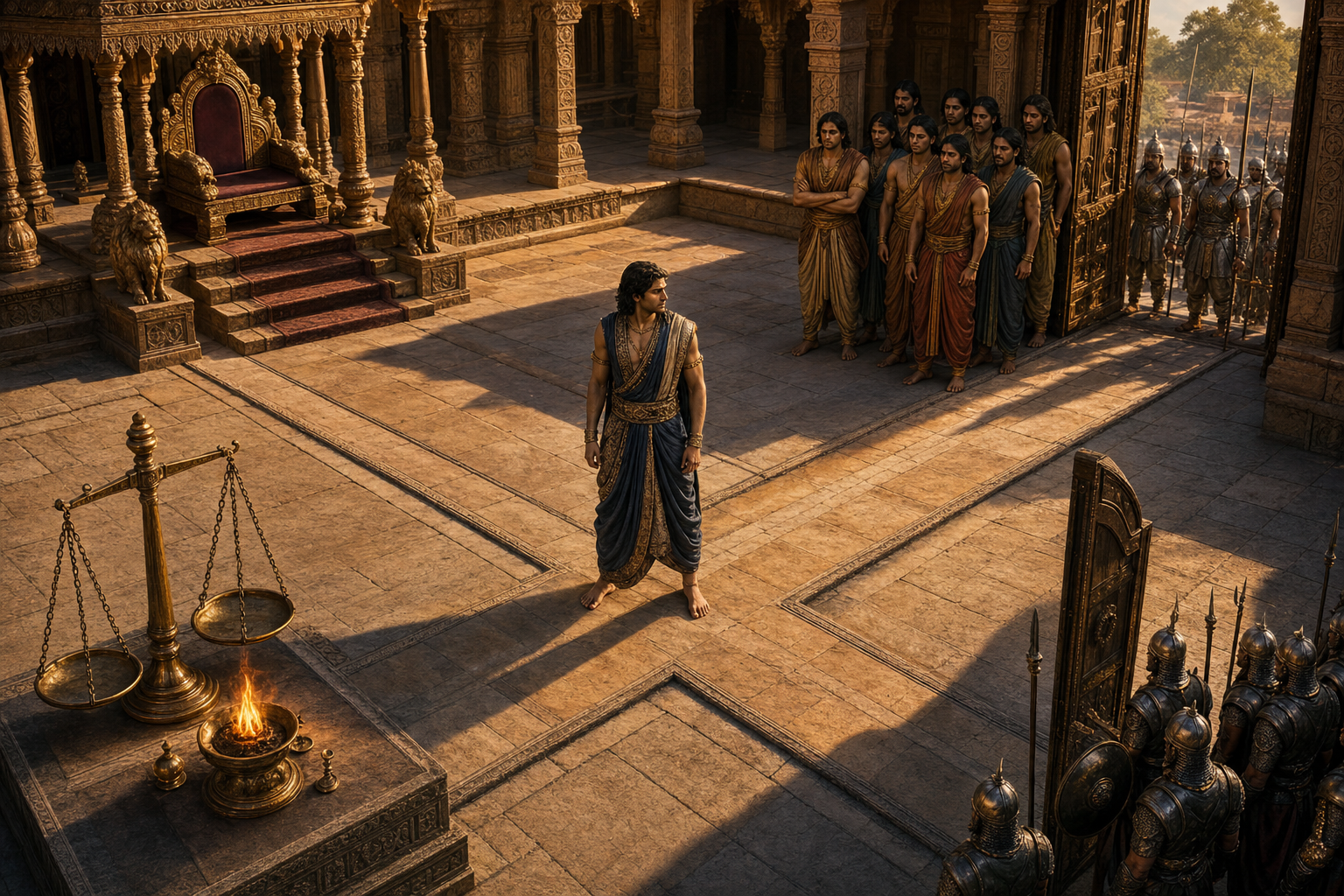
The word dharma can conceal a conflict when it is used without a qualifier. Vikarna was not choosing between duty and an obvious absence of duty. He stood where several recognizable duties made rival claims: universal ethics, family solidarity, fidelity to authority and the warrior’s code.
| Layer | Its legitimate claim | The question it raises for you |
|---|---|---|
| Sādhāraṇa-dharma | Truth, justice, non-cruelty and moral duties not confined to one office or group | What must no role, command or relationship be allowed to excuse? |
| Kula-dharma | Responsibility toward family, lineage and inherited relationships | Does this loyalty protect the family from wrongdoing, or merely protect it from accountability? |
| Rāja-dharma | Obligation connected with rule, sovereignty and political order | Is authority serving dharma, or demanding that status be treated as its own justification? |
| Kṣātra-dharma | Courage, steadfastness, protection and fidelity under the discipline of a warrior’s role | Is the courage of the role defending justice, or making an unjust cause more effective? |
| Nīti | Practical judgment about how duties should be carried out amid real consequences | Which course preserves the weightiest obligation while avoiding unnecessary harm? |
This distinction keeps you from accepting the vague claim, “I was only doing my duty.” Ask for the completed sentence: duty to whom, arising from which role, requiring what act, and imposing its cost on whom? Once those blanks are filled, a supposed duty may turn out to be fear of exclusion, attachment to status or unwillingness to disappoint one’s own side.
Sādhāraṇa-dharma works best here as a moral floor, not as a mechanical answer to every situation. Truth and non-cruelty can tell you that a proposed act is impermissible without automatically telling you the wisest way to resist it. That second question calls for judgment: whether to object privately or publicly, whether reform remains possible, when continued cooperation becomes complicity, and which consequences you are prepared to bear.
Family duty, political duty and professional duty remain genuine. The Mahabharata does not make relationships disposable whenever they become difficult. Yet a relational duty cannot manufacture moral innocence. If loyalty requires you to deny an evident humiliation, conceal a deliberate wrong or help powerful people silence the person they harmed, the language of loyalty has begun to shelter adharma.
Speaking against wrong is necessary, but it may not be enough

Vikarna’s protest is not futile merely because it fails to rescue Draupadi in that moment. It tells the victim that the wrong has been seen. It denies the perpetrators complete moral unanimity. It preserves a truthful judgment inside a corrupted assembly. Anyone deciding whether to speak within a family, organization or community should notice these effects. A dissenting voice can matter before it has the power to prevail.
But speech can also become a substitute for decision. Once you have objected, you may begin to regard yourself as morally separate from what the group does, even while your labor, vote, reputation or obedience continues to support it. Vikarna’s later allegiance forces a difficult follow-up: what changed because he knew and spoke the truth?
A useful practice is to give principled dissent three parts:
- Name the act. Say precisely what is wrong. Avoid a vague complaint about tone when the real issue is humiliation, deception, coercion or an abuse of authority.
- State your boundary. Explain what you will not do if the conduct continues. A boundary without a corresponding action is merely a preference.
- Choose the next step in advance. Decide what evidence, repetition or refusal to repair the wrong would require escalation, withdrawal or open opposition.
Vikarna powerfully completes the first part. Kurukshetra makes you ask about the second and third. His courage deserves remembrance, but remembrance should not turn his eventual choice into vindication. Moral worth and moral correctness are related, not identical. A person may speak truth bravely and still make a disastrous decision about whom to serve.
The epic gives neighboring examples rather than a single personality type. Yuyutsu changes sides; Karna remains entangled in loyalty and gratitude; Vikarna keeps his conscience audible while remaining with his brothers. These paths prevent an easy claim that birth, affection or indebtedness mechanically determines action. Competing duties explain the pressure on a person. They do not eliminate agency.
Bhima shows how to oppose a person without denying his virtue

When Bhima and Vikarna meet as enemies, Bhima remembers who spoke during Draupadi’s humiliation. In the traditional account, he is reluctant to kill Vikarna, recognizes his truthfulness and grieves after defeating him. Vikarna nevertheless refuses to abandon his place beside his brothers and king.
Bhima’s sorrow does not prevent action, and his action does not require hatred. That combination is morally demanding. It is easier to fight after reducing an opponent to a caricature. It is also easier to praise an opponent’s good qualities and then use that praise as a reason to ignore the harm of the cause. Bhima does neither.
You can translate that discipline into ordinary disputes without pretending that a workplace disagreement or family conflict is Kurukshetra:
- Acknowledge the person’s good act specifically: “You defended her when others stayed silent.” Do not inflate that act into a declaration that every later choice is righteous.
- Describe the present wrong just as specifically: “Your support is now helping this decision continue.” Do not replace evidence with insults about character or ancestry.
- Leave a genuine path to correction when one is still available. An honorable exit makes reform easier without making accountability optional.
- If the person persists, oppose the harmful conduct with proportionate means. Respect is not a requirement to become neutral between justice and injustice.
- Afterward, tell the moral truth about the cost. Regret does not prove that resistance was mistaken; it may prove that you refused to enjoy another person’s ruin.
This is one of the episode’s clearest lessons for public life. You do not need to deny every virtue of the opposing camp to defend dharma. In fact, the ability to recognize truth in an adversary is a safeguard against factional blindness. Satya becomes unreliable when it changes with the speaker’s banner.
The same restraint appears across the wider Dharmic moral field in different forms: truthfulness, compassion, disciplined non-harm, forbearance, seva and the protection of those subjected to injustice. Hindu, Buddhist, Jain and Sikh traditions do not erase their real differences by sharing these ethical anchors. They do, however, give you a common warning: righteous purpose is corrupted when cruelty, falsehood or contempt becomes a source of pleasure.
Use Vikarna’s dilemma before your next loyalty decision

When duties collide, do not begin with the identity of the people involved. Begin with the act being requested. A simple written test can stop affection, fear and group language from deciding the matter before reflection begins.
- Write the demand in one sentence. Use a verb: conceal, defend, repeat, sign, fund, exclude, remain silent, resign or oppose. If you can describe only the surrounding controversy, you have not yet identified your decision.
- Name everyone who bears the cost. Include the person with the least power to challenge the decision. Draupadi’s question exposes the failure of an assembly that had allowed powerful men’s claims to crowd out the standing of the person being humiliated.
- Separate your duties. List universal, familial, institutional and role-based obligations on different lines. Do not let the word “duty” merge them into one undifferentiated command.
- Test the universal floor. Ask whether the proposed action requires falsehood, deliberate cruelty or protection of an evident injustice. If it does, loyalty cannot make the act clean. The remaining question is how to refuse wisely.
- Set a consequence for ignored dissent. Decide what you will do if the responsible people reject correction. This is where conscience becomes conduct rather than self-image.
- Act without inventing hatred. Preserve every true fact about the other person’s courage or goodness, but do not let those facts conceal the choice that must now be opposed.
One more distinction will save you from many false dilemmas. Not every uncomfortable choice is a conflict between two duties. Sometimes justice is opposed only by convenience, reputation or the wish to remain welcome. Ask, “What genuine good would my loyalty protect?” If the only answer is your continued acceptance by the group, the moral conflict may be smaller than the emotional one.
Nor should you romanticize departure as the only courageous act. Internal dissent can restrain harm, alert others and create the possibility of reform. The point is to examine whether continued presence still serves that work. When your presence chiefly supplies legitimacy, manpower or silence to the wrong you condemned, staying has acquired a moral cost that must be named.
Key takeaways
- Vikarna’s defense of Draupadi proves that truth can be recognized and spoken from inside a compromised group.
- His later allegiance shows that correct speech does not by itself settle the duty to withdraw, refuse or oppose.
- Family, sovereign and professional obligations are real, but none should be allowed to erase truth, justice and non-cruelty.
- Bhima demonstrates that decisive opposition can coexist with accurate recognition of an adversary’s virtue.
- Before calling something your duty, identify the act, the beneficiary, the person bearing the cost and the boundary you will enforce.
Before your next difficult act of loyalty, put three lines on paper: what you are being asked to do, who will bear its cost, and what you will do if your objection is ignored. Vikarna’s warning is not that loyalty is worthless. It is that conscience must be allowed to govern loyalty before events make the choice irreversible.