
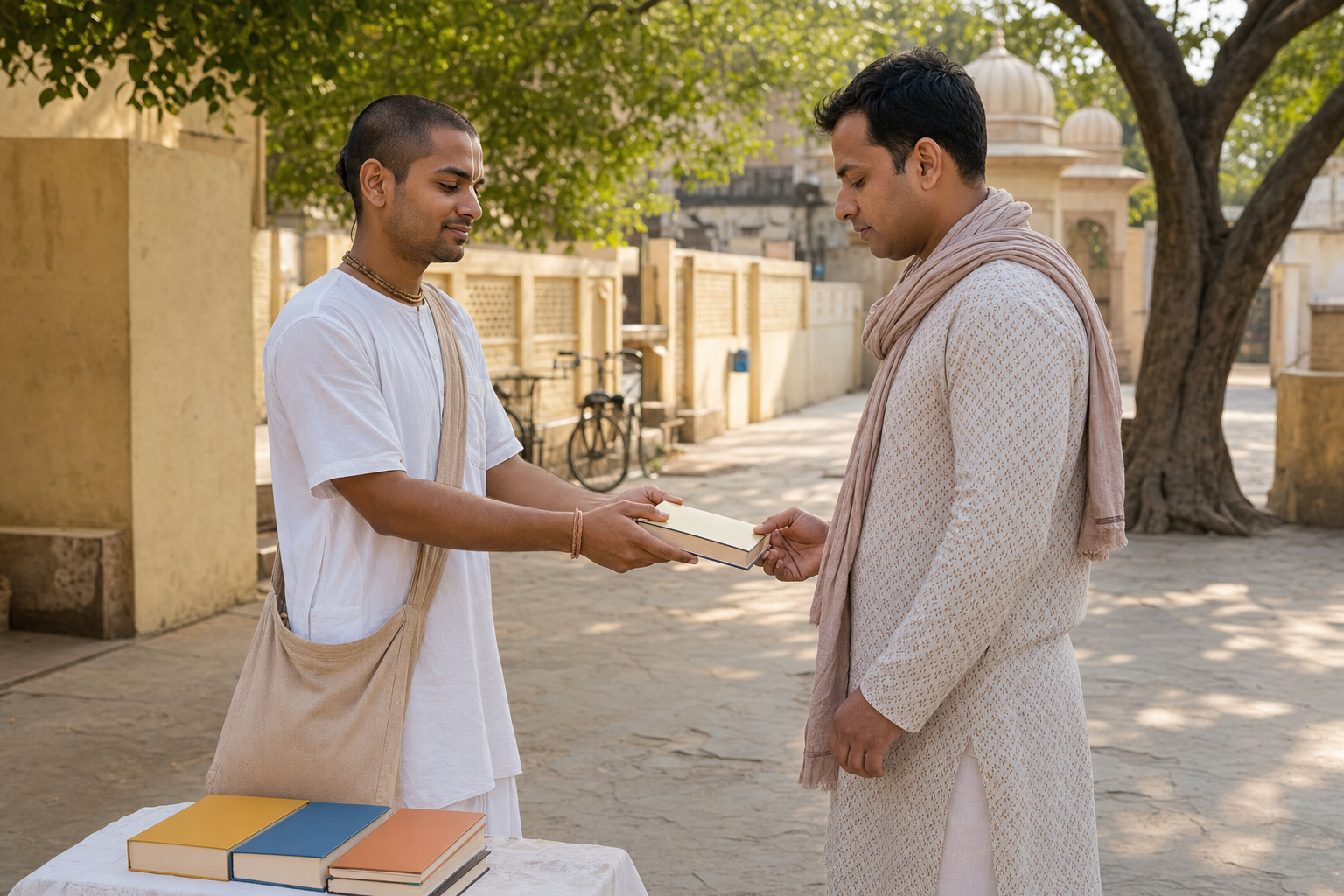
You may arrive in Vrindavan with a stack of books and sincere enthusiasm, yet still wonder whether approaching pilgrims is truly seva or merely religious marketing. The difference is not hidden in the book or the location. It lies in how you prepare, how you speak, and what happens after someone accepts a text.
Done well, ISKCON book distribution is an invitation to study rather than pressure to agree. You protect the other person’s freedom, recommend something they can realistically read, and leave a clear path for further learning. That standard gives you a practical way to serve, whether you distribute one book or help sustain an entire team.
The seva begins before you offer a book

Srila Prabhupada placed the publication, translation, and distribution of transcendental literature at the heart of his mission. In Vrindavan, that service belongs within a living sacred geography of temples, ghats, pilgrim routes, festivals, and daily worship. Your task is to support that atmosphere, not compete with it.
This is why book distribution cannot be judged by placement totals alone. A high count may show that a team moved stock efficiently, but it does not tell you whether readers received a suitable book, understood what it contained, or felt free to decline. The better test is whether the encounter joined devotion to responsibility.
Rasada Prabhu’s legacy gift renewed book distribution in Vrindavan by turning material resources into a means of sharing Srila Prabhupada’s teachings. That example widens the meaning of this seva. You can serve by speaking with readers, funding books, arranging storage, preparing study aids, translating explanations, keeping accounts, or supporting follow-up study. Street distribution is one visible part of a larger chain.
Three dharmic disciplines should govern every link in that chain:
- Ahimsa means that you do not corner, shame, obstruct, or wear down another person. A refusal ends the offer.
- Satya means that you describe the book, any requested contribution, and the intended use of funds plainly. Do not promise outcomes that a text cannot guarantee.
- Anukampa means that you listen for the reader’s actual need instead of delivering the same speech to everyone.
The setting imposes practical duties as well. Confirm where distribution is permitted. Coordinate with temple authorities when operating near a mandir, respect local rules for public space, keep entrances and walking routes clear, and never interrupt worship. A devotional intention does not excuse disorder.
Before a shift, settle five matters: the authorized location, the likely language mix, the titles available in those languages, protection from heat or rain, and the nearest secure restocking point. Kartik, Janmashtami, and other utsavas can bring heavier pilgrim movement. That creates more opportunities for service, but it also makes pedestrian flow, stock planning, and unhurried conduct more important.
Match the book to the reader, not the crowd
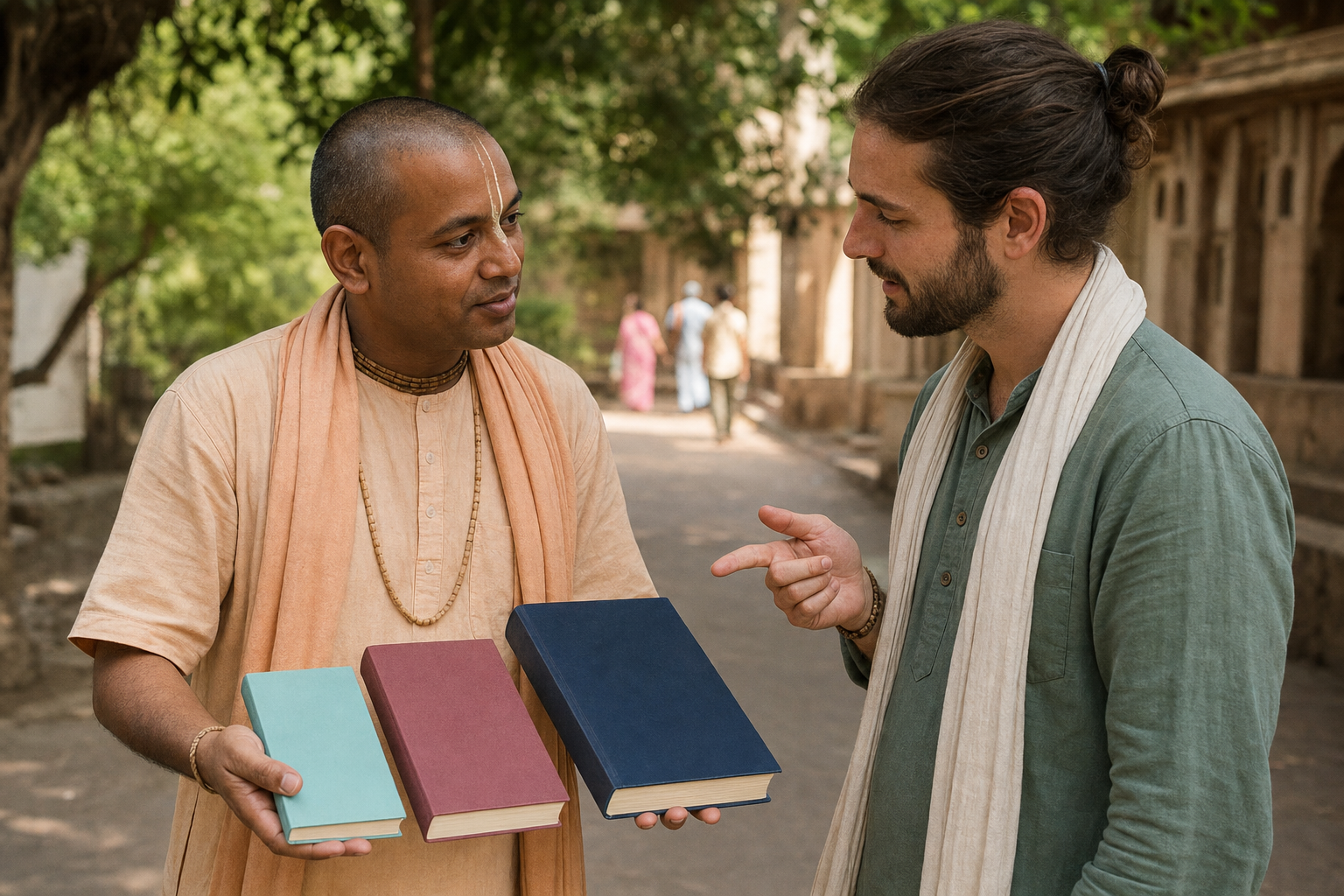
The Bhaktivedanta Book Trust makes Srila Prabhupada’s works available in editions and translations suited to a wide readership. A Vrindavan team may carry cornerstone texts such as Bhagavad-gita As It Is, Srimad-Bhagavatam, and Sri Caitanya-caritamrita, along with concise introductions and thematic selections. Carrying many titles is useful only if you can help a person choose among them.
Ask before recommending: Which language do you read most comfortably? Are you new to bhakti literature or already studying it? Are you looking for a broad introduction or help with a particular question? These questions take little time and prevent the common mistake of offering the largest or most prestigious volume instead of the most readable one.
| What you hear | A proportionate first offer | Why it fits |
|---|---|---|
| I am new to this and have limited time. | A concise primer or short thematic selection | It creates an achievable first encounter with the teachings. |
| I want a structured introduction to Krishna’s teaching. | Bhagavad-gita As It Is | It offers a defined entry into philosophy, duty, devotion, and spiritual practice. |
| I already study regularly and want to go deeper. | Srimad-Bhagavatam or Sri Caitanya-caritamrita | A substantial text suits someone prepared for sustained study. |
| Different members of my family read different languages. | Copies in two relevant languages | One supports immediate comprehension while the other can support shared family study. |
| I am interested but uncertain about religious outreach. | A short, clearly explained selection with an optional study resource | It lets the person examine the teaching without being pushed into a large commitment. |
Vrindavan receives readers from across Bharat and the world, so language choice is not a minor logistical detail. Hindi and English alone will not serve every pilgrim. Inventories in Bengali, Marathi, Tamil, Telugu, Gujarati, and other languages allow the person to encounter the teaching directly rather than struggle through an unfamiliar language.
Do not assume that an English-speaking visitor prefers to study philosophy in English, or that every member of a family wants the same edition. Ask. When a bilingual combination is genuinely useful, explain why and let the family decide. Matching must remain service, not a device for increasing the number of books placed.
Use a conversation that leaves room for no
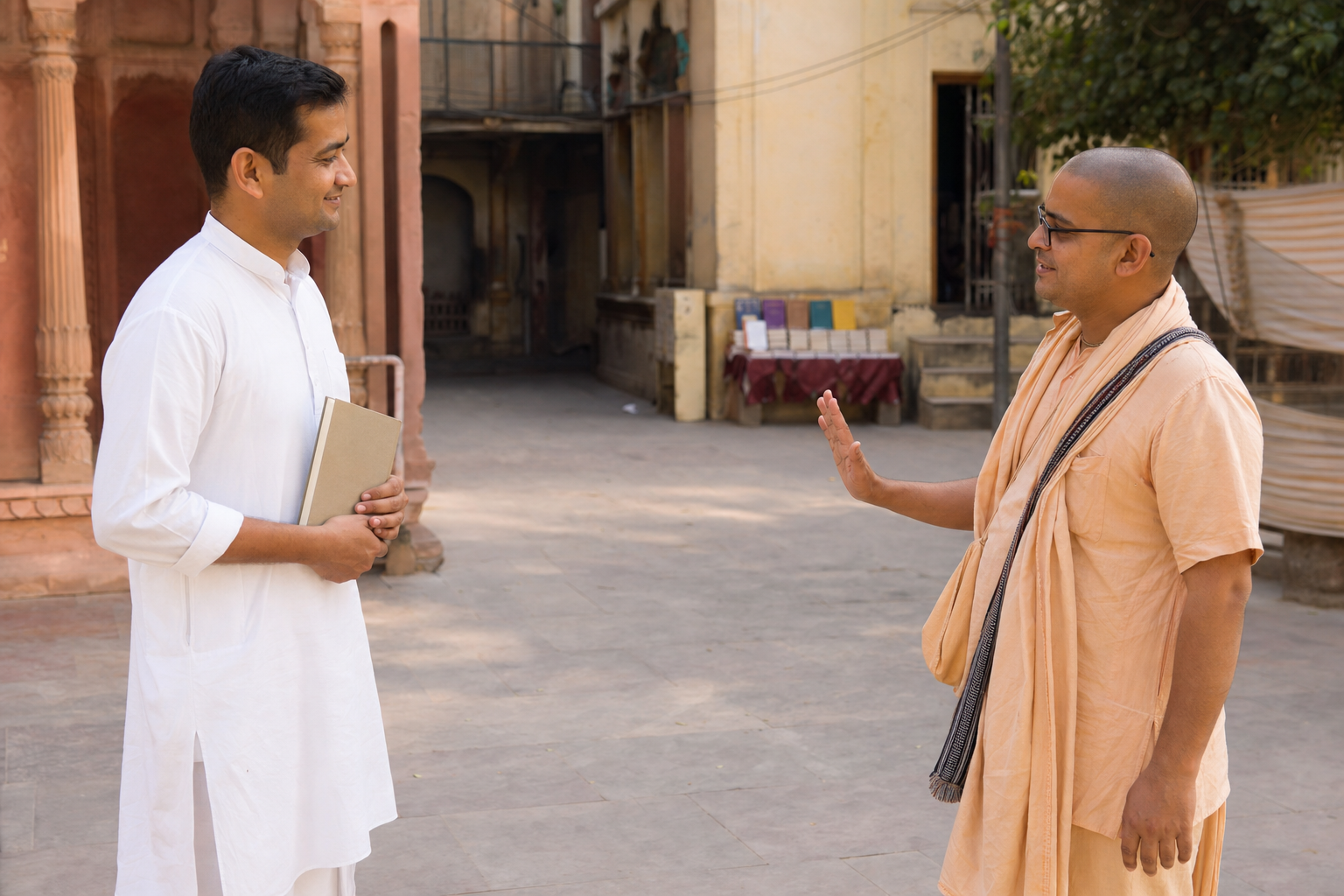
A respectful distribution conversation has three parts. Each part reduces friction while protecting the reader’s agency.
- Ask permission and establish language. Greet the person, ask whether they would like a brief introduction, and determine which language they prefer.
- Listen for interest and capacity. Find out whether they want an introduction, a text for regular study, a family resource, or an answer to a particular spiritual question.
- Make one proportionate offer. Show the most suitable title, explain its scope accurately, and mention one optional next step.
One offer is usually clearer than presenting a pile of unrelated choices. If the person is curious, you can widen the conversation. If the person declines, thank them and step aside immediately. A refusal is not a failed encounter. Your conduct has still communicated something about the tradition you represent.
Skepticism also deserves room. Do not turn a question about translation, commentary, religious institutions, or sectarianism into a contest that must be won. Answer what you know, distinguish explanation from personal speculation, and admit when you do not know. You can invite the person to inspect the contents, consult an experienced devotee, or attend a voluntary discussion. Accuracy serves Srila Prabhupada’s books better than a hurried answer.
Inter-dharmic sensitivity matters in a place visited by Hindus of many sampradayas as well as Buddhists, Jains, Sikhs, and people with no religious commitment. Shared values can create an honest point of contact: non-violence and self-restraint, compassion and mindful awareness, seva, remembrance of the Divine Name, humility, truthfulness, and care for living beings. Shared vocabulary, however, does not make distinct darshanas interchangeable. Use common ethical ground as a doorway to conversation, not as permission to flatten differences or make sectarian claims.
New volunteers should shadow an experienced distributor before approaching people alone. Watch how the senior devotee opens a conversation, notices hesitation, recommends a language, explains a title, and ends the encounter. Then ask for feedback on your own approach. Training is not merely about improving fluency; it is how a team makes humility and non-coercion reproducible.
Treat placement as the beginning of study
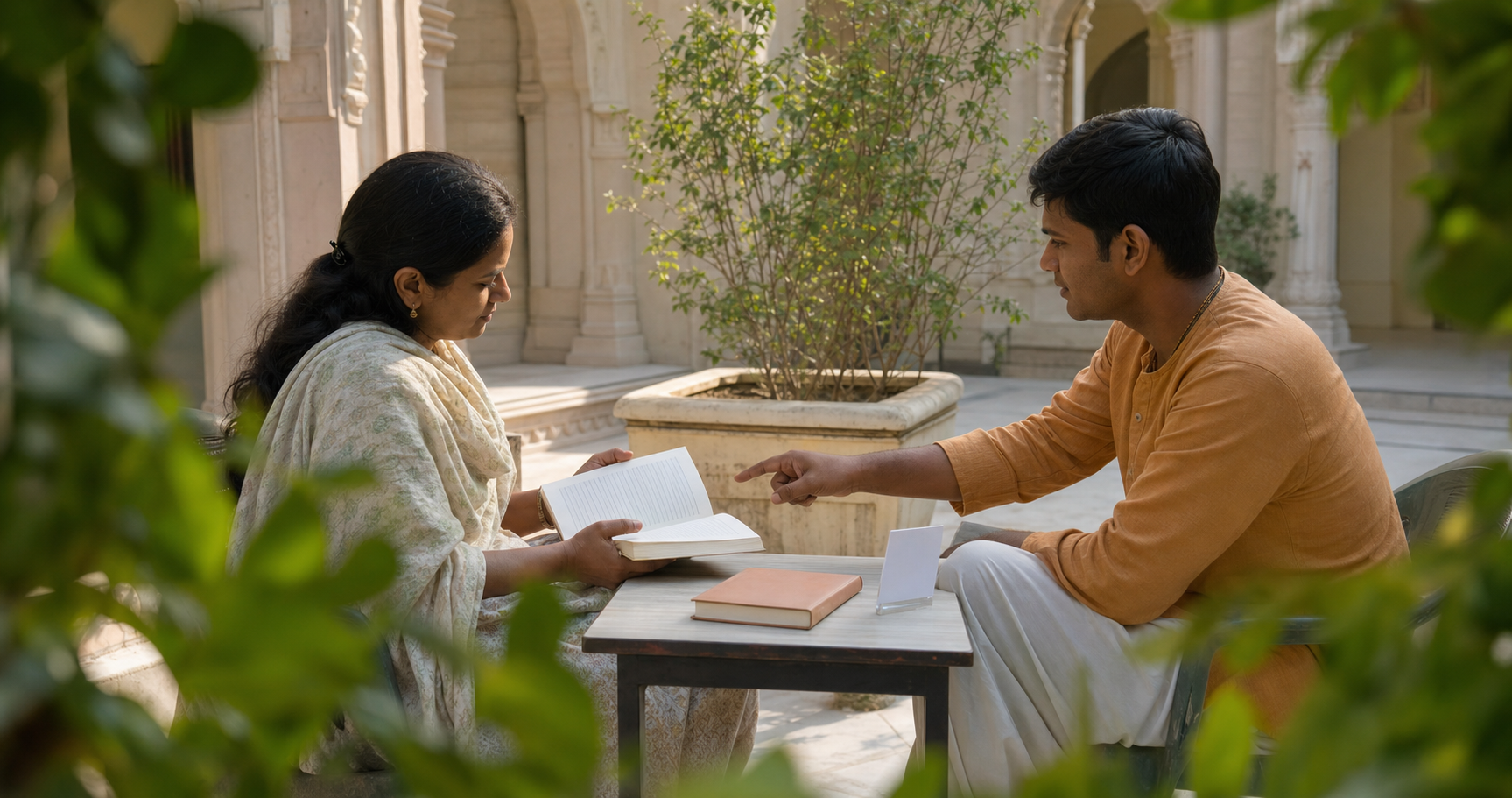
A book carried home but never opened has completed the logistical journey, not necessarily the educational one. At the handover, offer one low-friction next step suited to the reader: a bookmark with a study prompt, a glossary of Sanskrit terms, an audio reading, a relevant lecture, a short introductory course, or a local reading circle. QR-linked study aids can connect printed books with lectures, dictionaries, audio, and guided learning without replacing the book itself.
Keep that invitation proportionate. A new reader does not need a list of every class, group, channel, and course available. Too many follow-up options turn guidance into another burden. Choose the resource most closely related to the book and question in front of you, explain that participation is optional, and let the reader decide.
Teams also need two kinds of records:
- Operational records track books acquired and placed, titles and languages moving through each location, available stock, storage needs, and reader-support materials.
- Educational records capture anonymized questions, recurring misunderstandings, voluntary feedback, requests for particular languages, and interest in reading circles or introductory study.
These records answer different questions. Placement data helps you procure and position books. Interaction notes help you improve explanations, curation, and follow-up. Do not collect personal details merely to make the record look complete. Contact information belongs in the process only when the reader knowingly asks for continuing communication.
Small, secure storage points near busy distribution areas can reduce repeated transport and help a team respond to changes in pilgrim flow. Check stock by title and language before and after service. If concise Hindi introductions are repeatedly exhausted while deeper English volumes remain untouched, the answer is not to press the remaining books on unsuitable readers. Adjust the next procurement and restocking plan.
Financial stewardship follows the same logic. Distribution budgets may cover BBT procurement, storage, local logistics, study prompts, bookmarks, and minimal protective packaging. Record acquisitions and placements, review spending periodically, and make the use of donated or legacy funds intelligible to those responsible for them. Money offered for seva should remain traceable to the service it enables.
Counts still matter. They reveal demand, inventory movement, and operational strain. They simply cannot carry the whole meaning of success. A more mature review asks whether people received readable editions, whether questions were handled honestly, whether voluntary study continued, and whether the team’s behavior strengthened trust.
Key takeaways for your first distribution shift
- Confirm the permitted place and time before setting up, especially near temple entrances and crowded pilgrim routes.
- Carry books in the languages people actually read, then ask rather than assume which language a visitor prefers.
- Recommend according to interest, experience, and available study time; a concise introduction may serve better than a multi-volume set.
- Ask permission, listen, make one clear offer, and end the interaction graciously when the answer is no.
- Use shared Dharmic values to create understanding without erasing differences among traditions.
- Pair each accepted book with one optional study path, then assess both placements and meaningful reader engagement.
If you are beginning this seva, start by shadowing someone trusted and learning a small selection of books well. Your first goal should be one accurate, unhurried interaction in which the reader remains free and the book is matched thoughtfully. When a question exceeds your knowledge, take it to a senior devotee instead of improvising.
Vrindavan gives this service a sacred setting, but your conduct gives it credibility. Prepare carefully, speak truthfully, and leave the reader with both a worthy text and the freedom to approach it sincerely.