
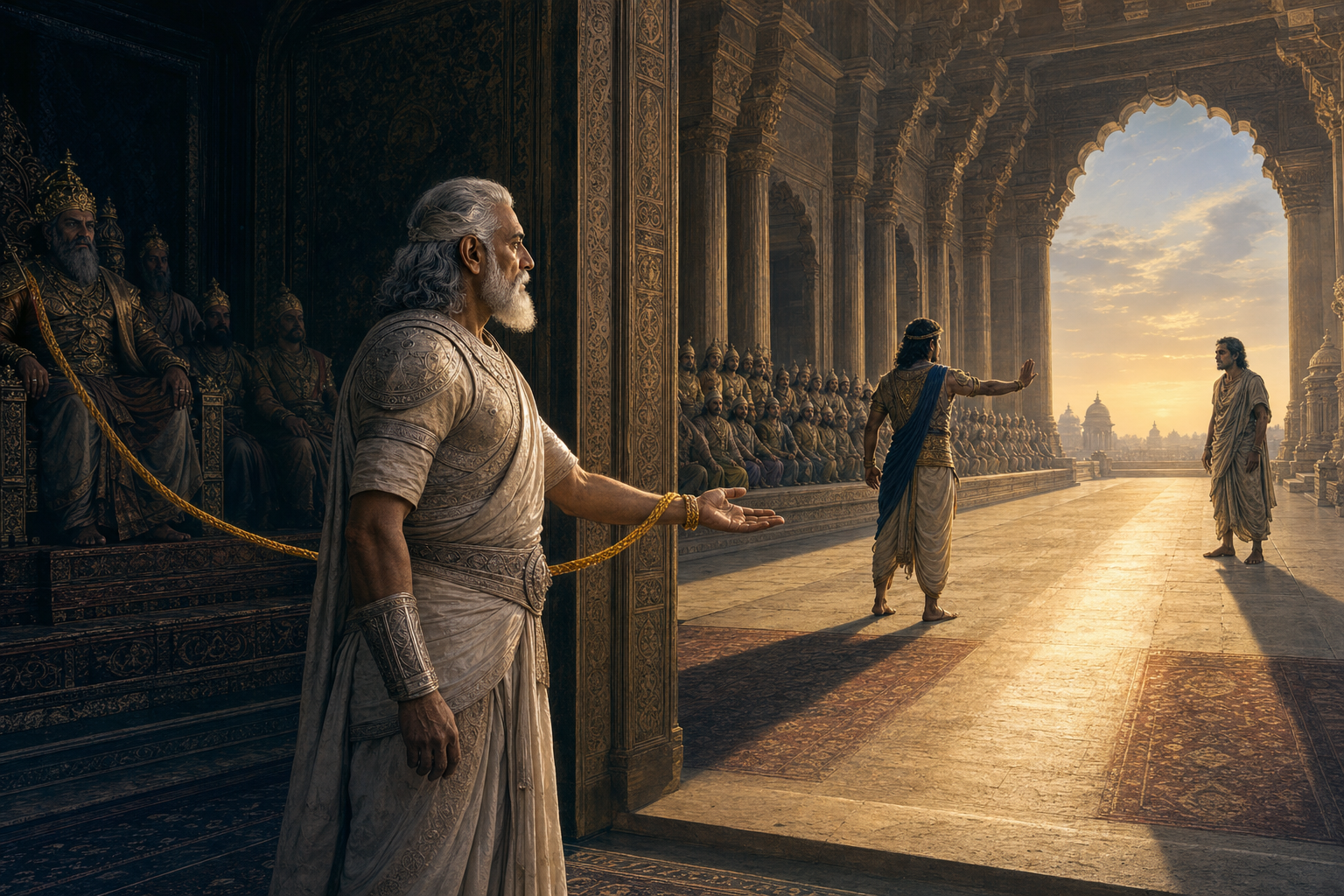
You promised to stand by a parent, sibling, leader, institution, or cause. Then the situation changed. Keeping your word now appears to support something wrong, but withdrawing feels like betrayal. The harder you try to be loyal, the less certain you become that loyalty is still dharmic.
The Mahabharata does not solve this problem with a slogan. Through Bhishma and Vikarna, it shows why a noble vow can become morally dangerous, why speaking against injustice may still be insufficient, and how you can distinguish steadfast duty from complicity.
A vow serves dharma; it does not replace it
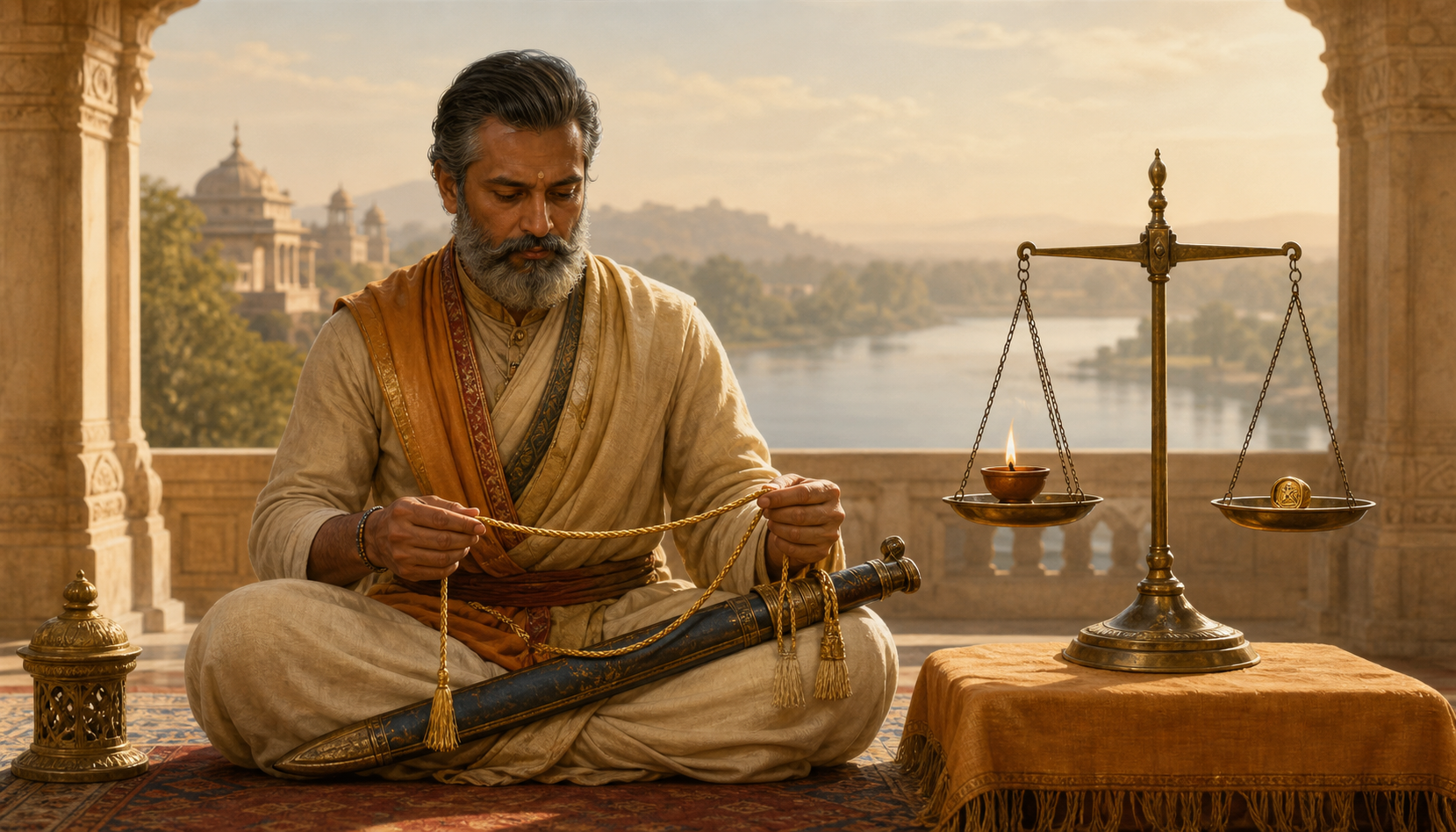
Bhishma’s vow began as an extraordinary act of renunciation. Born Devavrata, he gave up his claim to the Kuru throne and accepted lifelong celibacy so that Satyavati’s children and their descendants could inherit without rivalry. The sacrifice was intended to secure his father’s happiness, settle the succession, and protect the kingdom from conflict. Its severity earned him the name Bhishma.
That purpose matters. A vow is not righteous merely because it is difficult, permanent, or painful. Its moral force comes from the good it is meant to protect. Truthfulness, trust, legitimate order, family responsibility, and the welfare of others can make a promise sacred. Personal pride in being the person who never bends cannot.
This does not make every uncomfortable promise negotiable. A commitment loses its meaning if inconvenience, changed preference, or private advantage is enough to cancel it. The question becomes serious when fulfilling the promise now defeats its original purpose, violates a more fundamental obligation, or requires your participation in a clear wrong.
When that tension appears, examine three parts of the commitment separately:
- The object: What exactly did you promise to do, and what did you never promise?
- The purpose: What legitimate good was the promise supposed to preserve?
- The present effect: Does keeping it still protect that good, or has the promise become a vehicle for something contrary to it?
This distinction prevents two opposite errors. One is abandoning duty as soon as duty becomes costly. The other is treating obedience as automatically virtuous even when the consequences have changed. Dharma asks for steadiness, but steadiness must remain joined to discernment.
Bhishma’s life cannot be reduced to either praise or condemnation. His discipline, statecraft, protection of the Kuru throne, and later counsel to Yudhishthira on ethics and governance remain central to his remembrance. His guidance is still associated with dharma, restraint, and public responsibility. Yet the same life also forces you to ask whether fidelity to an institution can remain righteous when that institution’s conduct departs from righteousness.
Bhishma and Vikarna reveal two incomplete moral victories
Bhishma represents the grandeur and danger of irrevocable commitment. His original renunciation placed the cost upon himself. He surrendered power, marriage, and descendants for a perceived public good. That is morally different from making other people bear the price of your reputation for loyalty. The tragedy develops when commitment to the throne becomes difficult to separate from service to the people controlling it.
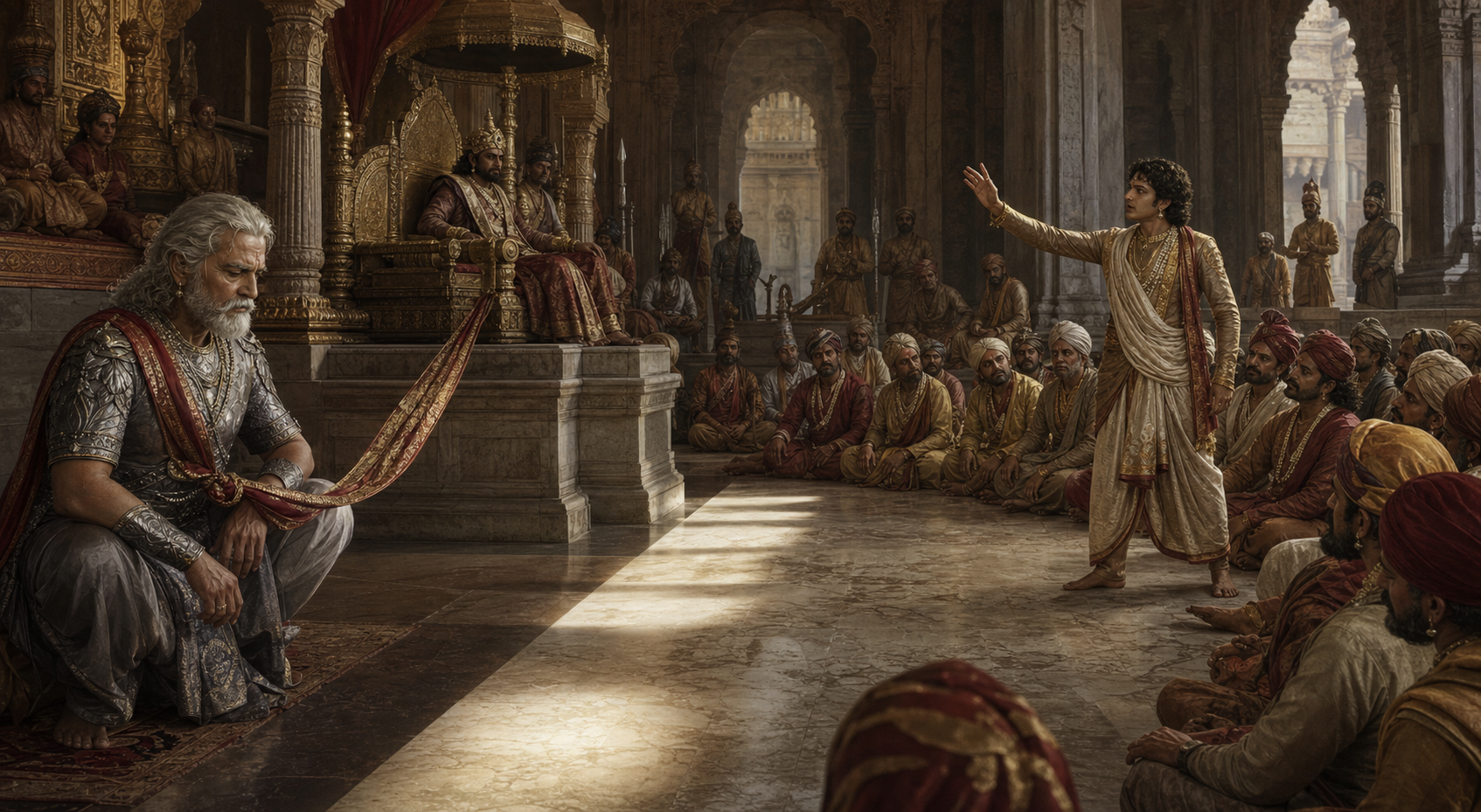
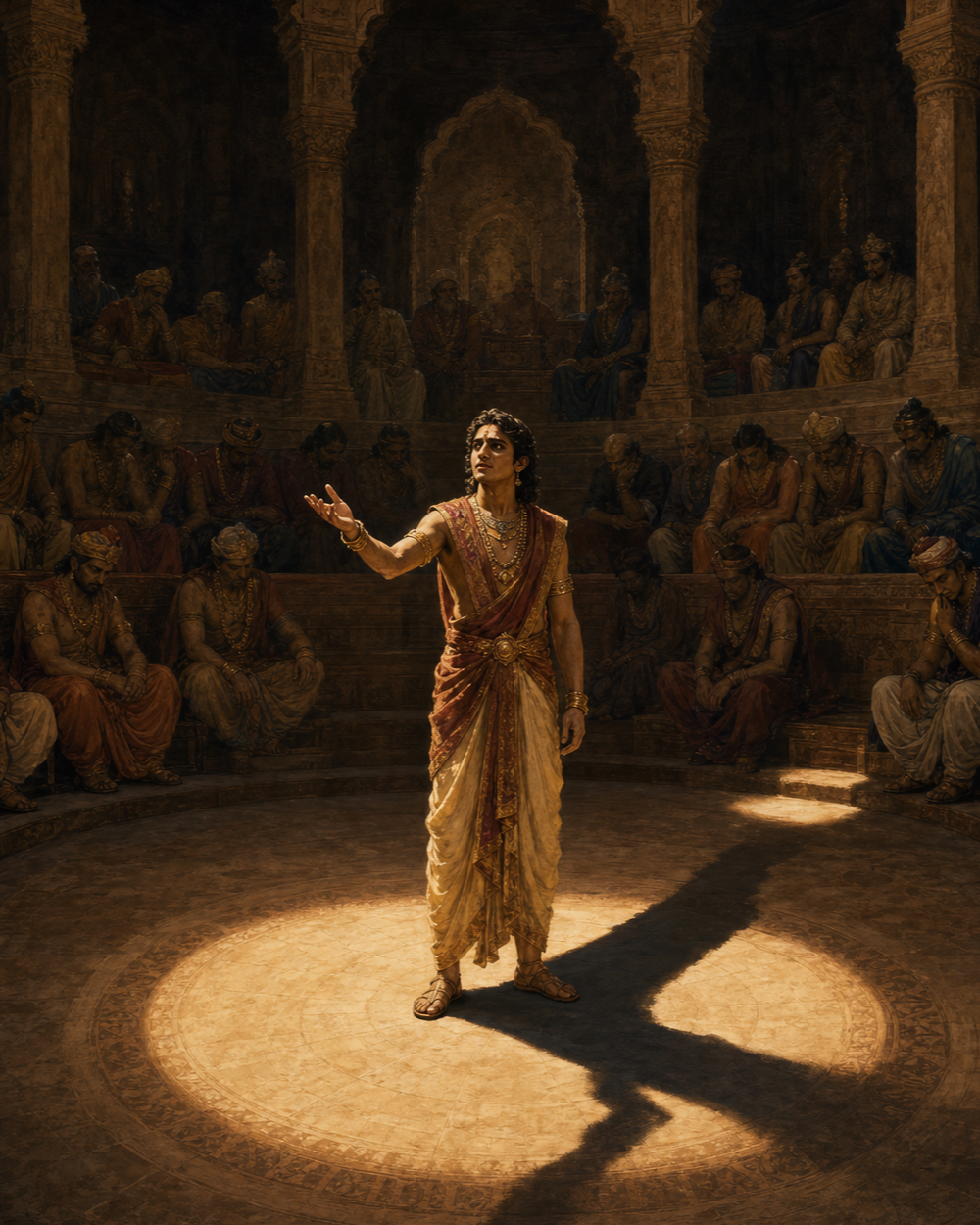
Vikarna exposes a different failure. In the dice hall, while Draupadi was being humiliated and powerful elders hesitated, he did not merely express discomfort. He challenged the validity of what had happened. If Yudhishthira had already lost himself, on what basis could he wager Draupadi afterward? Vikarna also rejected the treatment of a wife as property and recognized that the assembly’s standards of righteous conduct were being violated. His objection joined conscience to precise ethical reasoning.
That intervention mattered. Silence would have allowed everyone present to pretend that no moral argument had been made. Vikarna removed that excuse. He demonstrated that respectful dissent is not disloyal noise; it can be the only act preserving an institution’s claim to moral seriousness.
But Vikarna later fought beside his brothers at Kurukshetra. The remembered encounter with Bhima sharpens the paradox: Bhima, mindful of Vikarna’s defense of Draupadi, offered him an opportunity to withdraw, but Vikarna chose fraternal and warrior obligation. Bhima killed him and lamented the death of a righteous Kaurava. Vikarna’s conscience had governed his speech in the assembly, but it did not finally govern his allegiance.
The two lives therefore reveal different gaps:
- Perceiving a wrong is not the same as naming it.
- Naming a wrong is not the same as refusing to assist it.
- Accepting personal sacrifice is not enough if others later bear the consequences of your rigidity.
- Serving a family or institution is not identical to obeying whoever currently speaks in its name.
Bhishma warns that a vow can outlive the conditions that made it righteous. Vikarna warns that a correct objection can coexist with a disastrous final choice. Neither lesson requires you to deny their virtues. The moral tragedy lies precisely in the failure to integrate real virtues: loyalty without sufficient correction, conscience without decisive separation, and courage exercised at one moment but constrained at the next.
Use this six-question test when duty and conscience collide
When you are inside the conflict, words such as loyalty, duty, conscience, and betrayal become emotionally loaded. Reduce the problem to questions you can answer plainly. Write the answers if the stakes are high; an unwritten promise tends to expand whenever someone powerful invokes it.
- What did you actually promise? State the commitment without noble-sounding additions. Promising to support a sibling is not a promise to defend every action. Agreeing to serve an institution is not consent to every instruction. Accepting confidentiality is not a pledge to help someone mislead an injured party.
- What good was the promise meant to protect? Name the purpose: trust, care, stability, truthful cooperation, legitimate authority, or protection of a vulnerable person. If you cannot identify a just purpose, habit or pressure may be masquerading as duty.
- Which duties are now in conflict? The Mahabharata’s tension between svadharma, the duty connected to one’s role, and a wider righteousness is not solved by pretending one side does not exist. Name both claims. Then ask whether your role is being used to override truth, dignity, fairness, or another person’s legitimate protection.
- Who bears the cost of your fidelity? Self-sacrifice can give a vow moral seriousness. Transferring the sacrifice to someone with less power changes the ethical character of the act. Bhishma’s original vow cost Bhishma. In the dice hall, by contrast, Draupadi was made to bear the consequences of claims and wagers made by others. If your honor is preserved by another person’s humiliation or injury, stop calling the arrangement sacrifice.
- What is the least destructive faithful correction? The first step need not always be abandonment. You may be able to clarify the promise, object to the disputed act, ask for reconsideration, seek mediation, refuse one instruction, or withdraw from the particular decision. Use the smallest response capable of stopping the wrong. If delay will deepen the harm, gradual escalation becomes another form of avoidance.
- Can your reasoning survive reversal and disclosure? Would you accept the same conduct from an opponent? Could you explain your choice to the person who bears its cost? Would you defend the principle if it brought you no advantage? A no to any of these questions is a sign that loyalty, fear, or self-interest may be speaking in the language of dharma.
The resulting decision rule is demanding but clear. Keep the promise when its purpose remains just, the burden is substantially yours to bear, and performance does not violate a more basic duty. Renegotiate it when changed conditions have separated the original words from the original good. Refuse participation when keeping the promise requires you to become an active instrument of injustice.
Do not label refusal betrayal merely because the person demanding obedience uses that word. Sometimes refusal is the last available form of fidelity: fidelity to the family as distinct from one relative, to the institution as distinct from one officeholder, or to dharma as distinct from the role through which you hoped to serve it.
Dissent early, precisely, and without moral theatre
Speak in a form that can change the decision
Vikarna’s intervention offers a practical model because he identified defects in the act rather than merely denouncing the people around him. When you must object, make your dissent useful:
- Name the disputed action. Avoid attacking an entire family, faction, or person’s character when a specific decision is the issue.
- Identify the broken principle. Explain whether the problem is invalid authority, absence of consent, unfair burden, untruth, humiliation, or misuse of a role.
- Name the person carrying the cost. Moral language becomes clearer when the affected human being is no longer hidden behind procedure.
- Ask for a concrete correction. Request reconsideration, restoration, release, recusal, or another remedy appropriate to the act you challenged.
- State your boundary. If the correction is refused, say what you will not do. An objection with no consequence can become ceremonial permission for the wrongdoing to continue.
Timing matters. In the dice hall, an objection could still challenge the legitimacy of a decision. By the battlefield, Vikarna’s options had narrowed to fighting or withdrawing from his brothers. Look for your own dice-hall moment: the meeting before the order is implemented, the family conversation before humiliation becomes custom, or the first request to repeat something you know is untrue. Early dissent preserves more options and usually requires less destruction.
Test conscience for ego before you invoke dharma
Conscience is not the same as impulse. A mature conscience accepts scrutiny, admits uncertainty, and is prepared to bear a proportionate cost. Ego prefers the identity of solitary hero while leaving everyone else to manage the damage.
Before taking a dramatic stand, ask:
- Am I applying the same standard to allies and opponents?
- What private benefit do I gain from presenting my preference as a moral necessity?
- What fact, if established, would make me revise my judgment?
- Have I tried a quieter remedy capable of protecting the same person or principle?
- Am I willing to accept the foreseeable personal consequences of the boundary I am declaring?
These questions do not provide an excuse for silence. Silence is not humility when your position gives you a duty to object. But spectacle is not courage when a precise intervention could correct the wrong. The aim is neither submission nor performance. It is effective fidelity to what is right.
Key takeaways
- A vow receives its moral force from the just good it protects; severity alone does not make it dharmic.
- Difficulty is not proof that a promise has become wrong. Reconsider it when compliance defeats its purpose, violates a more basic duty, or makes you an agent of injustice.
- Separate the exact promise, its original purpose, and its present consequences before deciding.
- Ask who pays for your loyalty. A sacrifice imposed on a less powerful person is not made righteous by your reputation for steadfastness.
- Reasoned dissent should name the act, the violated principle, the affected person, the requested remedy, and the boundary you will enforce.
- Speak while correction remains possible. Waiting until the final confrontation turns a manageable moral choice into a tragic one.
Before your next difficult conversation, complete four sentences: I promised… The promise was meant to protect… Keeping it now would cause… The smallest dharmic correction is… If you cannot complete the last sentence, do not hide inside the language of loyalty. Find the earlier, narrower action that keeps conscience and duty in the same decision.

References
- DharmaRenaissance Blog – Vikarna, the Lone Kaurava of Conscience: A Stirring Lesson in Dharma and Courage
- DharmaRenaissance Blog – Bhishma Dwadashi 2026: Date, Parana Rituals, and Mahabharata-Inspired Reflections
- DharmaRenaissance Blog – Bhishma’s Birth and Vow: Ganga’s Son Devavrata and the Timeless Dharma of the Mahabharata
