

You may know the words of a Vedic hymn and have a clear translation, yet still feel that something present in recitation has disappeared on the page. The missing element is often not another meaning. It is the measured form in which the words are meant to be voiced.
Chandas gives you a disciplined way to approach that form. Once you stop treating meter as decoration, you can listen more carefully, evaluate learning resources more intelligently, and avoid confusing sacred recitation with either ordinary reading or a devotional tune.
Chandas is part of the verse, not an ornament around it
In its technical sense, Chandas concerns the poetic meters of the Vedas and belongs among the disciplines traditionally needed for understanding Vedic texts. The word also carries a broader sense of exhilaration or a protective covering. Those two senses should not be collapsed into a single literal definition, but together they point toward an important insight: measured form does something to a sacred utterance.
Meter gives words a recognizable shape. It governs how syllabic units are arranged, how sections of a verse answer one another, and where the voice encounters continuity or closure. A translation may communicate much of what a verse means, but it usually cannot reproduce this architecture. That is why reading only the translated prose can leave you with the teaching while withholding part of its verbal form.
This changes the question you bring to a hymn. Do not ask only, “What does this passage mean?” Also ask, “How has this utterance been shaped to return in the voice?” The first question takes you toward vocabulary, grammar, commentary, and philosophy. The second takes you toward Chandas. Neither can do the other’s work.
Learn to hear recurrence before memorizing classifications

A catalogue of metrical names is easy to copy and difficult to use. Begin instead with recurrence. Meter becomes perceptible when one part of a verse creates an expectation and a later part answers it. You are listening for an ordered return, not merely for a beat that feels pleasant.
- Notice the verse boundaries. Work from the Sanskrit text rather than assuming that the line breaks in a translation reproduce the original divisions.
- Attend to spoken units. Meter belongs to voiced language. Do not count visible letters as though every written sign automatically represented a separate beat.
- Compare corresponding sections. Listen for balance, recurrence, compression, and expansion across the verse instead of judging one line in isolation.
- Mark uncertainty rather than forcing regularity. If a passage does not fit the pattern you expect, check the text, your segmentation, and your pronunciation before drawing a conclusion.
The last point matters. An expected pattern can alert you that something deserves examination, but it does not give you permission to change the sacred wording. A hesitation may lie in your reading rather than in the verse. Meter is a diagnostic aid; it is not a licence for silent correction.
Keep meter, pronunciation, melody, and meaning separate

Many beginners hear an impressive recitation and call every feature of it “the meter.” That makes careful study almost impossible. Four related layers need separate questions.
- Text: What words and verse divisions are actually present?
- Meter: What recurring organization gives those spoken units their measured form?
- Pronunciation and recitation: How should the text be articulated and carried by the voice?
- Meaning: What do grammar, context, and interpretation disclose?
A modern melody may make a mantra memorable or support devotion, but musical attractiveness does not by itself reveal the underlying meter. In the same way, a steady beat does not certify accurate pronunciation. And a correct metrical pattern does not settle the philosophical meaning of a difficult passage.
This separation protects you from two common mistakes. The first is dismissing meter as mere musical embellishment. The second is treating meter as a master key that unlocks every dimension of a Vedic verse. Chandas has a precise responsibility: it discloses and preserves measured verbal form. You still need the other disciplines appropriate to pronunciation, language, ritual context, and interpretation.
Why measured form matters in a sacred tradition
Calling meter a protective covering is useful if you treat it as an interpretive image rather than a mechanical guarantee. A stable pattern makes the form of an utterance easier to recognize. When something is omitted, crowded, or divided poorly, the disturbance may become audible. Chandas therefore encourages verification: you return to the text instead of letting an uncertain rendering pass unnoticed.
The protection is also a protection of attention. Measured recitation resists the impatient habit of racing toward a paraphrased message. It requires you to meet the verse as ordered speech. Repetition, proportion, and closure become part of your encounter with it. The words are not merely containers from which an idea can be extracted and the container discarded.
Yet sacredness should not be reduced to arithmetic. Counting spoken units can reveal structure, but counting alone does not constitute understanding or reverence. The useful discipline is to let formal analysis sharpen your hearing, then return to the whole utterance. If analysis leaves you less attentive to the actual words, it has become a distraction.
This is also why Chandas belongs in the study of scripture, not only in literary appreciation. It asks you to respect how knowledge is embodied in language. Form and meaning remain distinguishable, but they are not disposable parts. The meter shapes the conditions under which the words are encountered, remembered, and voiced.
A practical method for studying one Vedic passage
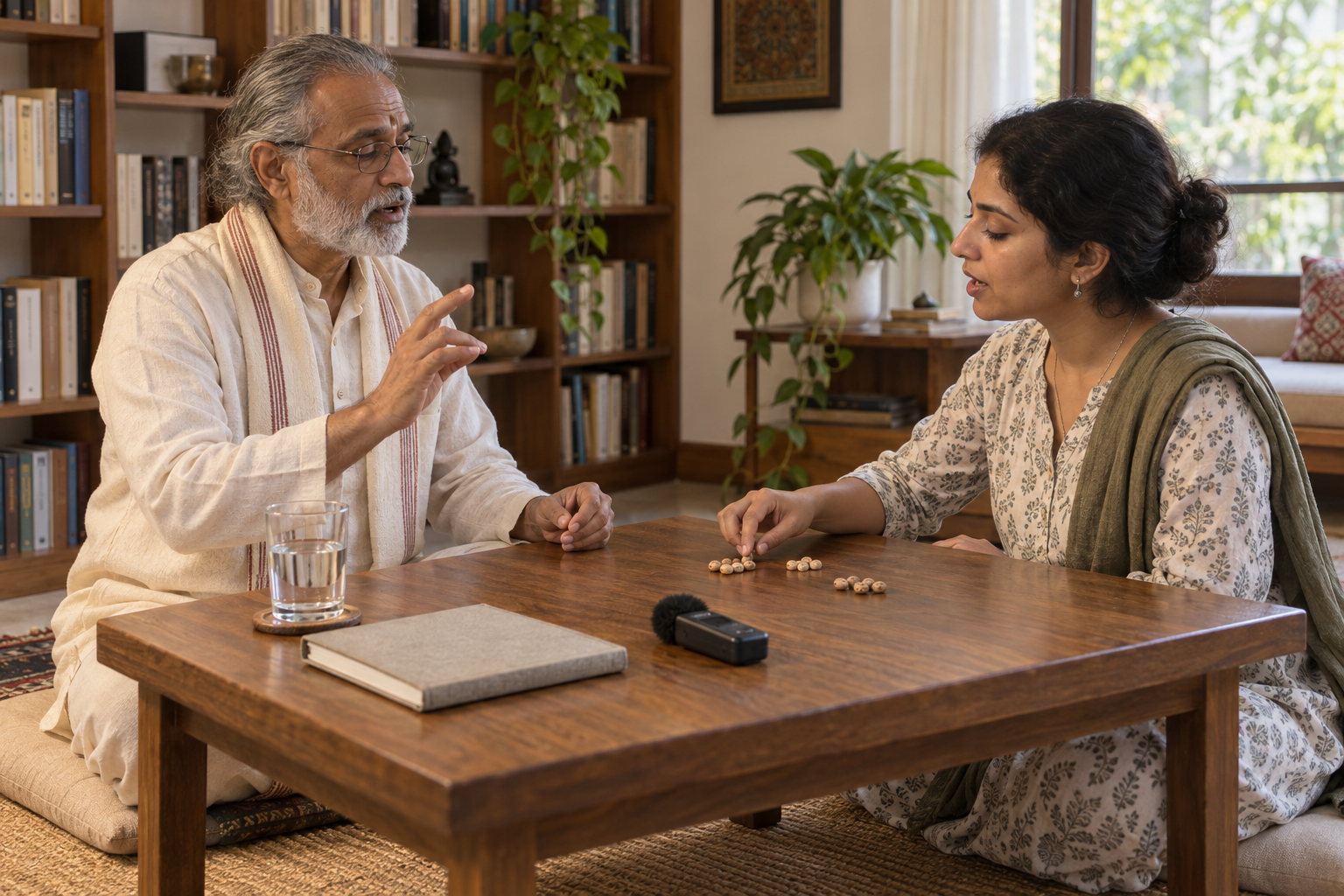
Choose one short passage for which you have the original text, a trustworthy explanation, and, if possible, a reliable recitation. Depth with one passage will teach you more than hurried exposure to a long list of meters.
- Establish the words first. Make sure the recitation and the printed passage correspond. Do not try to infer the original wording from a translation or from sound alone.
- Read for meaning once. State the central sense of the passage in plain language. This prevents the later exercise from turning into empty counting.
- Mark the printed verse divisions. Keep the Sanskrit arrangement visible. Treat line breaks added by a translator as aids to reading, not automatic evidence of metrical structure.
- Voice the passage slowly and neutrally. Attend to spoken syllabic units without imposing a song. If you are uncertain about pronunciation, note the uncertainty instead of building an analysis on it.
- Compare the sections. Look and listen for recurring length, balance, or closure. Ask where your expectation is fulfilled and where it is interrupted.
- Check your hearing against a competent rendering. Follow the same text while listening. Pay special attention to places where your division or pacing differed.
- Return to the meaning. Read the passage again and notice whether its measured movement changes where you pause, what you retain, or which verbal relationships become prominent.
For personal study, this method teaches you what to notice. It does not make a self-constructed recital ritually authoritative. If your goal is formal Vedic recitation, learn the text and its pronunciation within a competent teaching tradition. A transliteration, a beat chart, or an attractive recording can assist study, but none alone can correct every mistake.
When selecting a book, course, or recording, look for resources that keep the original text aligned with the recitation, show verse divisions clearly, distinguish meter from an added melody, and explain how the spoken form is being analysed. A resource that offers only a translation can support interpretation. One that offers only music can support listening or devotion. Neither, by itself, is enough for the disciplined study of Chandas.
Key takeaways
- Chandas is the discipline of Vedic poetic meter, while its wider associations include exhilaration and protective covering.
- Meter belongs to the organized form of the verse; it should not be confused with translation, pronunciation, or an added devotional melody.
- Begin by noticing verse boundaries, spoken units, recurrence, and closure rather than memorizing a catalogue of technical labels.
- Use an apparent break in pattern as a reason to check your text and reading, never as permission to alter the words.
- Formal analysis should return you to attentive recitation and meaning. Counting is a tool, not the final purpose.
The next time you encounter a Vedic verse, resist the urge to move immediately from Sanskrit words to an English meaning. Keep the original divisions in view, speak the passage slowly, and listen for the shape that returns. That small change turns Chandas from an entry in a glossary into a practice of careful hearing.
References

Leave a Reply
You must be logged in to post a comment.