

If you have encountered Veda Shasta in a temple, an image, or a list of the Ashta Sastha forms, the practical question is not merely, “Who is this deity?” It is, “What does this form ask me to protect, and how should that change the way I learn?” Looking for one universally fixed list or one compulsory iconographic formula will not answer that question.
Veda Shasta asks you to treat sacred knowledge as a responsibility. Words must be received carefully, attention must be trained, interpretation must remain humble, and learning must become conduct. In this vision, study and protection are not separate activities. The disciplined learner is already participating in Veda-rakshana, the guardianship of Vedic wisdom.
Guardianship begins with the right relationship to knowledge

The name gives you the essential framework. “Veda” points to shruti, revealed sacred knowledge. “Shasta” denotes a teacher, preceptor, guide, or one who establishes discipline. Veda Shasta therefore unites two roles that modern life often separates: the teacher who communicates knowledge and the guardian who protects its integrity.
Protection here should not be reduced to hiding texts, policing identity, or winning arguments. A teaching can remain physically preserved while its purpose is forgotten. It can also become widely available while careless quotation, poor transmission, and ego-driven interpretation distort it. Real guardianship has at least four parts:
- Receive accurately: distinguish the sacred passage from your memory of it, and the original wording from a later explanation.
- Learn humbly: recognise when pronunciation, ritual context, or interpretation requires a competent teacher.
- Practise ethically: let knowledge discipline speech, desire, attention, and action.
- Transmit responsibly: share what you understand without pretending that a fragment, translation, or personal opinion is the whole tradition.
This is why Veda Shasta cannot be understood through jnana alone. The form brings knowledge into relationship with karma and bhakti: understanding, right action, and devotion. If study increases pride but does not improve conduct, one part of that relationship has broken down. If devotion rejects disciplined learning, another part has been neglected.
You may encounter different lists of the eight forms of Shasta. Some regional and lineage-based enumerations emphasise Yoga Shasta, Vira Shasta, Bala Shasta, Jnana Shasta, Kalyana Varada Shasta, or other forms; some include Veda Shasta to foreground the protection of sacred learning. Do not use one list found online to declare a temple’s inherited list “wrong.” Ask which lineage, temple tradition, or regional enumeration is being used. Dharmic plurality can preserve a shared theological centre without forcing every community into identical terminology.
Shasta’s place within Hindu tradition has Puranic and regional dimensions. References to Shasta occur in the Skanda Purana and Brahmanda Purana, while Kerala’s sthala-puranas develop the veneration of Ayyappa as Hariharaputra, the son of Shiva and Vishnu in the form of Mohini. Veda Shasta is best approached as a focused expression of this wider theology: the Lord of Dharma is also the protector and teacher of sacred wisdom.
The murti gives you a method, not just an image

Not every Veda Shasta murti will display every possible attribute. Temple, Agamic, and regional conventions matter. Where the familiar knowledge-bearing features do appear, however, you can read them as a complete discipline of learning rather than as decorative details.
- The pustaka: The palm-leaf manuscript represents knowledge preserved through memory, teaching, and material care. Its practical instruction is simple: return to the actual text before repeating a claim about it. When you take notes, keep the passage, translation, commentary, and your own reflection visibly distinct.
- The akshamala: The rosary represents repetition, tapas, and the patient refinement of attention. It corrects the habit of collecting new teachings before digesting the last one. Repeat a short passage accurately and consistently before moving on simply because novelty feels more rewarding.
- The yogapatta and steady posture: Yogic composure shows that attention is part of knowledge. Before study, settle the body, remove avoidable interruptions, and give the passage undivided attention. A distracted glance may gather information, but it rarely produces understanding.
- The yajñopavita: The sacred thread signals obligation as well as learning. Knowledge received through a tradition creates responsibility toward teachers, students, ritual context, and future generations. Do not present borrowed authority as personal mastery.
- Abhaya and varada mudras: Assurance and gracious giving complete the image. Study should create enough inner security to ask honest questions and enough generosity to use understanding in service. Fearless inquiry without compassion becomes aggression; generosity without discernment becomes confusion.
These attributes make darshana pedagogical. The manuscript, rosary, sacred thread, yogic steadiness, and protective or beneficent gestures move the devotee through a sequence: receive, repeat, become steady, accept responsibility, and give wisely. The image is not asking you merely to admire knowledge. It is showing you how to become fit to carry it.
Turn devotion into a repeatable study vrata

A household practice need not imitate the full liturgy of a temple. In temple settings, avahana, snana, alankara, naivedya, diparadhana, Vedic recitation, and homa belong to a ritual grammar preserved through Kerala Tantra, South Indian Agamas, and priestly lineages. The meeting of Vedic mantra, Tantric procedure, and Agamic worship is part of the tradition’s integrity, not a collection of interchangeable techniques.
If your family, guru, or temple has given you a practice, follow that guidance for its ritual details. If you are beginning with a simple devotional study routine, use the following structure as a discipline of attention rather than as a substitute for lineage-specific worship:
- Prepare one place for study. Put the text and necessary materials in order before beginning. Silence notifications and remove whatever invites casual switching between tasks.
- Begin with peace, not intellectual conquest. Use a familiar prayer or shanti invocation from your received practice. The purpose is to make the learning relationship cooperative, attentive, and free of hostility.
- Work with one bounded passage. Read or hear it accurately, repeat it, and only then turn to explanation. Mark clearly what belongs to the sacred text, what belongs to a teacher or commentary, and what is your own current understanding.
- Choose one application. Connect the passage to a concrete discipline such as restraint in speech, patience in disagreement, regularity in duty, or service to another person. Do not choose a dramatic vow that you will abandon; choose an action you can actually maintain.
- Close by offering the result. End with gratitude, a familiar Ayyappa prayer, or a peace mantra, and record the point you intend to practise. This keeps study from ending at accumulation.
The well-known shanti mantra beginning with “Saha nav avatu” is especially fitting because it treats learning as shared work between teacher and student:
Saha nav avatu; saha nau bhunaktu; saha viryam karavavahai; tejasvinav adhitam astu; ma vidvishavahai.
Vedic shanti mantra
Its orientation matters as much as its recitation: may learning be protected, vigorous, illuminating, and free from mutual hostility. If you do not know the pronunciation or place of a mantra in your tradition, learn it from a qualified teacher rather than treating a phonetic line on a screen as sufficient instruction.
Vijayadashami and vidyarambham offer natural occasions to begin or renew this discipline. The Mandala-kalam associated with Ayyappa devotion offers another model: restraint and regular observance prepare the mind to receive what casual attention misses. These occasions can intensify practice, but they should not become excuses to neglect learning during the rest of the year.
Protect transmission without freezing the tradition
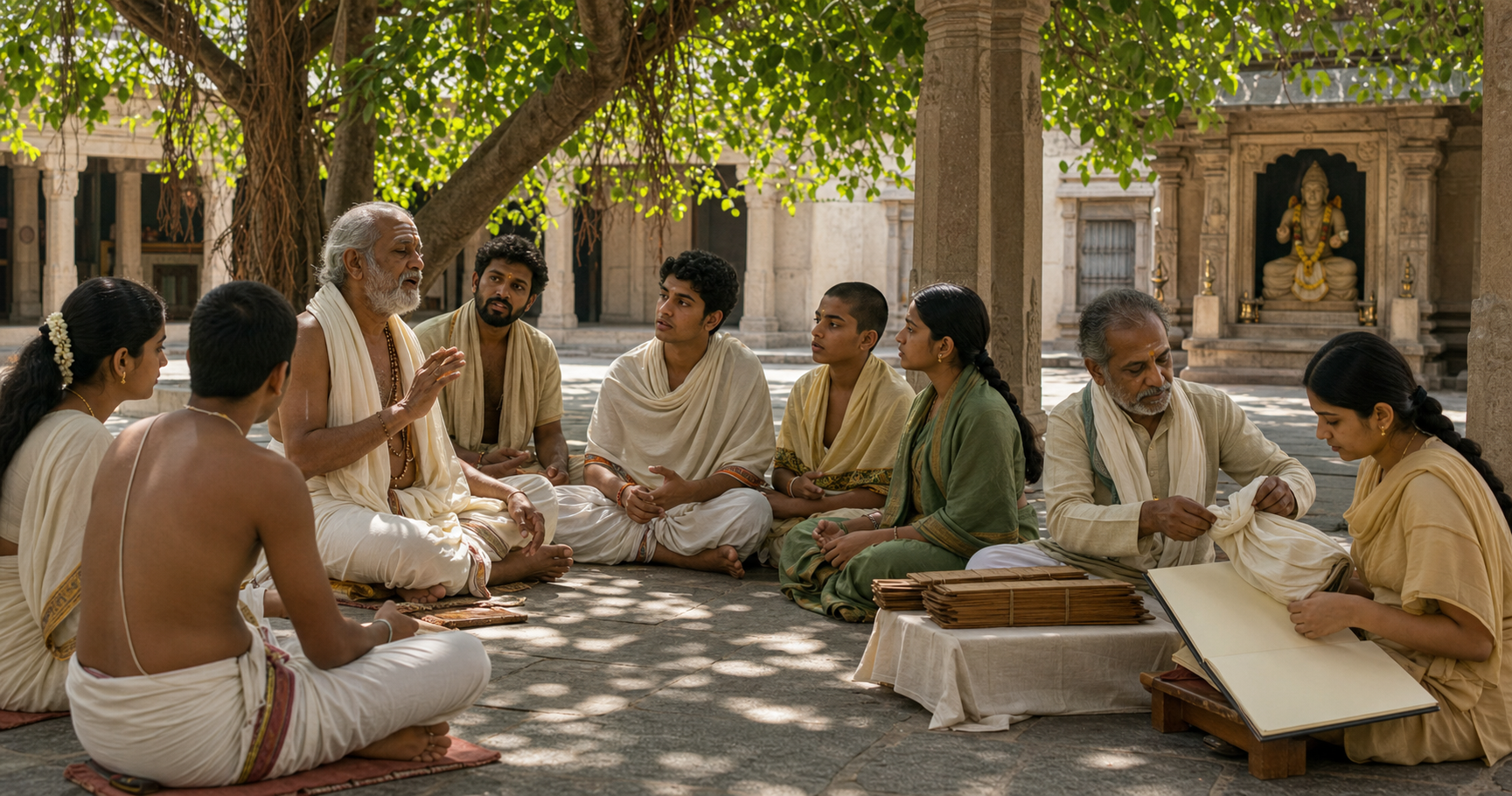
A tradition remains alive when its wording is handled reliably, people remain capable of teaching and practising it, and its wisdom continues to shape life. Neglect any one of these and preservation becomes incomplete. A pristine digital file without trained readers is inert. Enthusiastic interpretation without textual discipline becomes distortion. Precise recitation without ethical formation can become a performance detached from Dharma.
You can apply the Veda Shasta ideal at several levels:
- In personal sharing: Verify a quotation before posting it. Name the text and, when relevant, the translation or commentary you used. Do not silently convert a paraphrase into a scriptural quotation.
- In digital preservation: Keep an image of the original manuscript or printed page alongside a transcription when possible. Record provenance that is genuinely known, retain variant readings instead of silently erasing them, and separate editorial corrections from the preserved text.
- In the household: Give sacred study a regular place rather than reserving it for examinations, festivals, or moments of distress. Let children see that asking a sincere question is compatible with reverence.
- In community life: Support Veda-pathashalas, trustworthy manuscript work, recitation, classical learning, temple liturgy, and the teachers who sustain them. Funding buildings while overlooking the people who carry knowledge leaves the work half done.
- In conduct: Test learning by its fruit. Greater discernment should produce more responsible choices; deeper devotion should produce steadier service. If knowledge mainly supplies weapons for humiliating others, return to the disciplines symbolised by the rosary and abhaya mudra.
Wider access and faithful transmission need not be enemies. Digital archives can protect vulnerable materials and bring serious learners closer to them, while teachers and institutions preserve pronunciation, interpretive context, and responsible use. The right question is not simply, “Should this be old or new?” Ask instead, “What must remain exact, what can be translated or adapted, and who is competent to make that decision?”
This discipline also offers a careful way to recognise kinship across Dharmic traditions. Hindu communities protect the Vedas and Upanishads; Buddhist, Jain, and Sikh communities preserve the Tripitaka, Jain Agamas, and Guru Granth Sahib within their own distinct lineages. The shared value is reverence for knowledge, disciplined transmission, and compassionate application. The analogy should stop there: respect does not require treating different scriptures, practices, or theological claims as interchangeable.
South India’s sacred geography gives this guardianship an institutional home. Sabarimala and the Shasta kshetras associated with places such as Achankovil, Aryankavu, and Kulathupuzha preserve memory through worship, oral lineage, sthala-purana, and Tantri parampara. Supporting such living systems is as important as celebrating an isolated image of the deity.
Key takeaways
- Veda Shasta joins the authority of the teacher with the duty to protect shruti, making sacred learning a moral and devotional responsibility.
- Ashta Sastha lists vary by region and lineage. Identify the tradition being used before treating any enumeration as universal.
- The pustaka, akshamala, yogic posture, sacred thread, abhaya, and varada mudras form a practical sequence of accurate study, repetition, steadiness, responsibility, courage, and service.
- A simple household discipline can prepare the mind for study, but it should not be presented as a replacement for temple liturgy or instruction received from a qualified lineage.
- Preservation succeeds when texts remain reliable, teachers and practitioners remain supported, and knowledge continues to improve conduct.
Begin with one passage you are already studying. Give it a fixed place in your routine, verify its words, repeat it with attention, and choose one change in conduct that follows from it. Then ask your temple, teacher, or family elders how Veda Shasta is understood in their lineage. That small combination of accuracy, discipline, and humility is a meaningful act of guardianship.