
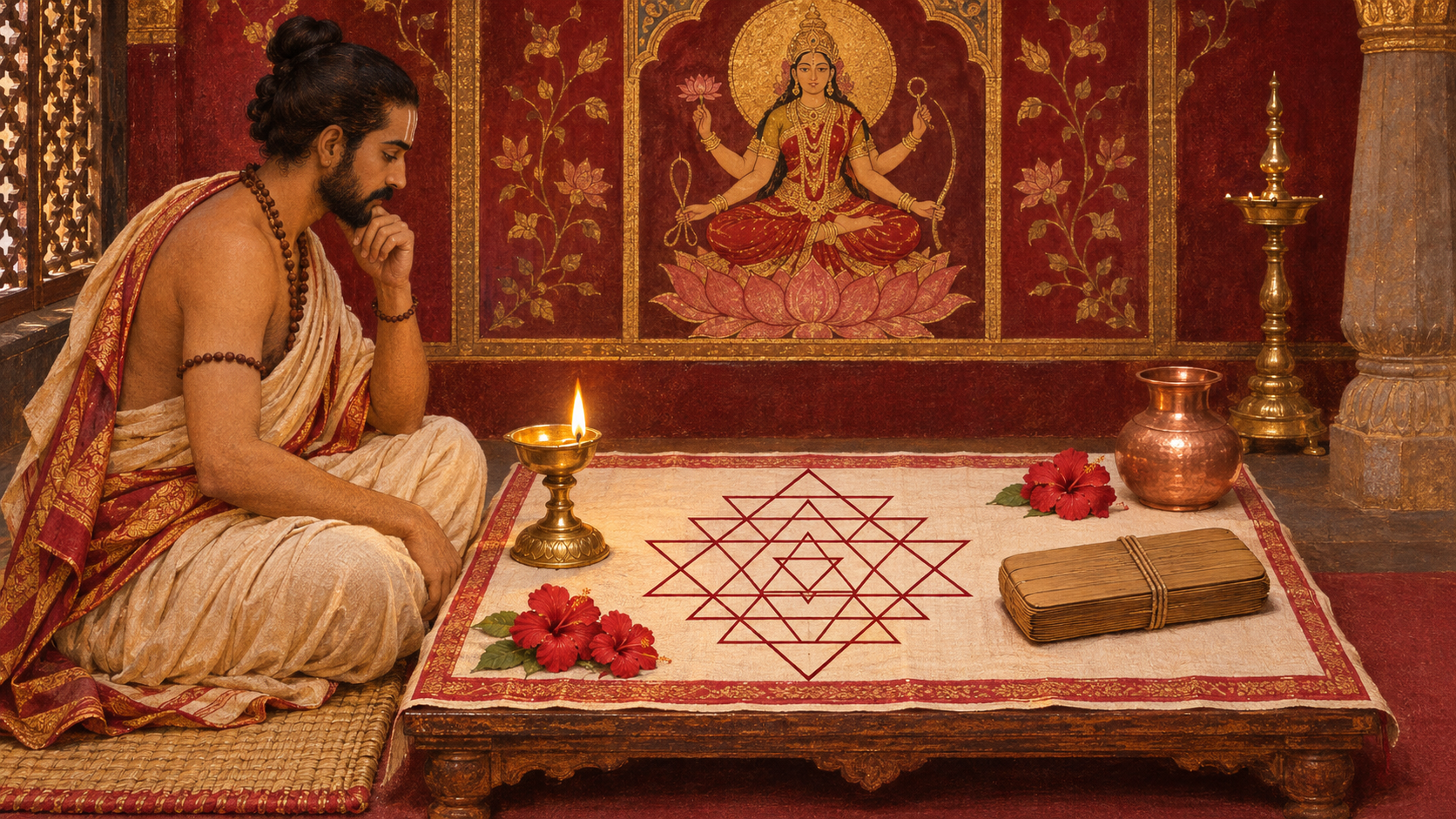
If you opened Chapter 9 expecting either a simple puja manual or a purely philosophical discussion, you may have found that neither description is enough. Tripura worship becomes difficult to understand when mantra, ritual method and sacred symbol are separated from one another.
You can read the chapter more clearly by asking three practical questions: What is being invoked? What does each action train the worshipper to notice? Which instructions can be studied from a text, and which require guidance within a living tradition?
Begin with the relationship, not the ritual inventory

Tradition places Adi Shankaracharya behind the Prapanchasara Tantra and its treatment of mantra, tantra and sacred symbols. The attribution is traditional rather than a reason to close every historical question, but it gives the reader an important interpretive problem: how should elaborate worship be understood beside a non-dual philosophical horizon?
Do not solve that problem by reducing one side to the other. If you call Tripura merely a metaphor, you discard the devotional and ritual seriousness of the worship. If you treat the rite merely as a transaction performed to obtain a result, you miss its capacity to discipline perception. A better reading keeps devotion, method and contemplation together.
Start by watching the relationship among worshipper, worship and worshipped. At one moment, the practitioner may address the divine as distinct and worthy of reverence. At another, ritual identification or contemplation may bring that distance into question. Instead of forcing the entire chapter into either dualism or non-dualism, notice how the relationship changes across the sequence.
This gives you a concrete annotation method. Beside each passage, write one of three temporary labels: distinction, where worshipper and deity remain clearly separate; approach, where mantra or visualization brings them into a closer relation; or identification, where the boundary is being reconsidered. These are reading aids, not claims that every edition uses those categories.
The name Tripura also warns against premature certainty. At its simplest linguistic level, it points toward a threefold domain. Tantric interpretation can work with more than one triad, so do not automatically insert whichever set of three you already know. First identify the triad actually established by your edition, commentary or teacher. If none is made explicit, leave the question open.
Keep mantra, method and sacred form together

Mantra, tantra and sacred symbol are not three interchangeable decorations around the same idea. Each contributes a different kind of order. Reading them together prevents several common mistakes.
- Mantra gives the worship an exact sound-form. Record the syllables exactly as your edition prints them. Preserve vowel length, conjunct consonants and any marks supplied by the editor. A mantra is not improved by silently replacing an unfamiliar form with a familiar one.
- Method gives the practice a sequence. Note what must happen before, during and after the central act of worship. In ritual literature, order can carry meaning. A list of ingredients or gestures cannot replace the relationships established by their sequence.
- Sacred form gives contemplation a spatial structure. When a diagram, arrangement or other symbol is involved, observe its center, boundary, orientation and internal relationships. Treating sacred geometry as ornament strips away the very structure the practitioner is meant to contemplate.
- Attention joins the three. Ask where the practitioner is expected to place the mind at each stage. Sound, action and form become a discipline only when attention follows them deliberately.
This framework is especially useful when a translation turns a compact ritual instruction into smooth prose. Smooth prose can make distinct operations look like one continuous description. Break the passage back into units: object, action, location, sequence and intended focus. If the grammar remains uncertain, mark the uncertainty instead of inventing a complete rite from context.
Be equally careful with symbolic interpretation. An offering may have contemplative significance, but that does not make its ritual form irrelevant. A bodily placement may point toward an inward identification, but that does not permit you to substitute any gesture you prefer. In tantra, inner meaning and disciplined form can support one another.
A five-pass method for studying Chapter 9

One reading rarely reveals the architecture of a tantric chapter. Use five short passes instead of trying to understand and perform everything at once.
- Identify the textual frame. Write down the edition, translator and commentary you are using. Check whether Sanskrit is printed beside the translation and whether variant readings are acknowledged. This matters because a small difference in a ritual or mantric term may change how a sentence is parsed.
- Map the visible sequence. Number the actions in the order presented. Mark invocations, visualizations, offerings, gestures, repetitions and closing acts only where they actually appear. Do not fill apparent gaps from memory.
- Separate description from instruction. A passage may praise Tripura, explain a symbol, state an expected result or direct the practitioner to act. Give each sentence a function. Otherwise, poetic praise can be mistaken for technical instruction, while technical qualifications can disappear into the surrounding praise.
- Trace the movement of attention. Note whether attention is directed outward toward an image or arrangement, inward toward the body or mind, or toward an identity connecting the two. This shows how ritual form and contemplative purpose work together without assuming that every external element is merely symbolic.
- Create a guidance list. Copy every unresolved mantra, technical placement, required preparation and lineage-dependent term onto a separate page. These are questions for a qualified teacher or a reliable traditional commentary, not invitations to improvise.
Your notes should distinguish three levels: what the passage plainly says, what a commentary explains and what you infer. Use separate columns if necessary. That simple separation keeps an attractive interpretation from quietly turning into a supposed textual fact.
If your edition presents a mantra or operation as restricted, initiated or dependent on a teacher, respect that boundary. Tantric traditions can attach importance to initiation, pronunciation, placement and lineage-specific sequencing. Reading for understanding is not the same act as authorizing yourself to perform every instruction you encounter.
Four readings that obscure Tripura worship

Collecting the mantra while discarding its setting
A mantra copied out of its ritual and contemplative setting may look like the chapter’s most portable element. That portability is deceptive. Before isolating it, record who is meant to use it, what precedes it, what form of Tripura it addresses and what mental orientation accompanies it. If the text in front of you does not answer those questions, you do not yet have a self-contained practice.
Using non-duality to cancel devotion
A non-dual horizon does not make reverence, invocation and form pointless. The practical question is not, “If reality is one, why worship?” Ask instead, “How does disciplined worship alter the worshipper’s ordinary experience of separation?” That question allows philosophical insight to illuminate the rite without dismissing it.
Treating every detail as a free-floating symbol
Symbolism without textual control becomes projection. Before assigning an inward meaning to a sound, direction, object or gesture, look for an explicit connection in the passage or its traditional commentary. If you cannot find one, label your reading as a possibility. Do not present it as the chapter’s settled teaching.
Turning traditional attribution into historical certainty
The association with Adi Shankaracharya matters because it shapes how many readers approach the work. It should not be converted into a stronger historical claim than the available description supports. Use the traditional attribution as interpretive context, while allowing questions of authorship, transmission and commentary to remain distinct.
Key takeaways for a careful reader
- Read Tripura worship as a coordinated discipline of sound, ordered action, sacred form and attention.
- Track how the relationship between worshipper and worshipped changes instead of imposing either a wholly dualistic or wholly non-dual conclusion at the start.
- Take the chapter’s threefold language from the text or commentary you are actually using; do not import a convenient triad without evidence.
- Separate what the passage states, what a commentary supplies and what you infer.
- Do not turn an isolated mantra or technical instruction into a personal practice when initiation, pronunciation or lineage guidance may be required.
For your next reading, choose one short passage rather than the whole chapter. Copy its sequence, underline every mantra, mark every sacred form and write one sentence describing what changes between the worshipper and Tripura. Then take the remaining technical questions to a qualified guide instead of completing the gaps by guesswork. That discipline will teach you more than a hurried attempt to reproduce the entire rite.
References

Leave a Reply
You must be logged in to post a comment.