
If you saw messages about a Diamond Harbour protest and are deciding whether to share them, begin with the verified core. Public attention can help vulnerable Hindus only when supporters keep the facts precise and refuse to turn concern into rumour or collective blame.
The immediate task is straightforward: understand what happened, separate documented details from unanswered questions, and turn solidarity into a focused demand for protection and lawful accountability.
What happened in Diamond Harbour
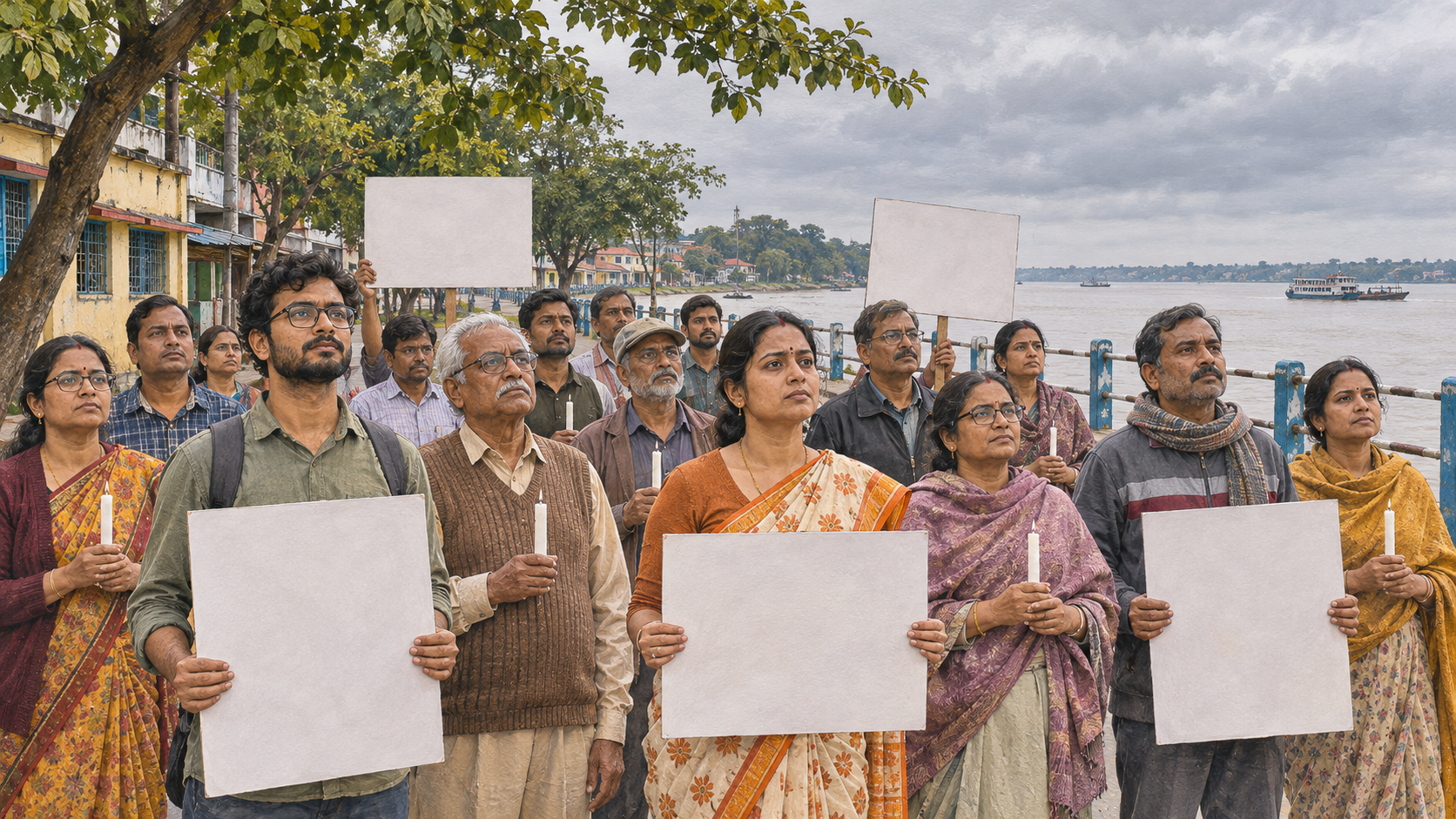
On 24 November 2026, a spontaneous street protest took place in Diamond Harbour. Demonstrators opposed the persecution of Hindus in Bangladesh and demanded justice for victims.
That is the factual core you can repeat confidently: the date, the place, the spontaneous character of the street demonstration, its stated cause, and its demand for justice. We cannot responsibly add a crowd estimate, a list of organisers, a route, official responses, or details about the underlying cases. Treat those points as unknown unless further evidence establishes them.
Precision matters even with a single adjective. “Spontaneous” does not necessarily mean leaderless, politically unaffiliated, or unplanned in every respect. It describes how the protest was characterised; it does not answer every question about its organisation. Likewise, a demand for justice shows what demonstrators sought. It is not, by itself, proof that a court or investigative authority has reached a finding.
If you need a shareable description, keep it this narrow: On 24 November 2026, a spontaneous street protest in Diamond Harbour demanded justice for victims of Hindu persecution in Bangladesh. Do not attach a crowd figure, name an organiser, or connect an unverified image to the gathering.
Justice is a stronger demand than retaliation

Persecution is a grave charge because it concerns targeted harm, fear, exclusion, or coercion directed at people because of their identity. In this case, it names the cause raised by the protesters. It does not eliminate the need to verify each alleged incident, identify responsible individuals, and establish what remedy the affected people need.
A demand for justice should therefore remain concrete. It can call for the protection of people at risk, impartial investigation of alleged offences, accountability for identified perpetrators, access to lawful remedies, and public follow-through. These requests keep attention on victims instead of allowing outrage to dissolve into slogans.
Retaliatory language does the opposite. It transfers blame from alleged offenders to an entire religious or national population. That neither protects a Hindu family in Bangladesh nor strengthens the credibility of Hindu advocacy in Bharat. You can oppose anti-Hindu persecution without making claims about every Bangladeshi or every Muslim.
A Dharmic response does not require passivity. It requires firmness governed by truth, restraint, and responsibility. The useful question is not whether anger is understandable. It is whether your next action makes a threatened person safer, a claim clearer, or accountability more likely.
How to support the cause without spreading harm

- Share the verified nucleus first. State the date, place, nature of the protest, and demand for justice. Mark every additional detail as unconfirmed until you can trace it to identifiable evidence.
- Preserve provenance. Keep the original page URL, publication date, and exact wording of the claim. A screenshot can disappear from its context, so retain the link alongside it. If the page later changes, note when you accessed it rather than presenting your memory as a quotation.
- Verify images separately. A photograph or video circulating beside a claim may come from another place or time. Look for the earliest available upload, visible landmarks, signs, language, weather, and an identifiable uploader. If you cannot establish when and where it was recorded, label it unverified or leave it out.
- Ask for a defined remedy. When contacting elected representatives, diplomatic offices, or human-rights institutions, request minority protection, monitoring, transparent reporting, impartial investigation, and lawful accountability. A specific request is easier to answer and harder to dismiss than a general expression of anger.
- Protect affected people. Do not publish a victim’s address, telephone number, family details, or precise location merely to make a claim appear convincing. Verification does not always require public identification, especially when disclosure could expose someone to further danger.
- Check before donating. Confirm an organisation’s legal identity, current work, reporting practices, and method of protecting beneficiaries. If you cannot determine who controls the funds or how recipients are safeguarded, do not send money; careless publicity or poorly managed assistance can expose families as well as waste donations.
This method may feel slower than forwarding an alarming message, but it creates a usable chain: a documented claim, a clearly identified need, an accountable recipient, and a follow-up question. That chain is what turns solidarity into civic pressure.
What to look for as the story develops

The protest deserves attention, but the next stage should produce information that can be checked. Watch for exact locations and dates of alleged persecution, descriptions of the harm, appropriately protected testimony, complaints or official records where they exist, and updates on whether victims obtained safety or redress.
Do not confuse repetition with corroboration. Ten accounts copying the same sentence still amount to one chain of information. Stronger corroboration comes when independently placed witnesses, institutions, records, or contemporaneous images confirm different parts of the same event.
Also watch what happens after the street gathering. Did any responsible body acknowledge the demand? Was a petition submitted? Did organisers or participants specify the cases for which they sought justice? Did the discussion produce protection, investigation, or continuing advocacy? These questions measure consequences without inventing them.
Absence of a public update does not prove that nothing happened. It means the outcome remains unknown. Keep that distinction visible whenever you discuss the protest.
Key takeaways
- A spontaneous street protest occurred in Diamond Harbour on 24 November 2026 and demanded justice for victims of Hindu persecution in Bangladesh.
- No crowd estimate, organiser list, official response, or incident-level account should be added without further verification.
- Effective Hindu advocacy asks for protection, investigation, lawful accountability, and measurable follow-through.
- Opposing persecution does not justify collective blame, communal hostility, or exposing vulnerable people.
- Your most useful next step is to share the verified facts with a specific request and then track whether the responsible institution responds.
Use the Diamond Harbour protest as a starting point, not as a substitute for evidence. Share its confirmed demand, ask who can act on it, and keep following the cases until “justice” becomes a documented outcome rather than a disappearing slogan.
References

Leave a Reply
You must be logged in to post a comment.