
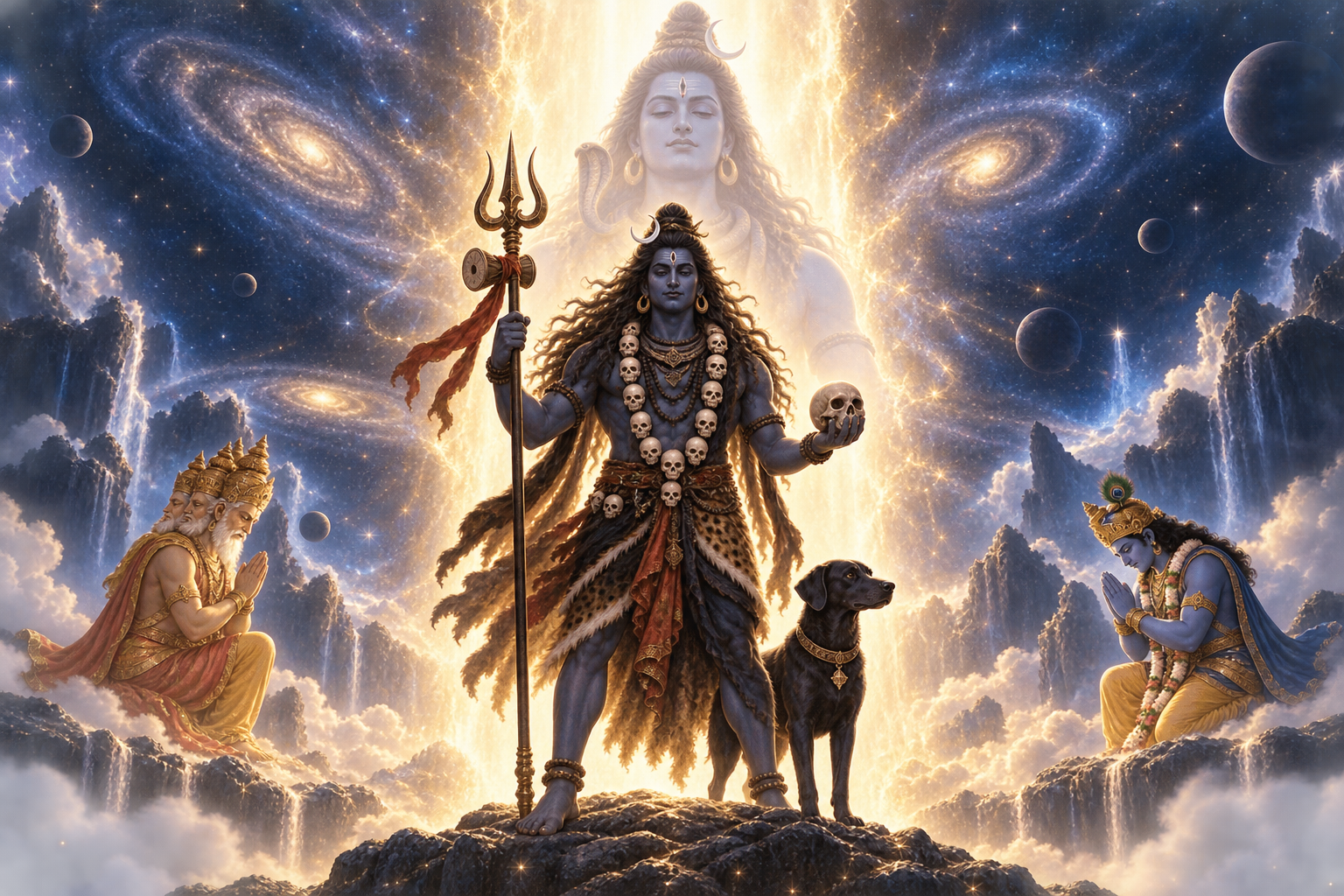
If you came looking for a simple divine family tree, Kala Bhairava’s origin asks you to look deeper. In the Jyotirlinga account, he does not appear merely to occupy another place in the pantheon. He emerges when rank has hardened into ego, a claim to supremacy has departed from truth, and a decisive correction has become necessary.
The order of events matters: the dispute between Brahma and Vishnu, the infinite pillar of light, the failed attempt to measure it, the false assertion, and only then the severing of Brahma’s head. Keep that sequence intact and Kala Bhairava’s fearsome form becomes intelligible. He is not violence without purpose. He is Shiva’s uncompromising answer to ego protected by authority.
The Jyotirlinga origin story, step by step
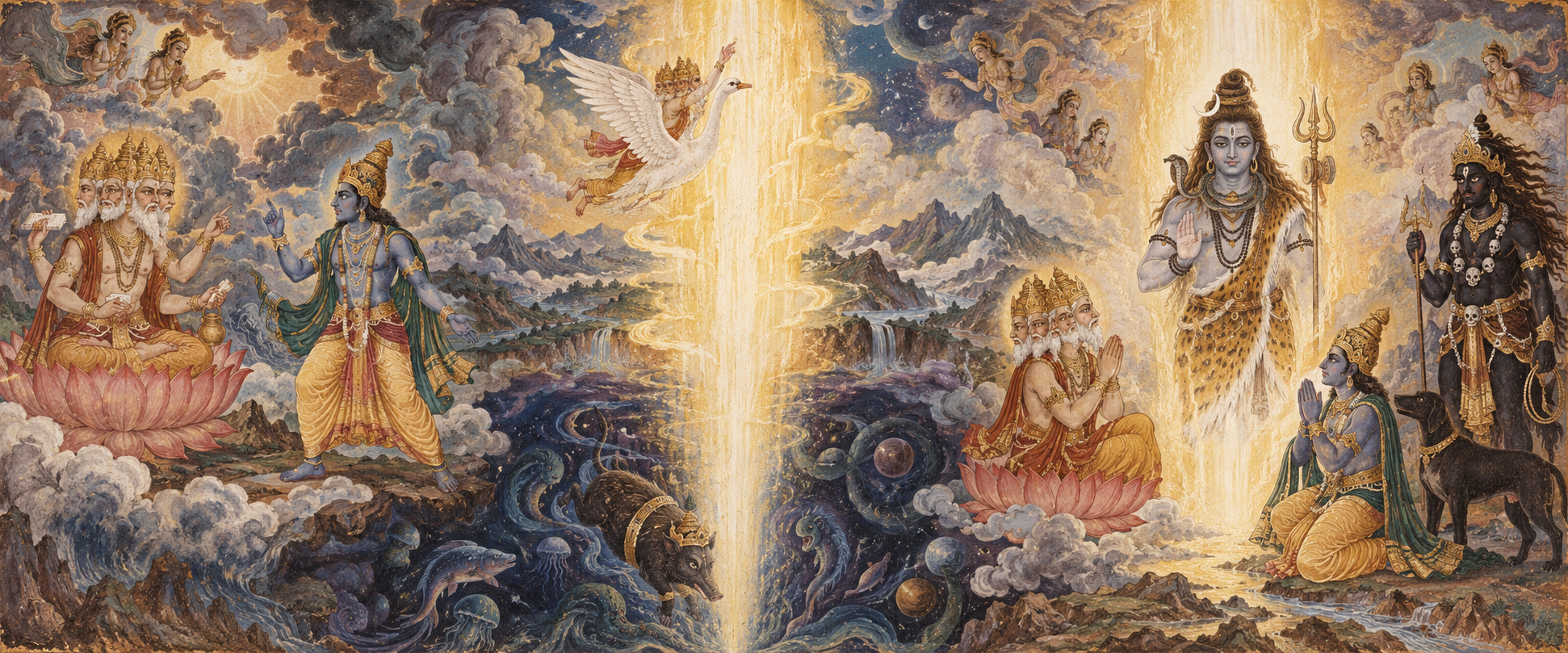
Hindu traditions preserve several accounts of Kala Bhairava’s manifestation. The Jyotirlinga narrative is one such sacred account, not a reason to dismiss other regional, scriptural, or sectarian tellings. Its distinctive teaching comes from the relationship between limitless light and the destruction of pride.
- Brahma and Vishnu dispute supremacy. The conflict is not initially between good and evil. It is a contest over who occupies the highest position in the cosmic order.
- An immeasurable pillar of light appears. The Jyotirlinga has no discoverable beginning or end. Its very form makes the dispute impossible to settle through status or measurement.
- The search exposes their limits. Neither contender can reach an endpoint. The infinite cannot be contained by the powers operating within it.
- The responses to failure diverge. Vishnu accepts that the limit cannot be found. Brahma converts inability into a false claim of success, turning rivalry into a failure of truth.
- Kala Bhairava emerges as the correction. From Shiva’s boundless radiance comes the fierce power that severs Brahma’s offending head and breaks the assertion of supremacy.
This sequence answers the central question about Kala Bhairava’s origin. He arises from the infinite reality of Shiva when ego tries to place itself above that reality. His manifestation is therefore judicial as well as fierce: the action restores the distinction between truth and pretence.
Why the infinite pillar must come before Bhairava

If you skip the Jyotirlinga and begin with the severed head, the story can look like an arbitrary display of divine anger. The pillar supplies the moral and philosophical setting. It has no summit from which anyone can declare, “I stand above all,” and no base that can be possessed as proof of complete knowledge.
The unsuccessful search is not presented as shameful. A finite power encountering the infinite will necessarily reach a limit. The ethical break occurs when that limit is concealed and failure is converted into false certainty. In practical terms, the story does not condemn inquiry or ambition. It condemns the refusal to admit what inquiry has not established.
This is the detail to preserve when explaining the story to a child, discussing it in a study group, or contemplating it during worship: not knowing is not the same as lying. Vishnu’s inability to find an endpoint does not diminish him. Honest acknowledgement places him in right relation to the infinite. Brahma’s problem is not that he encounters a limit; it is that authority is used to deny the limit.
What the severed head signifies
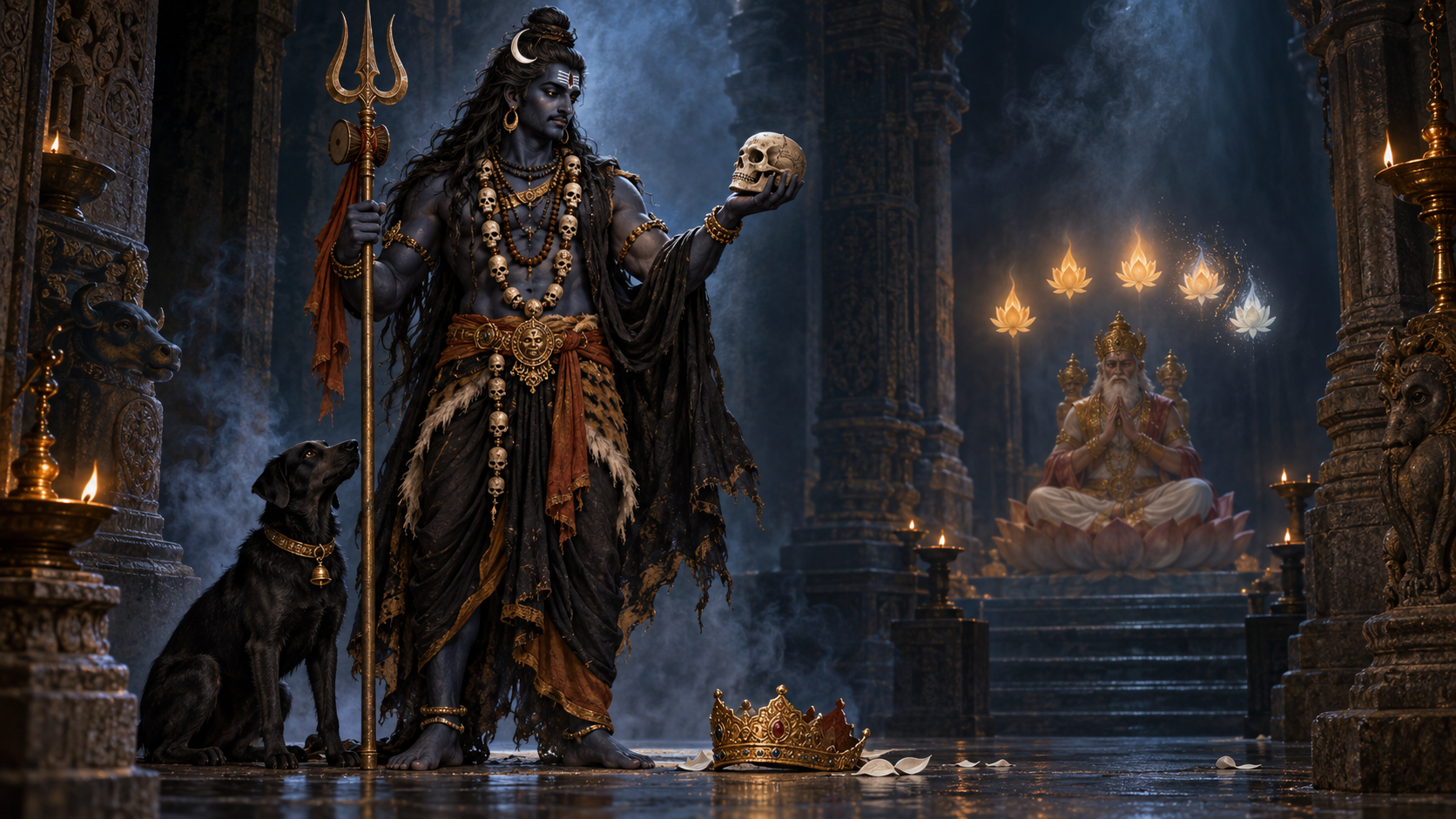
The severing should be read within the logic of the entire sacred narrative, not isolated as a shocking image. Brahma’s head has become the vehicle of the false claim: it speaks superiority, treats position as proof, and refuses correction. Kala Bhairava removes precisely what has become attached to untruth.
That does not make the story hostile to knowledge, speech, creation, or Brahma. Its target is knowledge claimed without truth and authority exercised without humility. The difference is essential. Hindu sacred narratives often place philosophical instruction inside vivid divine action; reducing that action to either literal violence alone or a harmless metaphor strips away half its force.
You can test whether a retelling has preserved the meaning by asking three questions:
- Does it explain the limitless Jyotirlinga before describing Bhairava’s act?
- Does it distinguish an honest admission of limitation from a false claim of mastery?
- Does it show that Kala Bhairava acts from Shiva’s boundless reality rather than from personal rivalry?
If those links disappear, Bhairava is easily misread as merely frightening. When they remain, the severed head becomes a precise warning: no office, title, achievement, or divine function places falsehood beyond consequence.
Kala Bhairava’s origin reveals his dharmic role
Kala Bhairava is not introduced here as Shiva’s competitor. He is the fierce manifestation of Shiva’s power arising from the same immeasurable light before which Brahma and Vishnu are tested. The origin therefore tells you how to interpret his severity: it protects the order that ego and falsehood threaten to overturn.
Fierceness and cruelty are not interchangeable. Cruelty inflicts suffering for its own sake or for private satisfaction. Bhairava’s act has a defined cause, target, and corrective purpose. The head associated with the false assertion is removed; the lie is not permitted to become cosmic truth simply because it comes from a powerful being.
Nor should humility be confused with self-erasure. The story does not ask you to pretend that you know nothing, possess no ability, or have no responsibilities. It asks for accuracy about the boundary of your knowledge. Vishnu’s honest response shows that admitting a limit can be an expression of strength. Brahma’s fall shows that exaggerating certainty is not strength, however elevated the speaker may be.
This is why “destroyer of ego” is more exact than “angry deity.” Anger describes an appearance or emotional tone. The destruction of ego identifies the function performed in the story. Kala Bhairava cuts through the part of identity that would rather defend status than submit to truth.
How to carry the story into practice

You do not need to invent a new ritual to respond to this origin account. Its first demand is ethical attention. Before prayer, study, or an important decision, place one disputed claim of your own before the image of the infinite pillar and examine it with four questions:
- What do I actually know? Separate what you have witnessed or verified from what you merely expect to be true.
- Where am I using status as evidence? A title, seniority, education, lineage, or past success can support responsibility, but none makes a present claim automatically true.
- What limit am I reluctant to admit? Name it plainly. “I do not know” is often closer to dharma than an impressive answer built on pretence.
- What should be severed? Identify the false statement, excuse, boast, or attachment to being right. Correct that specific thing rather than performing vague remorse.
The practical act may be small: retract an unsupported claim, acknowledge another person’s better judgment, correct a misleading account, or stop presenting an assumption as knowledge. One honest correction embodies the lesson more faithfully than admiring fierce imagery while protecting the same pride within yourself.
Use the teaching first as a mirror, not as a weapon against someone else. It is easy to identify Brahma’s pride in an opponent and much harder to notice the head speaking falsely within one’s own conduct. Kala Bhairava’s challenge becomes spiritually useful at precisely that uncomfortable point.
If your temple, sampradaya, or guru gives particular instructions for mantra, vrata, or worship, follow that living discipline. The origin story supplies a contemplative and ethical orientation; it should not be used by itself to manufacture ritual procedures.
Key takeaways
- The Jyotirlinga account is one of several traditional narratives about Kala Bhairava’s manifestation.
- Kala Bhairava emerges from Shiva’s infinite light during the dispute between Brahma and Vishnu.
- The endless pillar establishes the decisive truth: no ranked power within the cosmos can measure or stand above the infinite.
- The failed search is not the wrongdoing. The decisive fault is converting limitation into a false claim of supremacy.
- The severed head represents a precise correction of ego, untruth, and authority that refuses accountability.
- You apply the teaching by admitting what you do not know and correcting the particular falsehood that pride wants to preserve.
The next time you encounter Kala Bhairava, pause before the fearsome form and remember the pillar behind him. Then choose one claim in your own life that needs more truth and less status. That is where this origin story stops being distant mythology and begins doing its work.
References

Leave a Reply
You must be logged in to post a comment.