
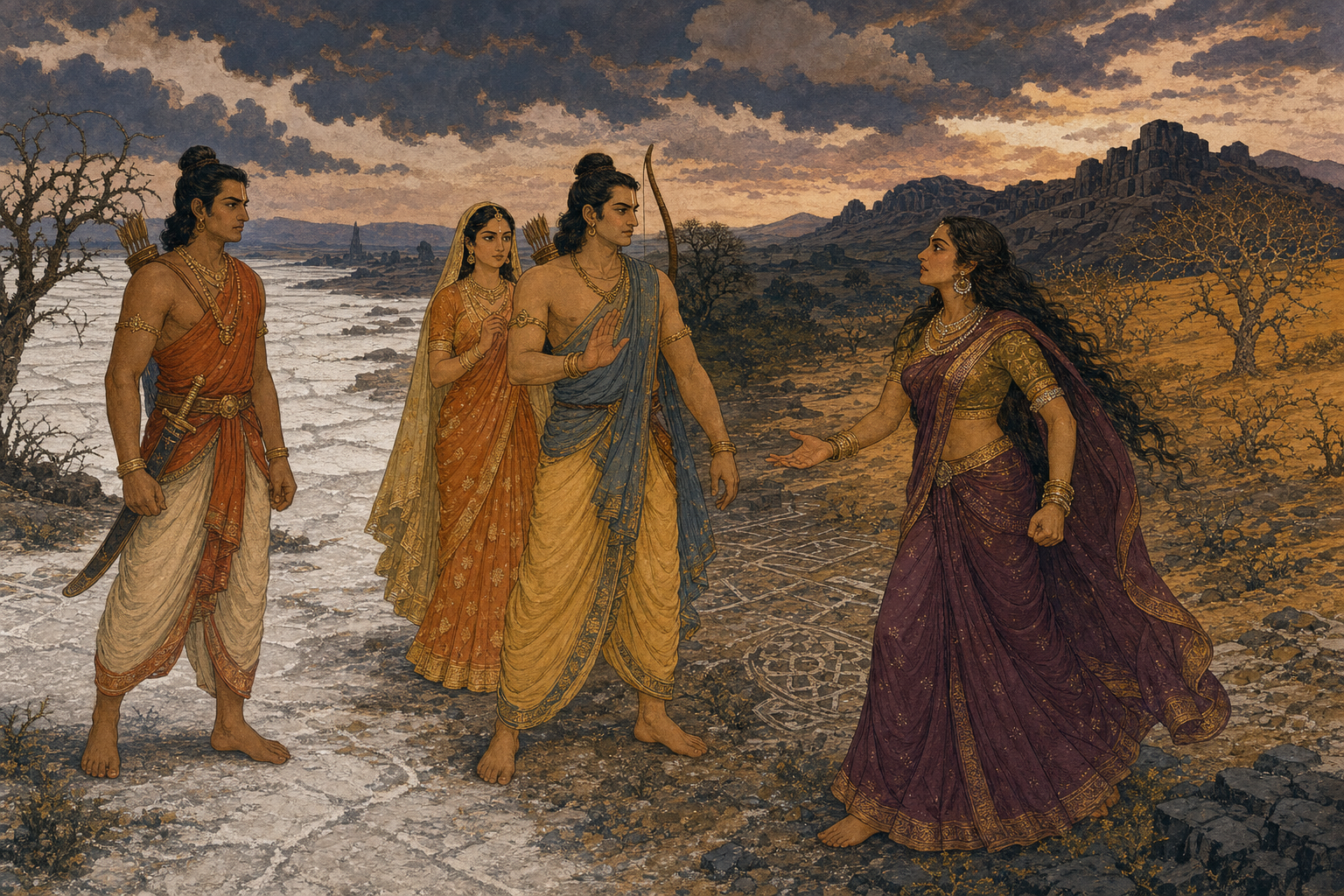
You may have reached Surpanakha’s story with a blunt question: was she mutilated simply because she expressed desire? If you isolate a single image from the episode, that conclusion can seem unavoidable. Many western Indian traditions, however, draw a firm line between her initial approach to Rama and her later threat to Sita. Desire begins the encounter; the threat changes its moral character.
That distinction does not require you to ignore the severity of Lakshmana’s response. It gives you a better way to examine it. Gujarat, Rajasthan, and Maharashtra preserve different performance vocabularies, yet they repeatedly ask the same practical questions: What does maryada protect? When may protection become force? How can force remain limited? And how does one angry encounter become a cycle of retaliation?
Read the ethical sequence before judging the isolated image
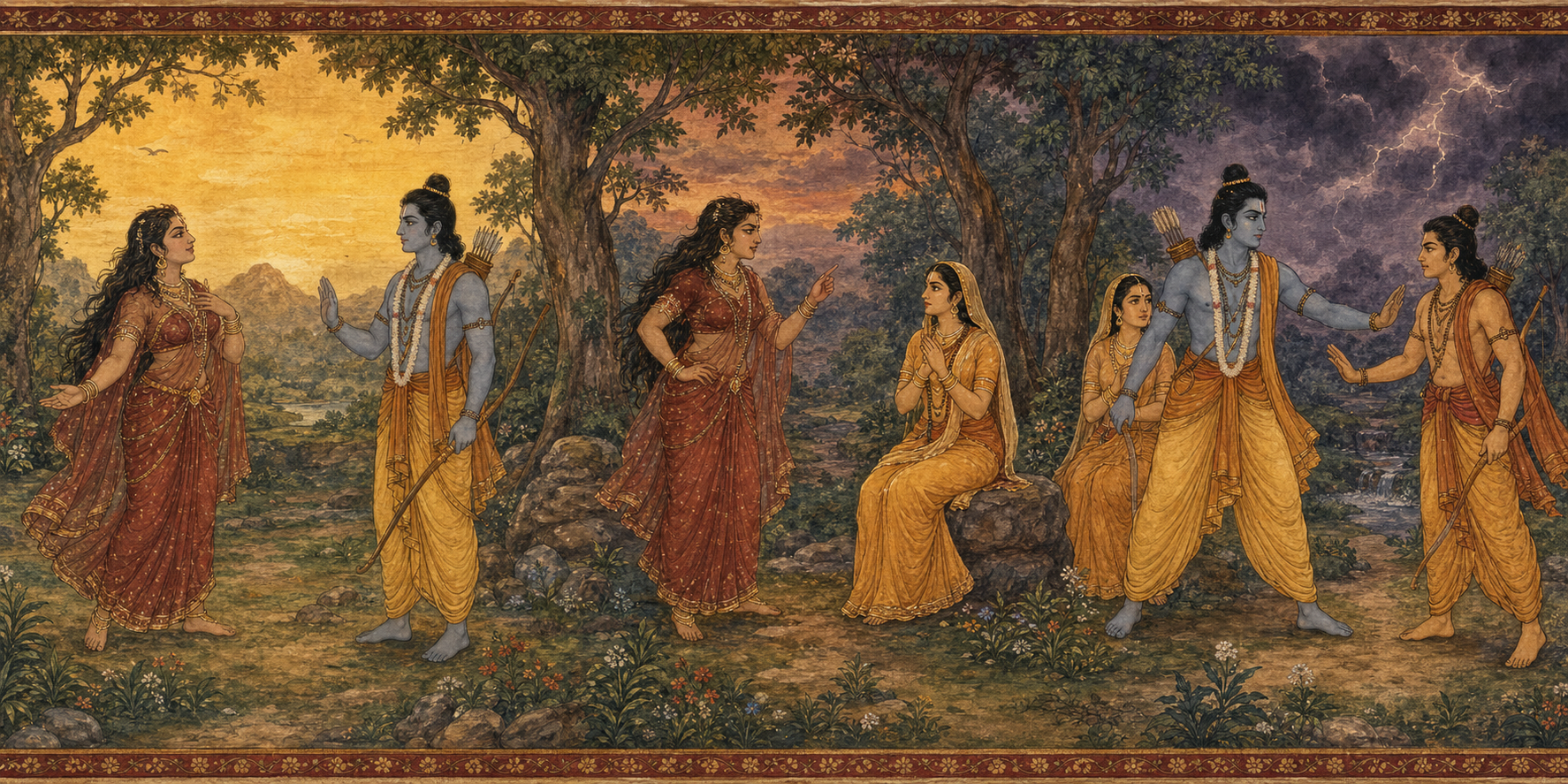
Valmiki’s Aranya Kanda supplies the narrative point of departure, but its sequence matters more than any frozen picture of Surpanakha or Lakshmana. The episode unfolds through five morally distinct moments:
- Surpanakha approaches Rama and expresses her desire.
- Rama refuses her without surrendering his composure.
- Surpanakha turns toward Sita and threatens the person whose presence stands between desire and possession.
- Lakshmana intervenes and disfigures her, traditionally by cutting her nose and ears.
- The intervention fails to end the conflict. Retaliation expands through Khara and Dushana and eventually reaches Ravana, Sita’s abduction, and war.
If you collapse these moments into one, you usually end up with one of two caricatures. In the first, a woman is punished merely for finding a man attractive. In the second, every act performed by an epic hero is treated as self-justifying and therefore exempt from moral examination. Neither reading captures the ethical work done by western Indian retellings.
Maryada in this setting is not just politeness. It is the boundary that makes fidelity, refusal, hospitality, household order, and protection credible. Surpanakha’s desire can be heard without being treated as a crime. Her refusal to accept the boundary, followed by a threat to Sita, is what moves the encounter from courtship into danger.
You should therefore ask two questions, not one. Was intervention warranted once Sita was threatened? Was the intervention restrained and proportionate? Many folk performances answer the first decisively and approach the second through symbolic staging, an insistence on protective rather than vindictive intent, and warnings about the consequences of escalation. That is a defence of guardianship, not an instruction to delight in bodily punishment.
Gujarat, Rajasthan, and Maharashtra speak in different moral registers
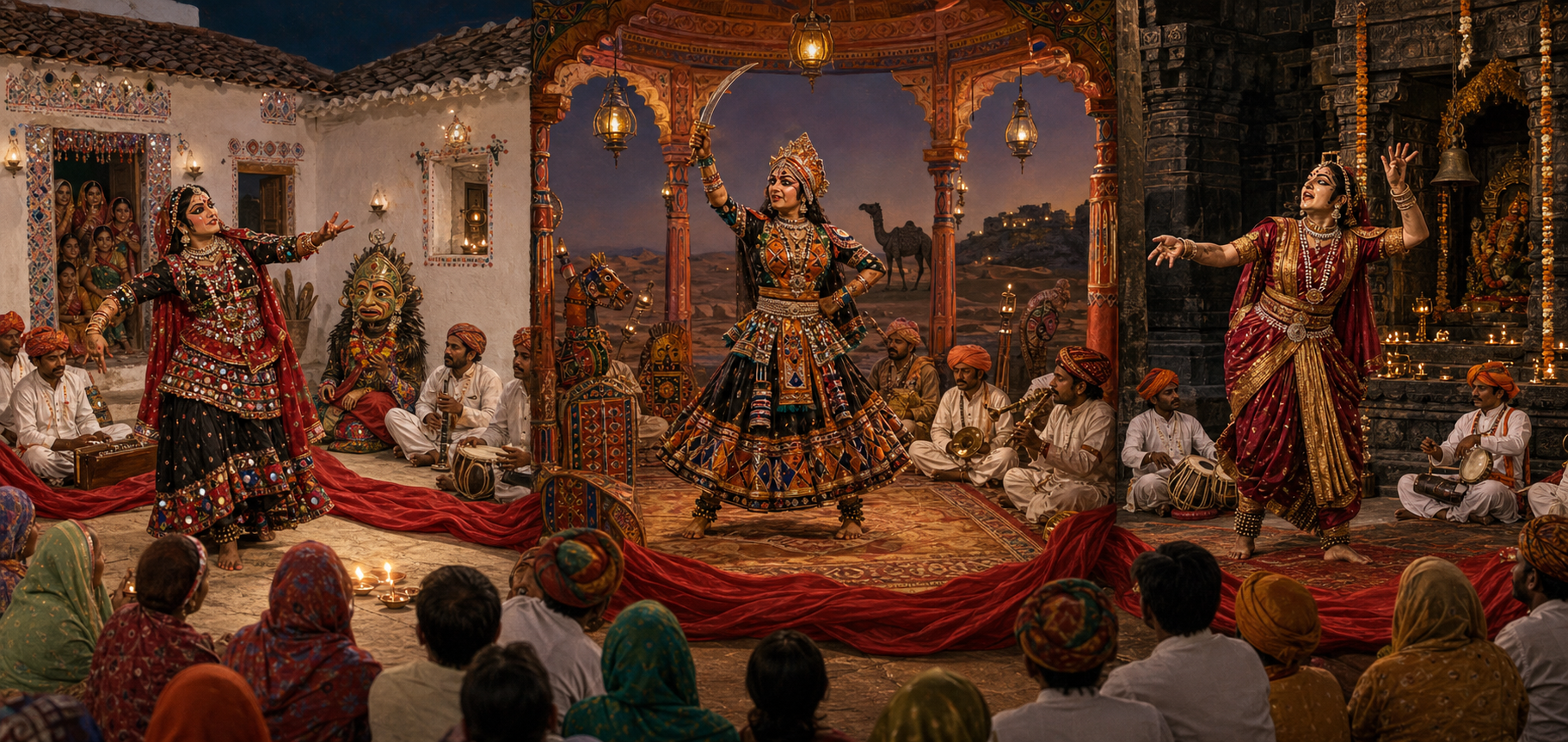
Western Indian folklore is not a single alternate Ramayana. It is a field of oral genres, devotional practices, poetic conventions, and theatrical choices. The regional patterns below are tendencies, not fixed scripts. When you hear a local retelling, identify its genre before assuming that every detail represents an entire state or community.
Gujarat: satire turns punishment into public instruction
Bhavai brings Ramayana episodes into public squares and temple courtyards through dialogue, music, gesture, and comic timing. In Surpanakha’s scene, hasya, the comic mood, often works alongside niti, moral instruction. Exaggeration directs attention toward uncontrolled impulse and social impropriety, while stylized action prevents the mutilation from becoming a spectacle of gore.
Dayro singing and Vaishnava katha in Saurashtra and Kutch draw on the Gujarati expression naak katvi, the cutting or loss of one’s nose, to evoke ruined honour. The nose consequently functions as more than anatomy. Its loss publicly marks conduct that has crossed a boundary and endangered trust. The emphasis falls especially on the security of the forest household and the obligations surrounding a protected guest.
When you encounter a comic Gujarati version, listen carefully for the target of the joke. If mere female attraction is the target, the episode has been flattened into ridicule. If the satire exposes possessiveness, refusal to listen, and a threat against another person, the comedy is carrying a more precise ethical argument. That distinction separates moral theatre from casual misogyny.
Rajasthan: honour becomes a form of public accountability
Charan-Bhat and Dingal traditions place the encounter within rajamaryada and lajja: the duties, reputation, and modesty that sustain a righteous social order. Here, naak can signify the standing of a household or community. The mutilation therefore operates as a juridical metaphor, announcing that a threat to protected persons carries a public consequence.
That language of honour can be misunderstood if honour is reduced to wounded pride. In the stronger reading, reputation matters because it represents the reliability of one’s duties. A household that cannot protect a threatened member has failed in guardianship; a defender who turns necessary action into indulgent cruelty has also failed. Decisiveness and restraint must remain together.
Rajasthani kathputli performance makes that restraint visible. Masks, veils, poetic repartee, and compact gestures can communicate disfigurement without reproducing bodily suffering in detail. As you watch, notice whether the action closes once protection has been achieved. Contained force supports the language of duty. Prolonged humiliation would shift the scene toward revenge.
Maharashtra: protective duty is tested by compassion
Marathi interpretation is strongly shaped by Harikatha, kirtan, ovi-based pravachan, and Eknath’s Bhavarth Ramayan. Within this devotional vocabulary, Rama can represent samashti-dharma, the order sustaining the whole, while Lakshmana represents vyashti-dharma, the duty confronting an immediate danger. Rama’s composure and Lakshmana’s protective action belong together only when the latter remains governed by the former.
The performance sequence frequently balances raudra, the mood of fury, with karuna, compassion, and shanta, tranquility. That transition is not decorative. It tells you how to judge the defender: true kshatra-dharma is shown by the ability to protect the vulnerable without becoming captive to anger. Strength is measured not only by the capacity to act, but also by the capacity to stop.
Tamasha, Lavani, and Gondhal can give Surpanakha a more audible presence through song and repartee. Her longing is allowed emotional reality even though her threat to Sita remains unacceptable. This is one of the most useful features of performance: it can acknowledge the humanity of a person whose conduct it condemns. You do not have to choose between hearing Surpanakha and protecting Sita.
Across the three regions, genre determines what the audience is asked to notice. Bhavai exposes folly through satire. Dayro and katha convert the event into moral discourse. Charan poetry speaks through honour and duty. Kathputli makes consequence visible without graphic realism. Kirtan and Harikatha place action under the discipline of bhakti. Popular Marathi theatre makes room for the emotional voice of the transgressor.
The nose and ears make the body an ethical symbol
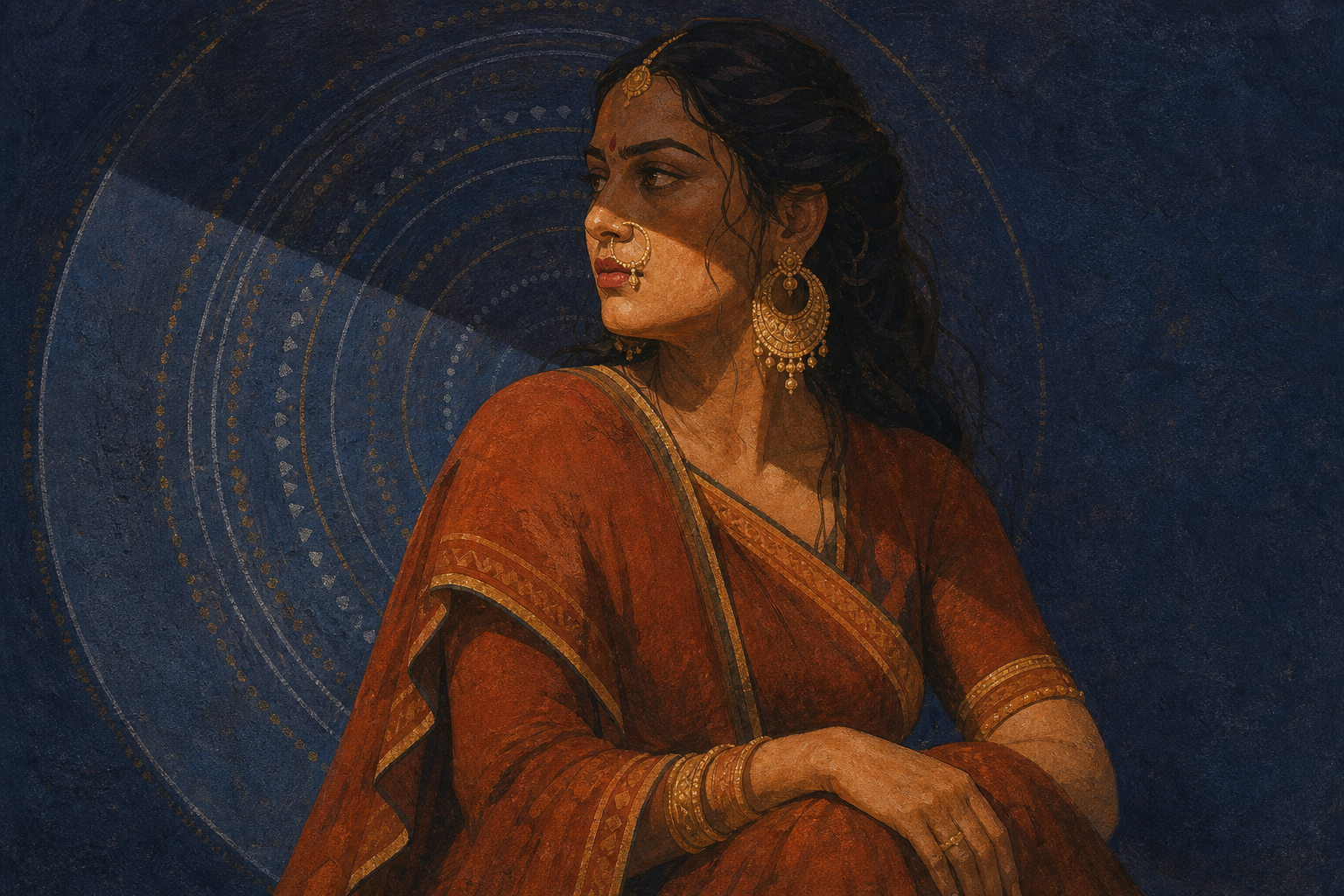
The cutting of Surpanakha’s nose and ears is bodily violence within the narrative. A responsible symbolic reading should not deny that plain fact. It asks why these particular features acquired such expressive force in communities where the episode was heard, watched, sung, and remembered.
The nose carries two related associations. Socially, it evokes honour and visible standing through regional idioms about losing one’s nose. Spiritually, it can be associated with prana, breath, and the regulation of impulse. The ears evoke shruti and the capacity for active, morally serious listening. Under this folk hermeneutic, nasika-chedana and karna-chedana mark a failure to govern appetite and a refusal to hear a boundary.
These associations do not turn mutilation into an abstract puzzle with no victim. Literal and symbolic meanings can operate at once. Within the plot, Surpanakha is wounded. Within performance, the wound becomes a sign of damaged honour, undisciplined desire, and failed listening. Keeping both levels in view prevents symbolism from becoming an excuse and literalism from exhausting the scene’s meaning.
Stagecraft shows how this double meaning works. A symbolic blade, a cloth nose, a mask, or a change in posture can stand for the act. Music then moves the audience away from raudra and toward reflection or calm. Dhvani, meaning suggestion, allows the consequence to be understood without graphic display; aucitya, propriety, governs what is suitable for a family or devotional gathering.
You can read the performance’s intention by watching what happens immediately after the gesture. Does the production linger on pain? Does it invite laughter at a woman’s damaged body? Or does music redirect attention toward cause, consequence, and restored boundaries? The movement from fury toward tranquility is itself part of the teaching. The community must not remain intoxicated by the force used in its defence.
The gender question requires a rule that works both ways
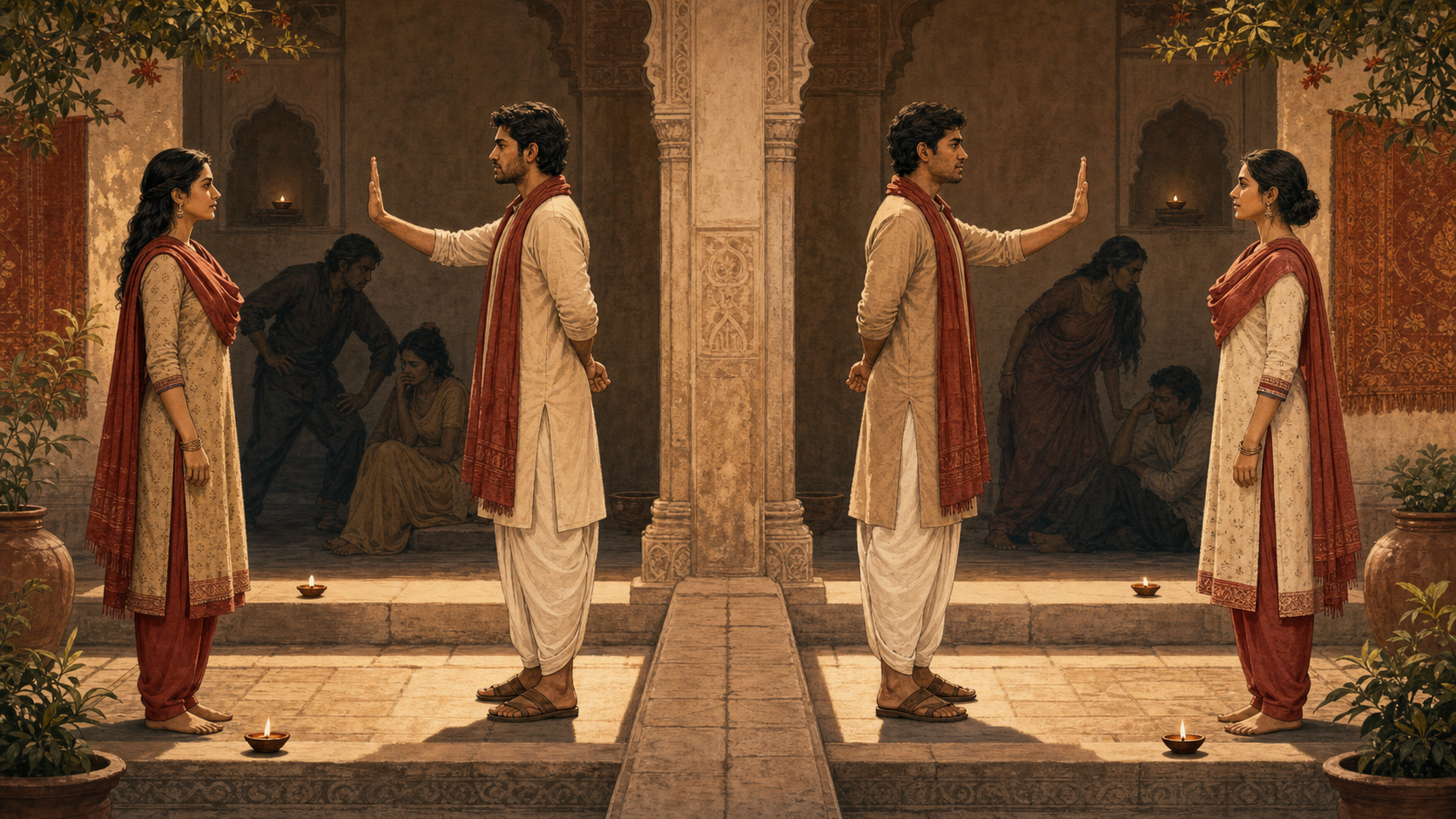
The easiest way to misuse this episode is to make female desire the offence. That reading fails the sequence. Surpanakha’s initial longing, however disruptive or comically exaggerated in some performances, is not identical to her threat against Sita. A refusal has been given. Another person’s safety is then placed at risk. The moral category changes because the conduct changes.
A second misuse is to invoke symbolism so quickly that Surpanakha’s suffering disappears. Saying that the lost nose represents lost honour may explain how an audience interprets the scene; it does not prove that every possible response would have been just. Western Indian devotional readings keep the question alive by stressing that force must be protective, delimited, and no greater than dharma permits.
A third misuse makes compassion compete with Sita’s protection. Karuna does not require leaving a threatened person undefended. Maryada does not require erasing the aggressor’s humanity. The more demanding position holds both: Sita’s protected space is non-negotiable, and Surpanakha remains a being whose desire, humiliation, rage, and later choices can be understood without being endorsed.
Use a gender-neutral test when you evaluate a retelling. Would the same interpretation condemn a male pursuer who ignored refusal and threatened a protected spouse? Would it still demand that a female defender stop once the danger had been contained? If the answer changes with the characters’ sex, the argument is probably defending a hierarchy rather than dharma.
Comic treatment deserves the same test. Hasya can create enough distance for an audience to face dangerous conduct without being overwhelmed by violence. It becomes ethically careless when womanhood, appearance, or injury itself is the joke. The right question is not whether a performance makes you laugh, but what it trains you to laugh at.
Key takeaways for reading Surpanakha responsibly
The episode does not end when Lakshmana lowers his weapon. Surpanakha’s appeal for retaliation draws Khara and Dushana into the conflict and ultimately brings Ravana into the causal chain. A boundary is defended, but anger continues to recruit new actors. That aftermath prevents the scene from becoming a simple celebration of punishment.
Jain ethical influence in Gujarat and Rajasthan sharpens this warning. Jain Ramayana traditions, notably the Paumacariya, arrange important events differently from Valmiki, yet their emphasis on ahimsa and rigorous self-restraint contributes a regional preference for minimizing injury and disciplining the senses. The central practice is indriya-nigraha: do not let appetite or anger seize command of the person who should be exercising judgement.
- Separate desire from threat. Surpanakha’s attraction begins the encounter; her movement against Sita creates the immediate need for protection.
- Treat refusal as a real boundary. Courtship, humour, or longing cannot turn another person’s no into an invitation to persist.
- Judge the defender by restraint. Protective intent matters, but so do the form, limit, and stopping point of the response.
- Read nose and ears on two levels. They are wounded body parts in the story and symbols of honour, impulse-regulation, and moral listening in performance.
- Listen for Surpanakha’s voice. A retelling can recognise her desire and humiliation without excusing her threat to Sita.
- Watch the change in rasa. A movement from fury through compassion toward tranquility tells the audience not to remain attached to violence.
- Follow the retaliation beyond the scene. Khara, Dushana, and Ravana reveal how an encounter expands when injury, anger, and family honour repeatedly summon another response.
- Name the genre before generalising. Bhavai, dayro, kathputli, kirtan, Harikatha, and popular Marathi theatre use different tools and should not be treated as one uniform folklore script.
The next time you hear this episode used as proof that dharma either suppresses women or licenses unquestioned violence, slow the argument down. Name the regional genre, identify the precise breach, examine the defender’s restraint, and follow the consequences after the blow. That method lets you protect Sita’s boundary, hear Surpanakha’s humanity, and preserve the difficult lesson at the centre of the western Indian tradition: justice loses its dharmic character when it becomes an appetite of its own.