
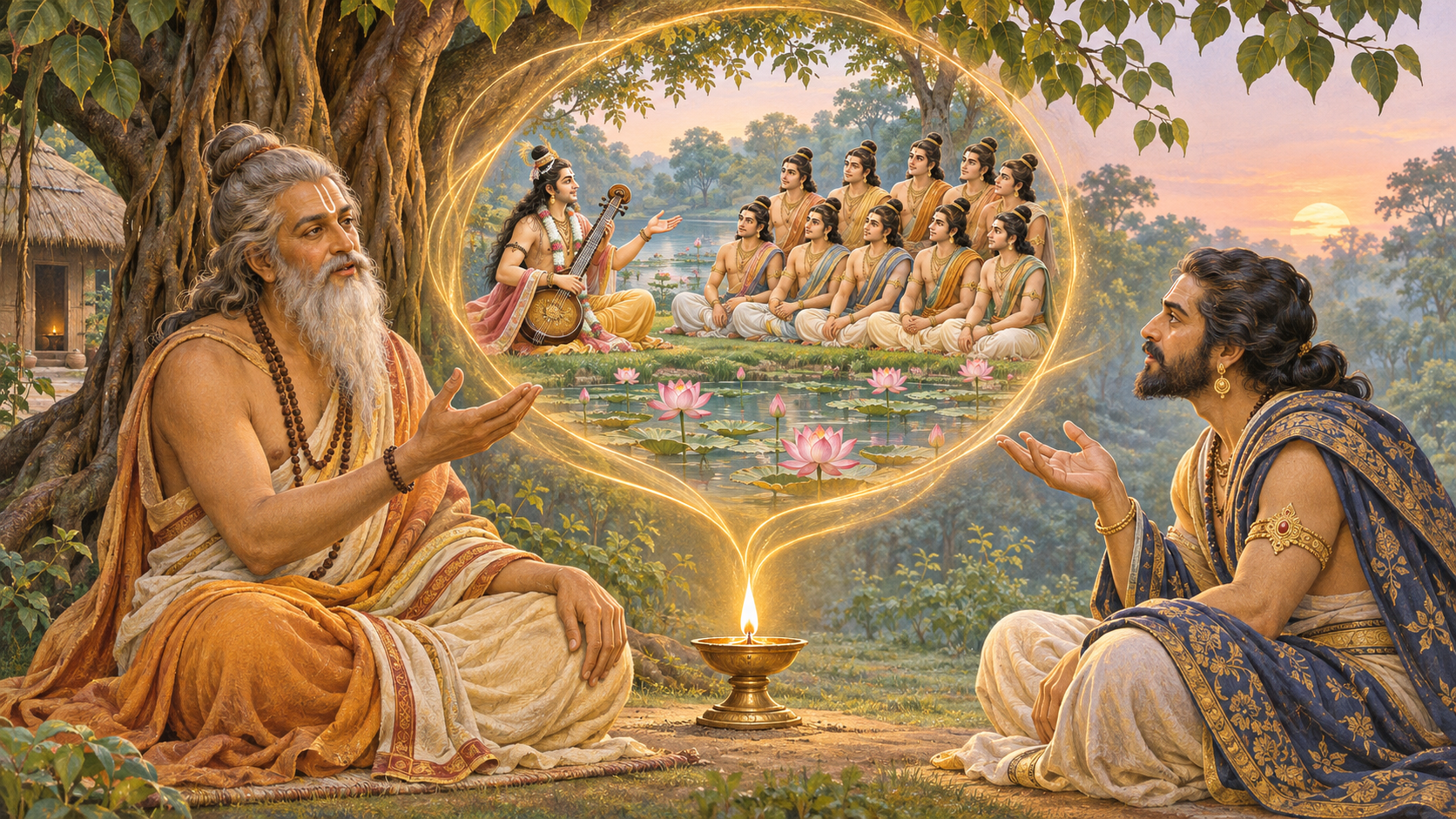
If you came here after hearing Srimad-Bhagavatam 4.31.25 discussed, you may wonder why a closing verse deserves sustained attention. It appears merely to confirm that an answer has been given. Read carefully, however, and it becomes a compact guide to hearing sacred katha well.
Vidura inquires. Maitreya answers. Within that answer, Narada speaks with the Pracetas. The entire exchange is identified as hari-kirtanam, speech that glorifies Hari. That sequence gives you a practical discipline: approach scripture with a real question, follow the dialogue rather than collecting isolated quotations, and leave with your attention more firmly directed toward Bhagavan.
A closing verse that maps the whole act of hearing

etat te ‘bhihitam ksattar
Srimad-Bhagavatam 4.31.25
yan mam tvam pariprstavan
pracetasam naradasya
samvadam hari-kirtanam
A close rendering is: O Vidura, I have answered your inquiry by recounting Narada’s dialogue with the Pracetas, a conversation that glorifies Hari.
This is not administrative closure. The verse gathers the chapter into four movements:
- Inquiry: Vidura has asked Maitreya something worth pursuing.
- Transmission: Maitreya responds by faithfully relating sacred history.
- Dialogue: The answer contains Narada’s exchange with the Pracetas, not merely a detached proposition.
- Orientation: The exchange is finally classified by its spiritual purpose: it is hari-kirtanam.
The last movement governs the others. Inquiry, narration and dialogue are not ends in themselves. They become spiritually fruitful when they help the hearer remember and glorify Hari. The historical personalities remain important, but they are not presented as isolated celebrities. Their words and choices make the relationship between Bhagavan and the devotee visible.
This gives you a sharp test for your own reading. If you can recall every name and event but cannot say what the passage reveals about Hari, how a devotee responds to Him, or what deserves remembrance, you have retained the narrative shell while missing its declared center.
Three Sanskrit terms that change how you listen

Pariprstavan: begin with a living inquiry
The verse remembers that Vidura inquired. His question is not an inconvenience that delays the teaching; it is part of the sacred process through which the teaching becomes available. This corrects the idea that faith requires passive silence. Reverence and intelligent inquiry can work together.
Before your next class or personal reading, write down the question you are actually carrying. Make it concrete. You might ask how duty can be performed without possessiveness, what attachment is obstructing service, or what quality of Bhagavan the passage invites you to remember. A live question gives your attention somewhere to stand.
Do not force every verse into answering the question you brought. Let the text correct the question when necessary. Vidura’s example supports inquiry, not the demand that revelation conform to our prior assumptions.
Samvadam: preserve the movement of the dialogue
Samvada means conversation or dialogue. Here, one dialogue is carried within another: Maitreya speaks to Vidura about Narada’s conversation with the Pracetas. The teaching therefore reaches you through relationships between speakers and hearers.
When taking notes, do not record only the final maxim. Capture the movement that produced it: Who asked? What condition prompted the teaching? What response was given? What changed in the hearer? A conclusion separated from its dialogue can become a slogan. Preserving the movement helps you understand when and how the teaching applies.
This also changes how you approach a teacher. Instead of asking for a general speech on spirituality, bring a precise question and remain ready for a response that examines your premise. Sacred dialogue requires both truthful instruction and teachable hearing.
Hari-kirtanam: let Hari remain the center
Many people associate kirtana primarily with devotional singing. That practice is central and precious, but this verse displays a wider use of the word. A conversation between Narada and the Pracetas is called hari-kirtanam. Narration, explanation and dialogue can therefore participate in kirtana when they genuinely glorify Hari.
That does not mean any talk containing divine names automatically becomes Hari-kirtana. Ask where the speech directs attention. Does Hari become easier to remember? Does a divine quality, action or relationship become clearer? Does the devotee’s example illuminate service, surrender or gratitude? Or does the discussion mainly magnify the speaker, encourage gossip, or reduce spiritual life to social identity?
Glorifying a devotee need not compete with glorifying Bhagavan. The devotee’s life matters because it shows what remembrance, obedience and loving service look like in action. Hari remains the center; the devotee makes that center visible in a human life.
A practical method for turning discourse into sadhana

You do not need elaborate notes to hear in the pattern of this verse. Use the following method during katha, a recorded class or your own reading.
- Arrive with one question. Write it in a complete sentence before the teaching begins. This prevents vague listening while leaving room for the question to be corrected.
- Mark what is revealed about Hari. Note a quality, action, relationship or reason for remembrance. If your page contains only human personalities, return to the passage and look for its divine center.
- Mark the devotee’s response. Notice what the devotee hears, relinquishes, accepts, remembers or does. This keeps devotion from remaining an abstraction.
- Write one therefore sentence. Complete the words: Therefore, in my present situation, I should… Make the sentence small enough to obey rather than grand enough to admire.
- Apply it before seeking more material. Repeat a divine name attentively, revisit the relevant verse, repair a neglected duty, ask a precise follow-up question, or retell the teaching in a way that keeps Hari at the center.
The final step matters because collecting spiritual content can imitate progress. A growing library, a long playlist and detailed notes may support sadhana, but none of them can perform remembrance or service for you. One teaching honestly applied is more useful than several teachings merely stored.
Common misreadings that weaken the verse

- The verse is only a formal ending. Its position is conclusive, but its language identifies the spiritual character of everything just narrated. It tells you how the preceding conversation should be understood.
- Questions indicate weak faith. Vidura’s inquiry belongs to the transmission of the teaching. The real problem is not sincere questioning but questioning that refuses correction or seeks only victory.
- Kirtana must always be musical. This verse explicitly calls a sacred conversation hari-kirtanam. Melody is one form of kirtana; faithful narration and discussion can also glorify Hari.
- Stories of devotees are ordinary biography. Their central value lies in what they reveal about devotion and Bhagavan. Remove that relation, and sacred character becomes mere personality study.
- Hearing is complete when the speaker stops. Maitreya can conclude his narration, but the hearer’s work continues through remembrance, discernment and application.
These corrections protect you from two opposite errors. One turns scripture into information about the past. The other extracts devotional slogans while ignoring context and disciplined inquiry. SB 4.31.25 holds history, dialogue, devotion and glorification together.
Key takeaways
- SB 4.31.25 presents sincere inquiry as part of sacred hearing, not as its enemy.
- The word samvadam asks you to follow the relationship between question, instruction and response.
- The description hari-kirtanam shows that sacred conversation can be kirtana when Hari remains its true center.
- Devotees are glorified most meaningfully when their lives reveal how loving service to Bhagavan is practiced.
- Your hearing becomes actionable when you identify what the passage reveals about Hari, how the devotee responds, and what you will now do differently.
Before your next katha, open your notebook before the speaker begins and write one honest question. When the teaching ends, do not ask only what information you gained. Ask what became clearer about Hari, what response you witnessed in the devotee, and what act of remembrance or service now belongs to you. That is how a concluding verse becomes the beginning of practice.
References

Leave a Reply
You must be logged in to post a comment.