
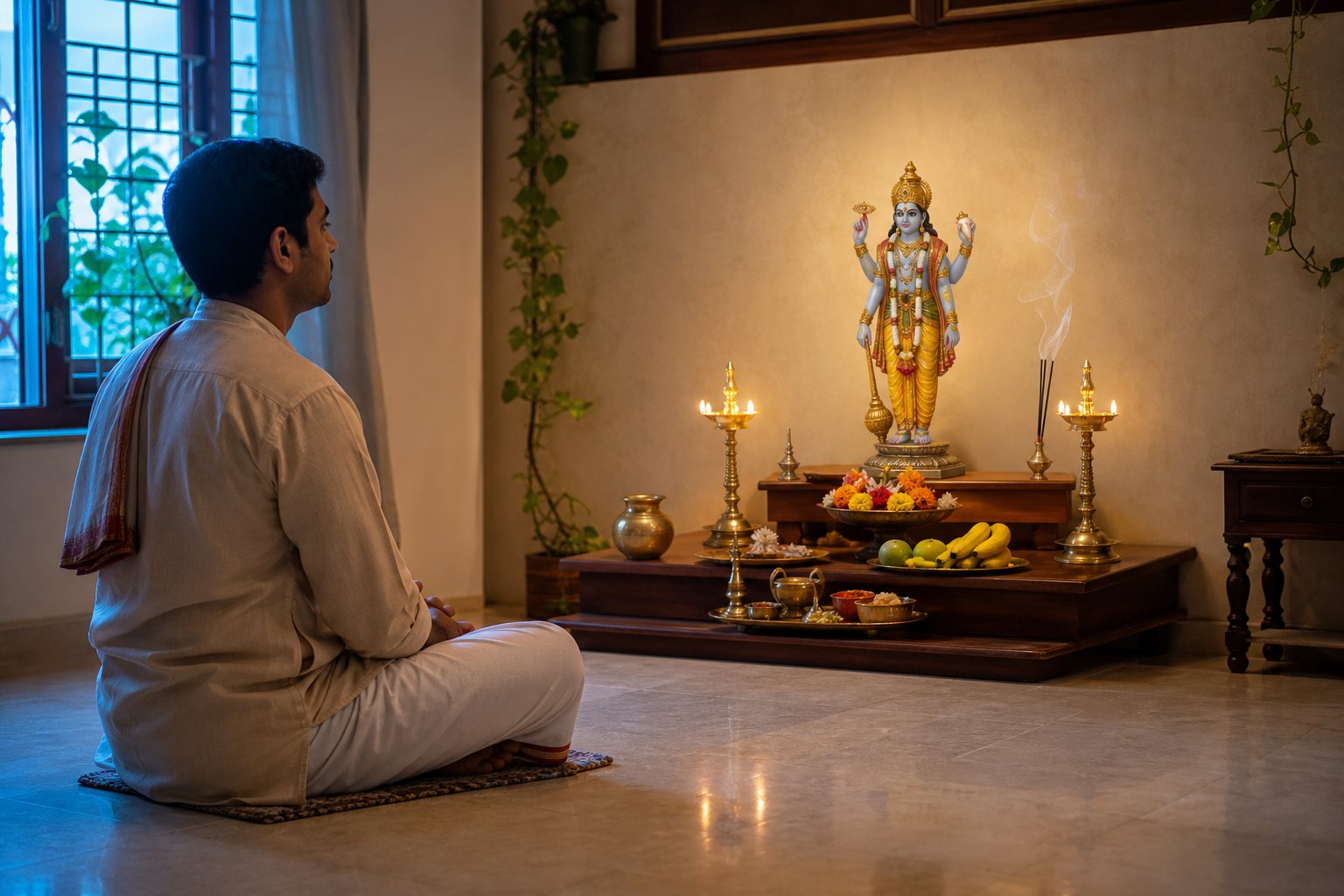
You can know where to place the lamp and flower yet still miss what puja is asking of you. Srimad Bhagavatam 11.3.52-53 closes that gap. The worshipper receives Bhagavan, serves His complete form in an ordered way, offers praise, and then bows.
If you arrived after the 26 August 2026 discourse by Sarvabhauma Prabhu on these verses, use this reading as a map for your own practice. The central question is not whether your altar looks elaborate. It is whether every action carries you from attention to service and from service to surrender.
Read the two verses as a movement, not an inventory
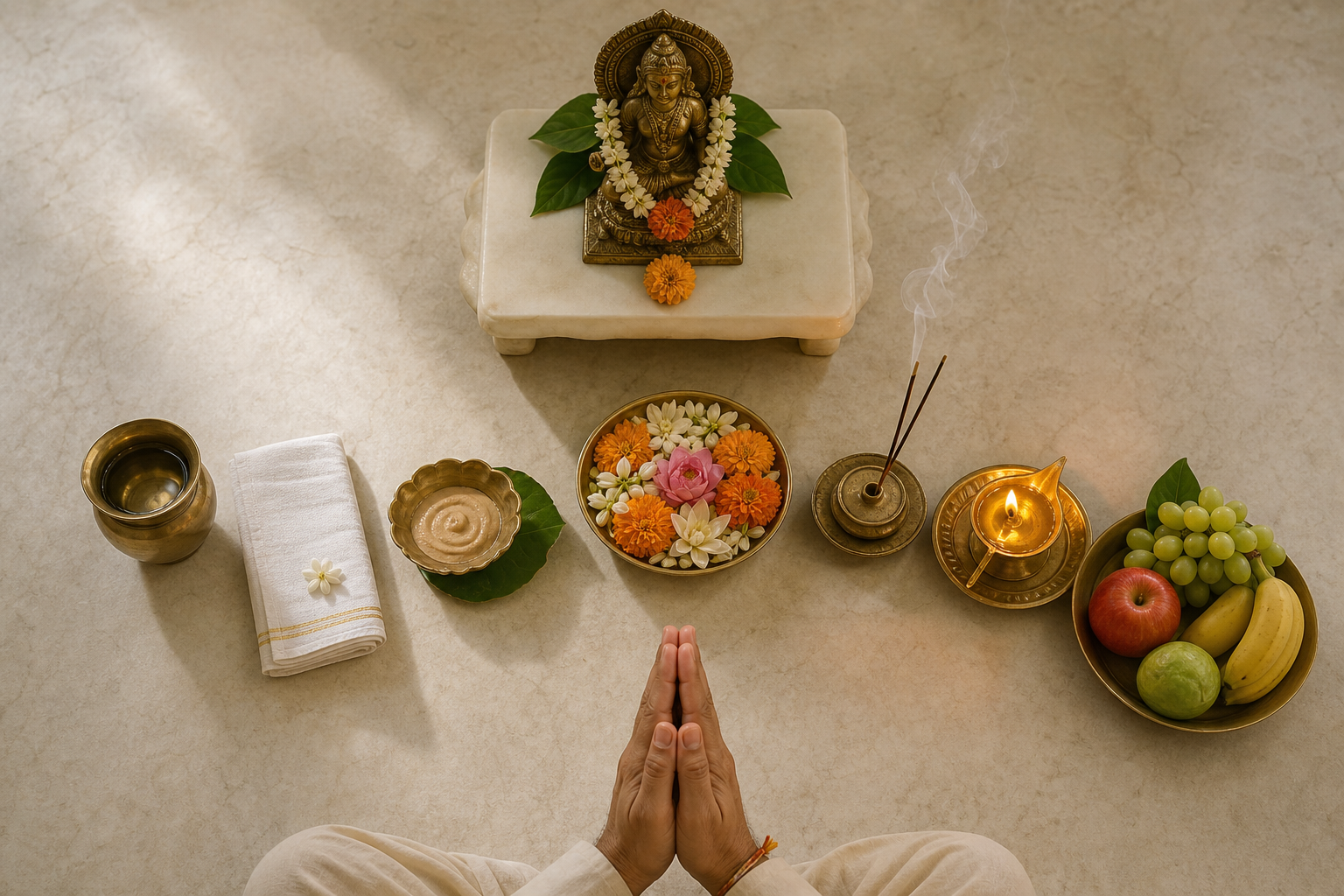
The verses name many elements of arcana: the divine form with its limbs, subsidiary features, and associates; the appropriate mantra; water for welcoming; bathing, clothing, and ornaments; fragrance, garlands, intact grains, incense, lamps, and other offerings; followed by praise and obeisance. Read only as a list, this can feel like ritual equipment. Read as a sequence, it reveals the inner grammar of worship.
- Recognize the complete divine presence. You are not addressing an anonymous sacred object. You remember the particular form of Bhagavan and those who accompany Him.
- Approach through the appropriate mantra. Sound directs the mind and identifies the relationship in which the act is being performed.
- Receive Bhagavan with honour. Pādya, arghya, and ācamanīya belong to the language of welcome rather than mere handling of water.
- Render personal service. Bathing, clothing, ornamentation, fragrance, and flowers treat the divine form as the recipient of attentive care.
- Offer what delights and nourishes. Incense, light, and other presentations gather the senses around service instead of allowing them to wander.
- Speak praise and bow. The sequence ends by placing both voice and body in a posture of reverence.
This order gives you an immediate correction to make. Do not begin with whichever item happens to be nearest. Pause first. Remember whom you are worshipping, use the prayer or mantra received in your tradition, and let each subsequent act express that recognition. If the mind wanders, return to the verbs: recognize, receive, serve, offer, praise, and bow.
What each offering asks you to notice
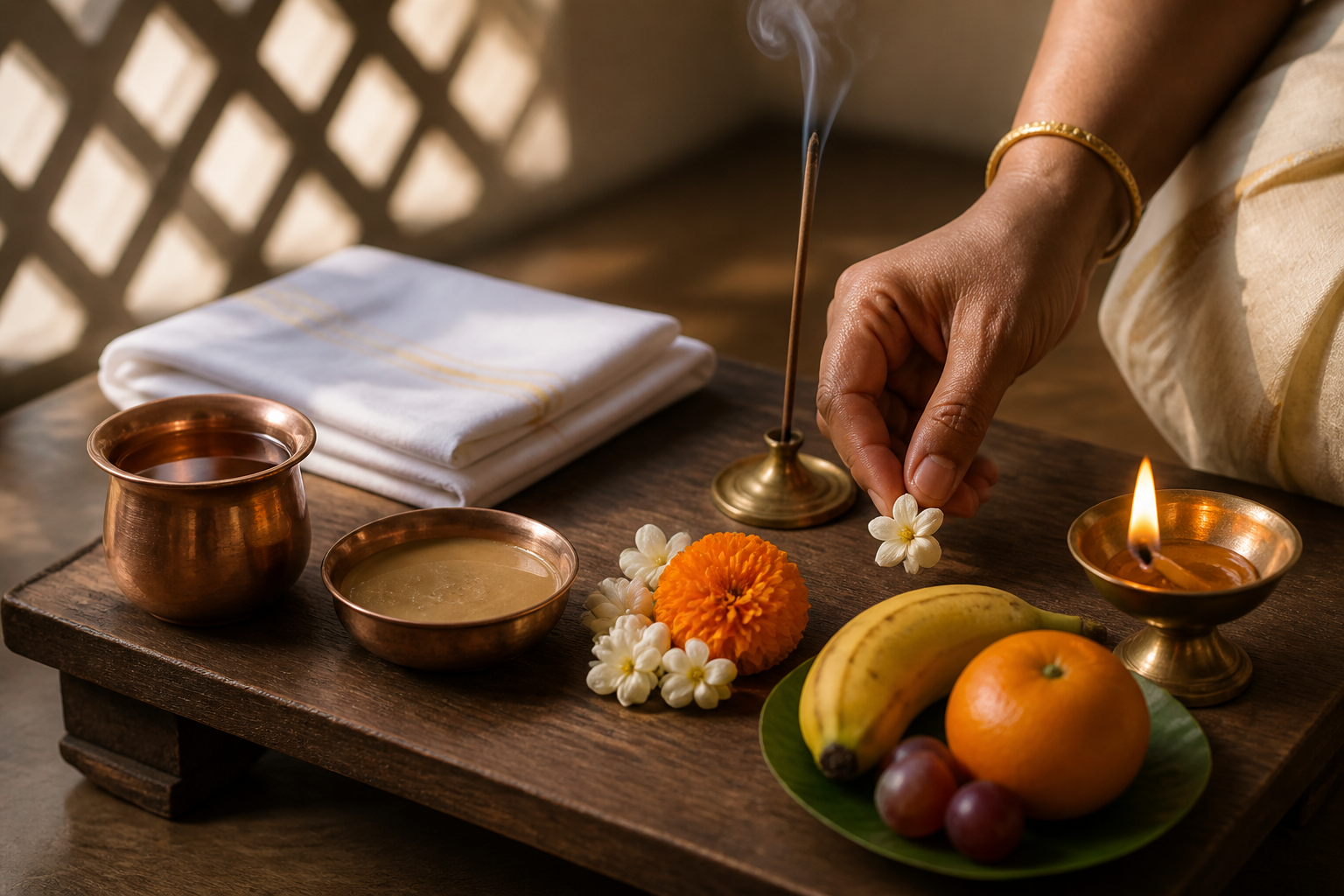
Ritual vocabulary can become opaque when it is left untranslated or reduced to stage directions. The following distinctions help you notice what the hands, voice, and mind are meant to be doing together.
| Element in the sequence | Ritual action | Question for the worshipper |
|---|---|---|
| The form and associates | Worship Bhagavan in completeness rather than as an isolated abstraction | Have you remembered the person and relationship at the centre of the altar? |
| Pādya, arghya, and ācamanīya | Offer the courtesies of welcome, honour, and refreshment | Are you receiving Bhagavan attentively, or merely moving vessels? |
| Snāna, clothing, and ornaments | Render intimate and careful service to the divine form | Are your actions governed by care and by the procedure you have been taught? |
| Fragrance, garlands, and akṣata | Present beauty, freshness, and suitable intact materials | Are the items clean, appropriate, and consciously offered? |
| Dhūpa and dīpa | Offer incense and light | Does your attention follow the offering, or are you already thinking about the next task? |
| Upahāra | Present the available offering to Bhagavan | Are you giving deliberately rather than treating the act as leftover distribution? |
| Stava and namaskāra | Praise with words and bow with the body | Do your words and posture acknowledge that you are the servant, not the centre? |
One distinction prevents a common misreading. Ācamanīya here is water presented to Bhagavan for sipping as part of honourable reception. It should not be collapsed into the worshipper’s own preliminary achamanam, even though both employ the language of purification and water. The recipient and place in the sequence are different.
Likewise, the verse names snāna, or bathing. In a received procedure this may include abhishekam, but that does not mean every picture or murti should be physically bathed. Water can damage paintings, finishes, wooden forms, and murtis not prepared for bathing. Follow the established care instructions for the form on your altar, and ask a qualified practitioner when you are unsure.
The lamp offering, often the most visually prominent part of aarti, is also not the whole of arcana. Light stands within a larger movement of recognition, welcome, service, praise, and surrender. If your attention begins only when the lamp is lit, the verses ask you to recover everything that prepares for that moment and everything that must follow it.
Vidhivat protects devotion from dependence on mood
Verse 53 uses vidhivat: worship is to be performed in the proper manner. This is not a demand for cold ceremonialism. It is a safeguard against making Bhagavan’s service depend entirely on your changing mood, convenience, or taste.
A known order frees you from deciding afresh what matters each day. The mantra prevents vague sentiment from replacing address. The sequence prevents attractive items from eclipsing basic acts of welcome. Praise prevents silent busyness from becoming the whole practice. Bowing prevents the worshipper from finishing as the manager of a successful ritual.
Mechanical worship is still a real danger, but mechanics are not the same as discipline. The practice becomes mechanical when the action no longer refers to its recipient: the flower is placed without being offered, the mantra is completed without being heard, or the bow is shortened because the mind has already moved on. The remedy is not to discard form. It is to restore meaning at the exact point where form and attention separated.
Detailed procedures can vary across Agama-based systems, sampradāyas, temples, and forms of household worship. If you have received a paddhati from a guru or established community, follow it. These two verses supply a coherent architecture for worship; they are not permission to assemble initiatory mantras and specialized rites from unrelated traditions. When you do not know a formal procedure, simplicity and honesty are safer than imitation.
Build a home practice you can perform with integrity
You do not need to reproduce the material scale of a temple to learn from this passage. You do need a stable sequence, suitable items, and enough attention to know what you are doing. Begin with the form of worship already proper to your household and sampradāya.
- Prepare before approaching the altar. Gather the clean vessels and offerings you actually intend to use. A scattered search for matches, flowers, or a spoon in the middle of worship breaks the movement these verses establish.
- Set aside competing demands. Silence avoidable interruptions and approach with clean hands. Preparation is part of attention, not an administrative task outside the puja.
- Remember the divine form and associates. Look before acting. Name inwardly whom you are about to serve rather than treating the altar as a generic sacred zone.
- Use only mantras you are entitled and able to use. Follow the prayers received from your guru, family tradition, temple, or sampradāya. If you have not received a specialized mantra, do not pretend initiation; use a familiar name or open prayer appropriate to your tradition while seeking proper instruction.
- Offer in a deliberate order. Present the welcome, personal service, fragrance or flower, incense, lamp, and other suitable offerings according to your practice. With any flame, use a stable heat-resistant surface, keep combustible material clear, and never leave it unattended.
- Give praise its own place. Do not let the final material offering silently end the puja. Recite a known stotra or an appropriate prayer slowly enough that its words remain an act of address.
- Bow before cleaning up. Namaskāra is the conclusion of worship, not an optional gesture to be skipped when you are hurried.
On a constrained day, reduce the quantity of materials rather than destroying the sequence. Remember Bhagavan, make a suitable offering you understand, speak praise, and bow. On a day of fuller worship, expand the same structure with the procedures you have been taught. This keeps simple practice from becoming casual and elaborate practice from becoming display.
Key takeaways
- Srimad Bhagavatam 11.3.52-53 presents worship as an ordered relationship, not a collection of ritual objects.
- Pādya, arghya, and ācamanīya express reception; bathing, clothing, and ornamentation express personal service.
- Incense, lamp, and aarti belong within the larger arc of recognition, offering, praise, and surrender.
- Vidhivat calls for disciplined procedure, while attention keeps that procedure from becoming mechanical.
- Formal mantras, abhishekam, and specialized altar service should follow the method of your guru, sampradāya, or established temple practice.
- The final praise and bow reveal whether you completed an act of service or merely finished a task.
Let the final bow test the whole puja

The last action in these verses is easy to underestimate. After the materials have been offered, the worshipper praises Hari and bows. The body is made to acknowledge what the entire sequence has been saying: Bhagavan is the honoured recipient, and the worshipper is the servant.
That bow gives you a practical test. If you are mainly pleased with how efficient, attractive, or technically impressive the puja was, remain there for a moment. Notice where you rushed, which action became mere handling, and what needs to be repaired in the next worship. This is not self-condemnation. It is how a repeated rite becomes repeated training in attention and humility.
At your next puja, do not add another object merely to make the altar feel more complete. Improve one transition instead. After the final offering, speak the praise distinctly, bow without treating it as punctuation, and let the conclusion return the whole act to Bhagavan.
References
