

If you came to this episode wondering why a king was cursed for violence committed by his brothers, the answer lies in kingship, not arbitrary divine anger. Janamejaya is not treated as a detached spectator. Harm done by his own royal household, within an undertaking conducted under his authority, becomes his concern when nobody provides justice.
The episode gives you a precise test for dharmic conduct: when a vulnerable being alleges undeserved harm, does power investigate, answer and correct the wrong, or does it hide behind rank and religious respectability? Sarama’s curse follows the failure of that test.
What happens between Sarama and Janamejaya

The encounter occurs in the Poushya Parva, identified as the third chapter of the Adi Parva, the Mahabharata’s first book. King Janamejaya is conducting a long sacrifice at Kurukshetra. He is accompanied by his three brothers, Shrutasena, Ugrasena and Bhimasena. Janamejaya is the son of Parikshit and the great-grandson of Arjuna, so the scene concerns a ruler who has inherited both royal authority and the moral weight of the Bharata lineage.
A young dog comes near the sacrificial setting, and Janamejaya’s brothers beat it. The animal returns crying to its mother, Sarama. Before condemning anyone, she asks whether her son had done something wrong. The dog maintains that it had committed no offence and had not interfered with the sacrificial offerings.
That exchange matters. Sarama does not begin from blind attachment to her offspring. She first tests the relevant fact: was the force a response to misconduct, or was an innocent creature struck merely because those with power could strike it?
Sarama then comes to the royal sacrifice and demands an explanation. No adequate cause is given for the beating. She consequently declares that an unexpected danger or evil will come upon the royal party. The curse is therefore not detached from the events that precede it. An accusation is raised, innocence is considered, authority is asked to answer, and consequence follows when power has no answer.
Keep one detail exact when you recount the story: Janamejaya is not said to have personally beaten the dog. His brothers do it. The king nevertheless becomes answerable because the violence occurs within the sphere of royal and sacrificial authority that he leads. That distinction is the key to the episode rather than a loose end in it.
Why the curse reaches the king as well as his brothers
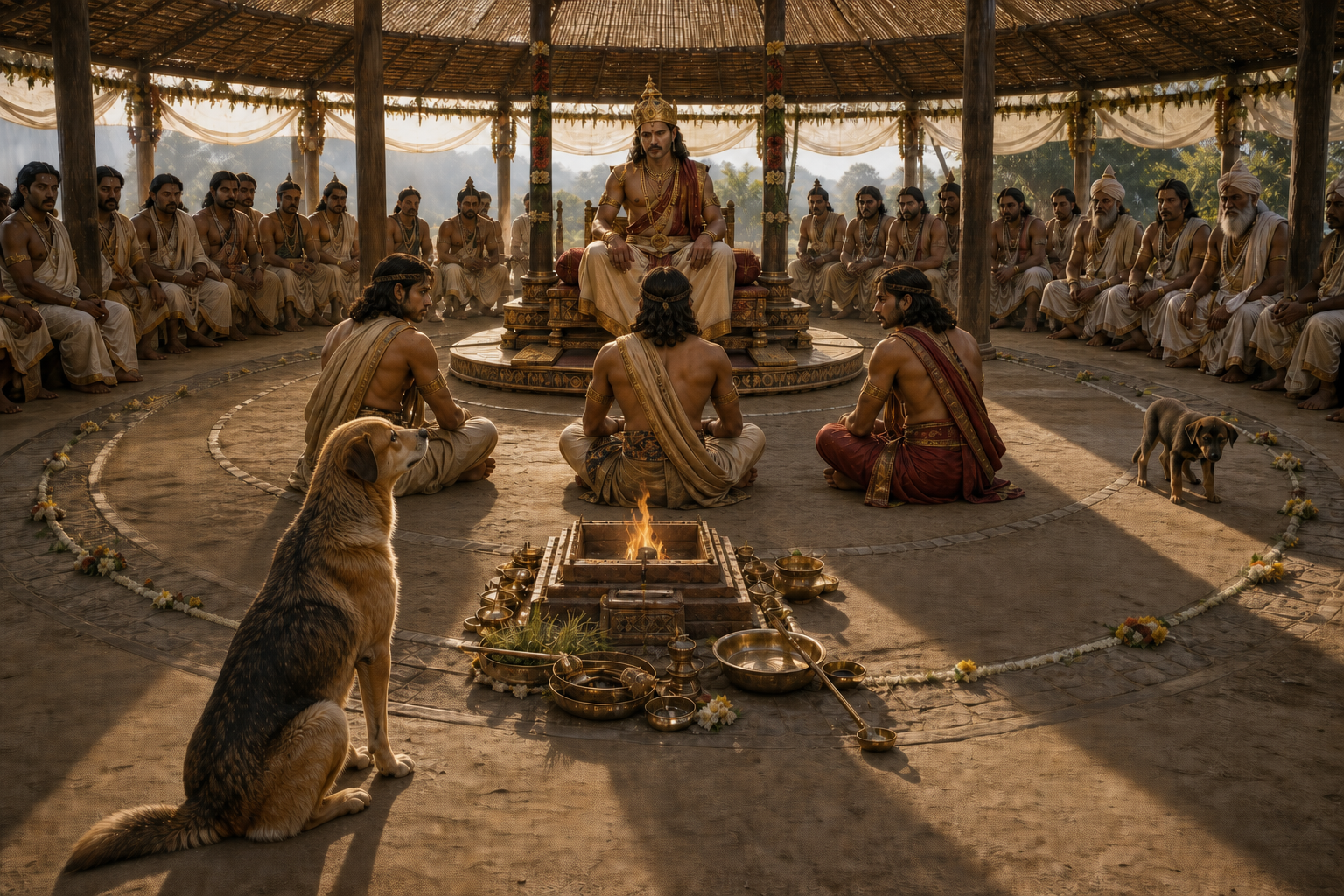
A king cannot claim all the merit of a royal undertaking while disclaiming every wrong committed by the people acting beside him. Janamejaya’s position gives him prestige, but it also gives him responsibility. The episode separates the person who performs an act from the authority responsible for the moral order in which that act occurs.
This is not a demand that every leader be treated as if personally guilty of every subordinate’s action. The sharper point is that responsibility begins once a wrong enters the leader’s awareness. Sarama brings the grievance to the place of authority. The royal side has an opportunity to explain, investigate or repair. Its failure is not simply that a dog was struck; it is that the victim’s appeal produces no just response.
You can see three layers of responsibility in the scene. The brothers are responsible for the blows. Those who could have objected are responsible for their silence. Janamejaya is responsible for what happens when a credible grievance reaches the order over which he presides. Collapsing these layers into one kind of guilt would make the story cruder than it is. Ignoring any of them would make its warning too easy to evade.
The dog’s low status is also morally significant. The creature has no rank with which to compel courtesy and no apparent usefulness that would make powerful people regret harming it. Its claim rests on innocence alone. Dharma is being tested at the point where worldly incentives to behave well are weakest.
That gives you a practical way to examine leadership. Do not judge an institution only by how its leaders treat honoured guests, donors, scholars or senior devotees. Notice what happens when a child, animal, worker, newcomer or inconvenient complainant is in the way. The treatment of someone who cannot reward or punish the powerful often reveals more than formal declarations of values.
Why a grand yajna cannot cover a small act of adharma

The setting is not incidental. The beating happens around a royal sacrifice, where great attention would have been given to correct performance and the protection of offerings. Yet the discipline directed toward ritual objects is not extended to a harmless living being near the ritual boundary.
This creates the episode’s central contrast. Ritual correctness and dharmic conduct are related, but they are not interchangeable. A sacrifice cannot become a moral shield for cruelty committed around it. Nor does sacred purpose make every action taken in the name of protecting a ceremony righteous.
The problem is not that yajna lacks value. The problem is the attempt, conscious or otherwise, to preserve the external order of worship while neglecting the ethical order that gives worship its integrity. If someone guards an offering but needlessly harms an innocent creature, the ceremony exposes the contradiction; it does not erase it.
This distinction remains useful whenever you help organise a puja, procession, temple programme or community gathering. Preparation should include more than schedules, materials and ceremonial roles. Decide who has authority to stop mistreatment. Make it possible for a person with less status to report a problem. When a complaint arrives, establish what happened before closing ranks around a respected organiser or family member.
You should also resist a common rationalisation: that harshness is acceptable because it protects something sacred. Protection may sometimes require firm boundaries, but the word sacred does not eliminate the need for cause, proportion and accountability. Sarama’s first question is effectively the right one for any such case: what offence justified the force?
How to understand the curse without missing its moral force
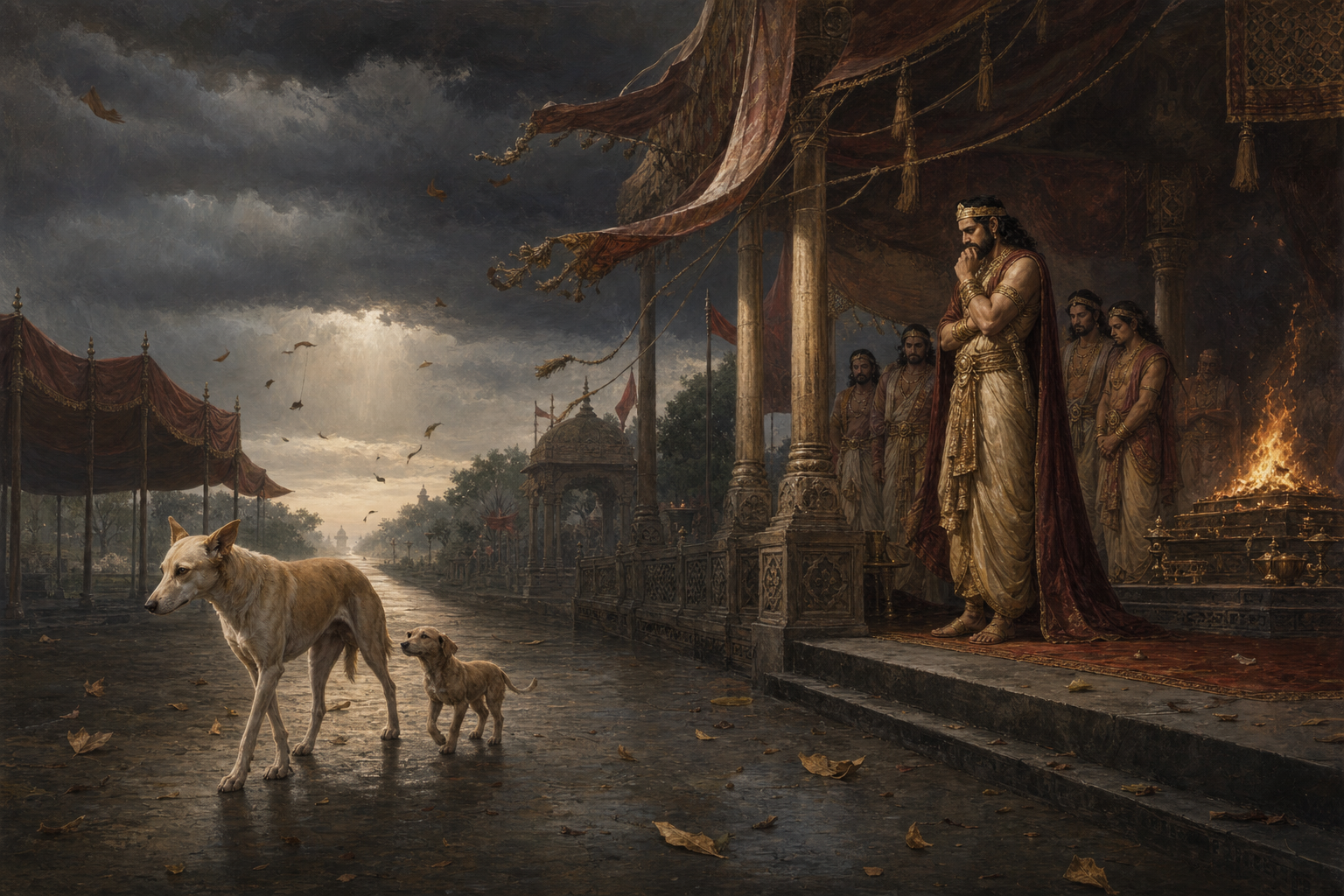
You do not have to reduce Sarama’s curse to either superstition or metaphor. Within the Mahabharata’s moral world, a curse is a consequential utterance. At the same time, its narrative form teaches something intelligible even to a reader who is mainly interested in ethics: power that creates fear for the innocent becomes vulnerable to a danger it cannot predict or control.
The form of the consequence fits the offence. The young dog encounters violence without a valid reason and without warning. Sarama announces trouble that will likewise arrive unexpectedly. The royal household that made another being insecure is told that its own security cannot be taken for granted.
That does not mean every later misfortune should be attributed to a curse, or that the episode gives you permission to threaten people who wrong you. Sarama first establishes innocence, seeks an answer and confronts the responsible authority. Removing those steps turns a judgment against arbitrary power into another exercise of arbitrary anger.
Nor should the story be flattened into the general advice to be kind to animals, worthy though that advice is. Its argument is more demanding. It concerns unjustified force, a victim’s right to be heard, the accountability of rulers for their circle, and the inability of religious prestige to compensate for adharma.
When you hear the episode described as a dog cursing a king, pause over the sequence rather than the spectacle. A powerless being is injured. A mother examines the claim instead of reacting blindly. Authority is confronted. No justification is produced. Only then is the consequence pronounced. The curse is the end of a failed process of accountability, not the beginning of an irrational quarrel.
Key takeaways
- Janamejaya’s brothers, not Janamejaya personally, beat Sarama’s son; the king becomes answerable as the authority presiding over the royal setting.
- Sarama first considers whether her son committed an offence. The curse follows a finding of undeserved harm, not unexamined parental anger.
- The absence of a satisfactory royal answer is central. Violence is compounded when the injured party cannot obtain explanation or redress.
- The sacrificial setting creates a deliberate moral contrast: elaborate ritual observance cannot cancel cruelty around the ritual itself.
- In your own sphere, test dharmic leadership by asking who may be harmed without consequence, who can safely complain, and what happens after the complaint is heard.
The next time you read this passage, do not stop at asking whether Sarama’s words supernaturally caused a later danger. Ask the question the episode places before every person with authority: when someone under your protection is harmed without cause, will you answer before the consequences answer for you?
Carry that question into practice. Before the next religious or community undertaking you help lead, make accountability part of the preparation itself. A ceremony honours dharma most convincingly when even the least powerful being at its edge is safe from needless harm.
References
