
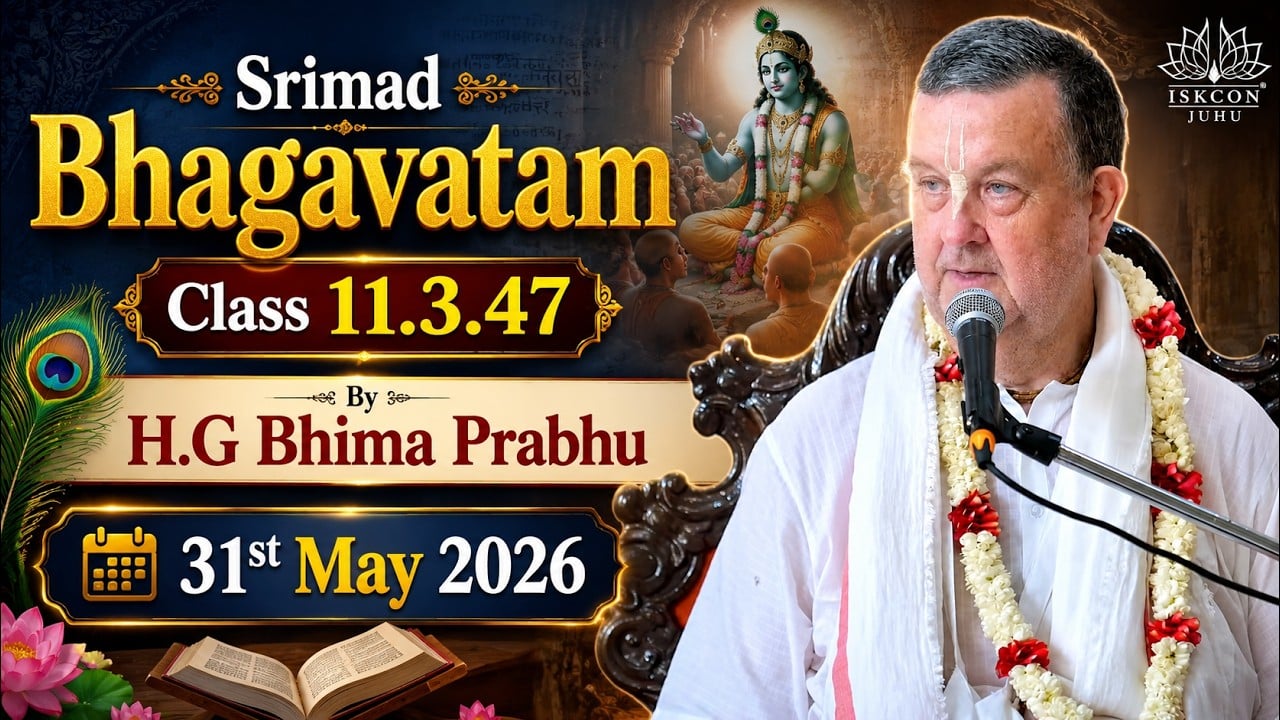
Delivered on 31st May 2026 at ISKCON Juhu Mumbai, the class on Srimad Bhagavatam (Bhagavata Purana) 11.3.47 by H.G Bhima Prabhu explored the architecture of living devotion (bhakti-sadhana) with precision and pastoral sensitivity. Situated within the celebrated Nimi–Nava-yogendra dialogue, this verse is best appreciated in the continuum of Chapter 11.3, where guidance on approaching a spiritual master, cultivating association with devotees, and grounding spiritual life in practical worship coalesce into a pragmatic path for modern practitioners. The teaching emphasized a harmonized vision of devotion that is scripturally rigorous, psychologically sound, and compassionate toward all living beingsan ethos deeply resonant with the shared civilizational ideals of Hinduism, Buddhism, Jainism, and Sikhism.
Textual context is essential. Canto 11 places the seeker amid expansive theological terrain: after the great synthesis of devotional principles in earlier cantos, Chapters 11.2–11.5 present King Nimi receiving profound answers from the nine yogendras. Chapter 11.3, in particular, develops the institutional and personal scaffolding of a spiritual lifehow to find and serve a qualified guru, how varṇa-āśrama and temple worship support concentration and purity, and how association with realized devotees becomes the engine of transformation. Verse 11.3.47 is read in this living context: not as an isolated aphorism, but as a node within a carefully layered pedagogy of bhakti-yoga.
A pivotal anchor for the chapterand a key that illuminates 11.3.47is 11.3.21: tasmād guruṁ prapadyeta jijñāsuḥ śreya uttamaṁ śabde pare ca niṣṇātaṁ brahmaṇy upaśamāśrayam. The instruction is clear: one seeking ultimate welfare (śreyaḥ) must take shelter of a spiritual master expert in revealed wisdom and established in inner tranquility. The class situated this imperative alongside the operational practices around 11.3.47, framing the verse as part of a toolkit that makes such guidance actionable in daily life.
In Gaudiya Vaishnava exegesis, 11.3.47 is frequently interpreted as reaffirming the living duties of devotion: stable hearing (śravaṇa), articulate glorification (kīrtana), internal remembrance (smaraṇa), service to the Deity (arcana), service to devotees (sādhu-sevā), and steady engagement of one’s occupational and familial roles as offerings. While commentators distinguish the precise verbal constructions across the chapter, the pedagogical arc of 11.3.21–55 repeatedly converges on these pillars. The class drew out how these limbs function togetheras a system, not fragmentsso that devotion matures from mood to method, and from method to character.
Guru-tattva and the Guru–Śiṣya Relationship were presented as the chapter’s ethical and epistemic foundation. Guidance is not merely inspirational; it is a disciplined transmission of knowledge (śabda) that reshapes perception and action. A bona fide teacher embodies alignment with truth (brahmaṇy upaśama) and prescribes measurable practicesregular hearing of Srimad Bhagavatam (Srimad Bhagavatham), clean habits, regulated diet, and servicethat synchronize the practitioner’s day with sattva (clarity and balance). This lens turns 11.3.47 into a lived curriculum: devotion is verified by changes in conduct, not proclamation alone.
The social architecture of devotionsatsaṅgawas mapped as the indispensable catalyst. Association does not mean casual proximity; it entails accountable relationships that foster humility, steadiness, and joy in service. The class underlined a well-attested progression recognized in the Bhakti Tradition: initial trust (śraddhā) leads to purposeful association (sādhu-saṅga), which supports consistent practice (bhajana-kriyā), gradual purification (anartha-nivṛtti), and the stabilizations of niṣṭhā, ruci, āsakti, bhāva, and ultimately prema. 11.3’s emphasis on guidance and worship gives this maturation a concrete daily grammar.
Arcana (Deity worship) was presented as embodied theology. Temple and home worship translate metaphysics into gesture: cleansing, dressing the Deity, offering incense, lamp, water, and food (panchopachara or daśopacāra), and receiving prasāda. The class highlighted how these ritual affordances shape cognition and behaviortraining attention, softening the ego through service, and grounding the abstract in the beautiful. Within this frame, 11.3.47’s devotional accent becomes not a mere injunction but a neurobehavioral practice that organizes the senses toward Hari.
Nāma-kīrtana and japa were interpreted as the heart of the chapter’s applied psychology. Repetition of the holy nameHare Krishna Hare Krishna, Krishna Krishna Hare Hare / Hare Rama Hare Rama, Rama Rama Hare Haremodulates attention and affect. Contemporary research on contemplative practices suggests improved autonomic balance and attentional control with rhythmic breath and sound. The class connected these findings with the Bhagavata’s pedagogy: 11.3’s devotional program leverages sound to stabilize the mind, enrich empathy, and elevate motivation for ethical action.
Ethical ecologydayā (compassion), ahiṁsā (non-harm), satya (truthfulness), and cleanlinesswas emphasized as both precondition and fruit of bhakti. The teaching underscored that devotion severs sectarianism by expanding identity from narrow self-reference to sarva-bhūta-hitāya (the welfare of all beings). Here the unity of dharmic traditions becomes vivid: Buddhist karuṇā, Jain ahiṁsā, Sikh sevā, and Vaishnava dayā harmonize as kindred virtues that refine character and social life. 11.3, read through this integrative lens, models spiritual maturity as care in action.
A hermeneutic of non-sectarian respect emerged repeatedly. Where the Bhagavata recognizes varied devas, sages, and paths, the text situates them within a non-competitive vision of the Divine’s all-pervasive presence. The class clarified a key Vaishnava principle: reverence to devas is natural when one understands them as empowered servants of the Supreme, never as rivals. This orientation supports the blog’s objectivenurturing unity among Hinduism, Buddhism, Jainism, and Sikhismby foregrounding shared ethics and the primacy of inner realization over dogmatic rivalry.
Practical scheduling distilled the chapter’s counsel into a replicable day: morning japa with conscious breathing, study of a measured section of Srimad Bhagavatam, mindful offering of food, and a period of kīrtana or contemplative remembrance in the evening. Weekly satsaṅga fosters accountability; monthly observances and festival participation sustain inspiration; periodic retreats deepen introspection. These practices operationalize 11.3.47’s devotional impulse across family, professional, and community life without conflict with contemporary responsibilities.
From a methodological standpoint, the class proposed three evaluative metrics for progress consistent with 11.3’s intent: clarity (does practice reduce mental turbulence and increase discernment?), character (do truthfulness, compassion, and responsibility increase?), and connection (is one’s heart naturally drawn to hearing, chanting, and serving without coercion?). By measuring change against these parameters, devotion remains evidence-based in the best sensetracked by transformation, not sentiment alone.
Historically, commentators such as Śrīdhara Svāmī, Jīva Gosvāmī, and Viśvanātha Cakravartī Ṭhākura align with the chapter’s integrated model: guru-guided practice, reverent Deity worship, heartfelt nāma, and satsaṅga. ISKCON’s pedagogy, as reflected in the teachings of A.C. Bhaktivedanta Swami Prabhupāda, extends this model globally: public kīrtana for social uplift, accessible study of the Bhagavata Purana, prasāda distribution, and congregational care. The class connected these historical insights to present needsdemonstrating how 11.3.47 breathes in the rhythms of contemporary community-building.
Inter-traditional resonance was drawn out with care: nāma-kīrtana and Sikh nām-simran share the centrality of the Divine Name; Jain ahiṁsā and Vaishnava dayā converge in non-violence and compassion; Buddhist mindfulness and Vaishnava smaraṇa both cultivate inward steadiness and insight. These parallels were presented not as homogenization but as a call to mutual honor grounded in the Bhagavata’s universal heart: to see the Divine within all and to act accordingly.
For urban practitioners, the class addressed two common challengestime scarcity and cognitive overload. The proposed response, true to 11.3’s design, is modular devotion: shorter, higher-frequency practices that retain continuity. Ten minutes of deep, undistracted japa; one passage of Srimad Bhagavatam with a brief reflection; a simple panchopachara offering; and one act of intentional kindness each daythis minimal viable routine preserves the current of bhakti while life’s demands fluctuate.
Finally, the class situated 11.3.47 within a hope-filled vision: devotion as cultural renewal and personal healing. When practiced with sincerity and guided by genuine teachers, the verse’s devotional imperatives cultivate resilient individuals and cohesive communities. The result is not withdrawal from society but a wiser participation in itwhere inner steadiness, ethical clarity, and service-first citizenship become the norm. In that spirit, the conversation at ISKCON Juhu affirmed Srimad Bhagavatam’s enduring relevance: a science of the heart that dignifies reason, celebrates compassion, and invites every seekeracross all dharmic traditionsto walk together toward the highest good.
Inspired by this post on Dandavats.
