
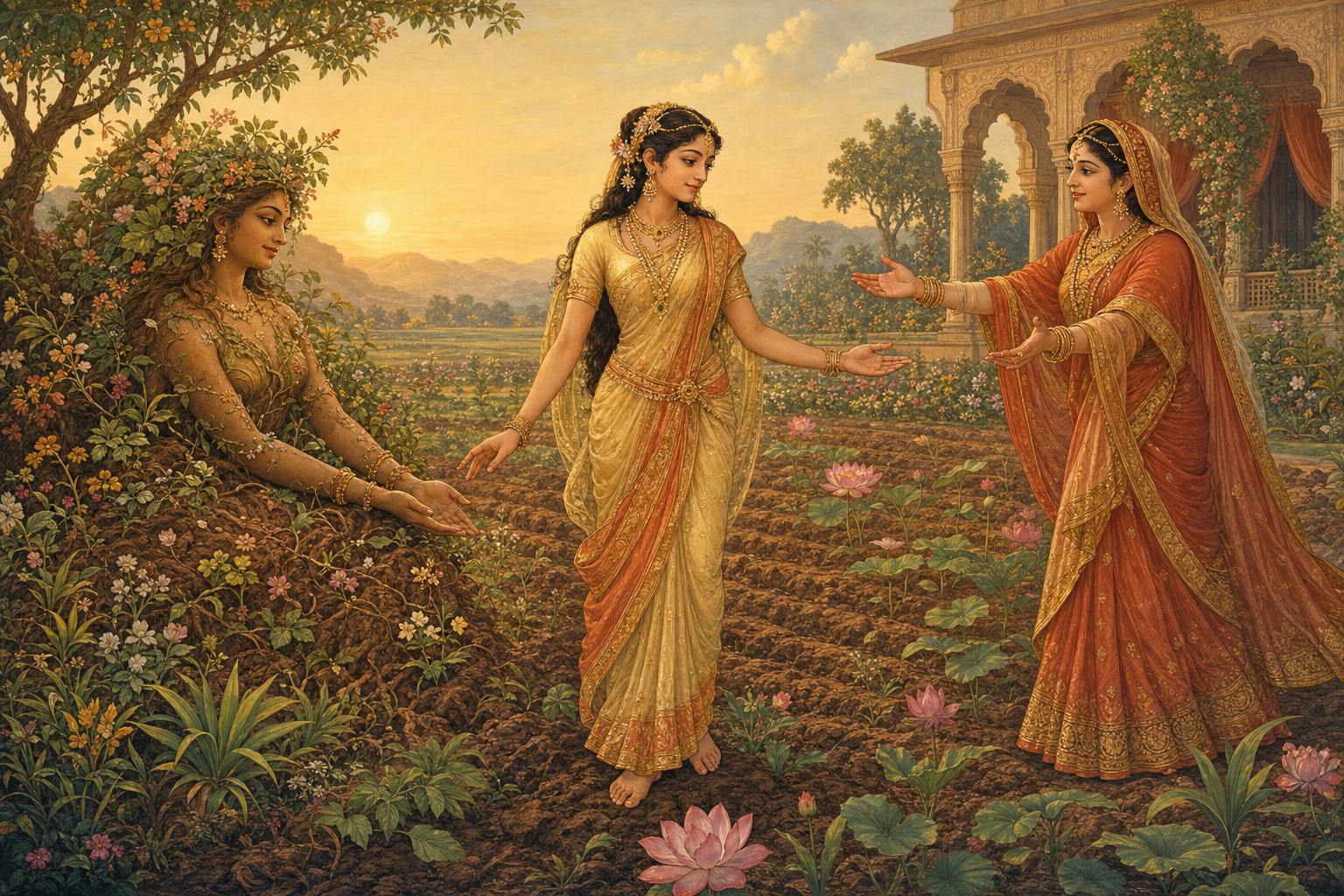
The question of Sita’s mother produces two answers within the supplied account of the Ramayana tradition. The Valmiki narrative points toward Bhumi, the sacred Earth from whom Sita emerges, while later devotional and regional memory gives greater visibility to Sunayana, the queen who raises her in Mithila.
These answers describe different dimensions of motherhood rather than competing biographies. Read together, they connect Sita’s cosmic origin with the human relationships through which she receives affection, formation, and social belonging.
Two maternal relationships, two kinds of belonging
The DharmaRenaissance source distinguishes between motherhood as origin and motherhood as nurture. In its reading of the Valmiki Ramayana, no biological mother is named: King Janaka discovers Sita while ploughing a field being prepared for a yajna. Her appearance from a furrow identifies the Earth as her deepest maternal source.
Sunayana, also called Sunaina in many later traditions, occupies the relational side of the picture. The source presents her as Janaka’s queen and Sita’s adoptive or royal mother: the person associated with raising Sita, loving her, and experiencing the separation that follows her marriage and departure from Mithila. Bhumi accounts for where Sita comes from; Sunayana represents the household in which she becomes a daughter and princess.
This distinction widens the meaning of motherhood. Birth, care, guardianship, moral formation, and acceptance need not be compressed into one role. The tradition can therefore honor the giver of life and the giver of a lived home without diminishing either relationship.
Why Sita’s emergence from the Earth shapes her story
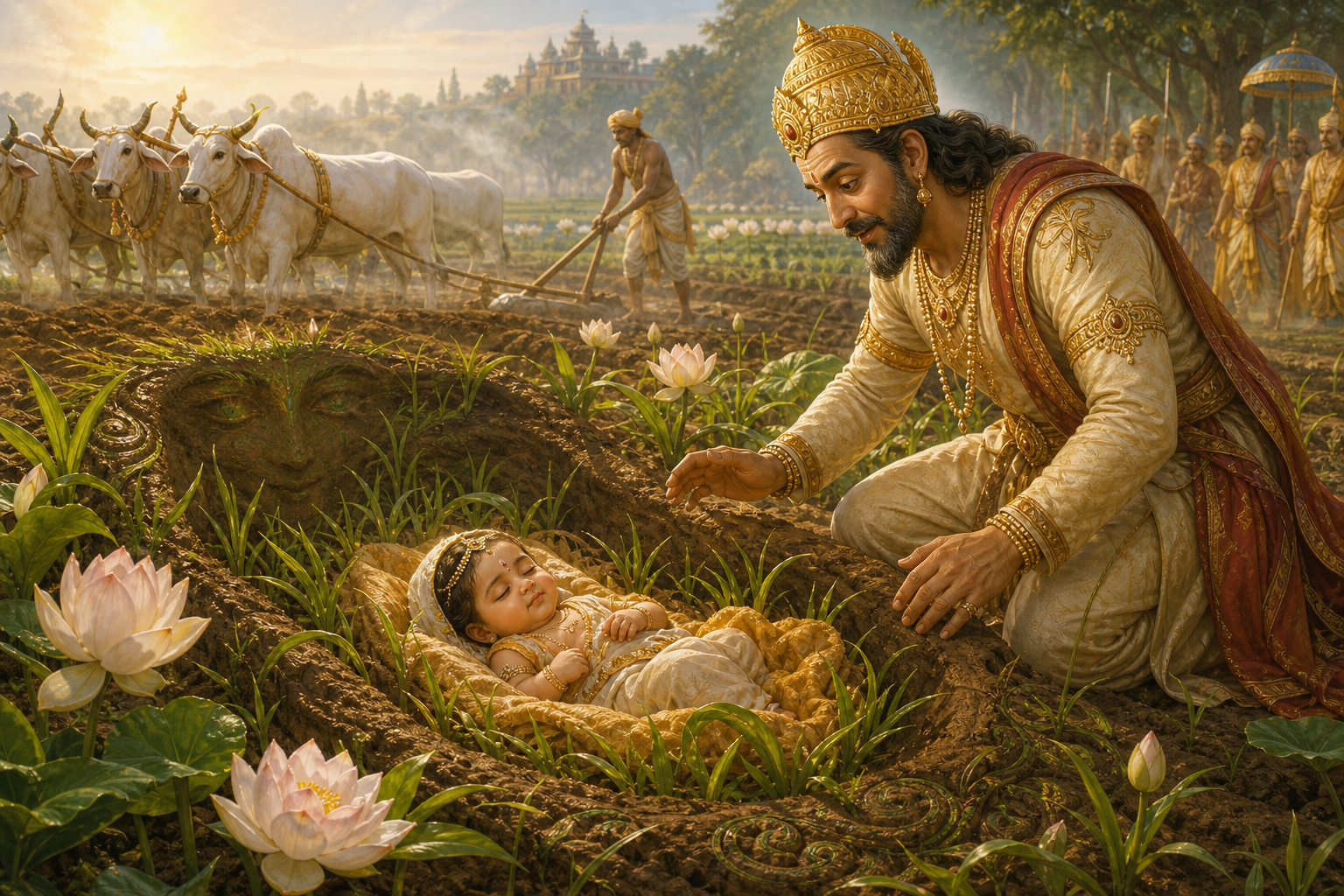
The source treats the ploughed field as more than a picturesque setting. Within the sacred symbolism it describes, the Earth sustains life, receives seed, supports civilization, and gives abundance. Sita’s name is associated with the furrow made by a plough, placing agriculture, fertility, human labor, and natural provision within her identity from the beginning.
Her origin also creates a narrative symmetry. The article reports that Sita eventually calls upon the Earth to receive her if she has remained pure in thought, word, and deed. Bhumi responds, completing the movement from emergence to return. On this reading, the ending is simultaneously a daughter’s return to her mother, a vindication of Sita’s integrity, and the withdrawal of a sacred feminine presence from a society that has failed to recognize her truth.
The Earth connection consequently illuminates several qualities that the source associates with Sita: patience, endurance, moral strength, and forbearance. It does not make suffering her defining virtue. Instead, it helps explain why her apparent gentleness coexists with decisive moral agency, especially when public judgment reaches its limit.
Sunayana makes Sita’s motherhood question human
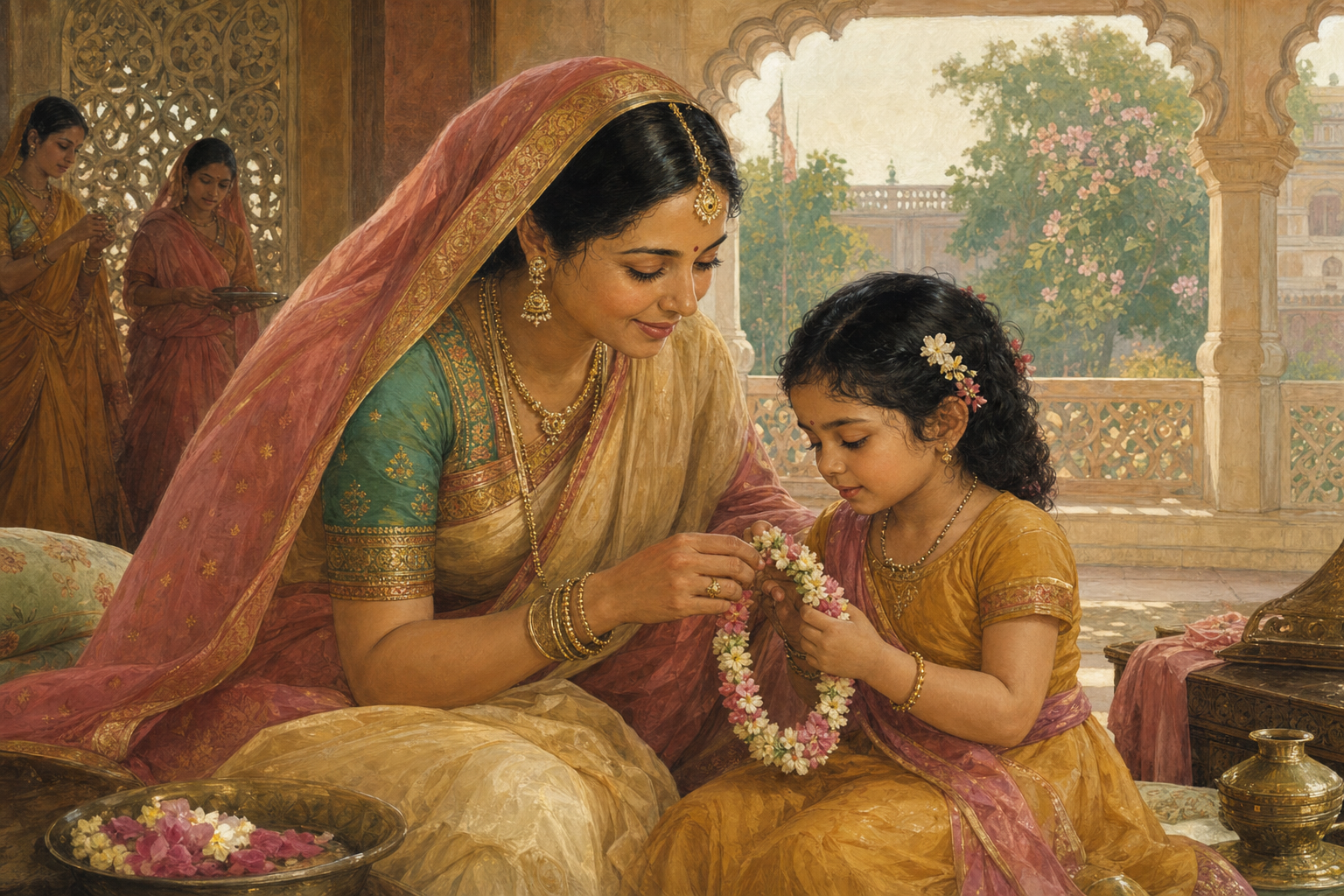
The source notes that the Valmiki account does not foreground Sunayana in the manner of later devotional tellings, folk memory, temple traditions, and popular retellings. Those later settings supply an emotional vocabulary that an origin story alone cannot provide: childhood nurture, preparation for marriage, maternal affection, and grief at separation.
Janaka’s acceptance of the child he finds is equally important to this human dimension. Sita is not treated as marginal because she lacks a conventional birth narrative. She is recognized as his daughter and given a royal, cultural, and ethical home in Mithila. The source therefore reads her story as meaningful for reflection on adoption and belonging: parenthood is enacted through recognition and responsibility as well as descent.
Sunayana’s relative textual visibility should not be confused with the significance of her role. A tradition may say little about the daily labor of nurture while later communities imaginatively preserve its emotional importance. Her motherhood identifies Sita not only with sacred land but also with family life, education, affection, and the difficult passage from a parental home to a marital one.
Key takeaways
- The supplied source presents Bhumi as Sita’s cosmic mother because Sita emerges from the Earth in the Valmiki account.
- Sunayana or Sunaina represents Sita’s adoptive, royal, and nurturing mother in later devotional and regional memory.
- The two figures answer different questions: Bhumi explains sacred origin, while Sunayana expresses care, formation, and family belonging.
- Sita’s emergence from and return to the Earth gives her narrative a deliberate symbolic arc.
- The layered tradition treats motherhood as broader than biological descent alone.
How to compare Ramayana traditions without forcing uniformity

The source describes the Ramayana as a civilizational tradition expressed through Sanskrit and numerous regional, devotional, religious, Southeast Asian, and oral forms. Variation is therefore not adequately understood as a search for one later detail that must displace every other account. Different tellings may preserve different theological and emotional priorities.
A careful comparison should first ask what kind of maternal claim a telling is making. A statement about Sita’s emergence concerns origin; a portrayal of Sunayana concerns upbringing and kinship; an emphasis on Sita’s divine identity concerns theology. These levels can overlap without being identical. Treating every maternal reference as a literal claim about biological genealogy creates a contradiction that the narratives themselves may not require.
Attention should also be paid to emphasis and silence. The absence of a named biological mother in the account attributed to Valmiki gives Sita’s birth its extraordinary character, whereas later attention to a queen of Mithila makes the emotional world of her childhood more tangible. Neither move is neutral, but each serves a distinct narrative purpose.
Only one source article was provided for this synthesis. Its descriptions of textual and regional variation are therefore reported here as that publication’s interpretive account, not as an independently corroborated survey of individual Ramayana texts. Future comparison can deepen the inquiry by examining how particular tellings distribute maternal agency among Earth, queen, family, and community.