
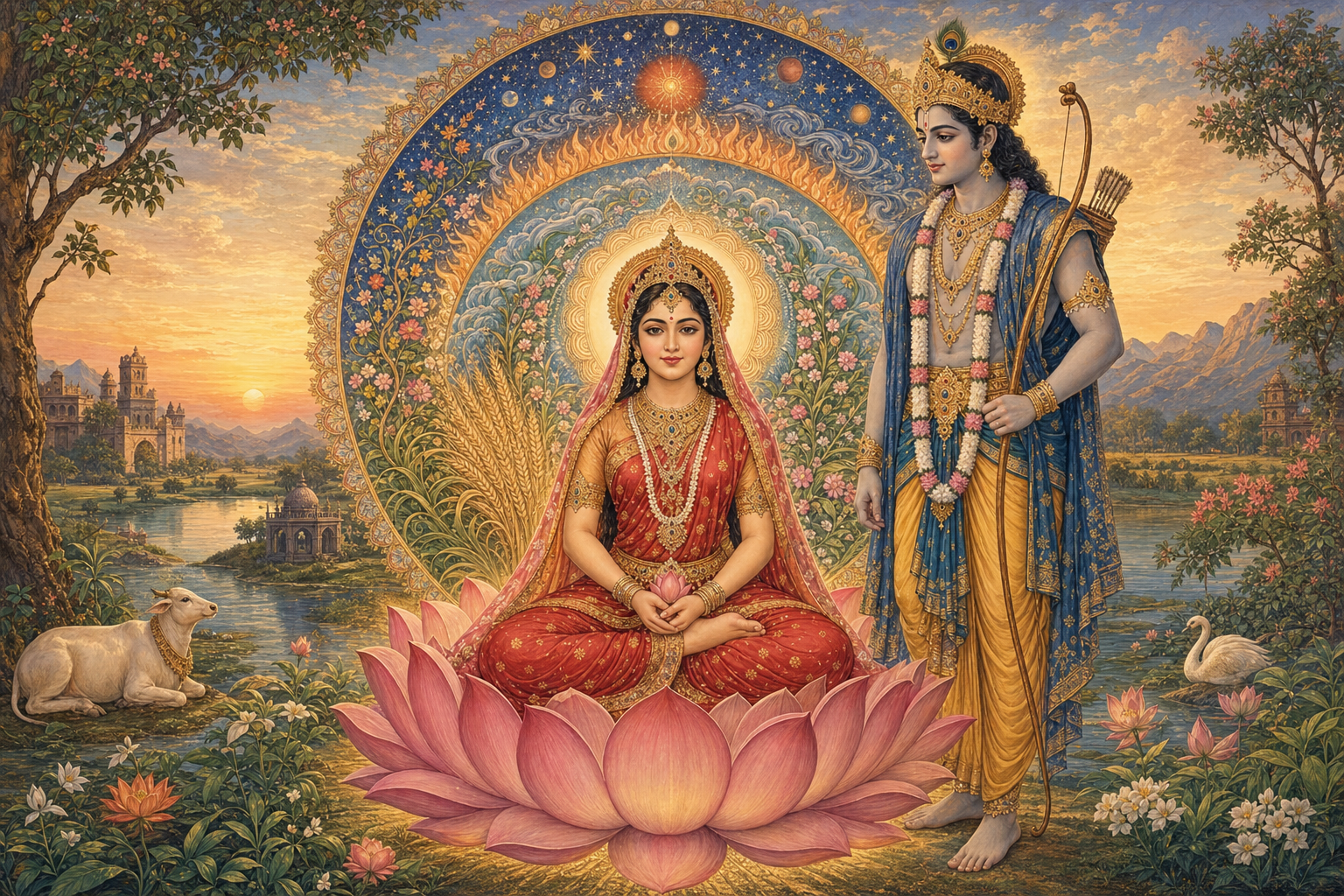
Sita Stavam presents Janaki through a wider theological lens than the one many readers first encounter in the familiar Ramayana story. Sita remains the compassionate princess of Mithila and Rama’s steadfast companion, but the hymn also praises her as the primordial Divine Power behind creation, knowledge, protection, prosperity, and the restoration of dharma.
The significance of this portrayal lies in the relationship between those identities. The hymn does not replace a gentle Sita with a fierce goddess; it treats compassion, endurance, sovereignty, and decisive action as expressions of one sacred personality. Its narrative setting, goddess names, and battle imagery together explain what it means to recognize Janaki as Adi Shakti.
Sita Stavam turns devotional praise into theology
A stava is a hymn of praise, but its theological work extends beyond assembling honorific titles. As the DharmaRenaissance source explains, the sequence of names and attributes in Sita Stavam forms a portrait of the deity being praised. Brahma invokes Sita through identities associated with Yogamaya, Vaishnavi, Durga, Lakshmi, Gauri, Saraswati, Varahi, Bhadrakali, Svaha, Svadha, Dhriti, Medha, Hri, and Sri.
These names connect Janaki with several dimensions of sacred life. Some evoke abundance and auspiciousness; others indicate wisdom, ritual efficacy, steadfastness, protection, or transformative force. Their cumulative effect is more important than any single epithet. According to the source article, the description of Sita as Adi Shakti is therefore a theological summary of the hymn rather than a claim resting on one expression appearing identically in every manuscript.
This also clarifies why the hymn should not be read as a catalogue of unrelated goddesses. Its many names express unity through function: the power that nourishes is also the power that knows, protects, disciplines, and destroys adharma. Janaki is presented as the common divine ground of these manifestations.
The battlefield reveals what the divine names mean
The hymn’s claims are anchored in a narrative crisis. In the Sita Vijaya account summarized by DharmaRenaissance, destructive forces connected with the sons of the sage Durvasa disturb cosmic order. The gods appeal to Yogamaya, who promises protection and takes birth as Sita while Vishnu descends as Rama. The destruction of the familiar ten-headed Ravana does not end this version of the Ramakatha; Sahasramukha Ravana subsequently becomes the greater threat.
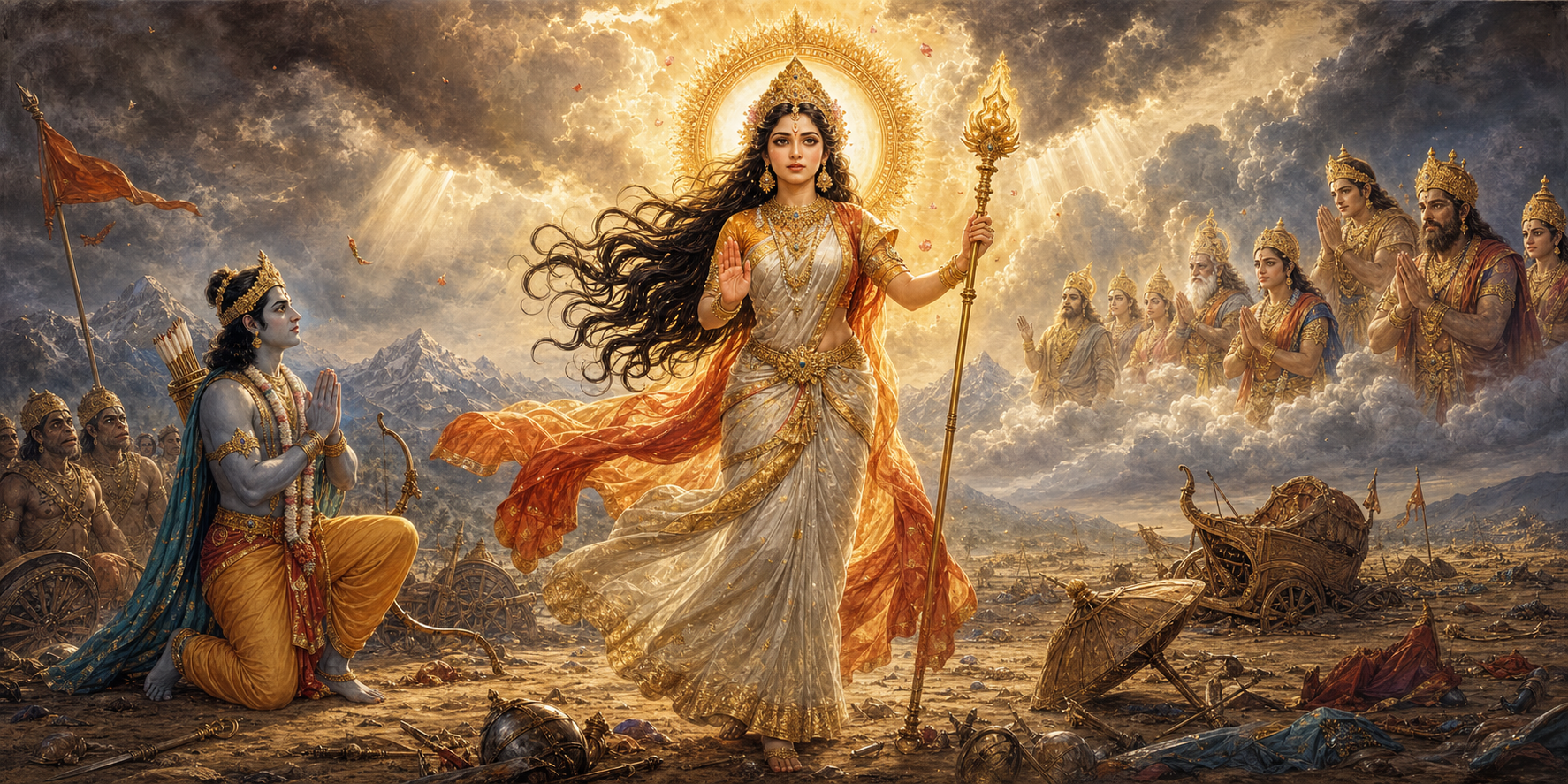
The source reports that Sahasramukha abducts Bharata and Shatrughna after mistaking them for Rama and Lakshmana. Rama later advances against his city of Visala with Hanuman and a coalition of humans, vanaras, and rakshasas. Divine powers also enter the conflict, yet the expected victory does not follow. Sahasramukha defeats the assembled opposition, and Rama falls on the battlefield.
This reversal is essential to the hymn’s theology. Conventional strength is brought to exhaustion before Sita’s power becomes fully visible. Her grief at Rama’s fall is not represented as passivity. It marks the transition from compassionate presence to cosmic intervention. Heavenly sages address her as the one Goddess manifested through many forms and ask her to restore the defeated gods.
Sita then assumes an extraordinary divine form and enables Hanuman to manifest a five-faced form appropriate to the conflict, according to the source. Their relationship adds an important dimension to the episode: Hanuman remains the devoted servant of Sita and Rama, while his enlarged capacity is conferred through Sita’s grace. Devotion and agency reinforce one another rather than compete.
Darbha makes sacred order stronger than spectacle
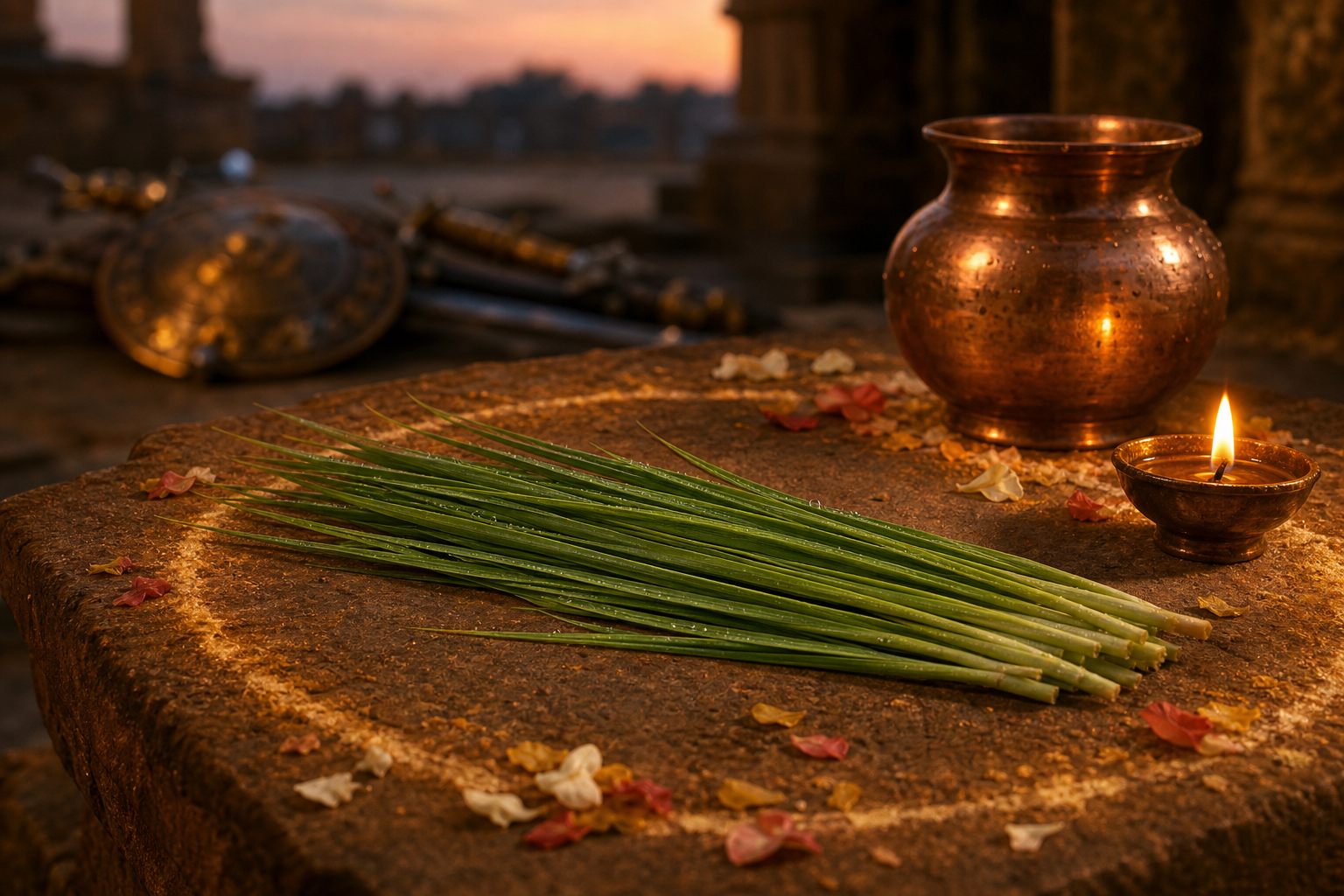
Sita’s weapon against Sahasramukha is strikingly modest. The DharmaRenaissance account says that she uses blades of darbha, the sacred grass associated with Vedic ritual. They become blazing instruments of power in her hands. Sahasramukha breaks the blades into fragments and swallows them, apparently believing that he has neutralized the attack. The pieces instead reunite within him and consume him from the inside.
The episode permits several related readings without requiring one symbolism to be treated as definitive. Darbha can suggest purification, consecrated discipline, and ritual order. Its transformation shows that divine efficacy need not resemble worldly grandeur: an ordinary-looking object becomes decisive when aligned with sacred purpose.
The manner of Sahasramukha’s death also shifts the meaning of victory. He is not merely overcome by a larger external force. His attempt to seize and contain sacred power carries the cause of his destruction into his own body. Read thematically, the scene presents adharma as internally unstable: domination fails because it cannot assimilate the order it tries to suppress.
Janaki’s gentleness and sovereignty belong together
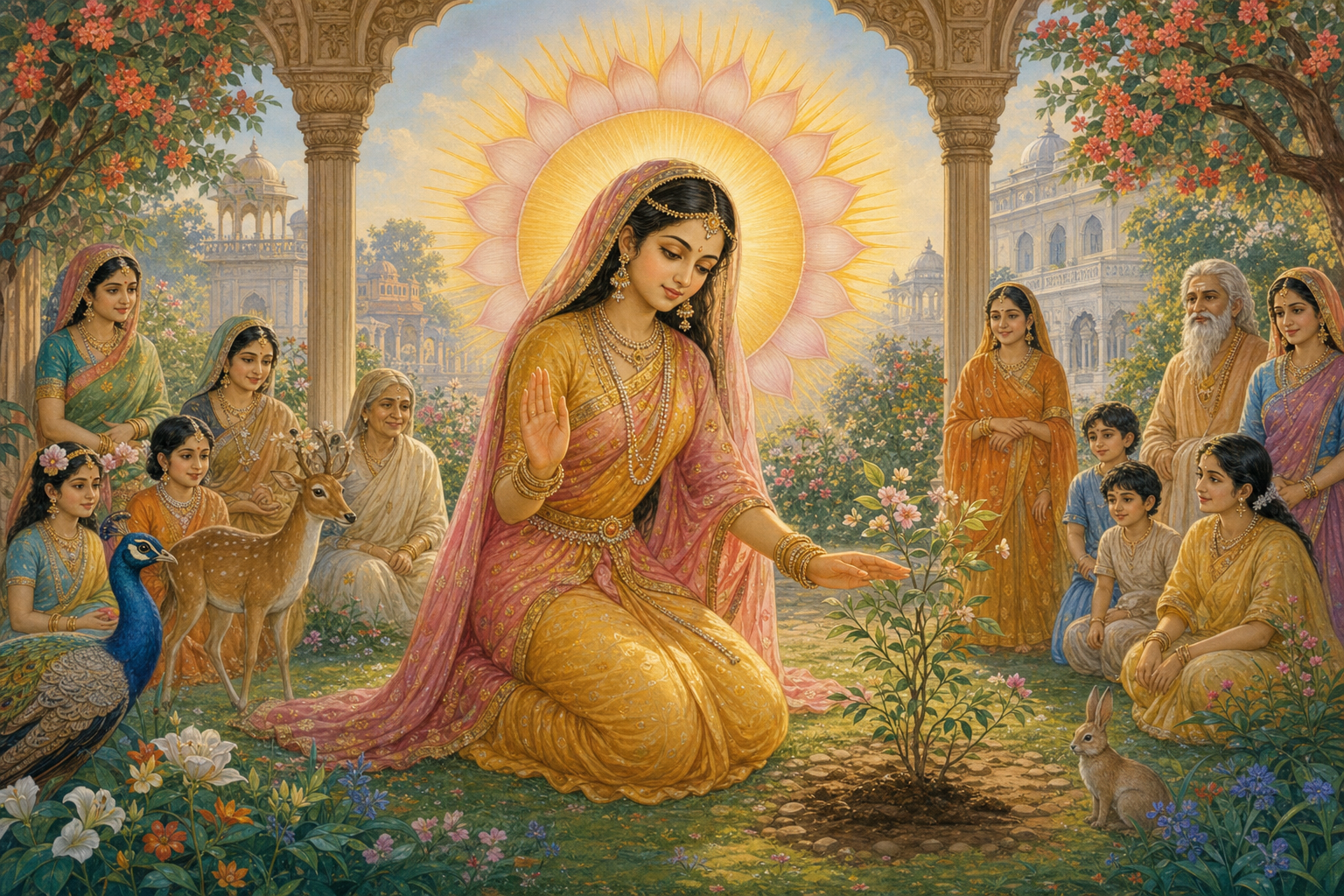
Identifying Sita with fierce and protective forms can initially seem to conflict with portrayals centered on patience, fidelity, sacrifice, and forbearance. Sita Stavam instead makes that apparent conflict productive. Endurance is distinguished from helplessness, while destructive power is placed in the service of protection rather than aggression.
The battlefield episode gives narrative substance to this integration. Sita observes suffering, grieves, responds, empowers a devotee, and restores cosmic order. Compassion supplies the reason for action; sovereignty supplies the capacity. Her fierce manifestation therefore does not cancel the virtues associated with Janaki. It reveals the power already contained within them.
This synthesis also changes how the relationship between Sita and Rama may be understood within this particular tradition. Sita is not merely appended to divine action accomplished elsewhere. As Yogamaya incarnate, she is indispensable to the restoration promised before her birth. The narrative gives Rama and Sita distinct roles while locating both within a larger sacred order.
Devotional meaning and textual history require different questions
The source places Sita Stavam in chapter 48 of Sita Vijaya, also called Sahasramukharavanacharitam. The work presents itself as part of the Ashramavasa Parva of a Jaiminiya Mahabharata tradition. Its framing reportedly begins when Jaimini, while discussing Arjuna’s conflict with Babhruvahana, compares it with an earlier encounter involving Rama and his sons Kusha and Lava. Janamejaya then requests the older story.
That traditional affiliation should not be confused with a settled conclusion about the text’s date or authorship. DharmaRenaissance notes that this episode is absent from the widely read Valmiki Ramayana and from the familiar critical and vulgate Mahabharata recensions. It reports that the work survives in Sanskrit manuscripts written in the Grantha script and that Pradip Bhattacharya and Sekhar Kumar Sen critically edited and translated it for a 2017 publication alongside Mairavanacharitam.
Traditional self-identification, manuscript history, and theological interpretation answer different questions. A reader can take the hymn seriously as sacred literature while still treating claims about genealogy and antiquity with scholarly caution. This distinction protects both forms of inquiry: devotion need not depend upon overstated historical certainty, and textual analysis need not dismiss the religious meaning carried by a layered Ramakatha tradition.
Key takeaways
- Sita Stavam presents Janaki as the unifying Divine Power expressed through wisdom, prosperity, ritual, protection, and transformative force.
- Sita’s victory over Sahasramukha interprets grief and compassion as sources of purposeful action, not signs of powerlessness.
- The darbha episode contrasts consecrated power with outward spectacle and depicts adharma collapsing from within.
- The text’s traditional Jaiminiya affiliation should be acknowledged without treating its authorship or antiquity as historically settled.
Future engagement with Sita Stavam can therefore proceed along two complementary paths: closer study of its manuscript and reception history, and deeper reflection on a vision of Janaki in which tenderness and cosmic authority are inseparable.