

Shalya’s predicament asks a harder question than whether a person should keep a promise: what happens when the promise itself has been elicited through concealment? The supplied DharmaRenaissance account connects this episode from the Mahabharata with royal honour, family loyalty, political manipulation, psychological warfare, and the binding power of speech.
The supplied source set contains one article, so cross-publication corroboration is not possible. The analysis below instead brings together the article’s narrative, political, psychological, and philosophical strands while distinguishing its reported details from broader ethical interpretation.
A promise compromised at its origin

According to the DharmaRenaissance account, Shalya was the king of Madra and the maternal uncle of Nakula and Sahadeva. He set out with a large army intending to support the Pandavas, an alignment consistent with both his affection for his sister’s sons and his political intentions before the war.
Duryodhana altered that course without openly debating Shalya. The article reports that he arranged lavish receptions for Shalya and his forces along their route. Shalya assumed that Yudhishthira had provided the hospitality and, pleased by the apparent honour, offered a boon to the unknown benefactor. Duryodhana then revealed himself and requested Shalya’s military support. Shalya accepted because he regarded his spoken commitment as binding.
The ethical problem therefore begins before Shalya joins the Kaurava side. His words were voluntary in a narrow sense, but the circumstances producing them were deliberately misrepresented. Duryodhana did not merely offer hospitality; he exploited the moral expectations attached to hospitality, gratitude, and royal generosity. The resulting promise carried Shalya’s authority while serving a purpose he had not knowingly chosen.
That compromised origin does not remove Shalya’s agency altogether. The source also draws attention to his pleasure in ceremonial recognition and his readiness to promise before identifying his host. Deception explains his predicament, but haste, assumption, and susceptibility to honour help explain why the deception succeeds. The episode thus distributes responsibility unevenly rather than reducing the event to an innocent victim and a clever adversary.
Dharma when valid duties point in opposite directions

Shalya faces several claims that each possess moral weight. Truthfulness and royal honour urge him to keep his word. Kinship draws him toward Nakula, Sahadeva, and the other Pandavas. Political judgment must consider the justice of the competing causes. Responsibility for consequences raises a further question: should fidelity to a manipulated promise outweigh the harm that fulfilling it may enable?
The source connects Shalya’s decision with satya, honour, and the serious force assigned to spoken commitments in the epic. Yet it also presents his loyalty as divided. He gives Duryodhana formal service without giving him wholehearted moral allegiance. The distinction is crucial: outward compliance does not convert manipulation into justice, and a fulfilled promise does not automatically settle every other duty.
The article reports that Yudhishthira responds to this conflict without simply condemning Shalya. He accepts the bind created by Duryodhana’s strategy and asks for a narrower form of assistance: if Shalya becomes Karna’s charioteer, he should weaken Karna’s confidence at the decisive time. Shalya can no longer choose his original alliance freely, but he can still exercise agency within the role imposed by his commitment.
This response should not be mistaken for an escape from ambiguity. Undermining an allied warrior through speech introduces its own moral discomfort. The episode does not replace a difficult choice with a spotless solution; it moves the conflict into a different arena. Its conception of dharma is therefore contextual and demanding: inherited rules remain important, but their application requires attention to intention, circumstance, competing obligations, and foreseeable effects.
The charioteer turns speech into battlefield power
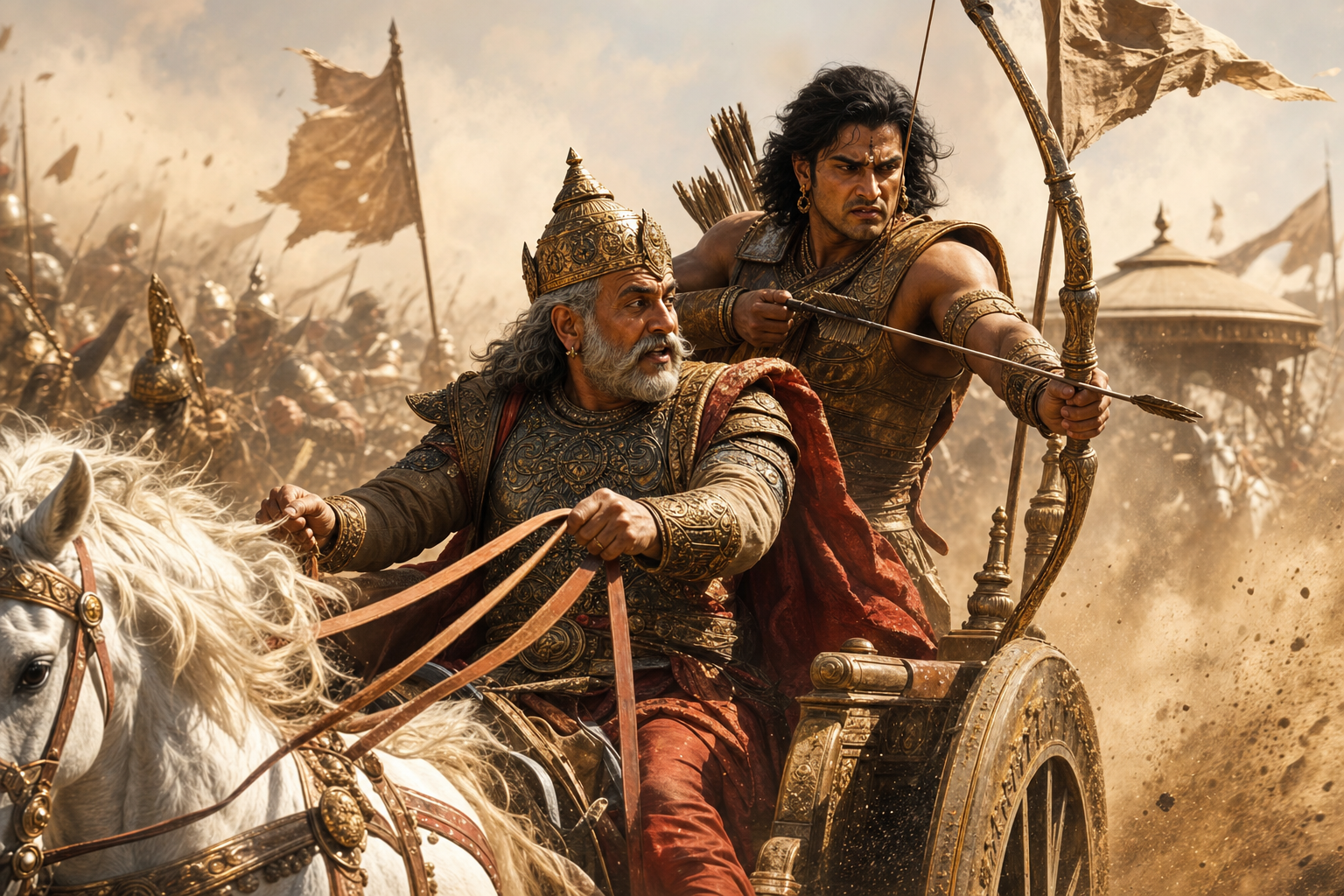
The DharmaRenaissance article emphasizes that an epic charioteer is more than a driver. The role combines observation, counsel, strategic coordination, and psychological support. This makes the contrast between Krishna beside Arjuna and Shalya beside Karna an interpretive key rather than a superficial parallel.
As presented in the source, Krishna guides Arjuna toward clarity about duty and consciousness. Shalya performs an opposing psychological function for Karna: his criticism and comparisons disturb confidence already burdened by Karna’s pride, loyalties, humiliations, choices, and unresolved wounds. The account is careful not to make Shalya’s words the sole cause of Karna’s downfall. They intensify existing instability rather than creating it from nothing.
The comparison shows why speech in the Mahabharata cannot be treated as decoration around physical action. A promise changes Shalya’s allegiance; counsel restores Arjuna’s capacity to act; discouragement places additional pressure on Karna. Language establishes obligations, shapes perception, and affects what warriors believe possible. Its moral significance depends not only on whether individual statements are accurate, but also on the speaker’s purpose, relationship, role, and chosen effect.
Shalya’s position is especially revealing because the same faculty binds and partially liberates him. His earlier speech traps him in Duryodhana’s alliance, while his later speech becomes the means through which he assists the Pandava cause from inside that alliance. Words first narrow his agency and then become the instrument of the agency he retains.
Political intelligence without moral legitimacy

The episode also separates tactical skill from rightful statecraft. The source portrays Duryodhana as perceptive enough to understand Shalya’s pride, royal etiquette, and the strategic value of timing. His plan succeeds operationally: an army intended for the Pandavas is redirected to his side. Its very success, however, exposes its weakness. He secures Shalya’s service without securing his trust or conviction.
An alliance created through concealment may deliver immediate advantage while preserving the ally’s inward opposition. In this sense, Duryodhana gains Shalya’s body but not his heart. The distinction provides a political measure more exacting than victory alone: legitimate leadership must consider how allegiance is obtained, not merely whether obedience results.
The article does not treat strategy itself as contrary to dharma. Yudhishthira also responds strategically after learning what has happened. The contrast lies in how each strategy relates to another person’s agency. Duryodhana manufactures an obligation through false appearance; Yudhishthira recognizes the obligation already created and seeks limited assistance within it. The latter response remains morally complicated, but it begins with acknowledgment of Shalya’s predicament rather than its exploitation.
The episode’s practical relevance follows from the sequence that makes Shalya vulnerable: he assumes the identity of a benefactor, responds emotionally to recognition, and promises before verifying. Similar ethical danger can accompany commitments made under social pressure or incomplete information. Gratitude need not become an unlimited obligation, and honour need not require intellectual haste. Careful inquiry before commitment protects both truthfulness and the freedom necessary for a promise to possess moral meaning.
Key takeaways
- A promise cannot be assessed only by its wording; the knowledge, intention, and pressure surrounding it also matter.
- Deception can compromise consent without erasing every element of personal responsibility.
- Dharma becomes most difficult when truthfulness, kinship, justice, and consequences support different courses of action.
- Speech is a form of action in the episode: it creates allegiance, restores clarity, or weakens confidence.
- Political success obtained through manipulation may command outward service while producing inward resistance.
Shalya’s enduring challenge is therefore prospective rather than merely historical. Before words harden into obligations, discernment must test who is asking, what is concealed, and which duties the commitment may place in conflict. That pause is not a retreat from honour; it is part of making honour trustworthy.