

You may know that the Sarayu is sacred, yet still be unsure what the Ramayana actually says about its origin and what belongs to spiritual interpretation. That distinction matters. Without it, you can reduce the river to a point on a map or bury the narrative beneath symbolism it never explicitly states.
The Bala Kanda offers a more disciplined way to understand the Sarayu. The account appears while Rama and Lakshmana are moving toward a demanding duty under Sage Vishwamitra’s guidance. Read in that setting, the river becomes part of an education in how sacred knowledge should accompany responsible action.
The setting: a sacred teaching on the way to Siddhashrama

In the Valmiki Ramayana, Bala Kanda, Chapter 23 gives the origin of the Sarayu. Vishwamitra is taking Rama and Lakshmana toward Siddhashrama, where they are to protect his yajna from rakshasas. During this journey, they travel by boat, and the movement across the water becomes the occasion for learning where the river comes from.
The sequence is important. The account is not presented as isolated geographical information. A sage is guiding two young men toward service; a yajna needs protection; danger lies ahead; and knowledge about the sacred landscape enters their journey before the task is complete.
This placement lets you notice something that a quick plot summary can miss: the Ramayana does not separate learning about sacred Bharat from acting in defence of dharma. Rama and Lakshmana are not given knowledge instead of responsibility. They receive it while proceeding toward responsibility.
When you read the chapter, keep four details together in your notes: the guide is Vishwamitra, the travellers are Rama and Lakshmana, the destination is Siddhashrama, and the immediate duty is the protection of a yajna. The Sarayu account gains much of its force from that setting.
What the Ramayana says about the Sarayu’s origin

The direct claim is concise: the Sarayu has a divine origin associated with Manasa Sarovar. That is the answer to the basic textual question. You do not need to add an elaborate theory before allowing that statement to stand on its own terms.
Within the epic’s sacred geography, an origin identifies more than the first point in a watercourse. It locates the visible river within a sacred order. The Sarayu flowing through the world is therefore not treated as anonymous water. Its sanctity is connected to where it comes from.
A careful reading should distinguish three levels:
- The narrative claim: Chapter 23 traces the Sarayu to Manasa Sarovar and presents that origin as divine.
- The devotional meaning: The river’s visible flow can be approached with reverence because it remains connected to a sacred beginning.
- The contemplative application: You can use the movement from source to stream as an image for examining what gives direction to your own conduct.
The last point is an interpretation, not a substitute for the narrative. That boundary keeps the reflection honest. You are drawing meaning from the stated origin rather than claiming that a personal metaphor is all the river ever meant.
Why sacred geography appears on the road to duty
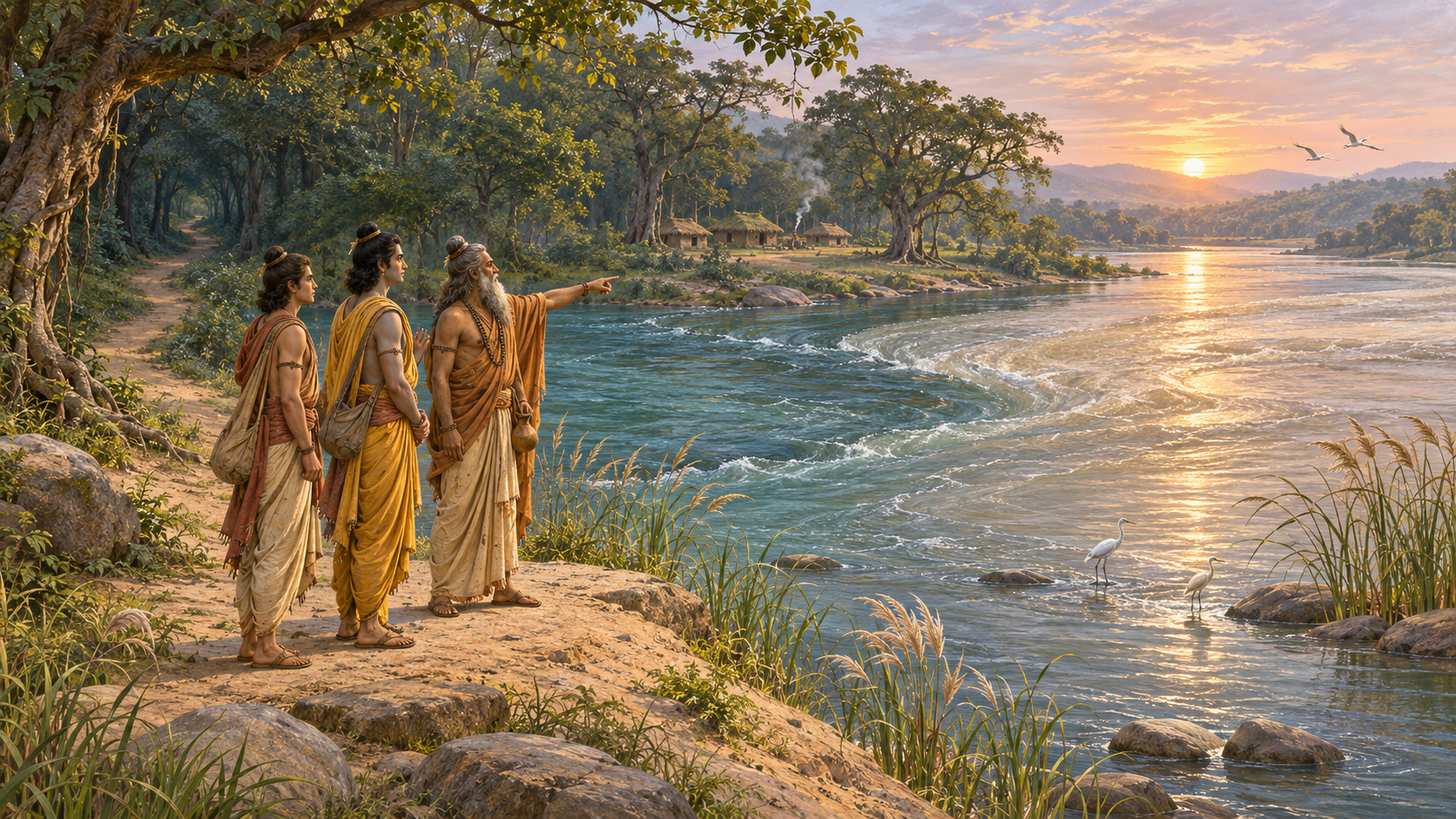
The Sarayu account arrives while Rama is going to help protect a yajna. This joins two themes that are sometimes pulled apart in modern religious life: reverence for sacred reality and readiness to carry out a difficult obligation.
The river suggests continuity between source and expression. The mission supplies the corresponding test: will sacred formation flow into conduct when protection is required? The narrative does not leave Rama’s education at the level of admiration. Knowledge accompanies movement, and movement leads toward service.
For you, the useful question is not merely whether you feel devotion beside a sacred river or while reading about one. Ask what that devotion produces when a responsibility is inconvenient. Does it make your action steadier, more restrained and more faithful to what you say you honour?
This does not give anyone permission to label every modern adversary a rakshasa or to force the episode onto a present-day dispute. The narrative supplies a moral pattern, not an automatic verdict on contemporary people. The pattern is demanding enough: know what is sacred, understand what duty requires, accept guidance and act without severing conduct from its source.
A practical way to study and contemplate the episode

You can turn this short episode into a focused reading practice without inventing claims that the chapter does not make.
- Begin with the narrative setting. Read Bala Kanda, Chapter 23 with attention to the journey, the boat, Siddhashrama and the yajna. Do not extract the origin statement from the mission surrounding it.
- Write the direct claim in plain language. Record that the Sarayu’s divine origin is traced to Manasa Sarovar. Keeping this sentence simple prevents later reflection from being mistaken for the text itself.
- Identify the narrative connection. Note that knowledge of the sacred river is received while Rama and Lakshmana are travelling toward an act of protection. Ask why a teaching about origin belongs at that moment.
- Apply the image to one actual duty. Before a responsibility in your own life, ask: What is the source from which I want my conduct to flow? Then choose an action consistent with that source rather than settling for a devotional feeling that changes nothing.
If you identify dharma, a vow, a teacher’s instruction or devotion to Shri Rama as a guiding source, examine the next visible expression of it. Courage without restraint can become aggression. Reverence without service can become sentiment. Discipline without a sacred orientation can become mechanical. The source-to-flow image helps you test whether the two remain connected.
This method also protects against two common reading errors. A purely literal reading may remember the name Manasa Sarovar but overlook why the teaching appears during Rama’s mission. A purely symbolic reading may dissolve the Sarayu into a generic metaphor. Close reading allows the river to remain a sacred presence in the narrative while also letting its origin shape contemplation.
Key takeaways
- The Sarayu’s origin is given in Bala Kanda, Chapter 23 of the Valmiki Ramayana.
- The chapter associates the river’s divine origin with Manasa Sarovar.
- The setting matters: Vishwamitra is leading Rama and Lakshmana toward Siddhashrama to protect his yajna from rakshasas.
- The boat journey places sacred instruction within movement toward duty, rather than apart from it.
- A sound spiritual reading distinguishes the chapter’s direct claim from the meaning you draw from it.
- The episode can help you ask whether your visible conduct truly flows from the dharmic source you profess to honour.
When you next read Chapter 23, pause at the journey by boat. Write down the stated origin first, then name the responsibility surrounding its disclosure. Finally, carry one question into your next duty: does the way you act remain connected to the sacred source you claim?
References

Leave a Reply
You must be logged in to post a comment.