
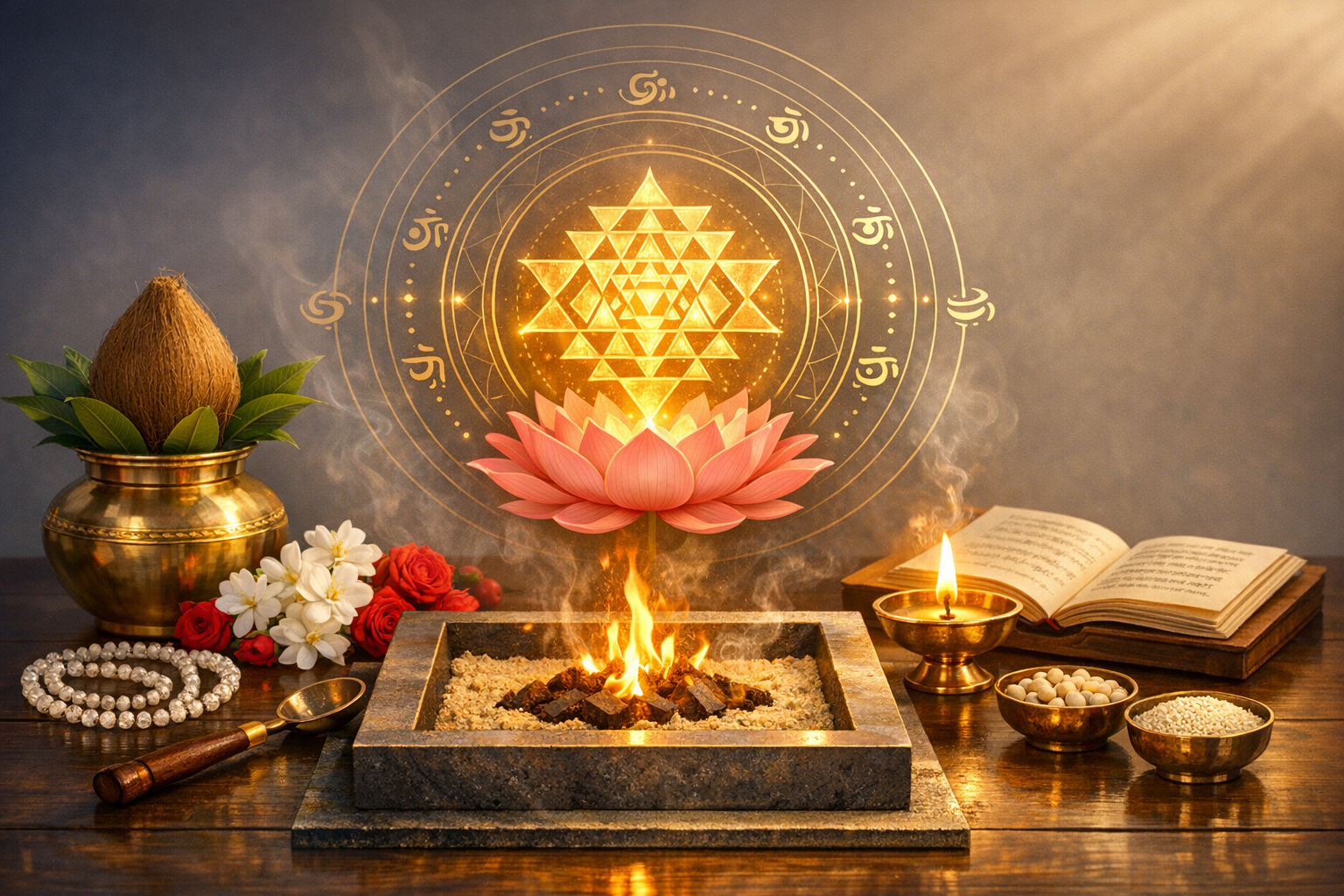
Samputitha Sri Suktam refers to the recitation of the Vedic Sri Suktam intensified through samputikaranathe practice of “enclosing” each verse with a chosen samputa mantra, typically composed of Lakshmi bija mantras. This calibrated embedding is intended to amplify mantra-shakti, align intention (sankalpa) with dharma, and stabilize both inner and outer prosperity. In contemporary practice, Samputitha Sri Suktam is performed as daily parayana, as a focused vrata across select lunar days, and as a full Vedic homa (fire ritual), particularly on Fridays, Purnima, Deepavali, and during the auspicious month of Margashirsha. The approach harmonizes Vedic recitation with time-tested mantra engineering and is valued for its clarity, repeatability, and measurable discipline.
Textually, Sri Suktam is found in the Rigveda Khilani and is dedicated to Śrī Mahālakṣmī. Traditional viniyoga identifies Bhṛgu as rishi, Śrī Mahālakṣmī as devata, and the principal bija as Śrīṁ, with Hṛīṁ and Klīṁ commonly accepted as shakti and kīlaka in certain recensional lineages. The suktam spans 15 principal ṛks in the widely used version, with some traditions employing 16 or 17 verses. Variations reflect living Vedic transmission systems rather than contradiction. For sadhakas, the essential aim remains unaltered: invoking the presence of “Śrī”the synergy of abundance, beauty, auspiciousness, and sustaining orderso that artha and kāma are governed by dharma and ultimately point toward mokṣa.
Samputikarana is the precise insertion of a chosen samputa before and after each verse. The samputa acts as a resonant frame, focuses mental one-pointedness, and ethically channels intention. In Samputitha Sri Suktam, practitioners recite the selected samputa mantra, then the verse (ṛk), then the same samputa again, maintaining metrical care and a steady breath rhythm. The method is not an arbitrary addition but a classical intensifier recorded in several ritual manuals and widely upheld in parampara. Consistencyselecting one samputa for the entire cycleis emphasized for energetic coherence.
Several samputa mantras are in current use under different paramparas. A widely employed and balanced choice is: Om Shreem Hreem Shreem Kamale Kamalalaye Praseeda Praseeda Om Shreem Hreem Shreem Mahalakshmyai Namah. Another succinct and popular variant is: Om Aim Hreem Shreem Kleem Mahalakshmyai Namah. When a tradition prescribes the use of a single bija as samputa, many adopt: Om Shreem Mahalakshmyai Namah. In all cases, adherence to one’s lineage guidance is paramount, as mantric grammar, bija sequencing, and nyasa protocols can differ across shakas and regional schools.
The guiding rationale for samputa selection follows classical semantics of bija syllables: Śrīṁ is associated with nourishment and auspicious prosperity, Hṛīṁ with inner radiance, ethical clarity, and transformative wisdom, and Klīṁ with cohesive attraction and harmonious relationships. The tri-bija configuration (Śrīṁ–Hṛīṁ–Klīṁ) is frequently recommended for householders seeking a dharmically integrated life where wealth is stabilized by compassion, restraint, and wise stewardship.
Before parayana, practitioners prepare the space and body-mind instrument. Cleanliness, sattvic diet, and a quiet, ventilated space facing east or north are standard. A simple altar with a kalasha, padma (lotus) or śrī-yantra, ghee lamp, and white or red flowers sets the tone. Friday sunrise, pradosha, Purnima, and Deepavali are classical windows of enhanced receptivity; however, daily practice at a consistent hour is equally effective. The sankalpa should be framed in dharma-positive language that emphasizes well-being, generosity, and right livelihood, rather than acquisitiveness.
Parayana Vidhi proceeds with ordered clarity. Step 1: achamana (purificatory sips) and prāṇāyāma to settle the breath. Step 2: sankalpa, clearly stating name, lineage details if known, place, date, and intentionfor example, “Śrī Mahālakṣmī prītyartham Samputitha Sri Suktam parayanam kariṣye.” Step 3: brief Gaṇapati dhyāna and mantra to remove impediments. Step 4: kara-nyāsa and aṅga-nyāsa using Lakshmi bijas if prescribed in the lineage. Step 5: rishi-nyāsa, chandas-nyāsa, and devata-nyāsa for the suktam. Step 6: dhyānam on Śrī Mahālakṣmī seated on a lotus, luminous and benevolent, bestowing fearlessness and abundance aligned with dharma. Step 7: formal viniyoga, commonly framed as, “Om asya Śrīsūktasya Bhṛgur ṛṣiḥ, Śrī Mahālakṣmīr devatā, Śrīṁ bījam, Hṛīṁ śaktiḥ, Klīṁ kīlakam, Śrī Mahālakṣmī prītyarthe jape viniyogaḥ.” Step 8: recitation of the Sri Suktam with samputikaranasamputa, verse, samputamaintaining clear enunciation. Step 9: closing shantis, nāmārcana if customary, and brief meditation in gratitude. Step 10: visarjana with reverence, and, wherever possible, an act of dāna or seva consistent with one’s capacity.
For counting, a tulasi or sphatika mālā is preferred, with the meru untouched. Common parayana counts include 1, 3, 9, 11, 16, 27, 54, or 108 avartanas depending on the vrata. Many householders adopt 11 avartanas daily for 21 or 40 consecutive days, or 108 avartanas on Purnima. On Deepavali, Samputitha Sri Suktam parayana is traditionally followed by a brief Lakshmi Arati, and where tradition allows, by homa. Periodic observances are often synchronized with Margashirsha Fridays, an auspicious cycle for Śrī worship.
Care in diction is critical. Each ṛk should be intoned with stable pitch, correct sandhi, and an even pace. Breath management avoids strain; a soft, steady volume sustains clarity. The samputa should be of identical wording and meter placement across all verses in a given cycle to keep resonance uniform. If a tradition prescribes adding Mahālakṣmī Gāyatrī before and after the entire suktam rather than after each verse, that format should be followed consistently rather than mixed with per-ṛk samputas.
Samputitha Sri Suktam Homa translates the same structure into the fire ritual, aligning mantra, dravya, and intention. A square homa-kunda lined with clean sand is prepared; mango or palāśa sticks are used where available, with clarified ghee as the primary offering. After āvāhana of Agni and Gaṇapati puja, Agni is invoked with introductory mantras and stabilized with ājyāhutis. Śrī Mahālakṣmī is then invoked, and Sri Suktam japa precedes homa to tune the field.
During the core homa, each offering follows the triadic cadence: the chosen samputa, the specific Sri Suktam verse, the same samputa again, and “svāhā,” accompanied by a measured āhuti of ghee. Some paramparas prescribe one āhuti per ṛk per avartana, while others recommend three āhutis per ṛk to mirror icchā, jñāna, and kriyā shaktis; both are in use. For household observances, 108 or 216 total āhutis are practical and auspicious. Lotus seeds (makhana), lotus petals, white sesame, and fragrant cardamom may be added judiciously to ghee āhutis when sanctioned by tradition, as lotus offerings hold special resonance with Śrī. Pūrṇāhuti concludes the rite, often with a coconut wrapped in cloth and sanctified grains, followed by kṣamā-prārthana, śānti mantras, and distribution of prasāda.
Offerings, dress, and altar aesthetics contribute to sattva. White or red flowers, fresh turmeric, kumkum, and a ghee lamp sustained without flicker are customary. The overall homa sequence adheres to standard Vedic homa architecture: saṅkalpa, punyāha-vācana, kalasha-sthāpanā, Gaṇapati puja, Agni-pratiṣṭhā, Lakshmi āvāhana and upachāras, mantra-japa, the Sri Sukta homa itself, pūrṇāhuti, kṣamā, and visarjana. Where a priest is engaged, adherence to shrauta-smarta detail and local śākhā nuance is expected; for householders, simplicity with precision is preferred to complexity with uncertainty.
Ethically, Samputitha Sri Suktam is rooted in the insight that prosperity is sustainable only when it flows through dharma. Across dharmic traditions this aligns with shared values: dāna and aparigraha in Hindu and Jain thought affirm restraint and generosity; the Buddhist dāna-pāramitā and right livelihood emphasize compassionate sustenance; Sikh seva and honest labor exemplify abundance as community uplift. A practitioner’s sankalpa framed as “for the welfare of all beings” harmonizes personal stability with collective well-being, strengthening spiritual unity across Hinduism, Buddhism, Jainism, and Sikhism.
Practitioners report recognizable inner markers when recitation matures: a calm, unhurried attention during japa; spontaneous gratitude; decreased anxiety about outcomes; and a natural inclination toward service. External outcomesclarity in financial decisions, reduction of wasteful habits, or timely opportunitiestend to reflect stabilized inner order rather than sudden windfalls. This orientation preserves the integrity of Sri Suktam as a path to holistic “Śrī,” not mere gain-seeking.
Sound practice includes a few safeguards. One lineage, one samputa, and one cadence per vrata yield the cleanest results. Where uncertainty about pronunciation exists, learning from a qualified teacher or priest is essential; recorded recitations can assist but do not substitute for live correction of chandas and svara. Observing basic vrata conducttruthfulness, restraint in speech, and food puritysupports the mantra’s sattvic field. Concluding each session with a small act of dāna, even symbolic, closes the ritual loop by returning value to society.
In summary, Samputitha Sri Suktam integrates Vedic authority, mantric precision, and practical devotion. Through clear parayana vidhi, carefully chosen samputa mantras, and, where appropriate, a modest yet exact homa, householders and practitioners stabilize auspicious order in life. The suktam’s enduring promise is not transactional wealth but the flowering of “Śrī”beauty, abundance, harmony, and wisdomshared with the world through generous living.
Inspired by this post on Hindu Pad.
