
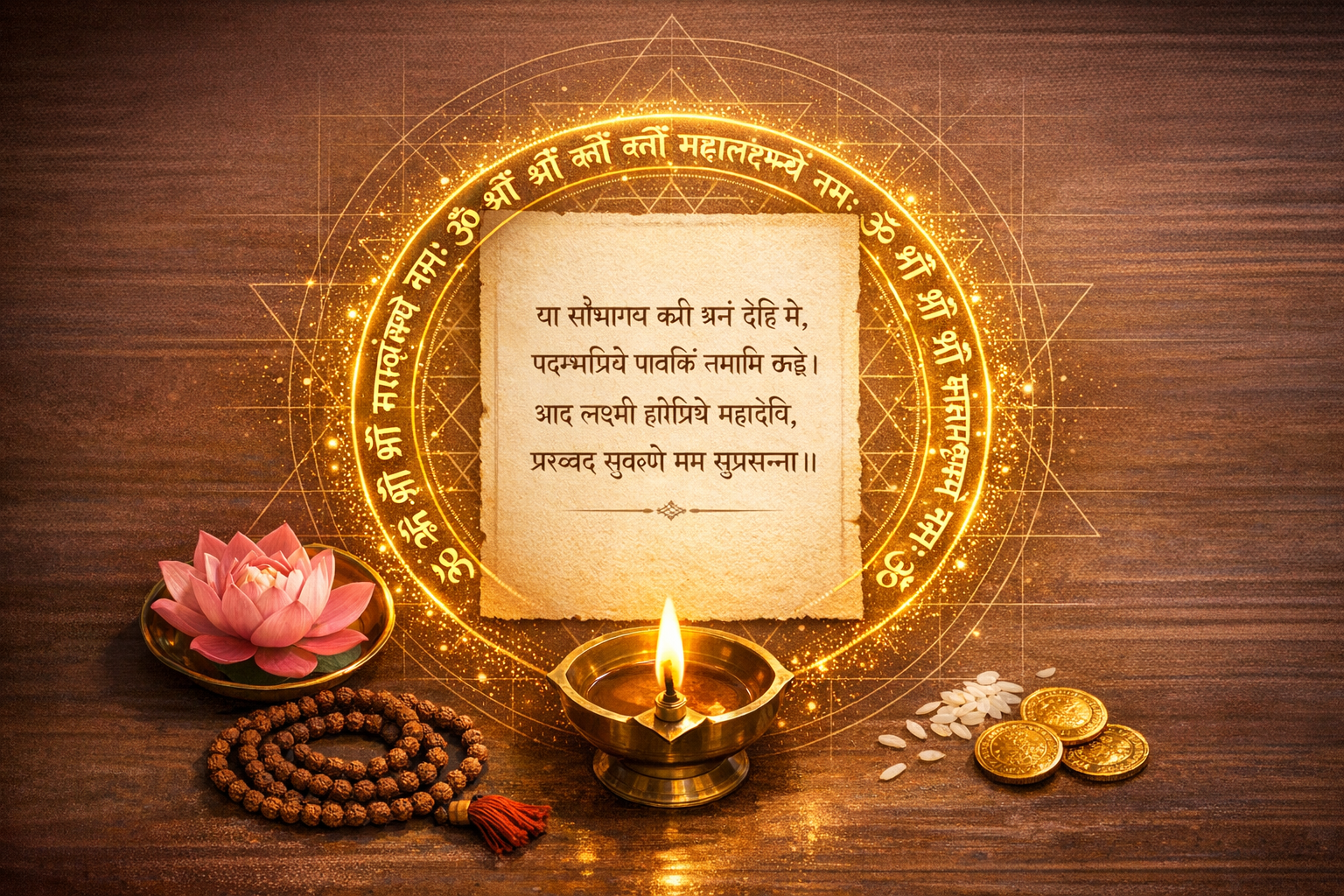
Sri Suktam Samputikarana is a disciplined Vedic–Tantric method for placing a targeted mantra “capsule” around each verse of the Sri Suktam so that the hymn’s foundational shakti is directed toward a clearly defined outcome. In this practice, the samputa functions as an energetic seal. By changing that seal, the practitioner changes the specific prayoga, aligning the same timeless Sri Suktam to different life aims such as prosperity, inner peace, protection, or collective well-being.
Situated in the Rigvedic Khila tradition and venerated across Hindu spirituality, Sri Suktam invokes Mahalakshmi as the principle of auspiciousness, abundance, and harmonious order. While its recitation is widespread in household puja and temple liturgy, Samputikarana introduces a technical layer known in both Vedic traditions and Tantrism. It does not alter the sanctity of the original scripture; rather, it surrounds the hymn with a selected mantra that tunes its functional emphasis, much as a refrain can guide the feeling-tone of music without changing the melody.
The structural golden rule of Samputikarana is unwavering consistency. One and the same samputa is placed in the same position throughout the entire recitation, and the original text of Sri Suktam remains intact. Placement must respect chandas and intonation, and the number of insertions per verse should remain uniform from beginning to end. This fidelity to structure is what allows the added mantra to act as an even, protective, and purposive seal around the whole hymn.
A clear sankalpa precedes all mantra work in Vedic traditions. Samputikarana is conventionally undertaken for sattvic aims that support dharma, such as prosperity with ethical use, peace with justice, or protection that upholds right conduct. A concise statement of intent, articulated mentally or aloud, aligns the mind, the breath, and the mantra. In this way, the practice becomes an offering, not merely a technique.
Preparation follows time-honored Hindu rituals. The space is made clean and quiet, a lamp is lit, and simple offerings like water and flowers are arranged. Many practitioners begin with Ganesha vandana to remove obstacles, followed by guru vandana and a short dhyana on Goddess Lakshmi. Fridays, the Shukla Paksha, and months dedicated to auspiciousness are common choices, though tradition ultimately prioritizes steadiness and purity over calendar precision.
Three placement patterns are commonly described. The bahya samputa places the seal mantra before and after each verse, enclosing the rik entirely. The antara samputa places the seal within the verse at a canonical caesura recognized by a lineage. The madhya samputa places the seal between padas or at the mid-verse pause. For household practice, the bahya samputa is the most straightforward because it leaves the interior of each verse untouched and is easy to keep consistent across the whole Sri Suktam.
A simple demonstration of bahya samputa with Sri Suktam’s opening line illustrates the method while preserving the text. One may seal the verse as: ॐ श्रीं ह्रीं क्लीं महालक्ष्म्यै नमः ॥ हिरण्यवर्णां हरिणीं सुवर्णरजतस्रजाम् ॥ ॐ श्रीं ह्रीं क्लीं महालक्ष्म्यै नमः ॥. This shows the seal mantra before and after the rik, without disturbing the original verse wording or its cadence.
Samputa choice determines the prayoga’s emphasis. The most widely used seed for Lakshmi is श्रीं. A classical, comprehensive seal is ॐ श्रीं महालक्ष्म्यै नमः, which expresses reverence and invites the compassionate abundance of Goddess Lakshmi. For amplifying auspiciousness with clarity and harmonious attraction, many traditions employ the triad ॐ श्रीं ह्रीं क्लीं महालक्ष्म्यै नमः. When the aim is deeply contemplative and sattvic, the Lakshmi Gayatri provides an expansive, luminous enclosure: ॐ महालक्ष्म्यै च विद्महे विष्णुपत्न्यै च धीमहि तन्नो लक्ष्मीः प्रचोदयात्.
Viniyoga is guided by intent and lineage. For steady household prosperity and ethical wealth, श्रीं-focused samputas are favored. For peace-making, relational harmony, and clarity in decision-making, traditions add ह्रीं to uplift understanding. For projects requiring magnetizing cooperation, क्लीं is included along with श्रीं and ह्रीं, always situated within a dharmic frame that benefits family, community, and society. In every case, the same seal is retained throughout the entire recitation to maintain structural and energetic integrity.
Counting and cadence anchor the practice. Common recitation counts include 11, 27, 54, or 108, chosen according to time and capacity. A single continuous session for each count is preferred, with a calm, even breath that does not strain the voice or disrupt attention. Where a purashcharana is undertaken under guidance, ancillary offerings follow classical ratios, but for most householders a disciplined daily routine with sincerity and right conduct is considered fully sufficient.
Nyasa and dhyana refine the inner alignment of body and mind to mantra. Many lineages precede Sri Suktam with hridaya nyasa or karanyasa on the name of Lakshmi to consecrate the limbs and steady prana. A brief visualization of Mahalakshmi on a lotus, bestowing shri, shanti, and dharma, deepens bhava without adding complexity to the textual recitation.
Some combine Samputikarana with homa, yantra, or vrata. A modest offering into a home lamp at the end of the japa symbolically completes the act of giving and receiving. Where a Lakshmi yantra is present, the mantra is offered mentally to the yantra with gratitude. Observances that include dana strengthen the ethical arc of prosperity, turning personal benefit into social contribution and lokasangraha.
Care is essential to avoid common pitfalls. The seal mantra should not fragment a verse at arbitrary points, the number of insertions should not vary unpredictably from rik to rik, and multiple different seals should not be mixed within a single ritual cycle. Above all, the seal must never replace or distort the original words of Sri Suktam. Consistency, humility, and clarity of purpose carry the practice farther than novelty or complexity.
The inclusivist ethos of the broader Dharmic family supports this method’s spirit. While Samputikarana is articulated within Hindu scriptures and Tantric prayoga, related principles of intentional recitation and protective refrains appear in Buddhist dharani traditions, in Jain liturgical repetitions, and in Sikh simran and shabad structures that center the mool mantar. Each community safeguards its own language and grammar of the sacred, yet all valorize ethical intent, inner clarity, and compassion. Honoring this shared ground nurtures unity among Hinduism, Buddhism, Jainism, and Sikhism.
Advanced practitioners sometimes map the seal to specific goals within the classical purusharthas. For dharma-centered leadership or stewardship, a sattvic seal emphasizing clarity and responsibility is selected. For artha, a Lakshmi-focused seal underscores ethical prosperity and the wise circulation of resources. For kama, the emphasis is on harmony, mutual respect, and beauty guided by dharma. For moksha, contemplative seals like the Lakshmi Gayatri open the heart to viveka and inner freedom, reminding the practitioner that all blessings culminate in insight and compassion.
Tradition places strong emphasis on the practitioner’s character. Mantras are not treated as instruments of compulsion; they are relationships of reverence and discipline. The fruits of Sri Suktam Samputikarana arrive most naturally when the practitioner lives in alignment with truthfulness, generosity, and fairness, and when prosperity is shared in service of community and the vulnerable. In this way, the seal around the hymn becomes a seal upon one’s own conduct.
For those new to the method, the recommended path is gradual. Begin with a single, well-understood seal such as ॐ श्रीं महालक्ष्म्यै नमः in the bahya placement, and recite a stable count, for example 27 or 54, on Fridays or any day that can be maintained consistently. Keep a simple journal of intent and observations, noting the qualities of attention, calm, and gratitude that arise. Over time, if guidance is available within a tradition, explore antara or madhya placements with the same devotion to structure and clarity.
In essence, Sri Suktam Samputikarana is a way of listening more deeply to a revered hymn and giving it a precise compass. The structure preserves the scripture, the samputa directs the energy, and the sankalpa binds the practice to dharma. When these elements are integrated, the ritual becomes an elegant synthesis of Vedic mantras, Tantric method, and lived ethics, radiating blessings that nurture both the household and the wider world.
Inspired by this post on Hindu Pad.
