
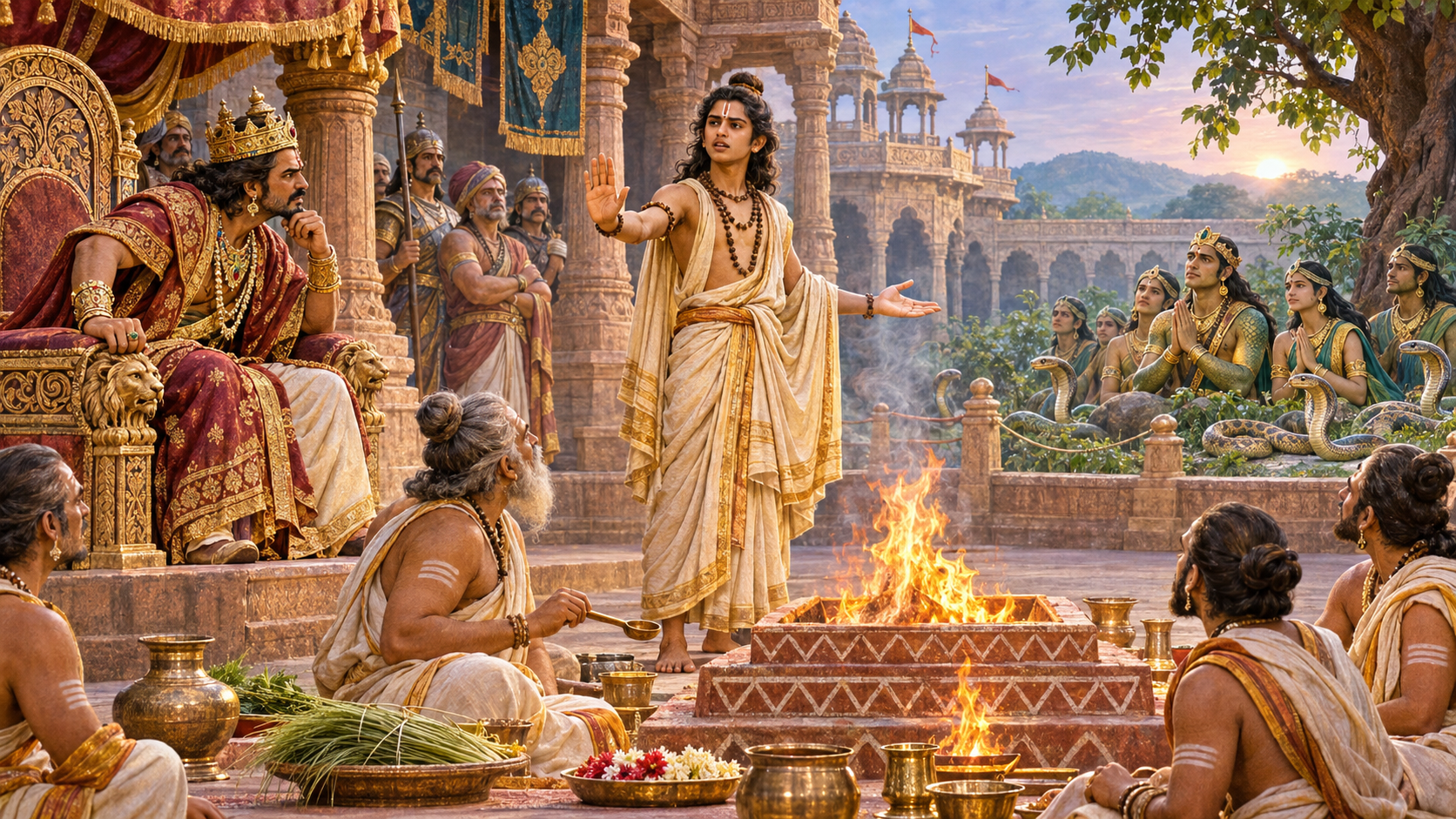
If you have wondered why the Mahabharata pauses over Rishi Astika’s name, do not treat it as a decorative biographical detail. His name helps you understand his decisive act: when destruction has acquired authority and momentum, Astika stands for the continued existence of those marked for death.
That connection between name and deed makes his story especially useful when you are trying to distinguish genuine peacemaking from vague calls for harmony. Astika does not merely lower the temperature of a dispute. He prevents vengeance from becoming the destruction of an entire community.
A name built around the affirmation “there is”
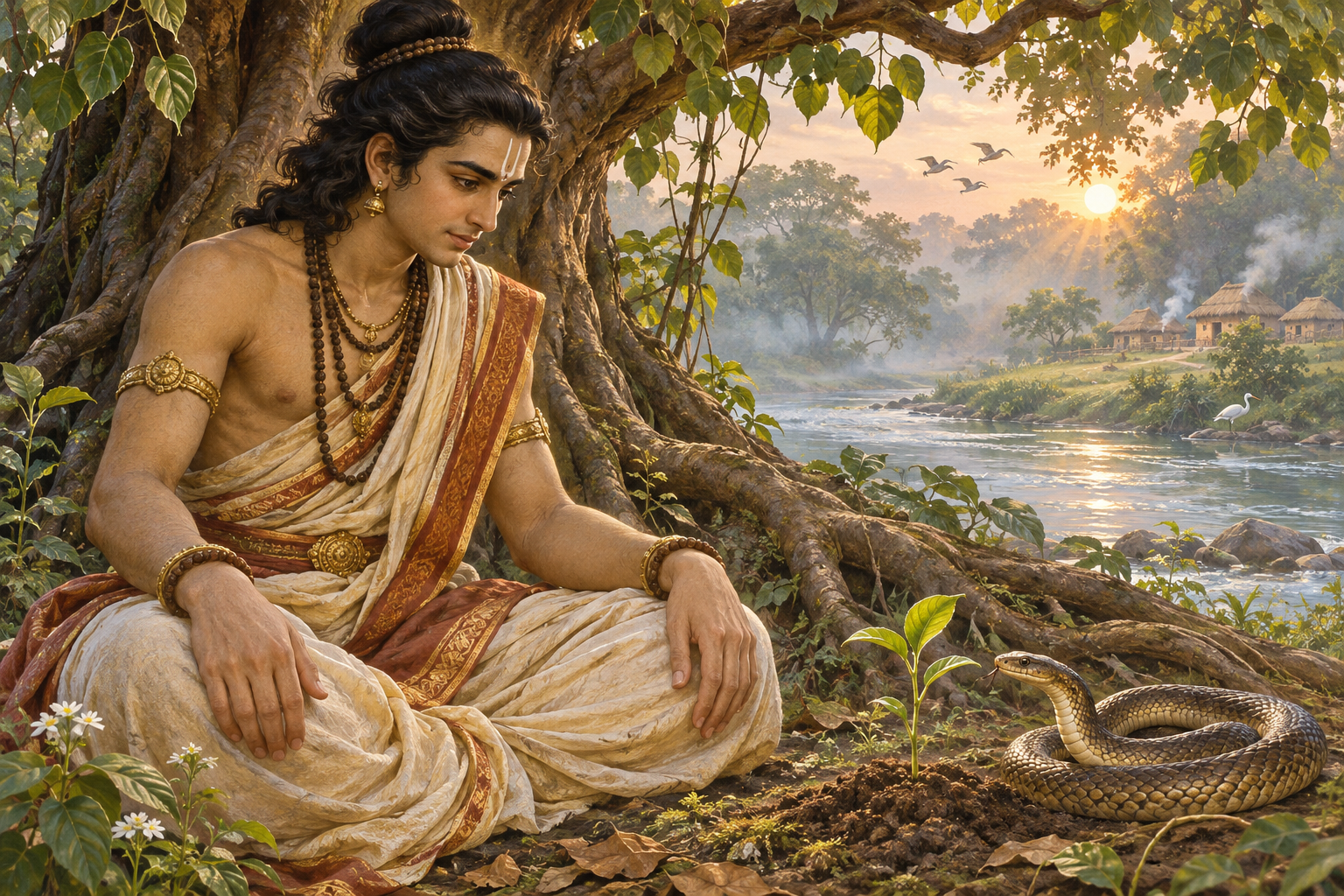
At the centre of Astika’s name is the Sanskrit word asti: “there is” or “it exists.” In the Astika Parva, chapter 44 of the Adi Parva, Astika’s birth is connected to the purpose he will fulfil. He is born to save the Nagas from King Janamejaya’s snake sacrifice.
The name therefore does more than identify a character. It prepares you to recognise what his life affirms. At the moment when the Nagas’ existence is threatened, Astika becomes the person through whom their continued existence is secured. His name and his action point in the same direction: life remains; annihilation is not the only possible ending.
You should be careful, however, not to force every technical or philosophical use of the word astika into this personal name. Indian intellectual traditions use related words in several contexts. The narrative connection here is direct and sufficient: asti is an affirmation of existence, while Astika’s appointed work is to preserve existence.
This gives you a practical way to read meaningful names in an itihasa. Do not stop at a dictionary gloss. Place the meaning beside the character’s crucial choice. Ask what the name allows you to notice about the action. With Astika, the answer is not an abstract doctrine but a limit placed upon destruction.
Astika’s peace begins by stopping collective destruction
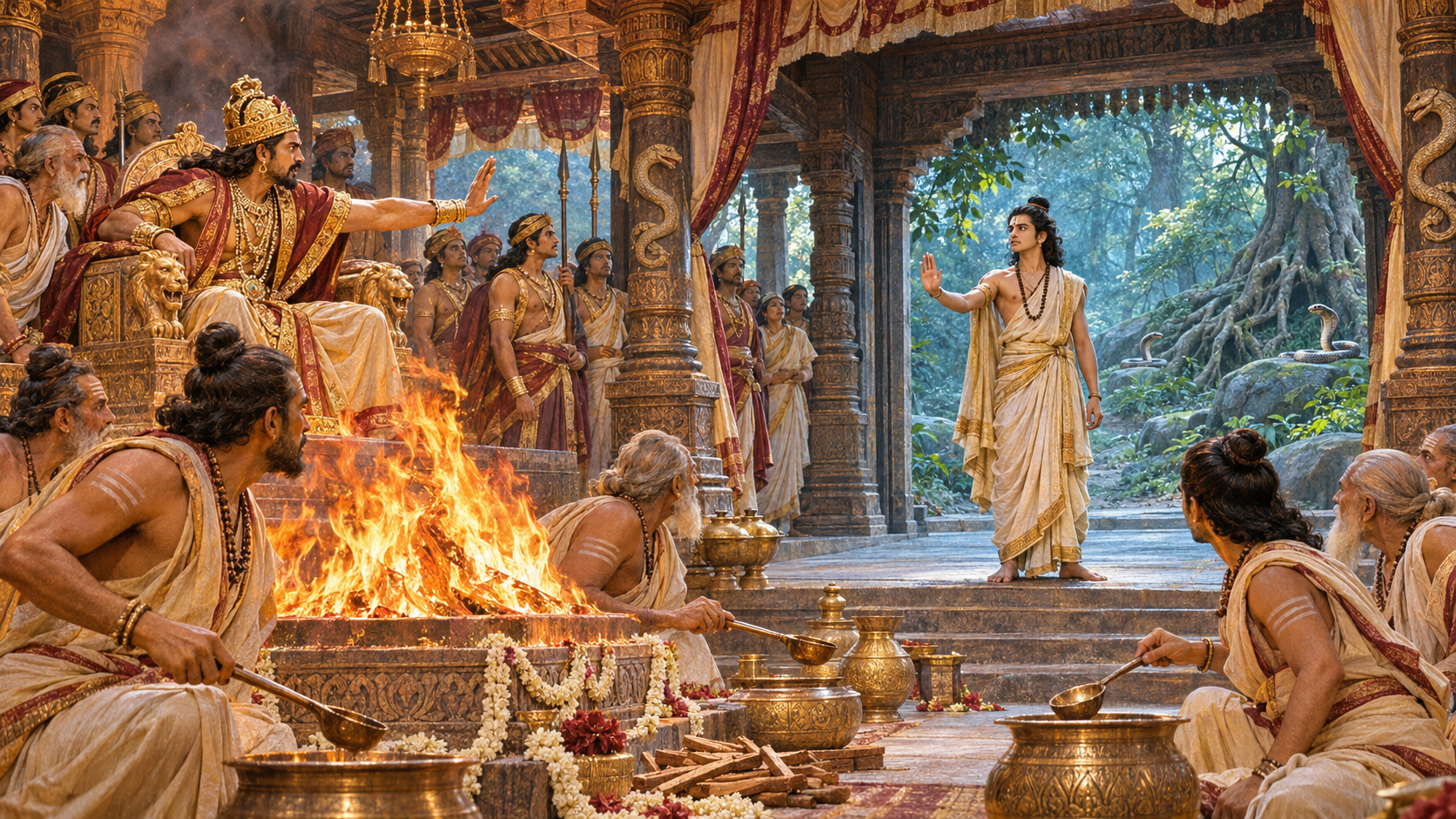
Astika was born to save the Nagas from Janamejaya’s sacrifice. That purpose makes his peacemaking more demanding than a general appeal for kindness. A king has committed his power to a destructive course. A ritual mechanism is carrying that course forward. The Nagas face the consequences collectively.
Astika’s intervention teaches that peace cannot be measured only by whether hostile words have ceased. The first measure is whether the threatened beings are still being destroyed. A courteous conversation that leaves the machinery of annihilation running is not peace.
Nor is peacemaking the same as declaring every party equally situated. Janamejaya possesses the authority associated with the sacrifice; the Nagas are the ones who must be saved from it. Astika’s role is therefore directed toward the place where a decision can halt the harm. That is a valuable discipline whenever moral language becomes hazy: identify who is endangered, identify who can stop the immediate danger, and make the stopping point explicit.
- The endangered community is named: Astika’s mission concerns the Nagas rather than an undefined appeal to peace.
- The destructive process is named: the danger comes through Janamejaya’s snake sacrifice.
- The necessary outcome is concrete: the Nagas must be saved, which requires the destructive course to end.
These distinctions matter because the language of reconciliation can otherwise conceal what is actually happening. When a whole community is treated as one guilty body, the immediate dharmic task is not to invent a more soothing description. It is to prevent punishment from becoming collective ruin.
Peacemaking interrupts vengeance without denying moral seriousness
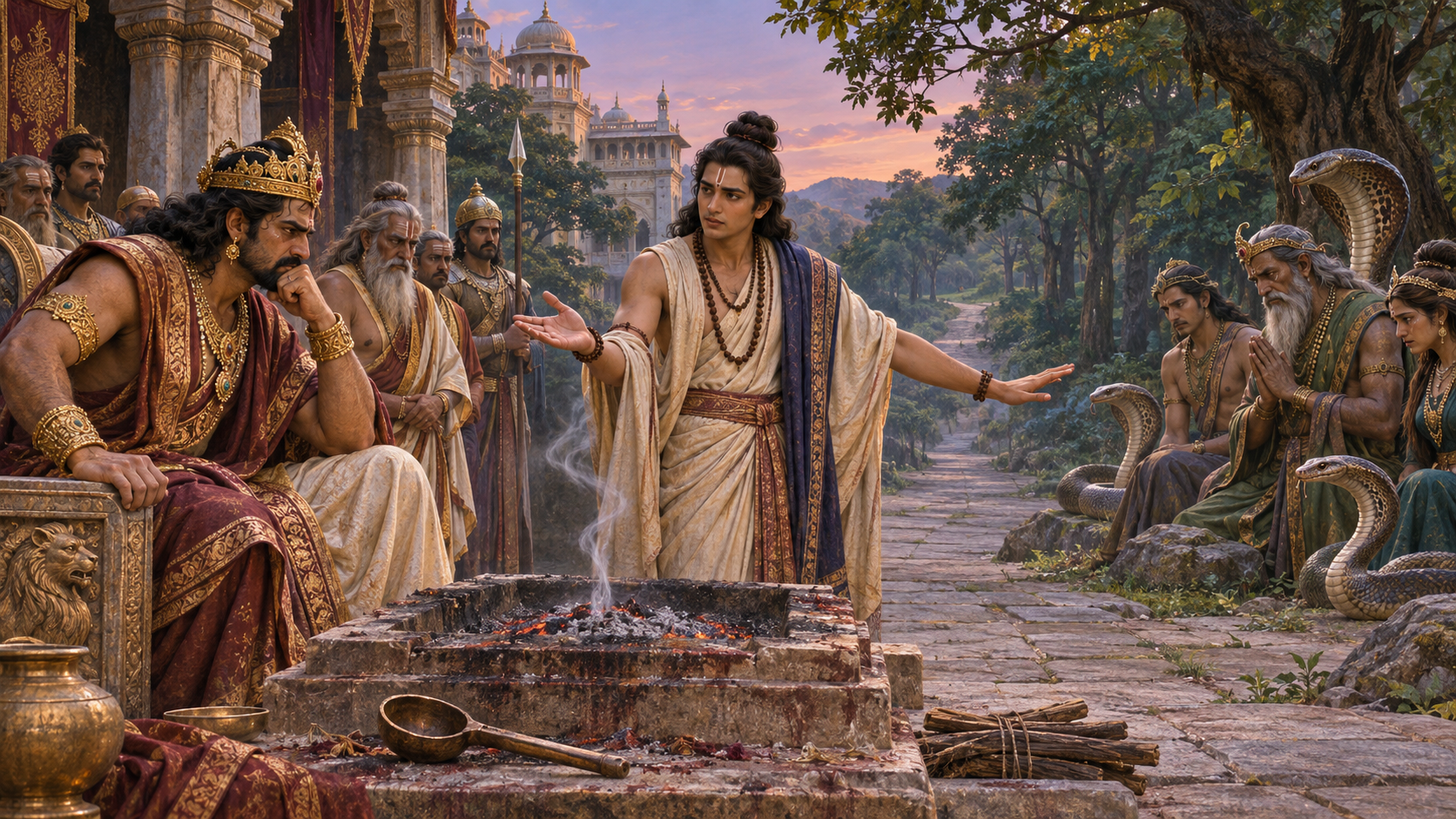
Astika’s role does not require you to pretend that grievances are unreal or that justice never matters. It reveals a more precise principle: even a grievance does not give vengeance an unlimited claim over the future. Once retaliation expands toward the destruction of a category of beings, someone must establish a boundary.
This is why Astika should not be reduced to a passive mediator standing at an emotionally convenient midpoint. His achievement has direction. He acts to save life. The peace he brings is not moral indifference; it is the refusal to let destruction continue merely because it has been given a ritual, political or retaliatory justification.
His name helps you see three affirmations within that refusal:
- There is someone here: no community should disappear behind a hostile label. The beings facing harm remain morally visible.
- There is a limit: power and grievance do not make every response proportionate or dharmic.
- There is a future: stopping destruction preserves the possibility of justice, restraint and relationship after the immediate crisis.
The third affirmation is easily overlooked. Vengeance tries to make the past sovereign over everything that comes next. Astika’s intervention reopens the future. It creates the possibility of an ending other than the one already set in motion.
How to apply Astika’s model without flattening the story
You do not honour a sacred narrative by turning it into a shallow slogan for every disagreement. A family argument, a political campaign and an attempt to destroy a community are not interchangeable. You can still carry Astika’s moral method into present conflicts if you preserve the distinctions that give it force.
- Locate the irreversible harm first. Ask what will be impossible to restore if the present course continues. Survival, physical safety and the continued existence of a community take priority over winning the argument.
- Separate responsibility from collective identity. Name the particular act and the responsible actor as precisely as the available facts allow. Do not convert ancestry, religion, kinship or community membership into automatic guilt.
- Address the person or institution with stopping power. Astika’s intervention matters because it reaches the king associated with the sacrifice. In your own situation, determine who can actually halt the harmful action rather than directing every appeal toward spectators.
- Make a bounded request. “Everyone should reconcile” is too vague when harm is underway. Specify what must stop: the order, punishment, public incitement, exclusion or retaliatory action. A precise limit can be acted upon.
- Do not confuse stopping with settling everything. Ending an immediately destructive course does not erase questions of truth, responsibility or justice. It creates the conditions in which those questions can be faced without further irreversible harm.
This method is particularly useful when you encounter political or communal rhetoric. Notice when a speaker slides from criticism of a definite action to condemnation of an entire people. Replace the collective accusation with three precise questions: What happened? Who is responsible for that act? What response would address it without treating unrelated members of a community as expendable?
You can use the same discipline before repeating an inflammatory claim. If a message assigns guilt by identity, pause. Ask whether sharing it would help establish responsibility or merely enlarge the circle of hostility. Astika’s lesson is not that you should avoid judgement. It is that judgement must not become a licence to erase the existence of others.
Key takeaways
- Asti means “there is” or “it exists,” making affirmation of existence central to the way Astika’s name can be read.
- In the Astika Parva of the Adi Parva, Astika is born with the purpose of saving the Nagas from King Janamejaya’s snake sacrifice.
- His peacemaking is concrete: it stops a destructive process and preserves a threatened community.
- The episode distinguishes peace from passivity. A peacemaker must identify the immediate harm and direct the appeal toward the power capable of ending it.
- You can apply this dharmic pattern by rejecting collective guilt, naming responsible acts precisely and demanding a clear limit before harm becomes irreversible.
When you next encounter Astika’s story, keep the meaning of asti beside his deed. Then carry one question into your own conflicts: what must be stopped now so that truth, justice and a shared future can still exist?
References

Leave a Reply
You must be logged in to post a comment.