

You can hear a Srimad Bhagavatam discourse in the morning, feel completely persuaded, and still spend the afternoon reacting from habit. The difficulty is usually not a lack of spiritual information. It is the missing bridge between hearing and conduct.
That bridge becomes clearer when you ask a practical question after every class: what should change in the next situation that tests me? Recent teachings around sankirtana, guru-guided worship, disciplined living, dharmic responsibility, and household attachment give you a workable answer.
Give devotion an embodied form

Devotion weakens when it remains an admired idea. It becomes durable through actions that involve your voice, attention, body, relationships, and daily choices.
Sankirtana supplies one such action. In Srimad Bhagavatam 11.5.31, worship appropriate to the age is centred on sacrifice performed chiefly through sankirtana. In the Gaudiya Vaishnava tradition, this means congregational glorification of Bhagavan through the chanting and hearing of His names. It is not merely devotional music playing in the background. You participate by voicing the name, hearing it, and returning the wandering mind to it.
That distinction matters. Background sound can accompany distraction; sankirtana confronts distraction. It gives the mind a sacred object, the tongue a sacred activity, and the community a shared centre. When your practice feels scattered, begin there rather than searching immediately for more material to consume.
Arcana makes the same principle visible in another way. The movement described in Srimad Bhagavatam 11.3.48 proceeds through the grace of the acharya, received instruction, and worship of the Lord in the murti cherished by the practitioner. The sequence is important. Sincerity does not make every improvised ritual equivalent to a received method. Form protects intention from becoming whatever happens to feel convenient that day.
- Give chanting a fixed cue. Begin after an existing daily act, such as bathing or entering your prayer space, so remembrance does not depend on a passing mood.
- Let your own voice enter the practice. If you are physically able, chant attentively rather than treating a recording as a substitute for participation.
- Receive the method before modifying it. When you are unsure about mantra, murti-seva, cleanliness, offerings, or sequence, ask a qualified teacher within the lineage you actually follow.
- End with a duty. Name the quality the practice must govern when you leave the prayer space: truthful speech, restraint, service, courage, or patience.
This is not mechanical religion. A form becomes empty when attention and service disappear, but formless aspiration has its own danger: it can evade correction. Mature practice needs both inner intention and an outer discipline capable of testing that intention.
Let discipline govern what reaches the mind

Many people try to repair an agitated mind only after agitation has taken hold. Bhagavata yoga works further upstream. It pays attention to the conduct, consumption, and surroundings from which mental states arise.
Kapila’s practical framework includes moderation in pure food, attraction to the path of liberation, withdrawal from merely worldly preoccupation, and use of a protected, undisturbed place. These are not decorative preliminaries to meditation. They reduce the occasions on which the senses continually renegotiate your spiritual intention.
Notice the mechanism. If your prayer place is also where you scroll, argue, work, and watch entertainment, the mind receives competing instructions from the same environment. If every period of quiet begins with deciding where to sit and what to read, indecision consumes the opening of the practice. If you regularly take in material that rewards anger, comparison, or sensual agitation, you carry those impressions into japa and then wonder why attention will not settle.
You do not need to imitate the external life of a renunciant to learn from this. You need to stop arranging your surroundings against the state you claim to seek.
- Protect one place. Keep a clean location for japa, reading, and worship. Do not use it casually for the activities that most fragment your attention.
- Audit the input before the distraction. When the mind is unusually restless, look back at what you watched, read, discussed, and ate before practice. Identify the recurring condition instead of condemning yourself in the abstract.
- Use moderation, not spiritual theatre. Choose food and routines compatible with your health, duties, and tradition. The aim is clarity and self-command, not a display of severity.
- Remove the predictable negotiation. Keep the needed text, beads, seat, or worship articles ready and clean. A small amount of order prevents convenience from deciding whether practice occurs.
Restraint is successful when it frees attention for Bhagavan and service. If it mainly produces pride, harshness toward others, or fascination with your own austerity, the means has displaced the end.
Respond to adharma without becoming governed by anger
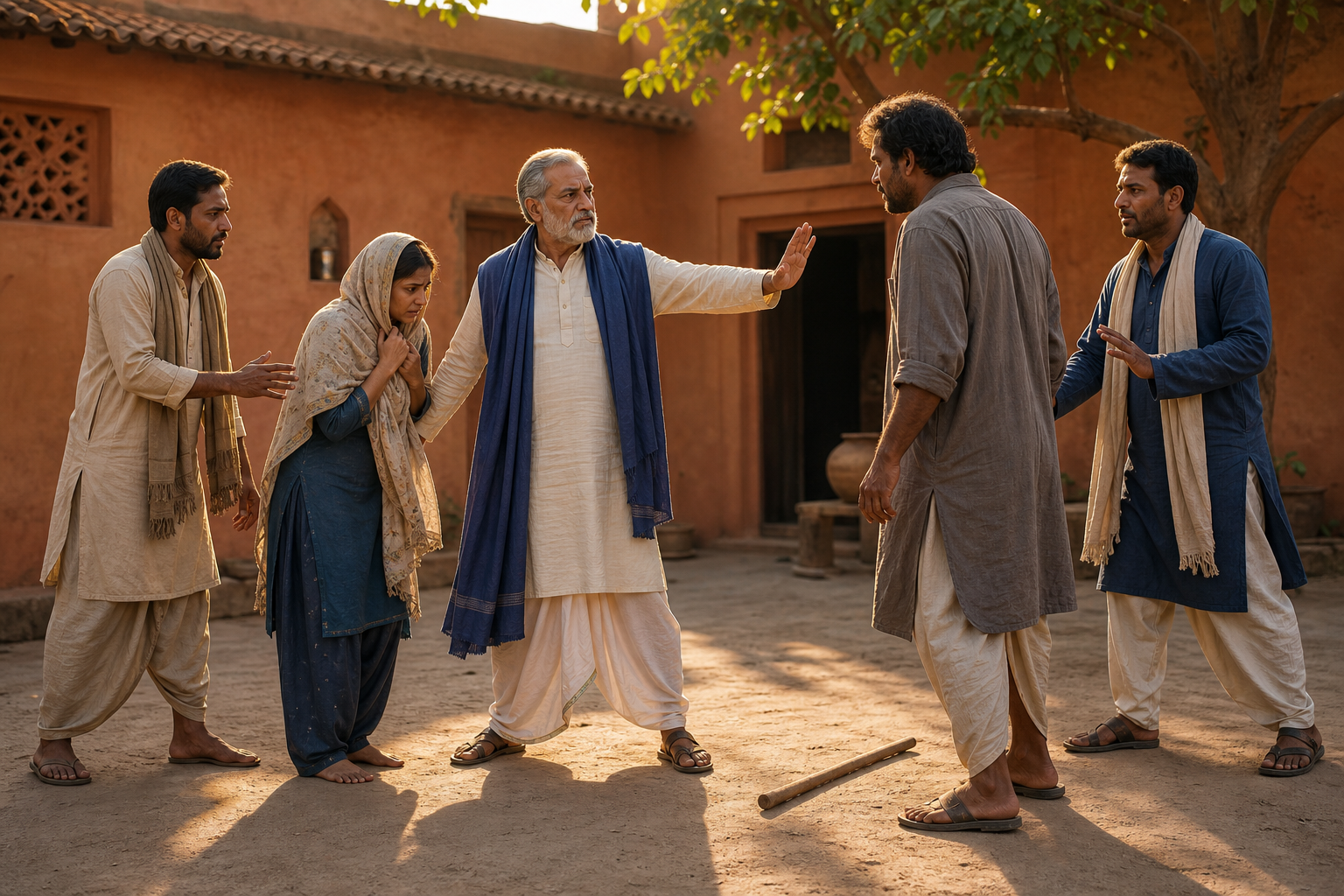
Bhakti is not passivity. The Bhagavatam repeatedly places devotion inside situations that demand judgment, protection, and action.
When a destructive weapon threatens life, Arjuna is directed in Srimad Bhagavatam 1.7.24 to apply the fitting countermeasure. The danger is not denied, and spiritual language is not used to avoid responsibility. Arjuna must hear clearly, use the knowledge appropriate to his role, and act.
King Parikshit’s encounter with the arrival of Kali develops the public dimension of the same duty. He hears that a force hostile to dharmic order has entered his jurisdiction and prepares to confront it. His responsibility is not confined to preserving a private devotional mood. As a ruler, he must protect the conditions in which dharma can be lived.
The settings are martial and kshatriya. They do not grant private individuals a license for vigilantism or uncontrolled force. The transferable principle is disciplined responsibility: recognise a real threat, understand your legitimate role, choose a proportionate means, and remain accountable to dharma while acting.
Use the following questions when a conflict presents itself:
- What exactly is being harmed? Distinguish injury to dharma, another person, or a legitimate boundary from injury to your prestige.
- What is my actual responsibility? A parent, teacher, manager, citizen, temple officer, and state authority do not possess the same mandate.
- What knowledge does the response require? Zeal cannot replace competence. Seek informed guidance where the matter exceeds your training.
- What is the proportionate instrument? A correction, refusal, record of events, appeal to proper authority, protective boundary, or organised lawful response may be stronger than an impulsive confrontation.
- Can I stop when the duty is complete? If you continue because anger has become pleasurable, the response is no longer governed by its original purpose.
This test is especially useful in online disputes. Sharing material because it is true, necessary, and responsibly framed can serve dharma. Sharing it because outrage gives you a temporary identity merely spreads the agitation further. Courage protects what is worthy; anger without discrimination often makes the self the centre again.
Keep household absorption from erasing spiritual direction

The household itself is not the enemy. Forgetfulness is. Work, family care, administration, and social duty become spiritually dangerous when their urgency gradually displaces the purpose they were meant to serve.
The Pracetas eventually seek Narada’s illumination because absorption in household life has allowed previously received divine instruction to fade from active memory. This is an exact description of a common devotional problem. You may still respect the teaching, possess the books, attend gatherings, and identify with the tradition. Yet the remembered instruction no longer governs the calendar, speech, expenditure, or relationships.
You can detect that drift before it becomes a crisis. Watch for these signs:
- You can recall the latest controversy more easily than the instruction you meant to practise.
- Worship is repeatedly postponed until every worldly task is finished, although worldly tasks never finish.
- You keep hearing new classes but cannot name the last teaching that changed your conduct.
- Family duty is invoked to excuse irritability, dishonesty, neglect of sadhana, or needless acquisition.
- Spiritual community has become content you consume rather than a relationship in which you serve and accept correction.
The remedy is deliberate recollection, not contempt for ordinary duties. Return to trusted sadhu-sanga. Reopen the instruction that has been crowded out. Ask where it belongs in the life you actually have. Then make the smallest observable correction that restores direction.
For example, if family conversation has become harsh, do not answer only by adding more reading. Carry remembrance into the next conversation through truthful but restrained speech. If work continually consumes the period reserved for worship, repair the boundary around worship. If possessions demand more maintenance than service permits, reconsider the acquisition pattern. The test is whether household life is being offered through dharma or whether dharma is being fitted around household appetite.
Use a hearing method that ends in action
Your next Bhagavatam class can become more practical without turning sacred hearing into a productivity exercise. Listen for transformation, not merely for information.
- Identify the pressure point. What human condition is exposed: fear, distraction, attachment, confusion, negligence, pride, or a threat to dharma?
- Name the spiritual response. Is the required movement toward sankirtana, guru-guided worship, restraint, inquiry, remembrance, service, or responsible action?
- Locate your real-life version. Find where that pressure already appears in your day. Avoid choosing a hypothetical problem because it is easier than confronting the present one.
- Define an observable act. Replace a vague intention such as becoming more devotional with something you can recognise when it happens: begin with chanting before messages, ask for instruction before altering worship, protect the prayer space, document a wrong responsibly, or restrain speech in the next conflict.
- Attach the act to a cue. Decide when or under what condition you will remember it. Without a cue, even a sincere resolution is easily swallowed by routine.
- Examine the fruit. Look for deeper remembrance, steadier conduct, greater willingness to serve, and less domination by ego. Adjust the application if it produces display without transformation.
Key takeaways
- Sankirtana gives scattered attention a repeatable sacred centre.
- Guru-guided arcana joins inner devotion to a received and accountable form.
- Food, sensory input, and physical surroundings influence whether recollection is continually supported or interrupted.
- Bhakti can require decisive action, but dharmic action must remain informed, proportionate, and appropriate to your role.
- Household duty becomes an obstacle when absorption in it erases remembered instruction.
- Hearing is carried forward when you connect a teaching to a concrete act and a recognisable cue.
At your next class, write down the pressure point and the next dharmic act. Carry that act into the first situation that calls for it. The discourse will then remain with you not only as something heard, but as remembrance made visible in conduct.
References
- Dandavats – SB 1.7.24 HH Janananda Goswami
- Dandavats – Srimad Bhagavatam Class 11.5.31 | By H.G Gokuleshwar Prabhu | 20th Aug 2026
- Dandavats – Srimad Bhagavatam 1.16.3 | HH Prahladananda Swami | ISKCON Ljubljana Live
- Dandavats – His Grace Venudhar Prabhu || SB-11.03.48 || 21-08-2026
- Dandavats – Srimad Bhagavatam Text 3.28.4 Speaker – H.G Lalitamrita Devi Dasi
- Dandavats – Bhagavatam Class 4.31 1-13 | Parambrahma Prabhu
