
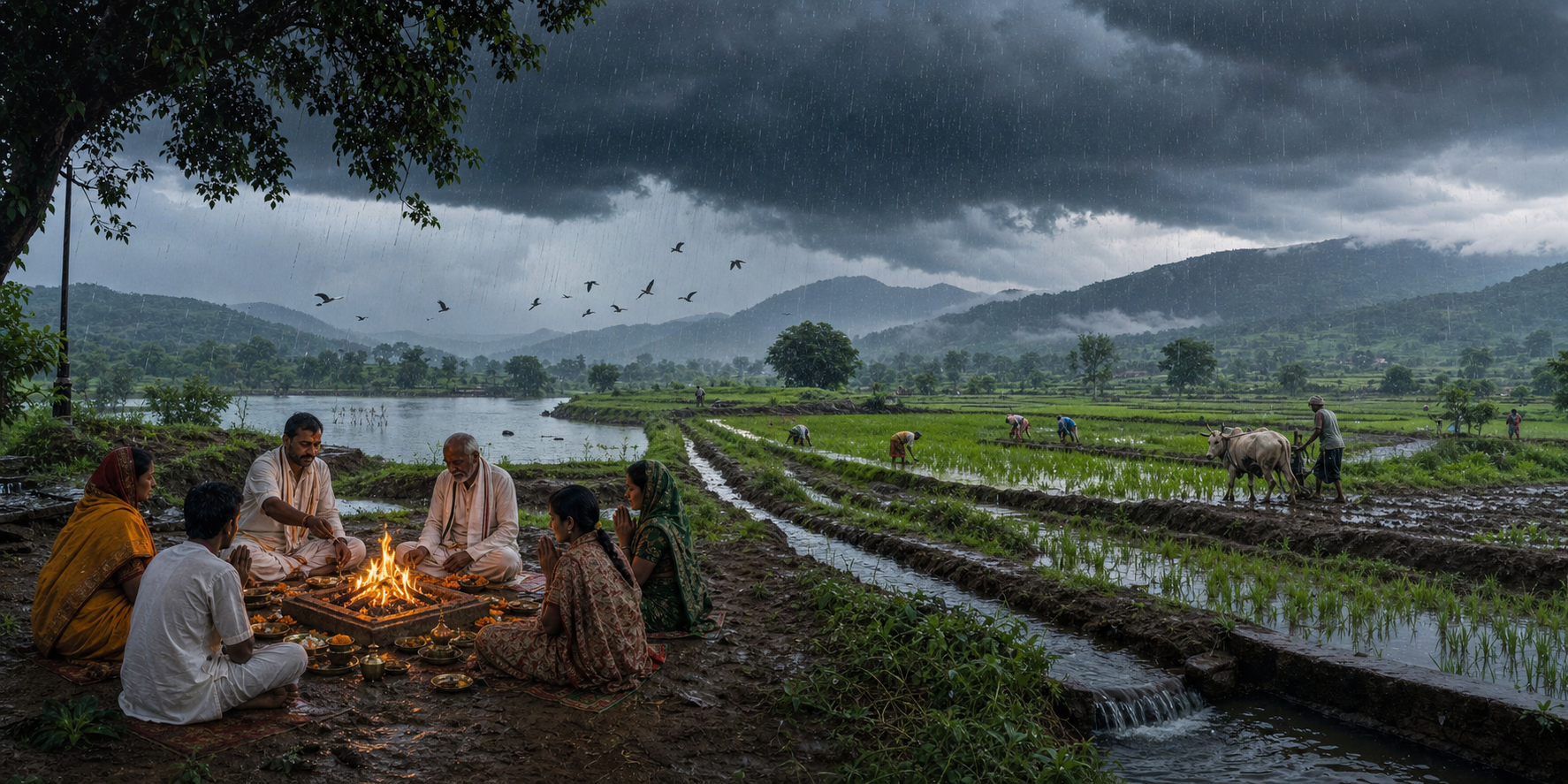
Rain has several meanings at once in India: it is a physical event, a condition of food and water security, and a sign of the dependence that binds human life to a larger order. Vedic rain theology and monsoon science become clearer when these meanings are connected without being confused.
The most useful synthesis separates three questions. Sacred texts ask what rain signifies and what obligations follow from receiving it. Meteorology explains how rainfall is produced and distributed. Water policy determines whether a deficit remains manageable or becomes a crisis. Together, these perspectives offer an ethics of resilience rather than a supernatural substitute for forecasting.
Key takeaways
- The Bhagavad Gita is part of the Mahabharata, not one of the four Vedic Samhitas, although it develops ideas inherited from the broader Vedic tradition.
- Bhagavad Gita 3.14 links nourishment, rain, Yajna and action within a cycle of reciprocal dependence; it should not be treated as a technical account of monsoon formation.
- Rainfall statistics require a stated place, reference average and observation period. Preliminary, monthly and seasonal deficits are not interchangeable.
- A water emergency results from more than deficient rain. Storage, demand, infrastructure, reuse, governance and unequal access determine the severity of its effects.
Three questions hidden inside a rain cloud
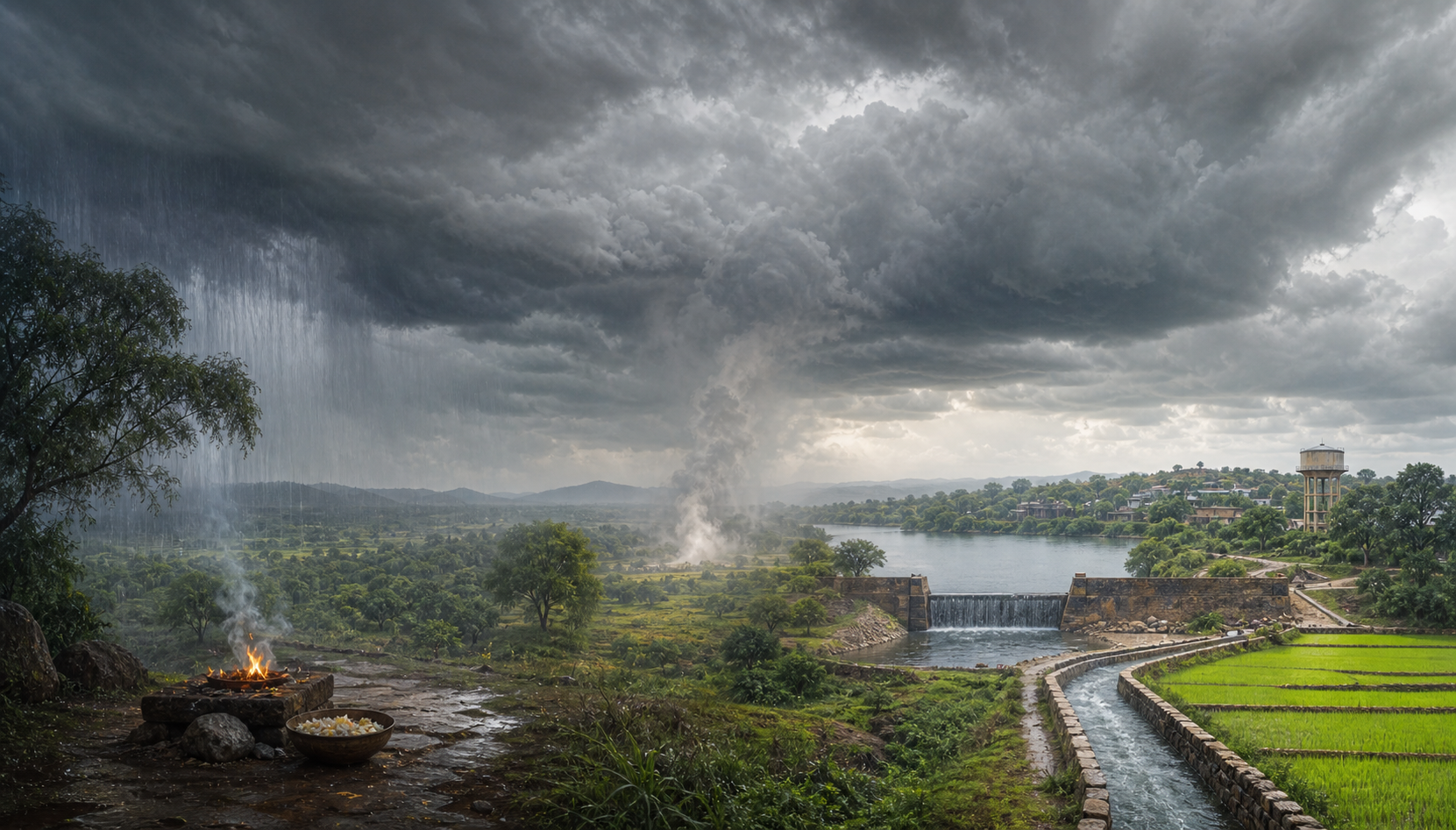
Theological and scientific accounts do different intellectual work. In sacred language, rain can express gift, reciprocity and participation in a life-sustaining order. In meteorology, rainfall follows physical processes involving winds, oceans, atmospheric pressure, moisture and topography. Neither account becomes stronger by pretending to answer the other account’s question.
Public policy introduces a third level. The same rainfall shortfall can have sharply different consequences in two places because reservoirs, irrigation, aquifers, distribution systems and household resources differ. A meteorological hazard becomes a social disaster through exposure and vulnerability. Conversely, sound preparation can reduce suffering even though it cannot command the clouds.
This distinction also prevents a common textual error. The Gita is frequently described as Vedic or Vedantic because of the tradition it interprets, but it is not itself a hymn from the Rigveda or Atharva Veda. Treating every Hindu scripture as the same kind of text erases differences of genre and historical setting. A careful account can place these works within a shared intellectual inheritance without collapsing them into one document.
What the Gita’s rain cycle is actually saying
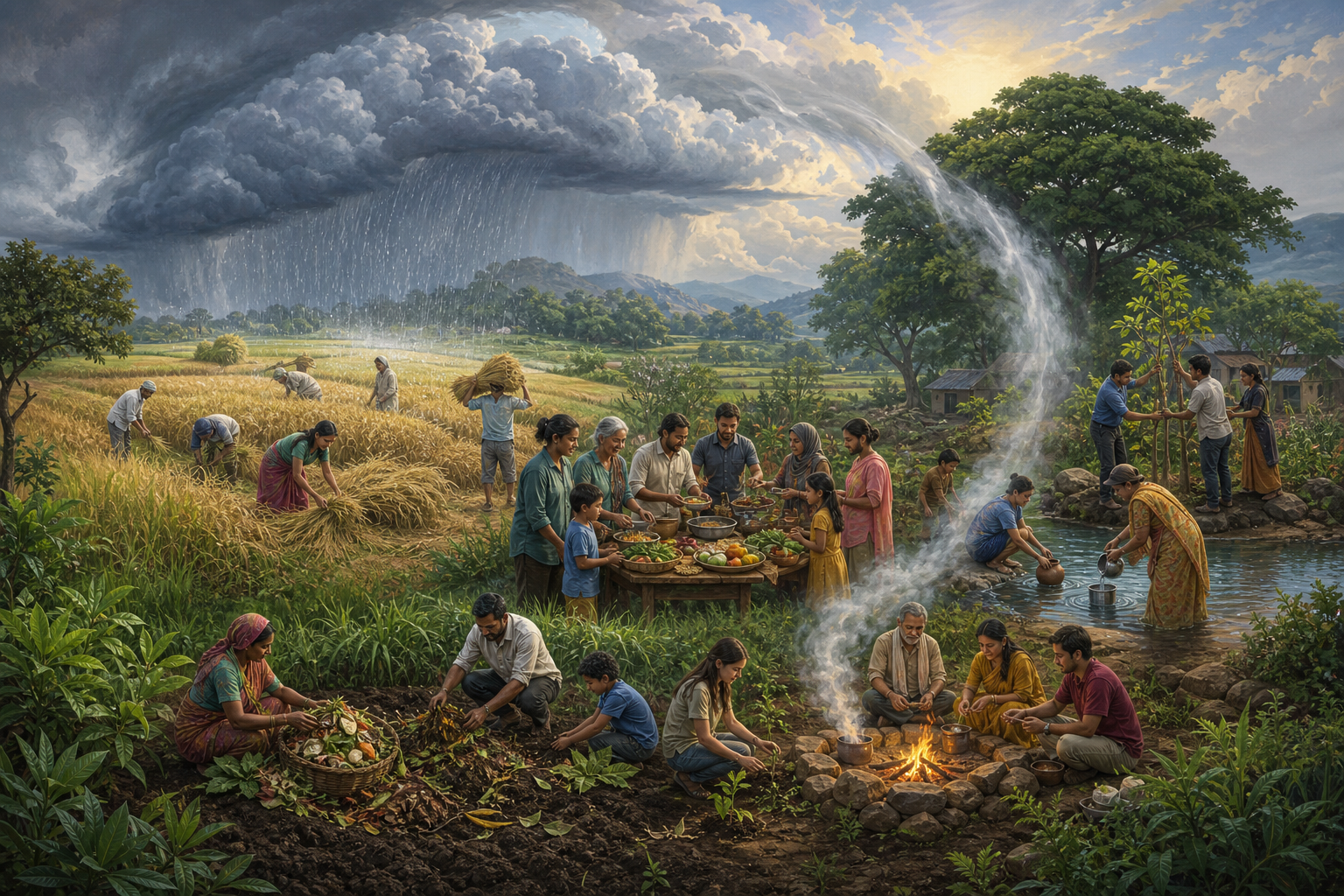
Bhagavad Gita 3.14 presents a compact chain: embodied beings depend on anna, or nourishment; nourishment depends on parjanya; parjanya arises from Yajna; and Yajna arises from karma, or action. The source article notes that parjanya can denote rain, a rain cloud or the divine power associated with rain. It also cautions that the familiar phrase “prescribed duties” expands interpretively upon the verse’s more direct reference to action.
The surrounding argument in verses 3.10-16 matters. It describes a system of mutual nourishment in which human beings receive the conditions of life and return a share through disciplined action and offering. Consumption without acknowledgment or contribution is criticized because it breaks reciprocity. Rain is therefore an indispensable link in a larger wheel, not an isolated reward dispensed through a mechanical transaction.
Yajna must retain more than one layer of meaning. In its early ritual context, it refers to sacrifice performed according to established procedures. Traditional interpretation may relate sacrifice and rain through divine agency or the unseen efficacy of correctly performed action. In the Gita’s wider ethical teaching, however, Yajna also becomes a pattern for action undertaken without possessiveness, directed toward a worthy end and supportive of the world.
An ecological reading can build upon that enlarged meaning, provided it is identified as an interpretation rather than a meteorological claim. The verse does not describe pressure systems or predict rainfall. It asks whether human beings participate responsibly in the conditions that sustain them. Its modern relevance lies in reciprocity, restraint and duty, not in using ritual language to displace atmospheric science.
What the 2026 deficit teaches about monsoon numbers
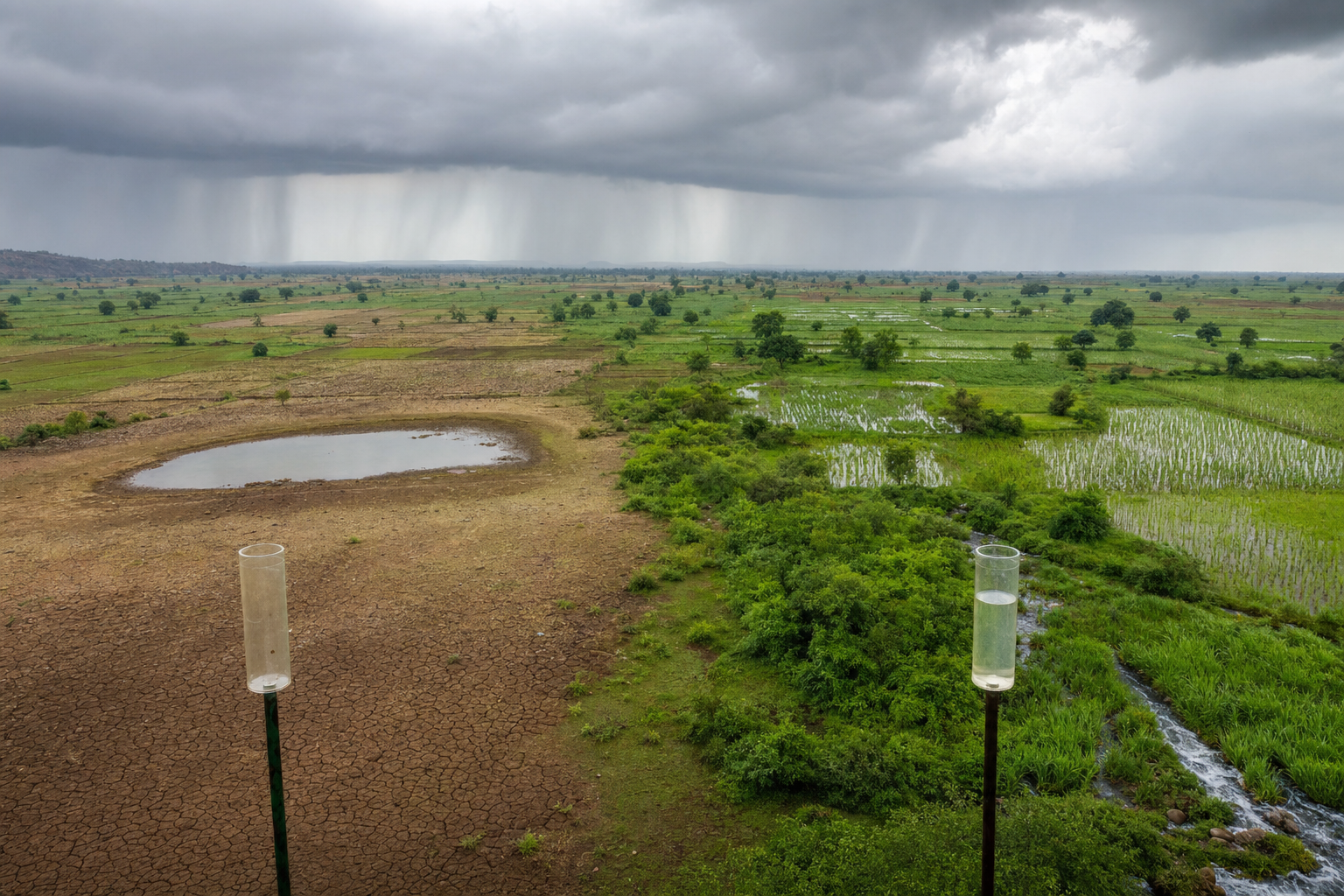
The practical importance of these distinctions appears in the source article’s account of India’s weak start to the 2026 southwest monsoon. Citing the India Meteorological Department’s finalized June assessment, it reports 99.5 millimetres of national rainfall from 1 to 30 June against a long-period normal of 165.3 millimetres. That produced an approximately 40 percent deficit, and the article describes June 2026 as the fifth driest June since nationwide records began in 1901.
Earlier reports had placed the shortfall between 42 and 45 percent and had discussed the period as potentially the third driest corresponding interval since 1901. The source explains that these were observations made before the month had ended, not necessarily competing measurements of the same finalized period. The episode shows why every rainfall figure needs three labels: the geographic area measured, the average used for comparison and the dates covered.
The numbers then changed rapidly. According to dated updates collected in the source article, the national cumulative deficit had narrowed to 14 percent by 9 July before widening to about 18 percent by 12 July as rainfall again became subdued. Uttar Pradesh was reported to have a statewide deficit of about 59 percent on 29 June, declining to roughly 40 percent by 9 July after substantial rain. Himachal Pradesh, meanwhile, reportedly received 63.8 millimetres from 1 to 29 June against a normal 95.4 millimetres, a 33 percent shortfall.
These shifts do not make the earlier danger unreal. They show that a monsoon is a developing season rather than a single national score. A dated deficit can guide decisions at that moment, but it should not be repeated later as though it were a permanent description. National totals can also conceal districts experiencing much more severe or much milder conditions.
Why deficient rain becomes a governance crisis
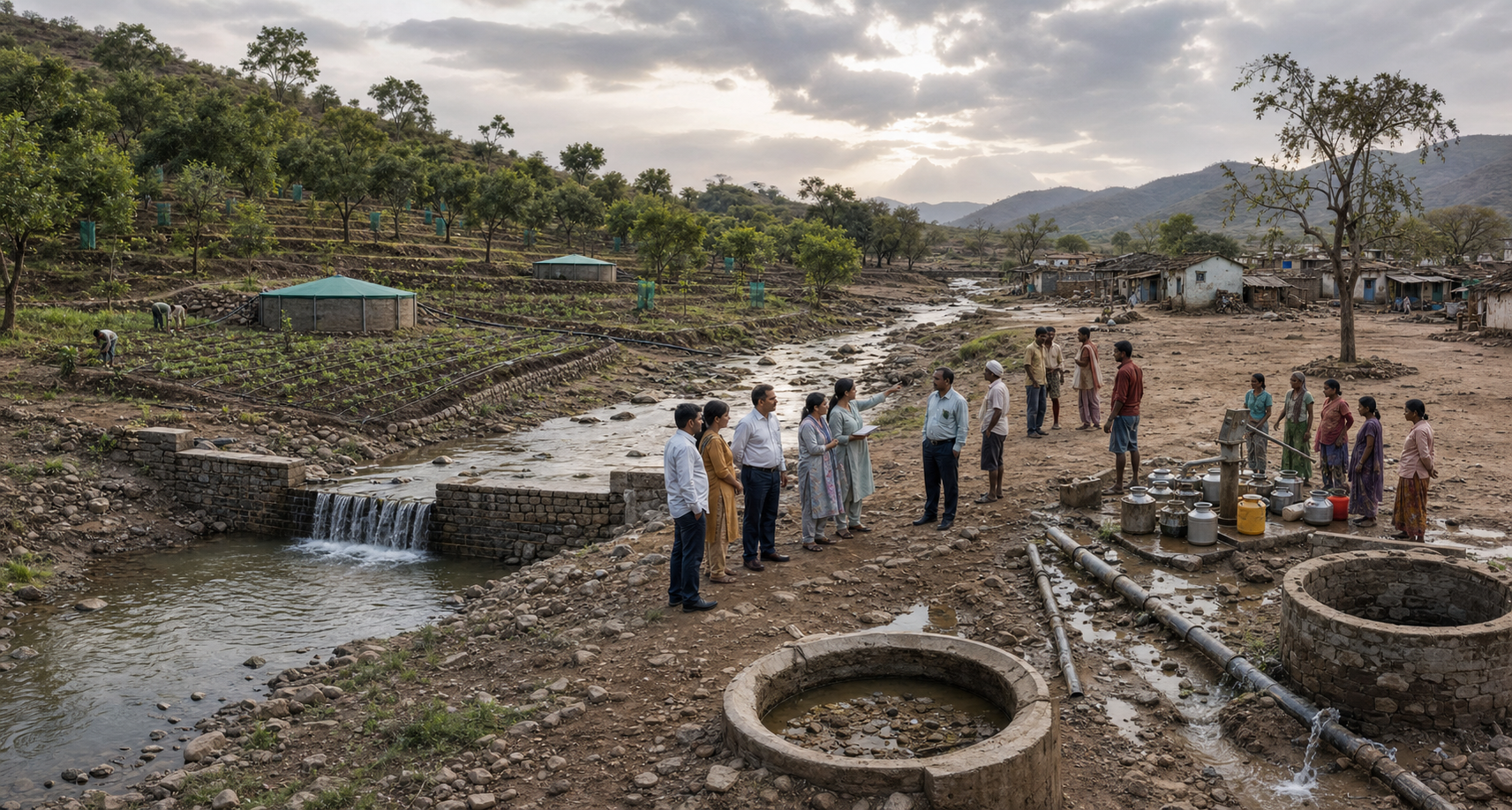
Mumbai illustrates the difference between a rainfall hazard and a water-system emergency. The source reports that Maharashtra received roughly half its normal June rainfall. On 29 June, usable storage in the seven rain-fed reservoirs serving Mumbai was reported at 6.93 percent, or about one lakh million litres. At the prevailing rate of consumption, that stock was projected to last until approximately 20 August.
That projection was a conditional planning estimate, not a prophecy that taps would inevitably run dry on a fixed date. Catchment rain subsequently raised usable reservoir storage to a reported 41.36 percent by 8 July. The reversal demonstrates both the real danger of low storage and the danger of detaching a crisis statistic from its timestamp and assumptions.
The source also reports that Mumbai was drawing about 4,100 million litres of water per day while estimated demand approached 4,600 million litres. Proposed additions involving the Gargai project, desalination and large-scale wastewater reuse were not yet available. Weak rainfall therefore exposed an existing mismatch among demand, supply diversity and the timing of infrastructure.
The human consequences are uneven. Delayed rain can postpone sowing, shorten the growing period and raise irrigation costs for farmers dependent on rainfall. Low reservoirs can lead to restrictions just as heat increases household demand. Private tanks, borewells and tanker purchases offer some households buffers that small farmers and residents of informal settlements may not possess. Rainfall is physical, but drought risk is distributed through income, access and governance.
From sacrificial reciprocity to practical resilience
A responsible contemporary application of Yajna begins with limits. It need not deny the historical reality of ritual sacrifice, and it should not claim that modern water programs are the literal meaning of an ancient Sanskrit term. It can nevertheless ask what reciprocal action looks like in a society dependent on shared ecological systems.
At the personal level, that question supports restraint rather than entitled consumption. At the institutional level, it points toward maintaining storage and distribution systems, diversifying sources, reusing treated water and planning before reservoirs approach critical levels. At the social level, it requires attention to who bears restrictions, crop losses, higher prices and the cost of privately obtained water. These are modern policy applications of an ethic of participation, not substitutes for textual interpretation or climate analysis.
The durable meeting point between theology and science is therefore responsibility. Monsoon science can clarify mechanisms, uncertainty and changing conditions; sacred thought can deepen the moral vocabulary of dependence and obligation; governance can translate both kinds of understanding into preparation. As rainfall becomes more variable from place to place and week to week, resilience will depend on preserving that division of labor while strengthening the connections among its parts.