
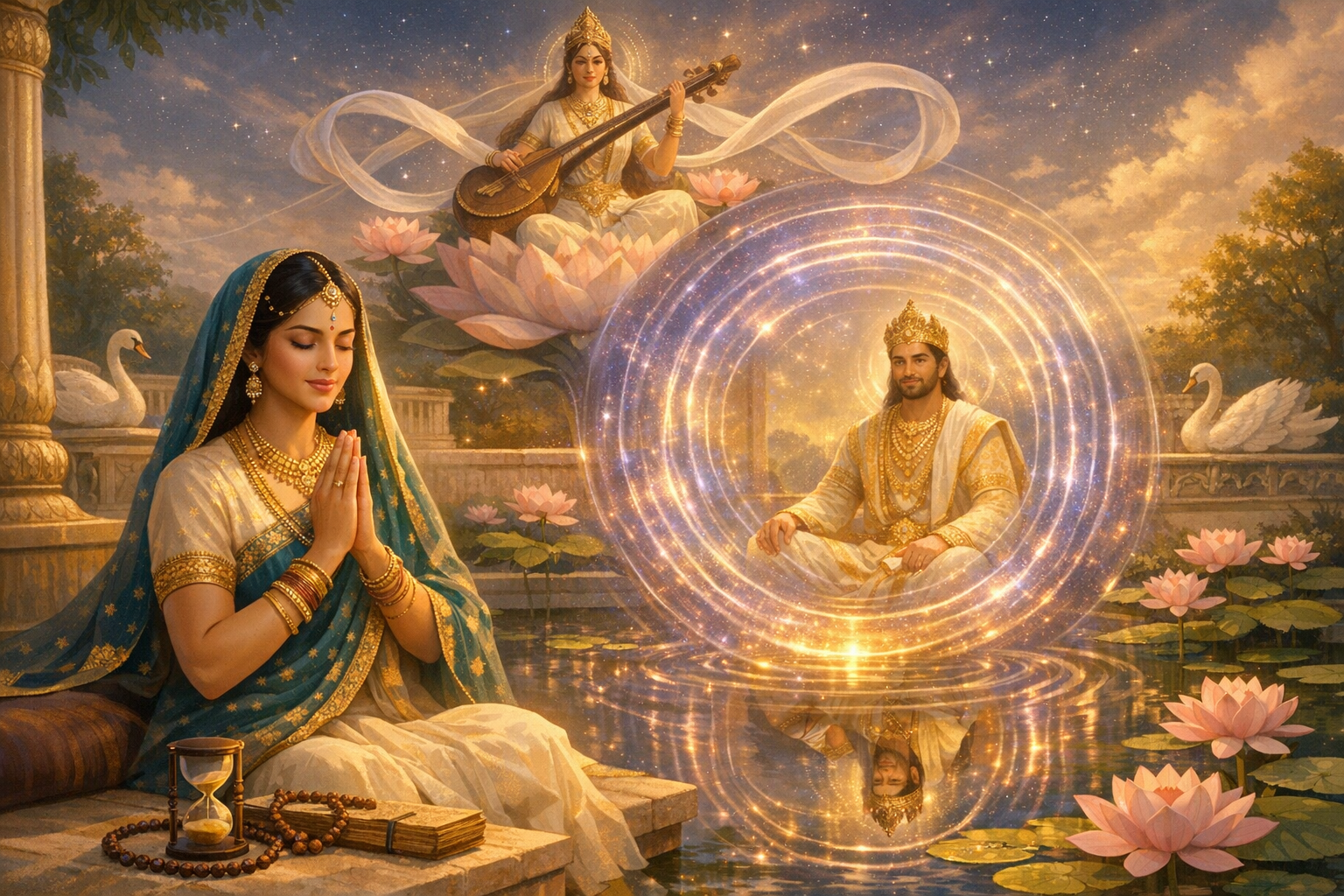
The narrative of Queen Leela and King Padma in the Yoga Vasistha stands among the most incisive explorations of consciousness, time, and reality in the Sanskrit philosophical corpus. Presented by Sage Vasishta to Lord Rama, it functions as both a compelling story and a rigorous metaphysical teaching, demonstrating how desire binds consciousness to cycles of experience and how insight loosens those bonds toward moksha. Its enduring power lies in reframing life, death, and rebirth as movements within awareness rather than as absolute beginnings or endings.
Set within the broader Advaita-leaning arc of the text, the episode follows Queen Leela’s devotion and her love for King Padma. Anticipating impermanence, Leela turns to the goddess Sarasvati for boons that will preserve connection beyond death and ease her husband’s transition. After King Padma’s passing, Sarasvati guides Leela through nested layers of experienceworlds within worldsrevealing that what appears as a single linear life is, in truth, a tapestry of simultaneous possibilities shaped by mind (citta) and intention (sankalpa). The king is encountered across planes, time flows at different rates in each, and Leela’s grief is gradually transmuted by knowledge.
Philosophically, the story operationalizes a core Yoga Vasistha insight: consciousness, stirred by latent tendencies (vasanas) and volitional projection (sankalpa), manifests entire experiential universes. What seems external is traced back to the movements of awareness; what seems final is recast as a threshold. The text’s analogiesdreams, reflections, miragesare not metaphors alone; they are epistemic tools for testing how perception (drishti) informs creation (srishti). This drishti–srishti logic reframes cosmology as phenomenology: the cosmos mirrors the knower’s standpoint.
The teaching on multiple realities invites careful attention to time. In the Leela–Padma cycle, a short interval in one sphere corresponds to decades elsewhere, anticipating discussions of relativity of time in classical Indian thought. Yoga Vasistha is not proposing a mechanical multiverse; it is describing the pliability of experienced time within consciousness. Temporal dilation and contraction are treated as lawful results of attention, memory, and karmic momentum, not as arbitrary anomalies.
Death and rebirth, often approached with anxiety or hope, are here analyzed through the layered embodiment model: sthula (gross), sukshma (subtle), and Karana Sharira (causal body). The subtle body carries samskara patterns and vasanas that condition the next projection of experience, while the causal body is the deep reservoir of latency. This triadic architecture clarifies why identity persists with difference across births: the gross frame dissolves, the subtle stream continues, and the causal storehouse underwrites continuity until insight deconditions it.
The narrative’s emotional chargeLeela’s love and fear of separationframes the ethical and psychological pivot of the teaching. Desire, in this account, is neither vilified nor romanticized; it is recognized as a binding force when unexamined and a potential vehicle of clarity when illumined by viveka (discernment). Queen Leela’s devotion initiates inquiry, and inquiry turns devotion into non-grasping love. The arc demonstrates how kama (desire) matures into vairagya (dispassion) without cynicism: what begins as clinging becomes care without possession.
This movement from bondage to freedom is supported by a precise soteriological method. Yoga Vasistha repeatedly emphasizes shravana (contemplative study), manana (reasoned reflection), and nididhyāsana (deep assimilation) as the engine of transformation. Within this triad, vichara (self-inquiry) is central: by questioning the knower, known, and knowing, the practitioner discovers that the apparent multiplicity of worlds resolves into one consciousness. Liberation (moksha) is then recognized not as flight from the world but as intimacy with the world’s ground.
Readers frequently report that the Leela–Padma episode helps metabolize grief. By relocating loss within a wider field of awareness and time, the story neither trivializes bereavement nor absolutizes it. Reflection on the subtle body (sukshma) and causal tendencies (Karana Sharira) provides a vocabulary for continuing bonds without unhealthy fixation. Practices such as japa, mindful breath awareness, and inquiry into the sense of “I” stabilize attention so that love is retained, clinging is reduced, and ethical presence is strengthened.
The text’s psychology is exacting. It identifies four interlocking drivers of experience: vasanas (latent impressions), sankalpa (intentional projection), prarabdha karma (fructifying momentum), and attention (the focusing function of citta). Together they shape the felt world. As attention relaxes clinging to prior impressions and volition aligns with dharma, experiential bandwidth changeswhat once felt inescapable becomes transparent, and choice reappears where compulsion once seemed absolute.
Within a broader Vedanta framework, Yoga Vasistha also engages the body–mind continuum through Pancha Kosha Viveka (discernment of the five sheaths). The story’s travel across layers of reality parallels inquiry through the annamaya (physical), pranamaya (vital), manomaya (mental), vijnanamaya (intellect), and anandamaya (bliss) sheaths. Recognizing each sheath as witnessed rather than ultimate allows experience to be honored without mistaking any single layer for absolute identity.
A frequent misunderstanding treats the narrative as endorsing solipsism or nihilism. The text, however, rejects both. Because all phenomena appear in consciousness, ethical responsibility increases rather than diminishes: harming others reinforces vasanas of harm within the same consciousness; compassion unties knots for self and other together. The teaching thus aligns with dharma-yoga: lucid action without possessiveness, rooted in clarity about the nature of the actor, action, and result.
Another misconception reads the episode as fatalistic. On the contrary, Yoga Vasistha locates freedom precisely at the point where attention meets vasana. While prarabdha sets the initial conditions of a life, present-centered inquiry transforms the way those conditions are lived. Practice is not the denial of karma but its intelligent completion.
Comparable intuitions appear across dharmic traditions, underscoring a shared civilizational quest. Buddhist analyses of mind-only (cittamatra) and emptiness (shunyata) interrogate the same habit of reifying appearances; Jain Anekantavada reminds that reality is many-sided, curbing dogmatism; Sikh wisdom emphasizes hukam as the cosmic order and the remembrance of the Name as stabilizing presence within maya. Read together, these teachings affirm unity in spiritual diversity: they offer converging methods for loosening grasping and embodying compassion without erasing distinctive vocabularies and disciplines.
From a practical standpoint, the Leela–Padma teaching can be translated into a daily sadhana sequence that is faithful to the text’s intent and hospitable to diverse practitioners:
1) Grounding: sit with steady posture; allow breath to become even. 2) Shravanam: read a brief passage from Yoga Vasistha or allied Vedanta, Buddhism, Jainism, or Sikh scriptures that echo non-grasping wisdom. 3) Mananam: test the passage against lived experience; identify where clinging or fear of loss is active. 4) Nididhyasanam: rest attention in the witnessing awareness; when thoughts arise, note “seen” and release. 5) Japa: softly repeat a chosen mantra to unify attention. 6) Vichara: inquire, “Who is the one to whom this thought, fear, or desire appears?” Allow silence to answer. 7) Dedication: conclude with an intention that any clarity support the well-being of all. 8) Integration: carry non-grasping into speech and action through the day.
Seen through contemporary lenses, the episode also dialoges fruitfully with cognitive science and philosophy of mind. The brain’s predictive processing can be read as an empirical analogue to sankalpa and vasanas: perception is not passive reception but active construction filtered by prior models. Likewise, nested simulations in the story echo how attention generates virtual scenarios, while the return to bare awareness parallels deconditioning of priors through contemplative practice. These resonances do not reduce the text to neuroscience; they simply widen the interpretive field.
Ethically, the narrative offers a charter for pluralism. If experience is conditioned by standpoint and projection, humility follows: certainty about metaphysical absolutes should soften into rigorous inquiry and generous dialogue. The story therefore supports a culture in which Hindus, Buddhists, Jains, and Sikhs can recognize a common aspirationfreedom from needless sufferingwhile honoring varied methods, mantras, and monasteries, gurudwaras, and temples that guide that work.
For students of Hindu philosophy, the Leela–Padma cycle repays systematic study. It synthesizes Upanishadic non-duality, Vedantic analysis of the sheaths and bodies, and yogic contemplative technologies, while remaining intensely literary and emotionally resonant. In a single, integrated teaching, it shows how desire initiates the path, how insight refines desire, and how freedom reframes both time and identity.
The takeaway is not escapism but a revaluation of participation: live fully, love deeply, and act skillfully, yet know the ground of all appearances as consciousness itself. In that knowing, grief yields to gratitude, fear to trust, and compulsion to wise choice. Queen Leela’s journey does not cancel the world; it clarifies the world’s source and, by that clarity, makes compassionate living both possible and natural.
In the end, the Yoga Vasistha invites a simple, rigorous test: when attention rests as the witness, does suffering loosen and ethical responsiveness increase? If so, the teaching is doing its work. The story of Queen Leela and King Padma continues to guide practitioners across traditions because it shows, with precision and grace, how the dance of desire and liberation can unfold within and as the light of awareness.
Inspired by this post on Hindu Blog.
