
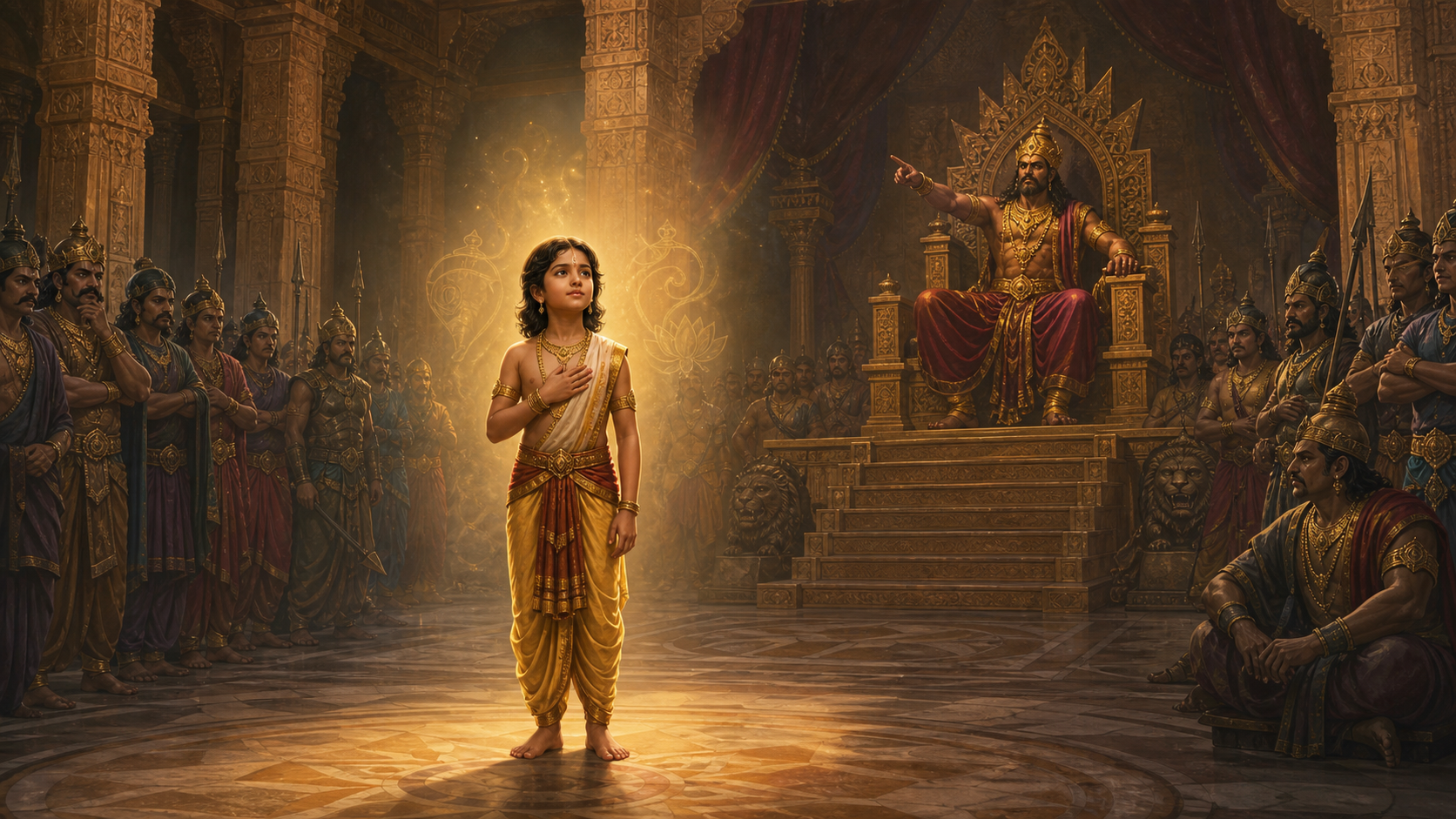
You may already know the dramatic ending: Narasimha appears, Hiranyakashipu falls, and Prahlada is vindicated. But if you want to understand how devotion helps when someone more powerful is pressuring your conscience, do not rush to the climax. Watch what Prahlada does before rescue arrives.
His bhakti follows a demanding sequence: remember Vishnu, see the danger without surrendering to it, refuse an adharmic command, and resist hatred. That sequence gives you something more useful than vague advice to have faith. It gives you a way to remain inwardly steady while deciding what dharma requires next.
The real contest is over who governs Prahlada’s conscience
Prahlada’s conflict may look like a quarrel between a father and son, but the difference in power is much greater. Strengthened by boons and determined to dominate the three worlds, Hiranyakashipu forbids the worship of Vishnu. He is not asking Prahlada to keep a private disagreement quiet. He is claiming authority over what the child may recognize as ultimate.
Prahlada’s answer is not a bid for the throne. He affirms that Vishnu is present in every direction and form, even while the ruler before him denies that presence. His first freedom is therefore perceptual: Hiranyakashipu may control the court, the punishments, and the people carrying out his orders, but he cannot make Prahlada see reality through an asuric lens.
This distinction matters whenever you are under pressure to compromise. A demand to preserve peace can sound reasonable until you name what it actually requires. Are you being asked to lie, mock what you hold sacred, conceal wrongdoing, participate in cruelty, or retaliate against someone weaker? Name the demanded act plainly. Then name the dharmic duty that would be abandoned if you complied.
- Ask whether your position remains truthful when the emotional language is removed.
- Check whether you are protecting dharma or merely protecting your pride.
- Choose a response that does not transfer your fear onto someone more vulnerable.
- Notice whether you still believe the position is right when no praise, victory, or recognition is available.
Stubbornness and steadfastness can look similar from outside. The difference lies in what they serve. Ego needs an opponent to be humiliated. Prahlada’s devotion does not depend on humiliating Hiranyakashipu; it depends on refusing to replace Vishnu with Hiranyakashipu. That is why the narrative is about bhakti rather than mere defiance.
The eighteen ordeals teach disciplined repetition
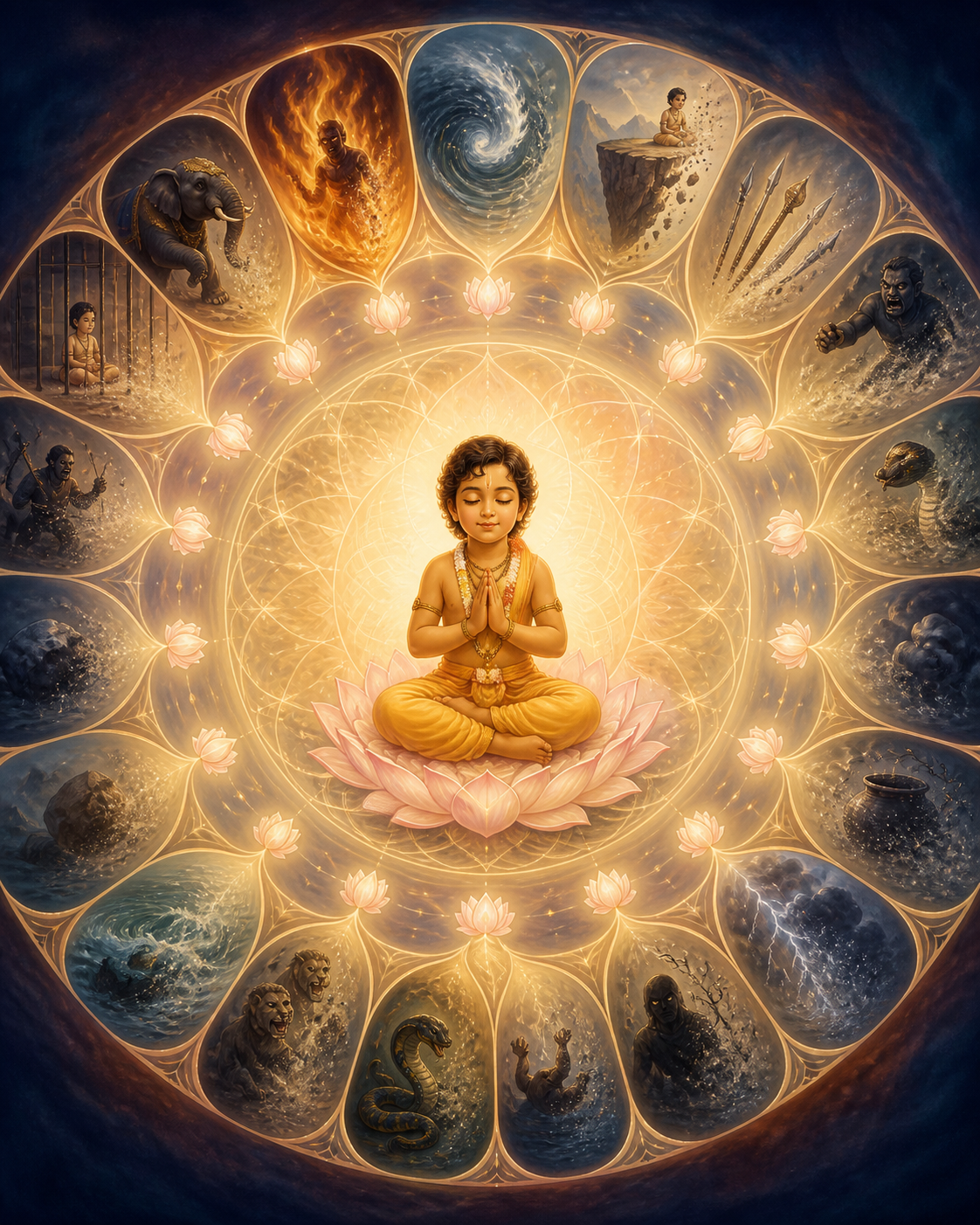
The attempts on Prahlada’s life are deliberately cumulative. The eighteen thwarted designs include poison, serpents, drowning, fire, weapons, crushing by elephant, and the deployment of Kritya, a destructive sorcery. The means change, but the intended result does not: fear is supposed to break the devotion that argument could not defeat.
The repetition is spiritually important. A single courageous response can come from anger, shock, or momentum. Repeated pressure tests whether remembrance has become a stable orientation. Prahlada does not receive one inspiring moment and then coast toward the appearance of Narasimha. He must return to the same center as each new danger takes a different form.
Your pressures may also change shape while demanding the same inward surrender. Ridicule can become exclusion; exclusion can become an inducement to compromise; compromise can become a demand that you help pressure someone else. If you renegotiate your deepest value from the beginning every time, fatigue will eventually make the decision for you. Establish a response pattern before the next round arrives.
- Define the threat precisely. Separate what has happened, what may realistically happen, and what fear is adding to the picture.
- Remember before replying. Use a name of Vishnu, prayer, verse, or period of silence that you already understand; do not treat unfamiliar words as a magical technique.
- Choose the next complete dharmic act within your control. It may be truthful speech, a refusal, a documented objection, a request for help, or a temporary withdrawal from the situation.
- Protect life and bodily safety. If coercion includes violence or a credible threat of violence, leave when you safely can and seek help from trusted people, local emergency services, or an appropriate professional.
- Review the response without either self-glorification or self-condemnation. Correct what was untruthful or needlessly harmful, then return to practice.
Prahlada’s miraculous preservation must never be used to tell an endangered person to remain within reach of an abuser. An ordinary devotee is not required to test divine grace by rejecting available safety. Nor should suffering be treated as evidence that someone’s faith was deficient. Within this narrative, Vishnu’s protection is miraculous; it is not a formula for judging injured people or making real-world risk assessments.
You can retain both the theological and ethical force of the episode. Within Vaishnava devotion, grace safeguards the devotee and ultimately vindicates bhakti. At the ethical level, coercive power repeatedly fails to acquire Prahlada’s inward allegiance. A devotional reader need not reduce the miracle to an allegory, and a practical reader need not imitate a supernatural ordeal.
Narasimha exposes the limits of power built on categories
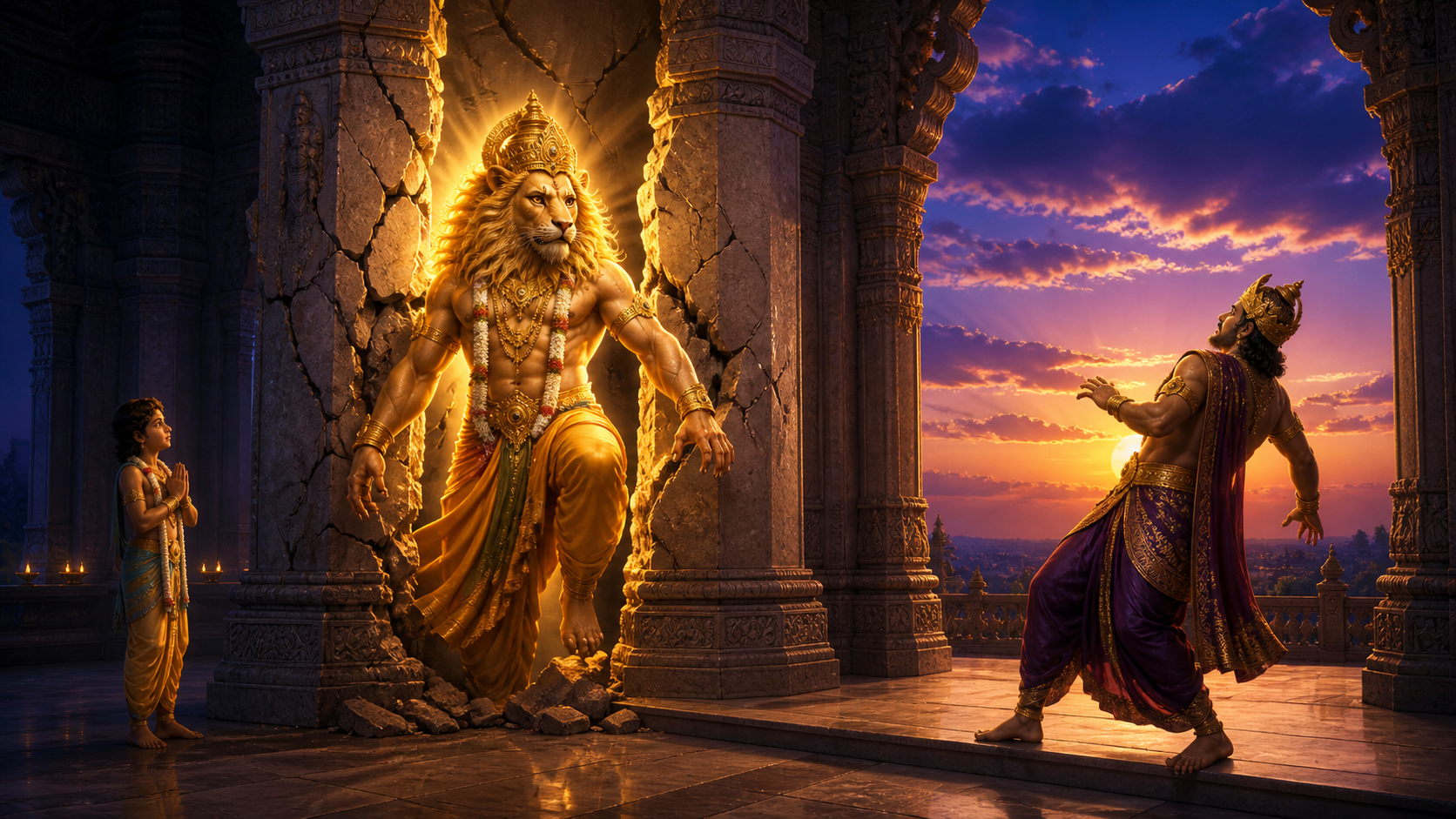
Hiranyakashipu treats the conditions of his boon as an architecture of exemption. Death appears to have been fenced out through a series of distinctions: neither human nor beast, neither inside nor outside, neither day nor night, neither on earth nor in the sky. The ruler mistakes difficulty of punishment for moral invulnerability.
Narasimha answers that mistake through a form that Hiranyakashipu’s categories cannot contain. The man-lion manifestation emerges from a pillar at twilight, meeting the conditions that had been converted into a claim of absolute security. The apparent loopholes do not abolish dharma; they reveal the limits of the ruler’s imagination.
The pillar also answers Prahlada’s affirmation that Vishnu is present everywhere. Hiranyakashipu points toward an apparently ordinary form as though it could disprove divine presence. The narrative turns that challenge into revelation. What the ruler regards as inert and spiritually empty becomes the place from which his certainty collapses.
This is a useful warning whenever authority hides behind technical protection. A person can possess status, wealth, institutional control, or carefully constructed rules without possessing moral legitimacy. When you evaluate a command, policy, or leader, ask:
- Is authority being used to preserve rightful order, or to demand personal submission?
- Is technical compliance being presented as proof that an action is ethical?
- Which boundary is being manipulated to avoid accountability?
- Would the decision still be defensible if made by someone with whom you disagreed?
- What response can restore a dharmic boundary without reproducing the same cruelty?
Prahlada and Narasimha have different roles. Prahlada remembers, speaks truth, and refuses inward surrender. Narasimha resolves a crisis that human power has made seemingly impossible. Do not turn the climax into permission for private vengeance. Its direction is the restoration of order, not the sanctification of personal rage.
Build remembrance before the difficult moment arrives

Bhakti in the Vishnu Purana is not passive sentiment. It is devotion joined to dharma, knowledge, and selfless action. Remembrance steadies the mind so that conduct can become clearer; it does not excuse you from deciding, speaking, serving, or seeking protection.
A simple pattern can bring Prahlada’s example into ordinary life:
- Before your first major obligation, remember Vishnu through a familiar name or prayer. State the duty you particularly do not want fear or ambition to displace that day.
- When agitation begins, pause before answering. Identify what fear is urging you to do: deceive, appease, attack, hide, or surrender responsibility.
- Before acting, test the response against truthfulness, non-harm, and duty. Choose the least harmful effective action, not the response that merely feels forceful.
- At the end of the day, examine where remembrance shaped your conduct and where ego borrowed the language of principle. Decide what apology, correction, or renewed boundary is needed.
- In family or community settings, retell the episode and discuss the choices, not only the miracle. Families already revisit Prahlada’s perseverance around Narasimha Jayanti and other devotional occasions; questions can turn the retelling into ethical preparation.
With children, avoid reducing the lesson to obedience. Prahlada does not accept an adharmic demand merely because it comes from his father and king. Ask what made his refusal different from an angry tantrum, how he kept devotion from becoming hatred, and whom a child should approach when an adult demands something wrong or unsafe. This teaches respect without giving wrongful authority a sacred disguise.
In a gathering that includes several dharmic traditions, begin by preserving the story’s distinctiveness. Vishnu’s supremacy, protective grace, and manifestation as Narasimha belong to its Vaishnava framework. You can then identify the ethical resonances of truthfulness, compassion, self-restraint, non-harm, contemplation, and service found across Hindu, Buddhist, Jain, and Sikh traditions. Unity becomes more credible when it does not require every tradition to say the same thing.
Questions to carry into your reading
Where should a new reader begin?
Begin with the narrative portions, especially Prahlada’s life, before moving into the Vishnu Purana’s cosmology, genealogies, dharma, and cycles of time. On the first reading, make separate notes about the command Prahlada receives, his response, and what follows. This prevents the spectacular ending from obscuring the discipline that precedes it.
Does bhakti mean that Prahlada never experiences fear?
The useful emphasis is not a claim about the absence of every bodily or emotional reaction. It is Prahlada’s composure and constant remembrance under pressure. Courage here means that fear does not become the final authority over truth and conduct.
Does divine protection guarantee that devotees will not be harmed?
No universal guarantee should be extracted from Prahlada’s miraculous preservation. The episode reveals Vishnu’s protective grace within its sacred narrative, but it does not authorize you to dismiss danger, refuse necessary help, test another person’s faith, or blame someone who suffers.
Why does Vishnu appear from the pillar?
The pillar makes Prahlada’s conviction concrete. Vishnu’s presence is not restricted to places recognized by the asuric ruler. The manifestation also defeats Hiranyakashipu’s confidence that reality must obey the categories through which he secured his boon.
When you next read the episode, resist hurrying toward Narasimha’s appearance. Stay with each moment in which Prahlada must decide what fear will be allowed to govern. Identify the point at which you would be tempted to bargain away clarity, then choose a practice of remembrance before your next difficult conversation. Prahlada’s example becomes living instruction when remembrance begins before the crisis.
References
- DharmaRenaissance Blog – Vishnu Purana Stories: Timeless Tales of Devotion, Dharma, and Unity in Diversity
- DharmaRenaissance Blog – 18 Miracles of Protection: How Vishnu Saved Prahlada from Hiranyakashipu in the Vishnu Purana
- DharmaRenaissance Blog – Timeless Wisdom of Vishnu Purana: Avatars, Devotees, and Dharma for Modern Life
