
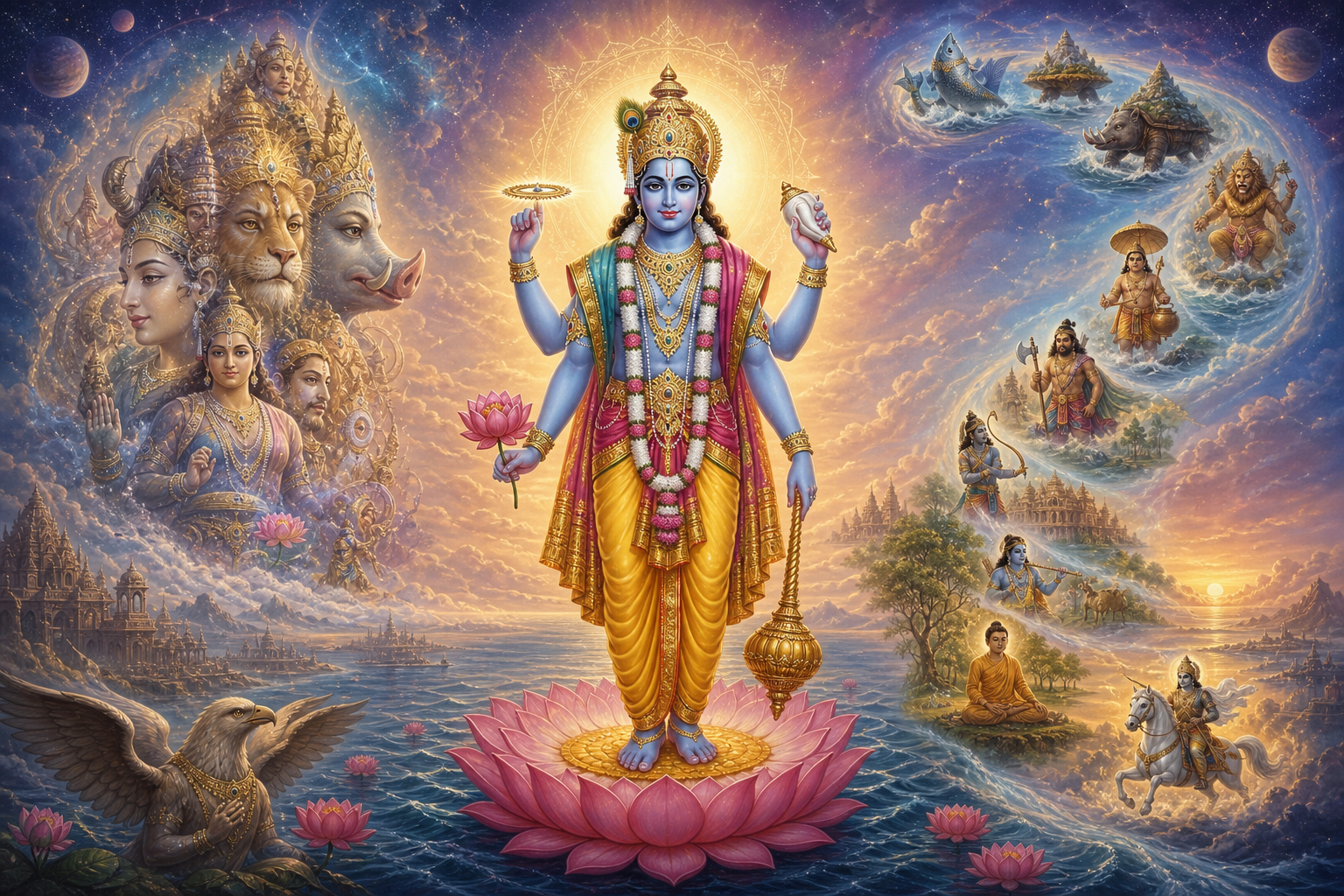
You recognize Vishnu’s chakra and shankha, yet the image in front of you raises harder questions. Why is half the figure Ma Lakshmi? Why do human, lion, and boar faces share one body? Is every unfamiliar form another avatar?
The confusion clears when you distinguish two ways of revealing Vishnu. A composite form gathers divine powers or relationships into one simultaneous presence. An incarnation shows Vishnu entering a particular crisis to uphold dharma. Once you know which visual language you are seeing, you can identify the form more accurately and contemplate what it asks of you.
Key takeaways
- A composite form answers, “Which divine realities belong together?” An incarnation answers, “How does the Divine respond when dharma is endangered?”
- A half Vishnu-half Lakshmi body points to Vaikuntha Kamalaja and the inseparability of preservation, grace, and well-being.
- A human face joined with lion, boar, and fierce faces points to Vaikuntha Chaturmurti, especially associated with Kashmir’s Vaishnava heritage.
- The Dashavatara presents ten principal incarnations across different conditions; it is not merely a ten-faced composite deity.
- Do not identify an icon by one feature alone. Read the body, faces, emblems, orientation, and devotional context together.
Composite forms show what must remain united
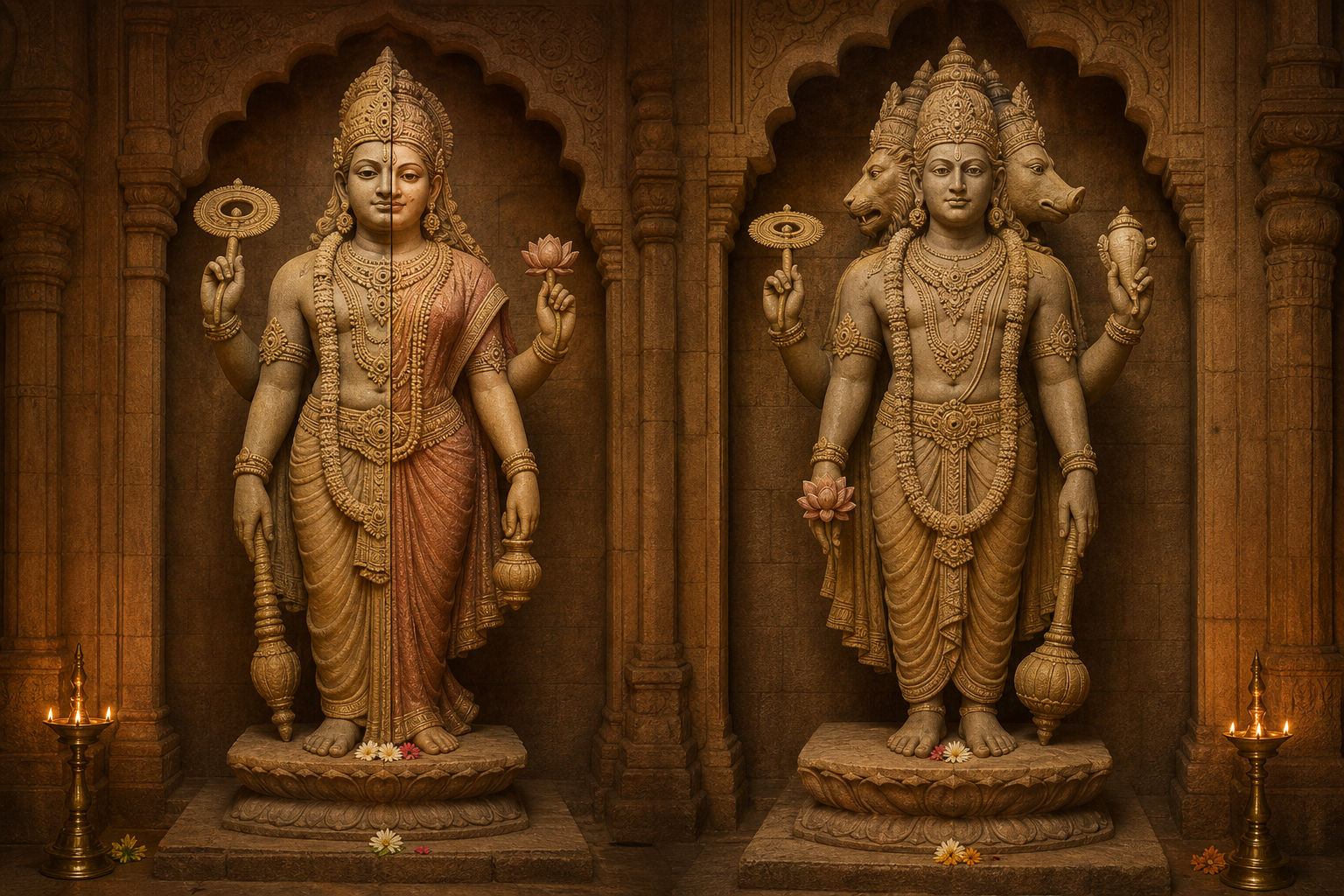
A composite icon is not a puzzle about which deity has displaced another. Its joined body is itself a theological statement: apparently different powers can be distinct without being separable. The form asks you to notice a relationship before you isolate its parts.
Read such an image in a deliberate order. First, determine whether you are looking at one integrated body or several separate figures. Next, identify the faces, bodily divisions, and emblems. Only then ask why those elements have been joined. Reversing that order often produces a familiar mistake: recognizing a lion or boar and immediately declaring the whole image an avatar.
Vaikuntha Kamalaja: Sri and Narayana in one body
Vaikuntha Kamalaja unites Vishnu and Lakshmi in a single divided form, much as Ardhanarishvara joins Shiva and Parvati. Vishnu’s side may carry the shankha and chakra, while Lakshmi’s side is marked by the lotus and her feminine form. Depictions can vary in orientation, so do not make left-versus-right placement your only test. The combination of attributes is more reliable than the side on which each half appears.
The form expresses the inseparability of Sri and Narayana. Vishnu preserves order; Lakshmi brings auspiciousness, nourishment, grace, and prosperity. These are not rival concerns. Order that ignores compassion becomes hard and sterile. Prosperity detached from dharma becomes accumulation without a worthy purpose. Vaikuntha Kamalaja corrects both distortions by placing the two principles within one sacred body.
This gives you a practical way to contemplate the image. When considering a household, professional, or community decision, test it in both halves of the form:
- Vishnu’s question: What protects dharma, stability, trust, and long-term responsibility?
- Lakshmi’s question: What sustains life, dignity, generosity, beauty, and shared well-being?
- The composite question: Have you chosen an outcome that preserves what is right while allowing people and relationships to flourish?
If a plan passes only one half of that examination, it is incomplete. A financially attractive choice that damages trust does not embody Lakshmi-Narayana. Nor does a rigid demand for order that leaves no room for daya, humane understanding, or restoration.
Vaikuntha Chaturmurti: several modes of protection, one guardian
Vaikuntha Chaturmurti gathers several of Vishnu’s protective capacities into one four-faced presence. The human face looks forward, Narasimha’s lion face turns to one side, Varaha’s boar face turns to the other, and a fierce Kapila or raudra countenance faces the rear. The deity also bears such Vishnu emblems as the chakra, shankha, gada, and padma.
A frontal photograph may not show the rear face, and sometimes the side faces are easier to recognize than the central theology. Look for the complete arrangement before naming the icon. The lion and boar are not simply two isolated stories placed beside a human deity. Together with the human and fierce faces, they present a unified account of divine guardianship:
- The human face conveys composure, compassion, wisdom, and rightful sovereignty.
- Narasimha conveys fearless protection when righteousness is under direct attack.
- Varaha conveys restoration, resilience, and the upliftment of the Earth.
- The fierce rear aspect conveys the force required to repel negativity and break through ignorance.
The placement matters. No single face exhausts Vishnu’s work. Preservation sometimes needs calm judgment, sometimes courage, sometimes patient restoration, and sometimes uncompromising resistance to ignorance. The fierce aspect does not cancel compassion, just as the serene face does not make courage unnecessary.
This form has a particularly important place in Kashmir’s sacred art, temple tradition, and Vaishnava memory. That context should affect how you approach it. It is not an exotic curiosity assembled from strange parts. It carries the theological vision and cultural continuity of a region in which Vishnu’s many capacities were contemplated as one sovereign presence.
For personal reflection, name the face your present duty requires without discarding the others. A tense dispute may call for the composure of the human face. An injustice may require Narasimha-like courage. A damaged institution or relationship may need Varaha-like restoration. A recurring falsehood may demand firm clarity. The icon trains you to choose the right mode of protection rather than applying the same reaction to every problem.
Incarnations reveal how dharma is restored in changing conditions
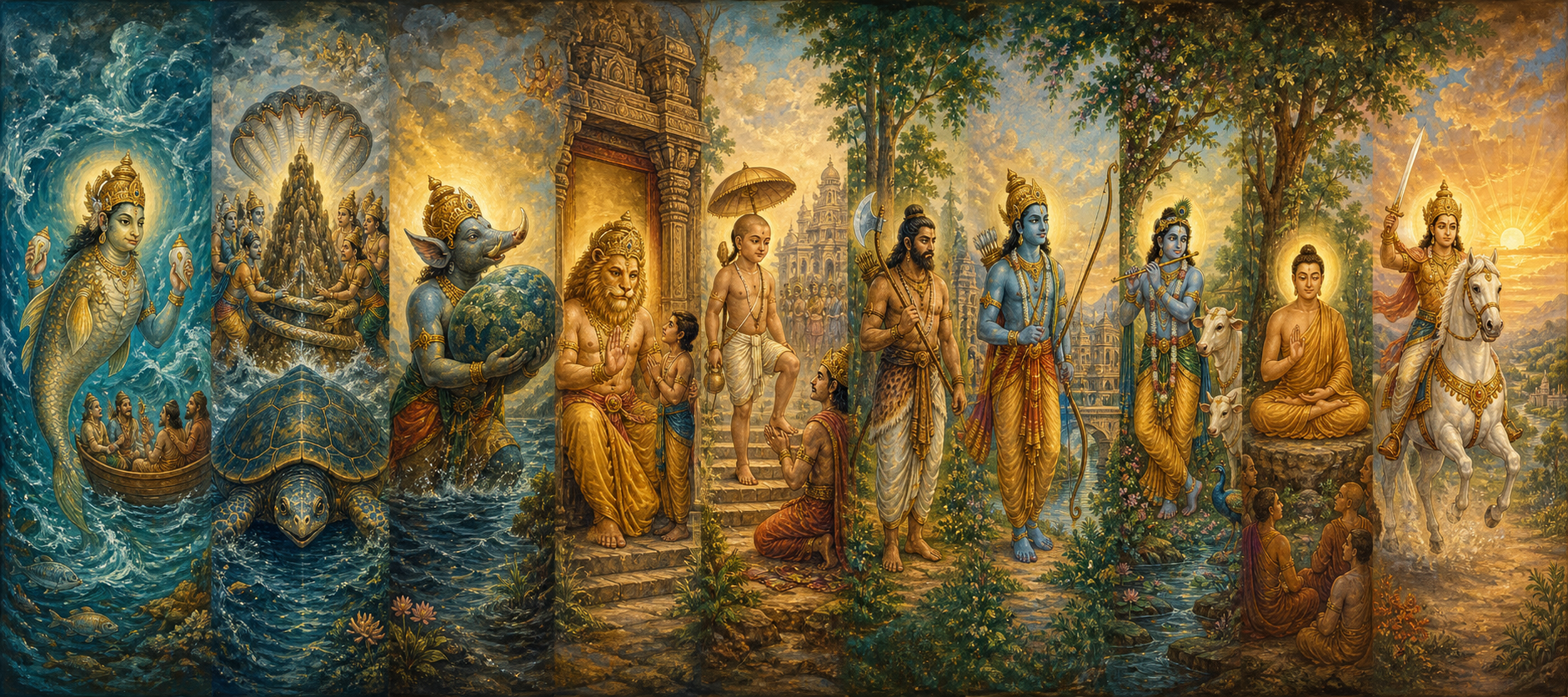
An avatar is not merely another arrangement of attributes. It is a divine descent or manifestation suited to particular conditions. The central concern is action within a crisis: adharma rises, beings require protection, and Vishnu assumes the form appropriate to restoring order.
The widely known Dashavatara sequence names Matsya, Kurma, Varaha, Narasimha, Vamana, Parashurama, Rama, Krishna, a ninth incarnation, and Kalki. Numerous Vaishnava lists place Buddha ninth, while some regional traditions place Balarama there. Kalki is understood as the future incarnation who will appear at the end of the present age to restore cosmic balance.
That variation in the ninth place is not a clerical error you must eliminate before learning the tradition. It is evidence that Hindu sacred memory can preserve a shared theological structure while allowing regional and textual recensions to differ. When you teach the list, name the version you are using. When you encounter another version, ask which tradition or text it follows before declaring it incorrect.
The Vishnu Purana and Bhagavata Purana place Vishnu’s incarnations within a Puranic vision of cosmic preservation, while the Ramayana and Mahabharata give Rama and Krishna vast narrative worlds in which dharma is tested through relationships, vows, conflict, governance, and moral choice. This is why merely memorizing ten names is not enough. The spiritual value lies in seeing why a particular response becomes necessary.
You can use the same questions whenever you read an avatara narrative:
<!– wp:list {