
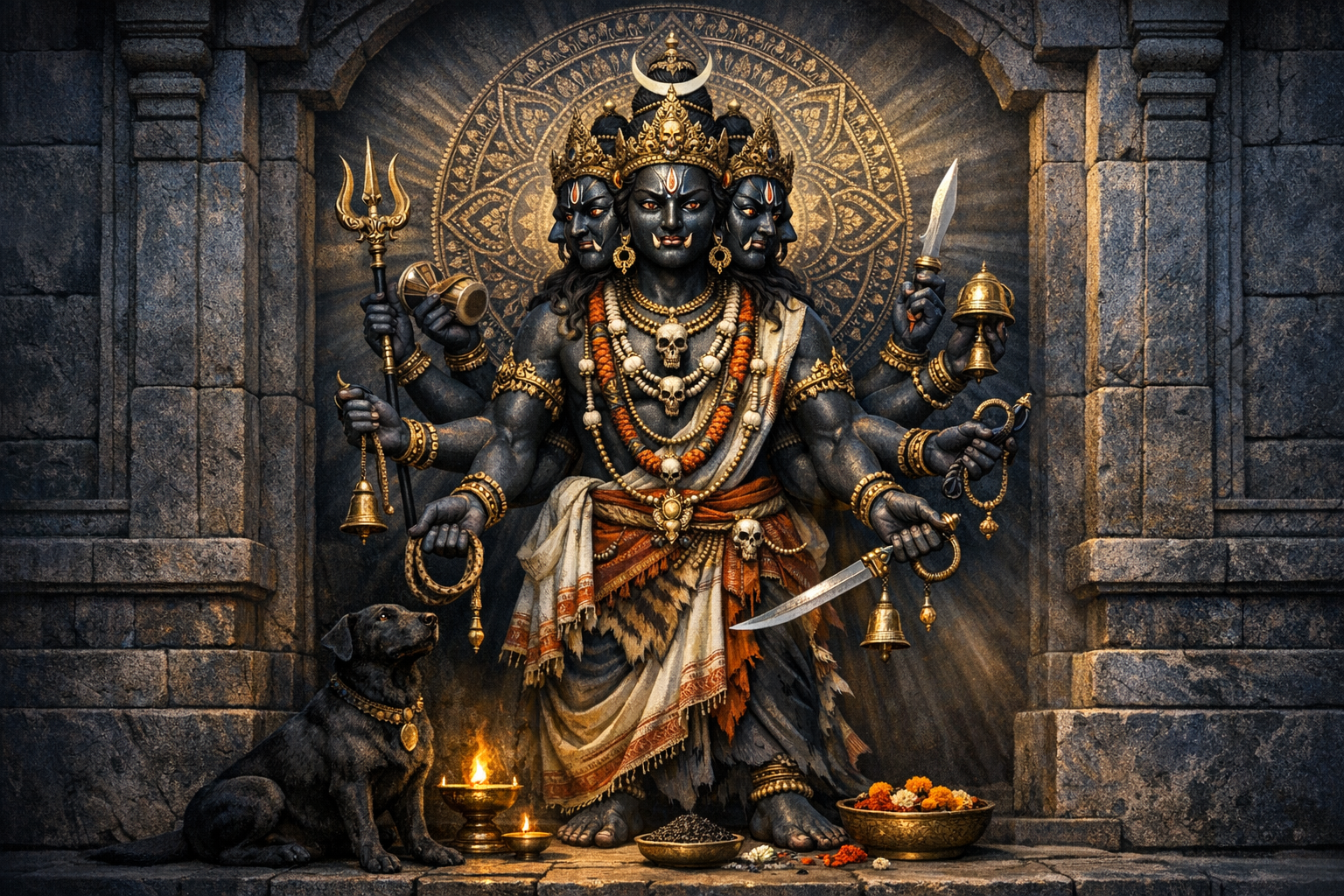
Among the most compelling forms in the Shaiva tradition, Panchavaktra Bhairavaalso known as Panchamukha Bhairavaembodies the power that severs ignorance while bestowing protective grace. Revered as a five-faced manifestation of Shiva’s terrifying yet compassionate energy, this deity stands at the threshold between fear and liberation, where fierce vigilance (raudra) turns into transformative compassion (karuṇā). In Hindu Dharma, such paradox is not contradiction but complementarity: the same force that destroys adharma also reveals inner clarity and fearlessness.
Scriptural and ritual sources across Shaiva Tantra and the Agamas locate Panchavaktra Bhairava at the heart of sacred guardianship (kshetrapāla) and inner awakening. The Skanda Purana, Shiva Purana, and several Tantrasmost notably the Svacchanda-tantra and the Vijñāna Bhairava Tantraframe Bhairava as both cosmic principle and experiential reality. While the Puranas privilege narrative and devotion, the Agamas and Tantras detail iconography, mantric liturgy, and meditative technologies oriented toward direct realization.
In Kashmir Shaivism, the cognate form Svacchanda Bhairava is frequently depicted with five faces and multiple arms (often eighteen), signaling an all-encompassing sovereignty over the directions, elements, and functions of the universe. Panchavaktra Bhairava, in this doctrinal horizon, is not merely a guardian at the temple’s threshold but the archetype of awakened awareness that patrols the thresholds of consciousnesswhere habitual fear, anger, and delusion give way to luminous recognition (pratyabhijñā).
The five faces align with the pancha-brahma mantras and the five cosmic functions (pañca-kṛtya): Tatpuruṣa (east), Aghora (south), Vāmadeva (north), Sadyojāta (west), and Īśāna (zenith). Textual traditions commonly map these to creation (sṛṣṭi), preservation (sthiti), dissolution (saṁhāra), concealment (tirobhāva), and grace (anugraha). Each face is three-eyed, crowned, and adorned with serpents and skulls, expressing sovereignty over time (kāla), death (mṛtyu), and change (pariṇāma). The upward-facing Īśāna suggests the ever-open axis to transcendence, anchoring the ensemble in stillness even as it radiates dynamic power.
Attributes vary by Agama and regional practice, yet core emblems remain stable: the triśūla (trident) for penetrating ignorance; ḍamaru (drum) for rhythmic creation; kapāla (skull-bowl) for transmuting mortality into wisdom; pāśa (noose) and aṅkuśa (goad) for restraint and guidance; khadga (sword) and vajra (thunderbolt) for decisive clarity; and the ghaṇṭā (bell) to wake dormant awareness. The vehicle, a dog (śvan), signals liminality, loyalty, and guardianship of thresholdsboth sacred spaces and the psyche’s hidden corridors.
Theologically, Panchavaktra Bhairava integrates the fivefold cosmic activity into a single icon, teaching that dissolution without grace is cruelty, grace without restraint is sentiment, and creation without concealment lacks the pedagogical depth of becoming. When absorbed contemplatively, the five faces become five pedagogies: fierce honesty, ethical steadiness, courage in impermanence, humility before mystery, and readiness to receive grace. This is fierce compassion: the courage to cut through, paired with the responsibility to uplift.
Tantric literature refines this insight. The Vijñāna Bhairava Tantraa dialogue between Bhairava and Bhairavīpresents 112 meditative gateways (dharanās) that require neither withdrawal from life nor denial of the senses. In this view, Bhairava is not only a deity to be approached but a quality of awareness to be recognized: the acutely present, all-pervading consciousness in which fear dissolves and insight stabilizes. Icon and method thus mirror each other: five faces outward, one boundless awareness within.
Ritual traditions surrounding Panchamukha Bhairava are diverse yet coherent. Agamic pūjā sequences often begin with purification, nyāsa (installing mantras in the body), and invocation through the pancha-brahma mantras, followed by offerings that range from strictly sattvic (water, flowers, black sesame, sweets, and lamps) to more esoteric kaula practices overseen by qualified gurus. In contemporary Hindu practice, household worship commonly emphasizes ethical intention (saṅkalpa), recitation, and disciplined behavior over austere or transgressive offerings, affirming dharma while honoring tradition’s breadth.
Festival observances highlight this guardianship. Kāla Aṣṭamī (also called Bhairava Aṣṭamī) recurs monthly on Kṛṣṇa Aṣṭamī, with an annual peak date varying by regional calendar around Kārttika/Mārgaśīrṣa. Devotees light lamps, chant the Kālabhairava Aṣṭakam, and feed dogsan accessible, compassionate practice that fuses symbolism with service. The act of caring for Bhairava’s vahana becomes an ethic: guard the vulnerable, protect thresholds, and meet fear with steadiness.
Pilgrimage geography reinforces these themes across India and the Himalayan cultural sphere. In Varanasi, the Kāla Bhairava Temple venerates the city’s guardian, invoked historically to protect pilgrims and ensure moral accountability. Ujjain’s Kal Bhairav shrine carries living traditions of guardianship linked with Mahākāleśvara. In Nepal’s Kathmandu Durbar Square, the monumental Kāl Bhairav image historically served as an oath-taking locustestifying to Bhairava’s civil as well as spiritual role. Numerous shrines in Tamil Nadu and Karnataka house Panchamukha Bhairava, and regional temples such as the Isannapally Kalabhairava Temple in Telangana sustain robust local devotion within a pan-Indian Shaiva network.
Inter-dharmic resonances underscore a broader civilizational unity. In Vajrayāna Buddhism, Mahākāla, a fierce dharma protector with genealogical links to Śiva-Bhairava, safeguards the path by subduing inner and outer obstacles; the function parallels Bhairava’s guardianship without collapsing distinct identities. Jain communities, while emphasizing strict ahiṁsā and inner purity, have historically shared sacred landscapes where guardians like Kṣetrapāla are acknowledged as boundary-protectors in local practice. Sikh tradition, grounded in the oneness of the Divine and the cultivation of fearlessness (nirbhau), echoes the transformative courage valorized in Bhairava’s fierce compassion. Each dharmic stream converges on a common aim: overcoming ignorance and embodying ethical clarity.
Art-historically, five-faced Bhairava images appear from the early medieval period onward, with significant survivals in Kashmir, the Deccan, and the Tamil region. Visual canons stabilized around crowned, three-eyed faces, bone and serpent ornaments, and the dog vahanayet regional idioms diversified posture, hand-gestures, and the distribution of weapons. The Chola and post-Chola South, the Paramara and later Central Indian ateliers, and Newar artistry in the Kathmandu Valley each contributed distinctive refinements, attesting to a living tradition rather than a static template.
Mantric frameworks bind these expressions into a unified soteriology. The pañca-brahma mantrasSadyojātam, Vāmadevam, Aghora, Tatpuruṣa, and Īśānaare recited to align practitioner, icon, and cosmos. The Kālabhairava Aṣṭakam, commonly attributed to Ādi Śaṅkarācārya, praises the Lord of Time as the remover of fear and guardian of sacred order. These recitations function not merely as petitions but as precise calibrations of attention, breath, and intentionbringing the psyche into sympathetic resonance with dharma.
For contemplative practice aligned with household dharma, a structured approach is both accessible and traditional: begin with ethical preparation (truthfulness, restraint, compassion); sit for breath-awareness; intone the five seed verses of the pañca-brahma mantras; contemplate each face as a pedagogyhonest seeing (east), steady caretaking (north), courageous release (south), reverent unknowing (west), and silent grace (zenith); close by dedicating merit to all beings across dharmic paths. Advanced rituals described in Shaiva Tantra belong under the guidance of a competent guru; their aim, however esoteric, remains the same: the alleviation of suffering through the dissolution of ignorance.
Ethically interpreted, fierce imagery never licenses outer violence; rather, it retools inner force toward vigilance, self-scrutiny, and protective compassion. In contemporary societymarked by distraction, anxiety, and polarized narrativesPanchavaktra Bhairava’s lesson is strikingly current: cultivate clear perception, act with courage, safeguard what is sacred, and temper power with grace. This is a practical spirituality compatible with yoga, meditation, and service, and consonant with the wider values shared across Hinduism, Buddhism, Jainism, and Sikhism.
Seen in full, Panchavaktra Bhairava is less an image to be feared than a mirror to be understood: five faces, one awareness; many pathways, one freedom. In the pluralistic embrace of Sanātana Dharmaand in dialogue with other dharmic traditionsthe fivefold Bhairava becomes a grammar of unity in diversity. Iconography, scripture, and lived practice converge on a single invitation: meet time without fear, meet change without clinging, and meet the world with disciplined compassion.
Inspired by this post on Hindu Blog.
