
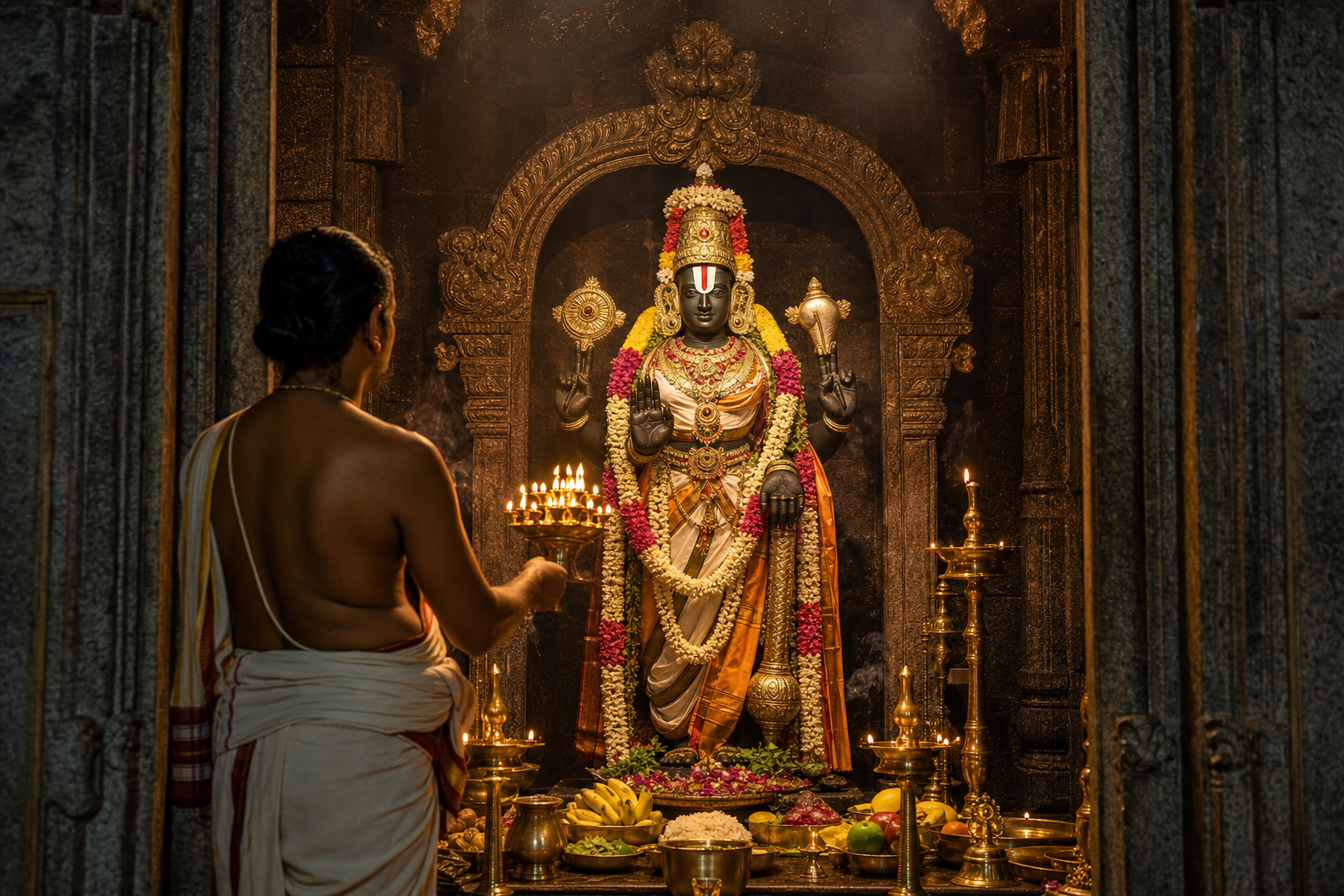
When the sanctum curtain closes just as you arrive, or an archaka continues a precise sequence instead of responding to the crowd, Pancharatra worship can seem needlessly formal. If devotion is sincere, you may wonder, why should order, timing, mantra, or priestly qualification matter so much?
The answer begins with how the murti is understood. Pancharatra ritual is not decoration arranged around an object. It is disciplined service offered to the Divine in an accessible, consecrated form. Once you see that premise, the bathing, adornment, food, lamps, thresholds, festivals, and even periods when darshan pauses become parts of one coherent relationship.
The central claim: the murti is approached as presence
Two opposite explanations both miss Pancharatra theology. One reduces the murti to a visual reminder that could be treated like any other religious artwork. The other imagines that the limitless Divine has somehow been trapped inside a material object. Pancharatra accepts neither extreme.
The governing idea is arcavatara: the Divine compassionately becomes approachable through a form suited to embodied worshippers. Transcendence is not cancelled, but neither is the consecrated form treated as an empty symbol. Through prana-pratishtha, divine presence is ritually invited to abide in the murti. The rite does not manufacture God. It establishes a sacred relationship in which a particular form, place, community, and discipline are bound together.
This distinction changes how you enter a temple. A museum visitor asks what an image represents. A devotee approaching an arca asks how to present oneself before the One who has consented to be encountered there. Cleanliness, attention, circumambulation, offerings, and respect for the sanctum threshold follow from that second question.
The Vyuha doctrine supplies a wider theological map. Vasudeva, Sankarshana, Pradyumna, and Aniruddha articulate an ordered relationship between divine manifestation, cosmic origination, subtle psychology, and the path to liberation. They should not be read casually as four unrelated deities competing for attention. The sequence provides a grammar for understanding how the Supreme can remain supreme while becoming present and active at multiple levels of existence.
That grammar prevents a common mistake. Accessibility is not the opposite of majesty. The same theology that affirms the Divine beyond ordinary limitation also explains why a devotee can stand before a particular murti, offer a flower, and receive darshan. Temple ritual protects both truths at once.
Daily worship is an ordered day of divine service
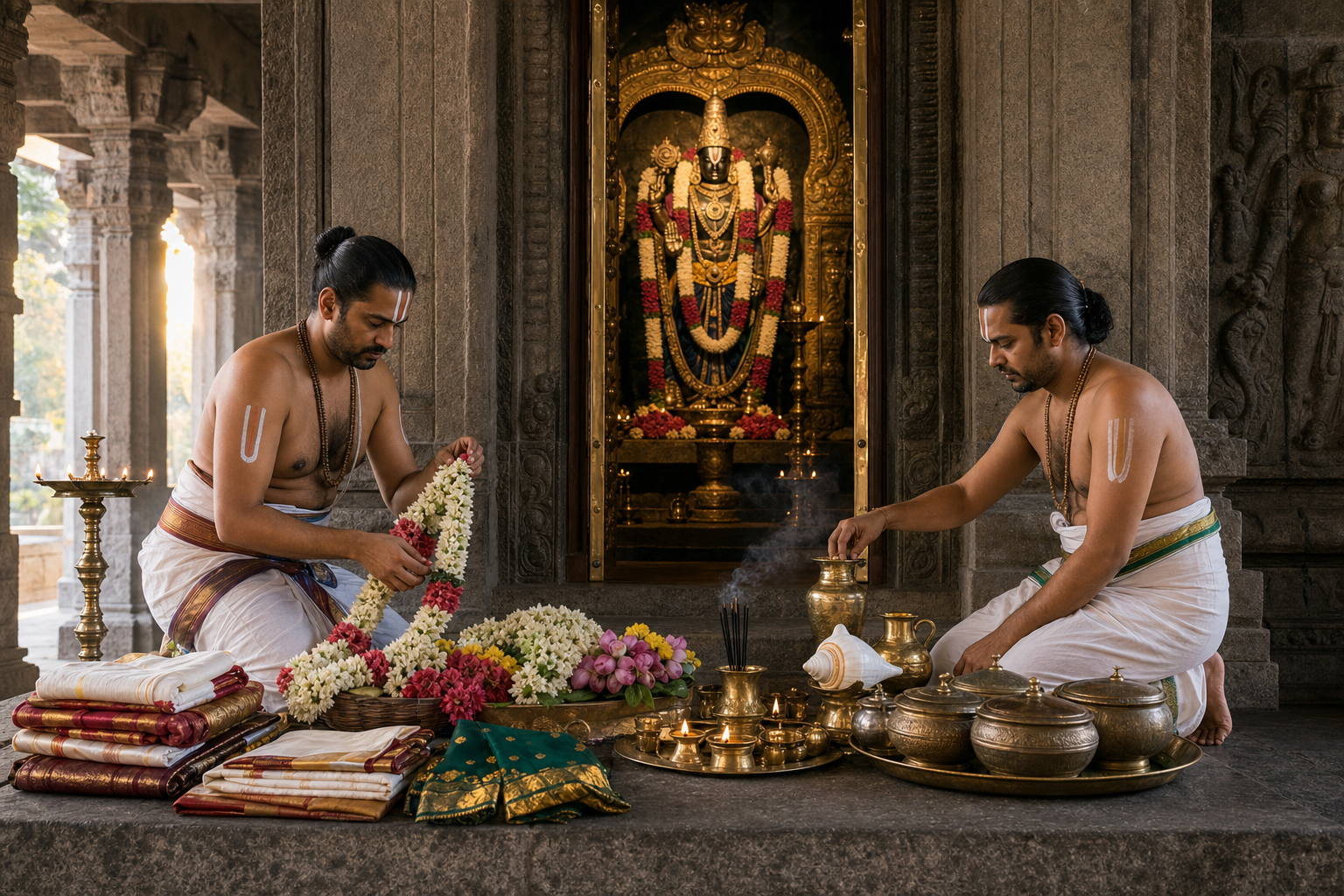
A Pancharatra temple does not merely schedule several disconnected ceremonies. Its daily worship forms a liturgical day, moving broadly from ceremonial awakening toward repose. Local lineages differ in detail, and not every element appears in every service, but the overall arc explains why one ritual cannot always be moved, shortened, or interrupted without affecting another.
- Preparation establishes ritual fitness. Depending on the rite, this can involve purification, concentrated breath, mantra, mudra, and nyasa, the placement of mantric power upon the body.
- Abhisheka bathes the murti with prescribed care. It is followed, where appropriate, by drying, clothing, and alankara, or adornment.
- Archana addresses the Divine through names and praises, while dhupa and dipa offer fragrance and light.
- Naivedya presents food rather than treating eating as an activity outside sacred life.
- Later services lead toward sayana, ritual repose, completing the movement from awakening to rest.
This is a broad interpretive sequence, not a universal do-it-yourself script. Exact orders, mantras, materials, and ritual responsibilities belong to particular lineages and temple contexts. What you should notice is the relation joining the actions. Abhisheka is more than washing, alankara more than ornament, naivedya more than a transaction, and dipa more than atmosphere. Body, food, fragrance, sound, light, time, and attention are gathered into service.
The distinction between Panchopachara and Shodashopachara makes the principle of right measure especially clear. Panchopachara uses five modes of offering, while Shodashopachara expands worship to sixteen. The shorter form is not simply a failed version of the longer one. Pancharatra practice allows graded forms of worship suited to context, provided that simplification remains reverent and does not pretend to a competence the worshipper does not possess.
Three categories also help you read a temple calendar. Nitya rites sustain the regular daily relationship. Naimittika rites arise on particular occasions. Utsavas intensify worship through festivals and public celebration. A large festival cannot replace neglected daily service, just as an elaborate annual gesture cannot substitute for dependable care in any enduring relationship.
This gives you a practical rule during a visit: do not interpret every closed curtain, delayed darshan, or restricted movement as poor hospitality. A liturgical transition may be underway. Follow the local temple’s instructions, allow the archakas to finish the service, and receive darshan when the worship cycle permits it. The temple exists to welcome devotees, but welcome is ordered around seva to the deity rather than around uninterrupted access to a display.
Precision protects the relationship, and ethics protect precision
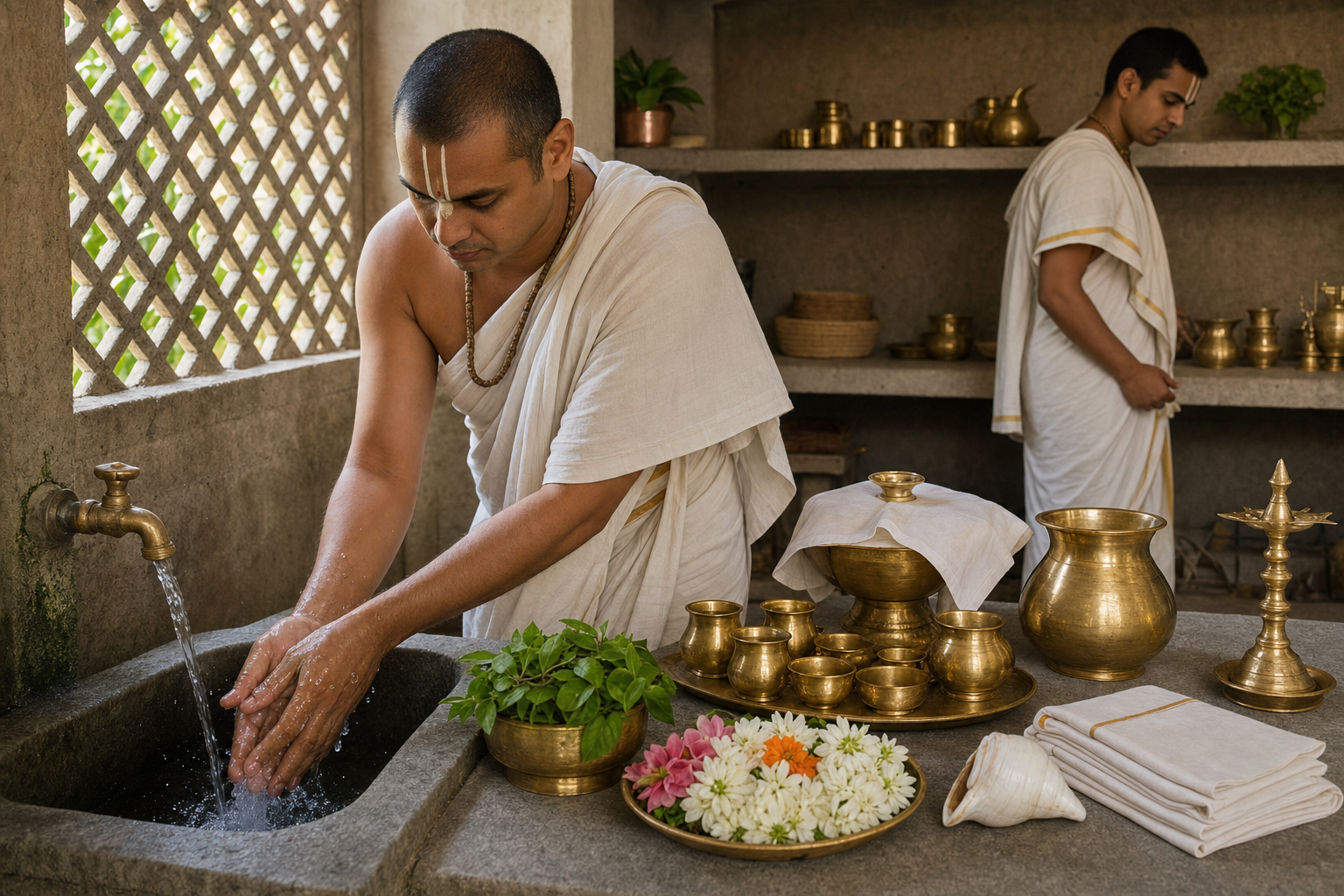
Mantra, mudra, nyasa, breath, and purification are sometimes dismissed as technical additions to the supposedly more authentic feeling of bhakti. Pancharatra takes a different view. Outer form can gather scattered attention, and disciplined repetition can train devotion to survive changes in mood. Precision is valuable because it makes sustained service possible.
That does not mean technique works mechanically. Ritual fitness includes character. Restraint, truthfulness, compassion, cleanliness, and disciplined speech support worship, while worship is meant to deepen those same virtues. A technically fluent priest without ethical responsibility does not satisfy this standard. Neither does warm sentiment without the knowledge needed to care for a consecrated murti.
The qualifications of archakas, assistants, and singers therefore involve more than the ability to reproduce gestures. Training, lineage accountability, doctrinal understanding, and ethical conduct belong together. Diksha, or initiation, places advanced practice within a relationship of instruction and responsibility. It is not merely a badge of spiritual rank.
The same boundary applies to mantra. A widely revered formula such as Om Namo Narayanaya can anchor straightforward devotional recitation with attention and humility. Esoteric bija combinations, specialized nyasa, and consecratory operations should not be reconstructed from fragments or copied because they look powerful. If a practice presupposes initiation, use the simpler devotional form until a qualified guru or acharya provides instruction.
If you help manage a temple, sponsor a new shrine, or assess a proposed consecration, ask concrete questions before discussing spectacle or fundraising:
- Which Pancharatra lineage and ritual procedure will govern the shrine?
- Who is qualified to conduct the consecration, and who will maintain the daily worship afterward?
- How are nitya, naimittika, and festival responsibilities divided among archakas, assistants, singers, and organizers?
- Can the institution reliably sustain naivedya, abhisheka, adornment, and the other obligations it is assuming?
- What ethical and practical accountability applies when a ritual role is neglected or performed carelessly?
The question after prana-pratishtha matters as much as the ceremony itself. Consecration establishes continuing service; it should not be planned as a one-day cultural event with no durable arrangement for the next morning.
Visible variation between temples does not automatically prove that one has abandoned tradition. Pancharatra transmission preserves a shared doctrinal structure alongside regional and lineage-specific variations. Judge a temple’s practice by its internal coherence, recognized transmission, competence, and fidelity to its obligations, not by whether every detail matches another temple you know.
Architecture and festivals carry the theology beyond the sanctum
Sacred space does not serve as a neutral container for ritual. Orientation, the sanctum, thresholds, paths of movement, sound, light, and scent work together to shape attention. The architecture tells your body that approach has an order: the sacred center is not encountered in the same manner as an ordinary room.
A threshold both welcomes and distinguishes. It makes proximity meaningful. Restrictions near a sanctum should therefore be understood first in terms of graded ritual responsibility, not reduced automatically to the language of prestige. This does not excuse arbitrary or disrespectful treatment of devotees. It does explain why access to every ritual zone is not identical, even when the whole community is invited to darshan.
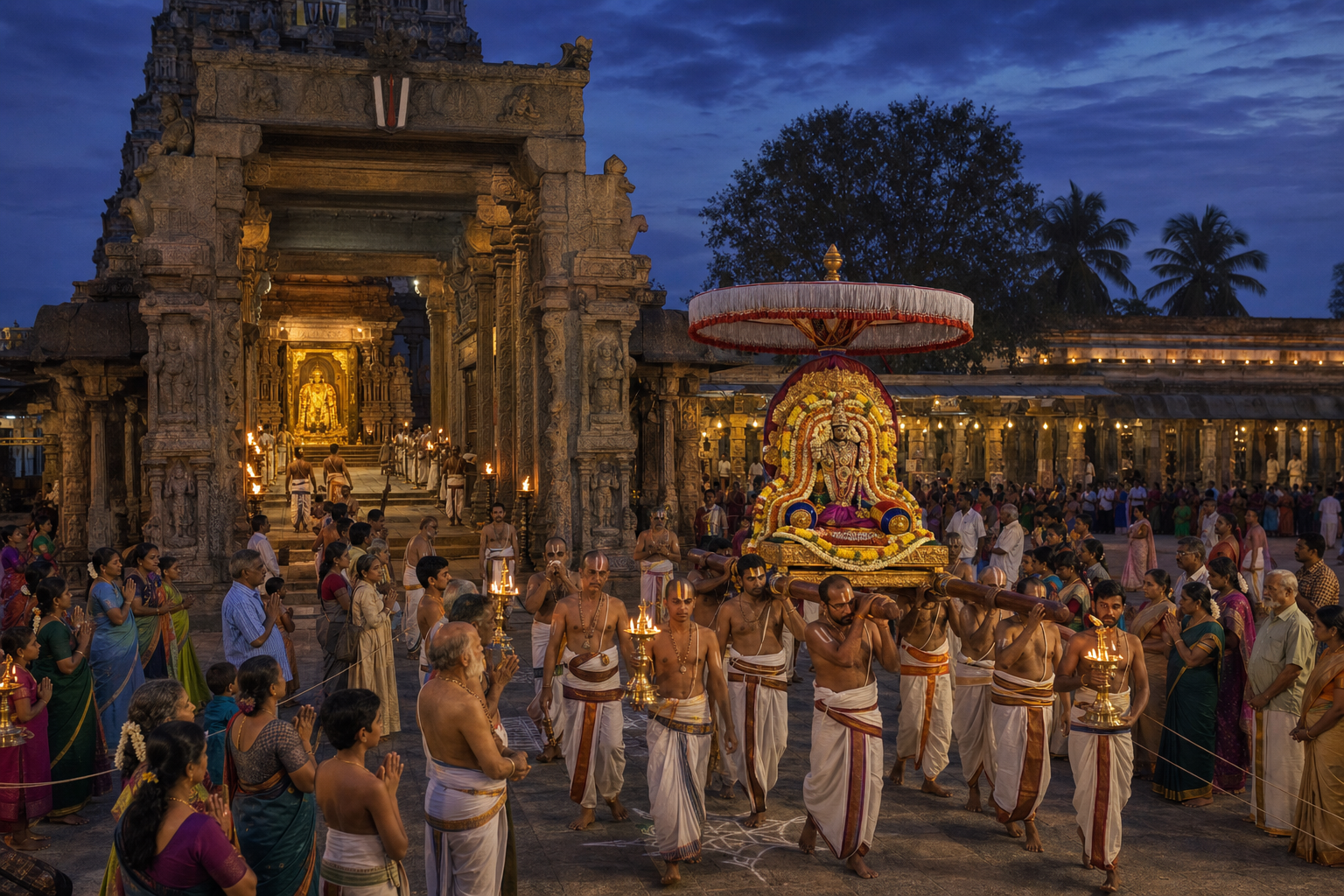
The direction of movement changes during an utsava. In ordinary worship, devotees approach the sanctum. In a procession, the consecrated presence comes into civic space. Vahanas, music, recitation, communal offerings, and decorated routes make a theological claim visible: divine accessibility is not confined to those able to enter the innermost temple precinct.
Brahmotsava, Kalyanotsava, and regional observances are therefore more than cultural entertainment. Their processions, music, offerings, tithis, and lunar timings extend temple theology into community life. Celebration transmits sacred aesthetics across generations, but its public scale remains anchored in the deity’s ritual service.
If you organize such a festival, plan from the liturgical center outward. Confirm the deity’s regular service, qualified personnel, offerings, ritual timings, and procession requirements before adding publicity, staging, or crowd programming. A successful crowd event can still be a failed temple festival if the nitya worship is displaced by the event built around it.
If you attend, watch more than the spectacle. Notice when the deity moves, who accompanies the procession, how music and offerings mark transitions, and how the community’s attention reorganizes around the arca. Those details reveal the difference between a parade featuring a sacred image and an utsava understood as the movement of divine presence.
Gesture, contemplative attention, disciplined recitation, ethical formation, and communal service also create points of resonance with Buddhist, Jain, and Sikh practice. Those affinities belong to a wider Dharmic civilization, but they do not erase doctrinal distinctions. Pancharatra’s Vyuha and arcavatara teachings give its temple ritual a specifically Vaishnava theological center.
Build a household practice you can actually sustain
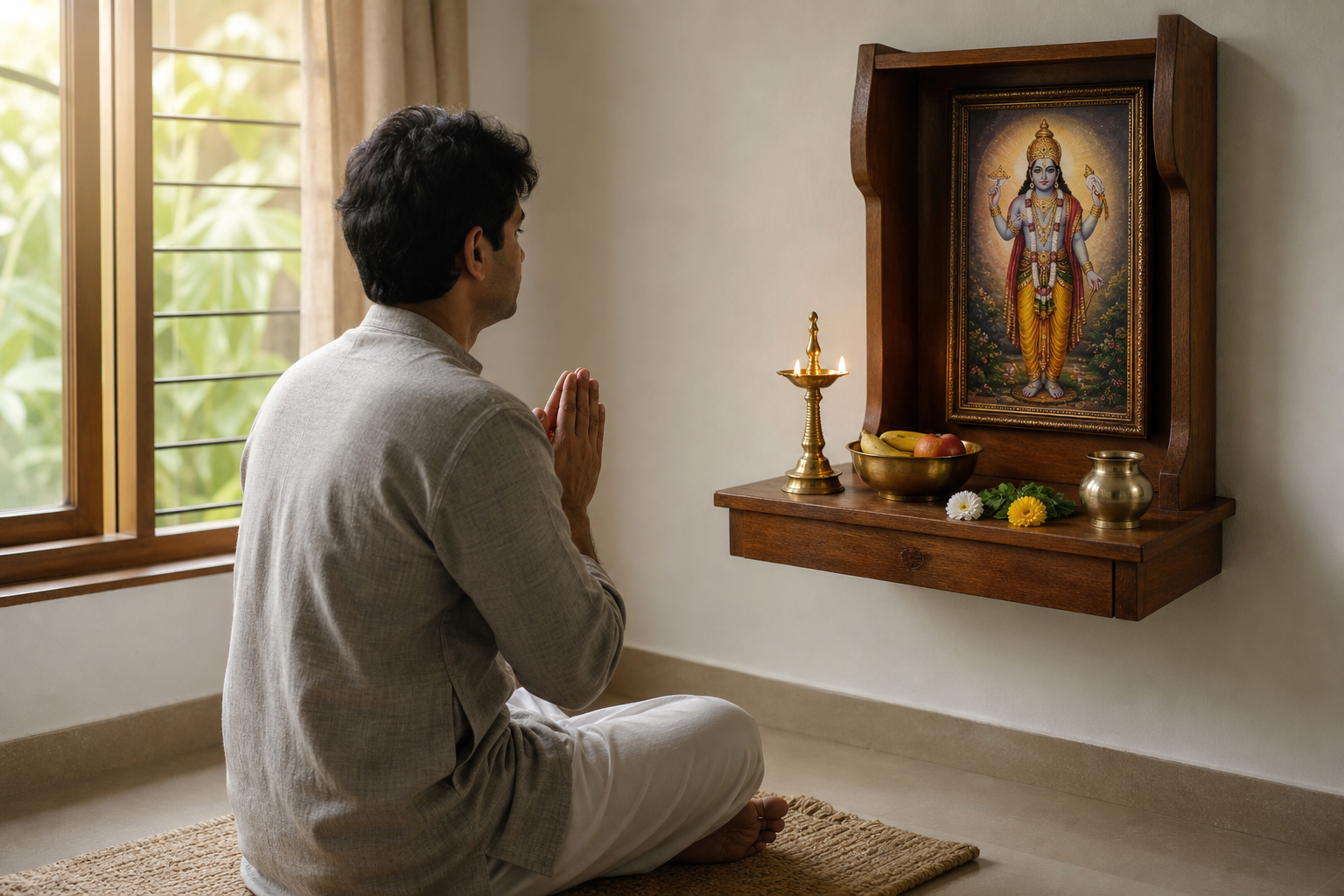
Temple worship and household worship are complementary, not interchangeable. A home shrine can become a genuine place of sacred encounter without imitating every operation of an institutional temple. The right question is not how much complexity you can import into the house. It is what reverent discipline you can maintain without negligence or pretence.
- Choose a stable, clean place for the shrine. Treat cleanliness as part of worship rather than as hurried preparation immediately before it.
- Pause before beginning. Settle the breath and withdraw attention from competing tasks so the body arrives at the shrine with the mind.
- Use a devotional formula you know, such as Om Namo Narayanaya, rather than experimenting with bija mantras or advanced nyasa without instruction.
- Select the right measure. On a constrained day, a sincere Panchopachara form is better than beginning a fuller sequence you cannot complete attentively. Use Shodashopachara when time, knowledge, and household tradition support it.
- Include forms that make devotion shareable, such as Tulasi worship, name-recitation, or devotional singing. These allow children and other family members to participate without pretending to priestly roles.
- Close the worship deliberately. Maintain the shrine and handle offerings respectfully rather than walking away the moment recitation ends.
Regularity matters more than collecting techniques. The household adaptation of clean space, attentive breath, measured offerings, Tulasi worship, and devotional singing preserves the central discipline without reproducing the entire temple establishment. A simple form repeated with care trains attention more effectively than occasional complexity followed by abandonment.
Formal prana-pratishtha should not be attempted casually from online instructions. Before arranging consecration, consult a qualified teacher or archaka about the obligations that follow. Ask who will provide continuing worship, which lineage will govern the procedure, and what should happen when the principal householder is absent. If those responsibilities cannot yet be sustained, continue with straightforward devotional worship rather than assuming obligations you are not prepared to keep.
Key takeaways
- Pancharatra worship approaches the consecrated murti as an accessible divine presence, not merely as religious art.
- The daily sequence from awakening to repose is one continuous service, so closures and ritual timings have theological meaning.
- Panchopachara and Shodashopachara express different measures of offering; shorter worship can be complete when it is appropriate to the setting.
- Diksha, training, and ethical accountability protect practices whose power depends on correct transmission and continuing responsibility.
- A festival carries worship into public space, but it must remain anchored in the deity’s daily service.
- At home, choose the smallest reverent practice you can sustain and seek qualified guidance before undertaking consecratory or esoteric rites.
On your next temple visit, follow one complete movement instead of trying to see everything: preparation, offering, darshan, or procession. At home, establish one clean place and one repeatable form of worship. Pancharatra becomes intelligible when you stop measuring devotion by display and begin measuring it by attentive, dependable seva.
References
