

You may have heard Narmada called Reva, the daughter of Shiva, a purifier of wrongdoing, and a source of protection, only to find that different teachers place those ideas in different Puranas. The apparent mismatch can make the tradition seem harder to navigate than it is. The key is to distinguish a sacred river’s place on the Puranic map, the literature praising her greatness, and the disciplines through which devotees encounter her.
Once you separate those layers, Narmada becomes much easier to understand. You can read scriptural claims more precisely, approach her tirthas without reducing pilgrimage to sightseeing, and recognize why caring for the physical river belongs inside the religious meaning of purity.
The river’s route is already a theological claim
On an ordinary map, Narmada is a west-flowing river. She rises at Amarkantak in the Maikal range, passes through the valley between the Vindhya and Satpura ranges, and reaches the Arabian Sea near Bharuch. On a Puranic map, that same route is also a chain of divine presence, pilgrimage, memory, and moral obligation.
This does not require you to choose between physical and sacred geography. Amarkantak, Omkareshwar, Maheshwar, and Bharuch belong to one observable river system; the sacred reading asks what it means to move through that system attentively. Headwaters become a place of origin, ghats become thresholds between ordinary and consecrated activity, and the river’s passage toward the sea becomes a route along which communities order worship, hospitality, work, and remembrance.
This is how Bhāratavarṣa functions in Puranic imagination. It is not merely territory divided by boundaries. Mountains, forests, rivers, settlements, and tirthas form a morally significant landscape. A river does more than connect places. She makes certain forms of conduct possible: bathing with a vow, carrying water for abhishekam, supporting a pilgrim, maintaining a ghat, or refusing to pollute what one calls sacred.
That last point matters. Sacred geography is not an escape from material geography. If Narmada is revered as a living presence, the condition of her water and banks cannot be dismissed as someone else’s secular concern. The physical river is where the theological claim has to become visible.
Three layers clarify what a Narmada claim means

Many disagreements about Narmada are really disagreements about which layer is being discussed. A geographic placement, a hymn of praise, and a pilgrimage custom can support one another without coming from the same chapter, recension, or ritual lineage.
| Layer | Question it answers | Narmada example | How to read it |
|---|---|---|---|
| Puranic geography | Where does the river belong in Bhāratavarṣa? | Narmada appears among the rivers that make the land sacred. | Look for the cosmological and territorial frame rather than a complete ritual manual. |
| Tirtha-mahatmya | Why is this river or place spiritually powerful? | The Reva-khanda develops praise, pilgrimage disciplines, purification, and protection. | Check the named section and recension when citing a particular verse or promise. |
| Living practice | How is sanctity embodied? | Snana, abhishekam, stotra recitation, hospitality, and Narmada Parikrama. | Identify the local lineage and vow instead of assuming every custom is uniform. |
The Vishnu Purana supplies a broad cosmological and geographic setting in which Narmada stands among the sacred rivers of the land. The most extensive body of Narmada praise is associated with the Reva-khanda of the Skanda Purana. The difference is not a competition between a Vaishnava text and a Shaiva tradition. One layer situates the river within a sacred whole; another expands her particular mahatmya.
Tirtha-mahatmyas have also circulated through recitation, regional manuscripts, abridgments, expansions, and later compendia. A protective Narmada hymn may therefore be remembered locally as belonging to the Vishnu Purana even when its fuller literary setting is identified with the Reva-khanda. That variation should neither be concealed nor used to dismiss living devotion. It should change the precision of your claim.
If you cite a particular verse, record the edition, section, or lineage from which you received it. If you are describing a widespread belief, call it regional or devotional tradition unless you have verified the textual location. If you need a concise formulation, use this: Narmada’s sanctity belongs to the wider Puranic geography of Bhāratavarṣa, while the Reva-khanda gives her mahatmya its most elaborate expression.
Purity and protection require disciplined conduct
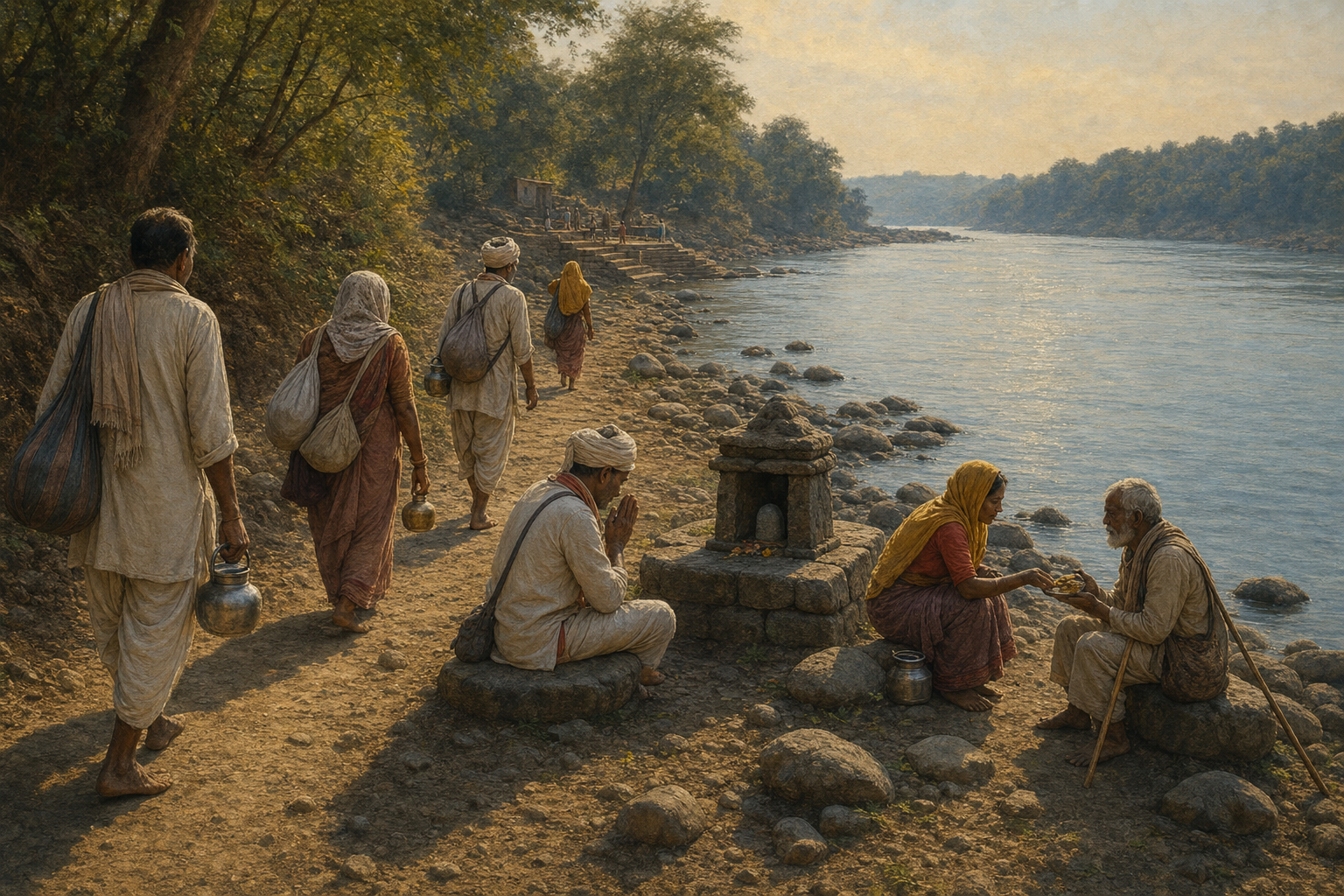
Puranic praise often associates sacred rivers with pāpa-vimocana, release from the burden of wrongdoing. In Narmada devotion, purification also nurtures bhakti, or devotion, and dhriti, the steadiness needed to remain faithful to a worthy course. This is more demanding than treating contact with water as an automatic spiritual transaction.
The structure of the practice makes that clear. Tirtha-sparsha, touching the sacred water, and snana, ritual bathing, are placed within vrata: a chosen discipline governing intention and conduct. During Narmada Parikrama, the river’s whole course becomes the field of the vow. Traditionally undertaken as an arduous, multi-year circumambulation, the parikrama is shaped by ahimsa, truthfulness, simple food, gratitude, endurance, and dependence on hospitality.
The walking is therefore not incidental. A long route exposes impatience, appetite, fear, pride, and the desire to control one’s surroundings. The ethical commitments tell the pilgrim what to do when those tendencies appear. Without that discipline, a river circuit can become physical achievement or religious tourism while missing the practice it was meant to embody.
Protection needs equally careful interpretation. Narmada praise includes a venom-countering motif in which remembrance of the sacred confronts immediate mortal danger. Related protective repertoires occur in Garuda-centered Vaishnava practice and in Shaiva traditions. At the symbolic level, serpent venom gives concrete form to human vulnerability; invocation restores spiritual orientation when the body and mind are threatened.
Devotional recitation may steady the mind and sustain faith, but it is not medical treatment for venom. A suspected snakebite requires urgent medical care. Do not delay emergency help while reciting a stotra, seeking river water, or performing a rite. Prayer can accompany rational care; it must not replace it.
You do not need to undertake the complete parikrama to begin learning its moral grammar. A shorter visit can be approached responsibly, although it should not be presented as equivalent to the traditional vow:
- Choose one discipline before arriving. Truthful speech, simple consumption, non-harm, or gratitude gives your visit a moral center.
- Learn which practice you are performing. Bathing, collecting Narmada-jala, offering abhishekam, reciting a stotra, and beginning parikrama are not interchangeable acts.
- Follow the norms of the particular ghat or shrine. Ask locally before entering the water, collecting it, or making an offering.
- Leave no ritual or travel waste behind. Do not make the river absorb the material remains of your devotion.
- Carry the vow home. Decide which restraint, service, or daily remembrance will continue after the journey.
Shaiva and Vaishnava meanings meet without collapsing

Regional devotional memory reveres Narmada as a daughter of Shiva. Omkareshwar, one of the twelve Jyotirlingas, gives this Shaiva relationship a powerful ritual center. Narmada-jala is also carried for abhishekam in both Shaiva and Vaishnava settings. Her place in Vishnu-centered sacred geography does not erase her Shaiva personality, just as Shaiva devotion does not remove her from the larger map of Bhāratavarṣa.
This is a useful test whenever someone claims that Narmada must belong exclusively to one sampradaya. Ask what kind of belonging is meant. A regional account of divine kinship, a temple’s presiding deity, a Purana’s cosmology, and a devotee’s ritual use can coexist at different levels. Unity does not require every lineage to tell the same story or assign the same theological emphasis.
The same care is needed when speaking across the dharmic traditions. Buddhist stream-entry uses the movement of water to imagine a passage from confusion toward clarity. In Jain thought, a tirtha is a ford across samsara, inseparable from disciplined ethical crossing. Sikh traditions bring remembrance and seva into relation with the sarovar and the community gathered around it. These resonances reveal a shared vocabulary of crossing, purification, discipline, and service. They do not prove that Hindu, Buddhist, Jain, and Sikh doctrines are identical.
That distinction lets you honor common dharmic sensibilities without flattening them. Look for converging conduct – hospitality, self-restraint, non-harm, remembrance, and care for shared places – while allowing each tradition to explain the ultimate meaning of that conduct in its own terms.
Maheshwar shows why this plurality needs material institutions as well as beautiful metaphors. Ahilyabai Holkar’s patronage left enduring architecture and temple networks there, including the Ahalyeshvara Mahadeva Temple. Ghats, shrines, festivals, agriculture, crafts, trade, hospitality, and endowments allow sacred memory to survive beyond an individual’s private devotion.
In this civilizational sense, protection is not only miraculous rescue. It is also the resilience created when communities connect worship with responsibility. People preserve places, receive pilgrims, transmit prayers, maintain institutions, and share resources because the river has taught them to see those actions as dharma.
The river that purifies must also be kept pure
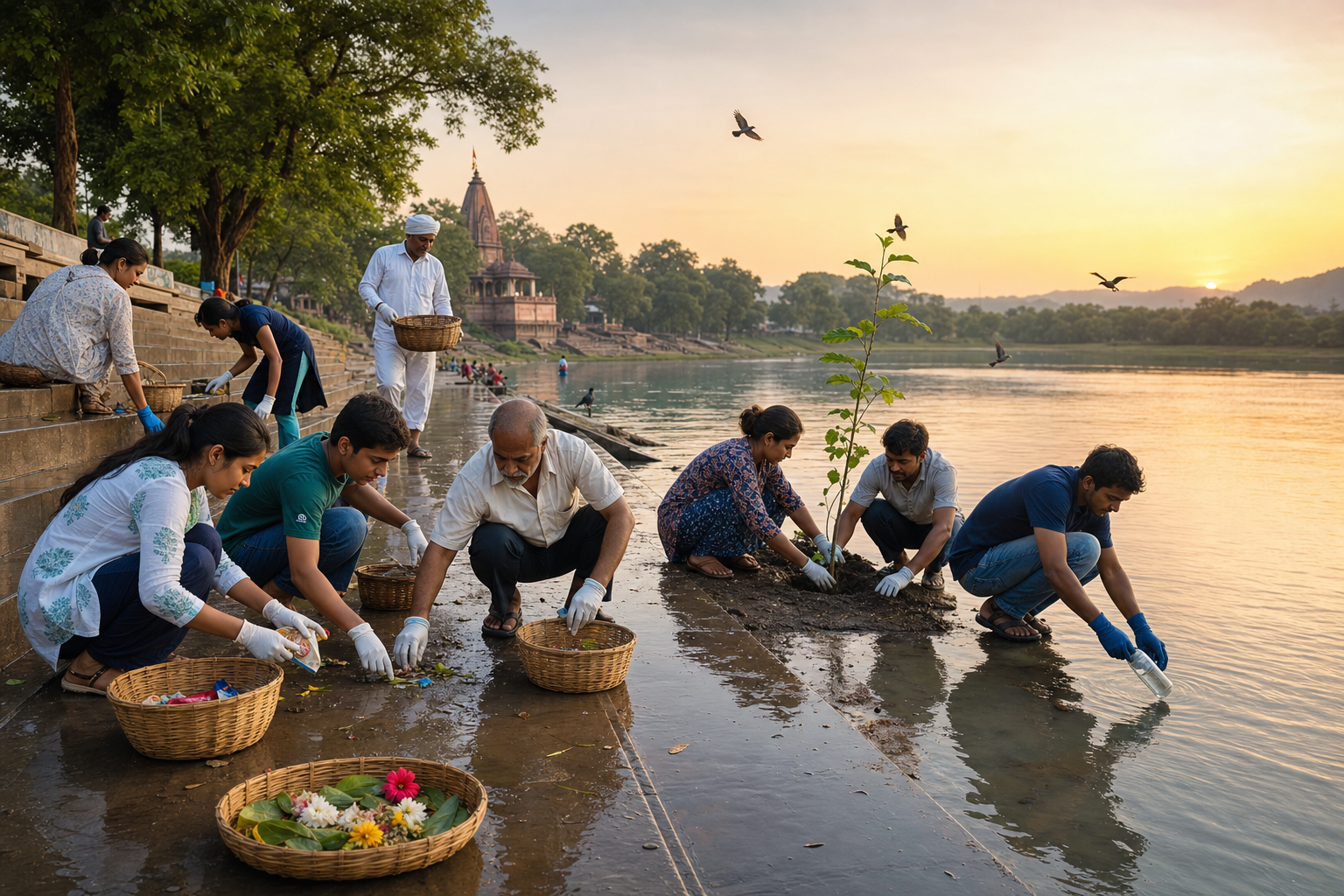
A sacred river creates reciprocity. Devotees ask Narmada for purification and protection; reverence obliges them to protect the conditions under which the river and riverine communities can flourish. Otherwise, ritual language and civic conduct move in opposite directions.
This gives traditional categories direct practical force. Ahimsa includes refusing needless harm to the river. Seva includes supporting responsible maintenance of ghats and water places. Dana can support restoration and community stewardship rather than merely adding more objects to a ritual site. Purity includes reducing effluent and waste, not only performing ceremonial bathing.
The principle often expressed as dharma rakshati rakshitah – dharma protects those who protect it – is especially concrete here. A polluted river cannot be defended by praise alone. If you regard Narmada-jala as suitable for consecration, then keeping contaminants out of that water is not an optional environmental interest attached to religion from outside. It follows from the meaning of consecration itself.
Before supporting a river initiative, look for work you can identify rather than a vague appeal: reduction of untreated discharge, restoration of riverbank vegetation, maintenance of traditional water structures, responsible waste handling at pilgrimage sites, or service to communities carrying the daily burden of stewardship. Sacred geography becomes credible when devotion changes what people permit themselves to do to a sacred place.
Key takeaways
- Narmada’s Puranic identity joins a physical river route to divine presence, pilgrimage, memory, and obligation.
- The Vishnu Purana provides a broad sacred-geographic frame; the Skanda Purana’s Reva-khanda develops Narmada’s mahatmya in greater detail.
- When the textual location of a hymn varies, distinguish a verified citation from regional oral or liturgical attribution.
- Purification is linked to vrata and ethical steadiness, not merely to physical contact with water.
- Protective recitation may accompany medical care but must never delay or replace treatment for a suspected snakebite.
- Shaiva, Vaishnava, and wider dharmic resonances can meet around Narmada without making their doctrines identical.
- Protecting the river’s water, banks, ghats, and communities is a direct expression of the sacred geography that calls Narmada purifying.
On your next reading or visit, carry three questions: Which layer of tradition am I encountering? What conduct does it ask of me? What obligation does it create toward the river and those who live beside her? Begin with one verified textual distinction and one concrete discipline. That is enough to turn Narmada from a name on a sacred map into a practice of lived dharma.
References
