
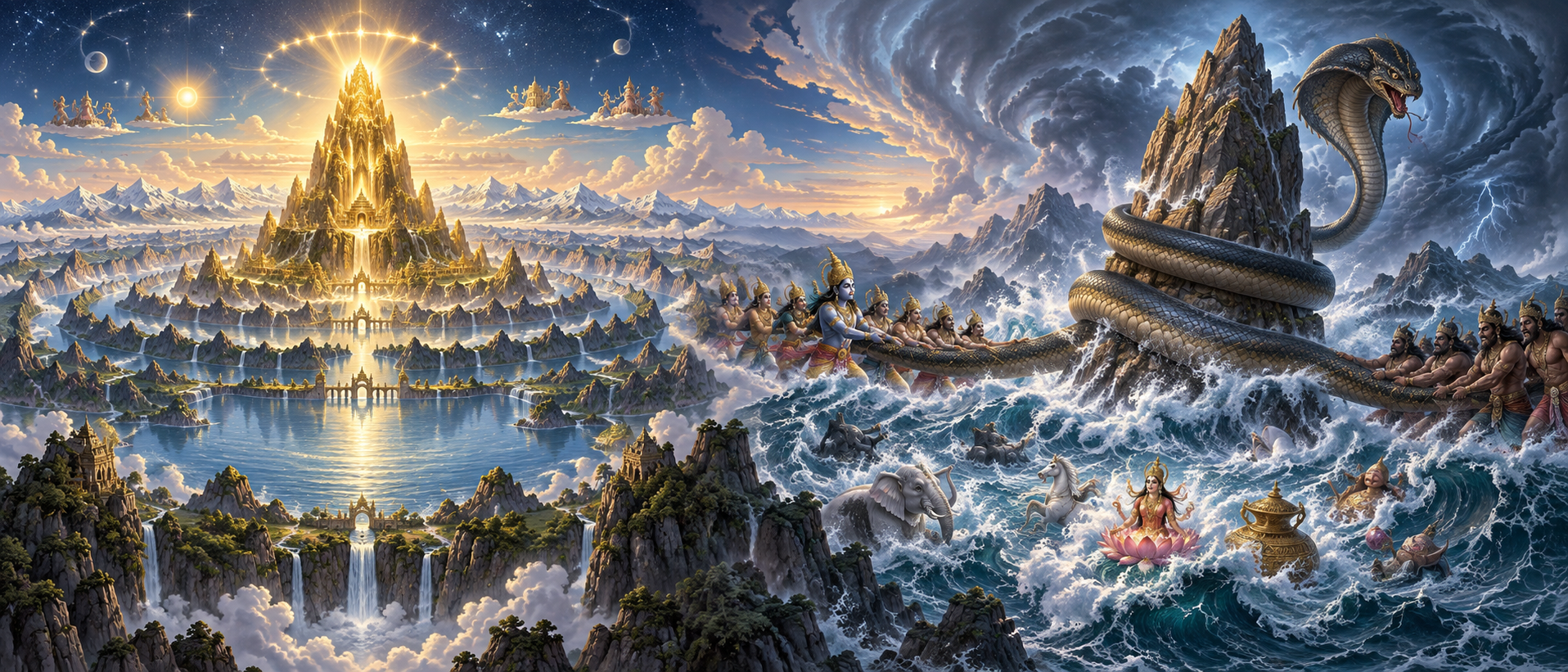
If you have encountered Meru in one Hindu narrative and Mandara in another, the shared description “sacred mountain” can make them seem interchangeable. They are not. Confusing them turns two distinct ideas into one vague piece of mythology.
The useful distinction is simple: Meru establishes the centre and order of the sacred cosmos, while Mandara serves as the mountain through which a decisive event—the churning of the ocean—takes place. Watch what each mountain does, and the difference becomes clear.
The distinction that resolves most confusion
Meru and Mandara are both immense, divine mountains, but that shared description does not give them the same identity or function. Their difference is not merely that one is greater than the other. They perform different jobs within Hindu sacred imagination.
| Question | Mount Meru | Mount Mandara |
|---|---|---|
| What defines it? | Cosmic centrality | Its role in a sacred event |
| What does it do? | Provides an axis and point of orientation | Makes the churning of the ocean possible |
| How should you picture it? | Stable, central and ordering | Active, instrumental and involved in action |
| What question does it answer? | Where is the sacred cosmos centred? | By what means does this transformation occur? |
A useful analogy is to think of Meru as an axis and Mandara as a churning instrument. This is a reading aid, not a scriptural definition. It prevents the word “mountain” from hiding the difference between a cosmic centre and a narrative agent.
Meru gives the sacred cosmos its centre
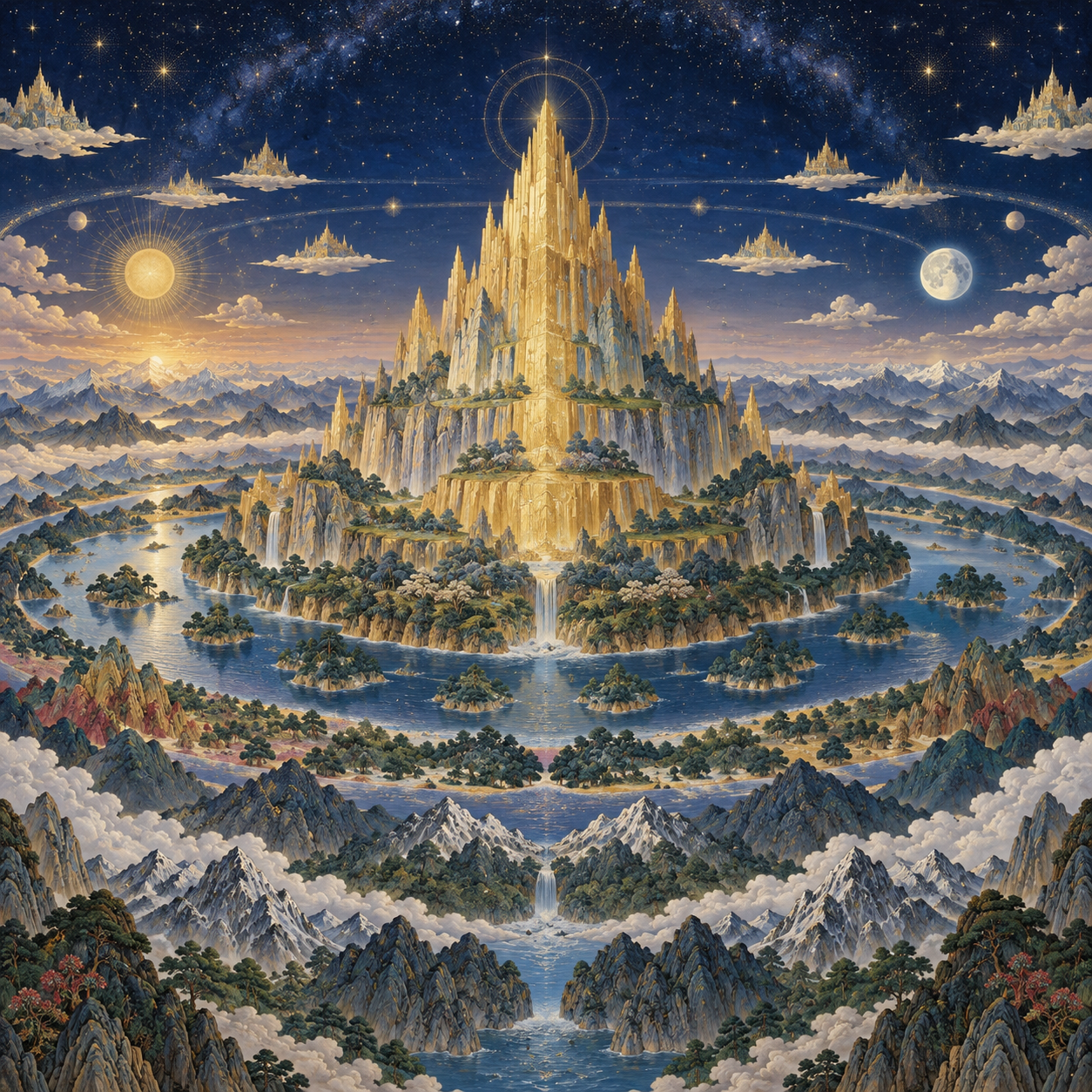
Meru does not need to be carried into an episode or assigned a temporary task in order to matter. Its defining importance is its position. It is revered as the greatest of mountains and the centre of the universe.
“Centre” here is richer than a dot on a modern map. In sacred cosmology, a centre establishes orientation. It tells you how a world is ordered and where its levels, directions or powers stand in relation to one another. Meru therefore functions as an axis of intelligibility: it makes the cosmos imaginable as an ordered whole rather than an unstructured expanse.
When Meru appears in a passage, ask what is being organised around it. Is the passage establishing hierarchy, direction, elevation or sacred centrality? Those questions will usually help more than immediately asking which present-day summit corresponds to the name.
This also explains why Meru can remain central even when it is not the site of the passage’s main action. An axis does not have to move to govern a pattern. Its apparent stillness is part of its meaning.
Mandara matters because it becomes an instrument

Mandara is also represented as vast and divine, but its distinctive fame comes from the churning of the ocean, commonly called Samudra Manthana. In that setting, the mountain is not scenery surrounding the action. It is part of the means by which the action unfolds.
That difference should govern how you read it. Meru tells you where the cosmos is centred; Mandara makes you notice the mechanism of a transformative event. Its importance is functional and dramatic. Remove Mandara from the churning narrative and you remove a necessary part of how the event occurs.
Pay particular attention to verbs whenever Mandara appears. A noun tells you that a mountain is present, but the verbs reveal its role. If the mountain is being used in the churning, the text is presenting an active instrument rather than a stationary cosmic reference point.
You can then consider the passage’s spiritual implications, but keep interpretation disciplined. First establish what the narrative depicts. Only after that should you explore themes such as effort, upheaval or transformation. This keeps a fruitful interpretation from being mistaken for the basic identity of the mountain itself.
How to read sacred geography without flattening it

Two opposite mistakes cause most confusion about sacred mountains. One treats every description as though it were only a modern geographical claim. The other turns every mountain into a free-floating metaphor and ignores its actual narrative role. A better reading preserves geography, cosmology and spiritual significance without collapsing them into one another.
- Identify the mountain by name. Do not let the generic word “mountain” erase the proper name. Meru and Mandara carry different associations.
- Find its immediate function. Ask whether the mountain is ordering the world, marking a centre, hosting an event or being used to accomplish something.
- Notice whether it is stable or instrumental. Stability points you toward Meru’s axial role. Instrumentality in the ocean-churning episode points you toward Mandara.
- Separate the narrative from later reflection. Write down what happens before deciding what it symbolises. That small discipline prevents personal interpretation from replacing the story.
- Treat geographical identification as a separate question. Even when a tradition connects a sacred name with an earthly place, that connection does not automatically exhaust the mountain’s cosmological or narrative significance.
This method works beyond these two mountains. Hindu sacred geography often communicates through relationships: centre and circumference, stability and motion, place and action. You understand a sacred feature more accurately when you ask how it participates in those relationships.
It also helps to resist the question “Which mountain is more important?” Meru’s cosmic centrality and Mandara’s role in a defining sacred event are not competing entries in a single ranking. Importance follows function. An axis and an instrument can both be indispensable for different reasons.
Key takeaways
- Mount Meru and Mount Mandara should not be treated as interchangeable names.
- Meru is defined chiefly by cosmic position: it is the central and ordering mountain.
- Mandara is defined chiefly by sacred action: it serves as the mountain involved in the churning of the ocean.
- Meru is best approached as an axis; Mandara, in its famous episode, as an instrument.
- A physical-location question does not by itself settle a mountain’s cosmological or theological meaning.
- Before drawing an allegorical lesson, identify what the mountain actually does in the passage.
The next time either name appears, make two short margin notes: “Meru—axis” and “Mandara—instrument.” Then reread the surrounding passage and look for either order and centrality or action and transformation. That simple check will prevent the common conflation while leaving the depth of both sacred mountains intact.
References

Leave a Reply
You must be logged in to post a comment.