
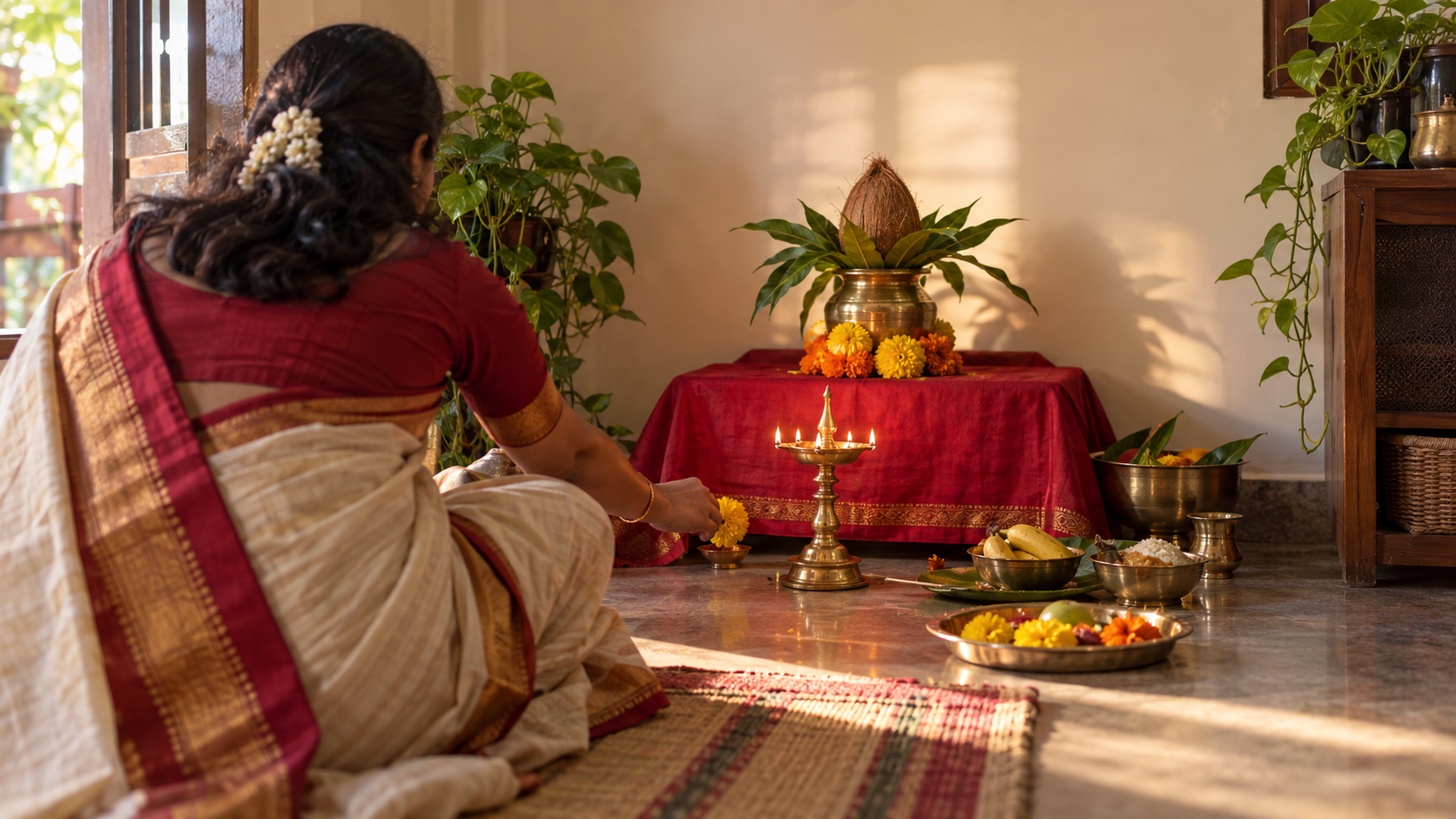
You want to observe Navaratri sincerely at home, but the daily charts do not agree. One names a form of Devi, another assigns a different form, and a third gives a completely different naivedyam. The confusion usually comes from treating several regional traditions as though they were one universal sequence.
You do not need to assemble the most elaborate chart. You need a nine-day plan that belongs to one recognisable tradition, fits your household’s discipline, and can be followed without waste or last-minute improvisation.
Begin with your tradition, not a universal-looking chart
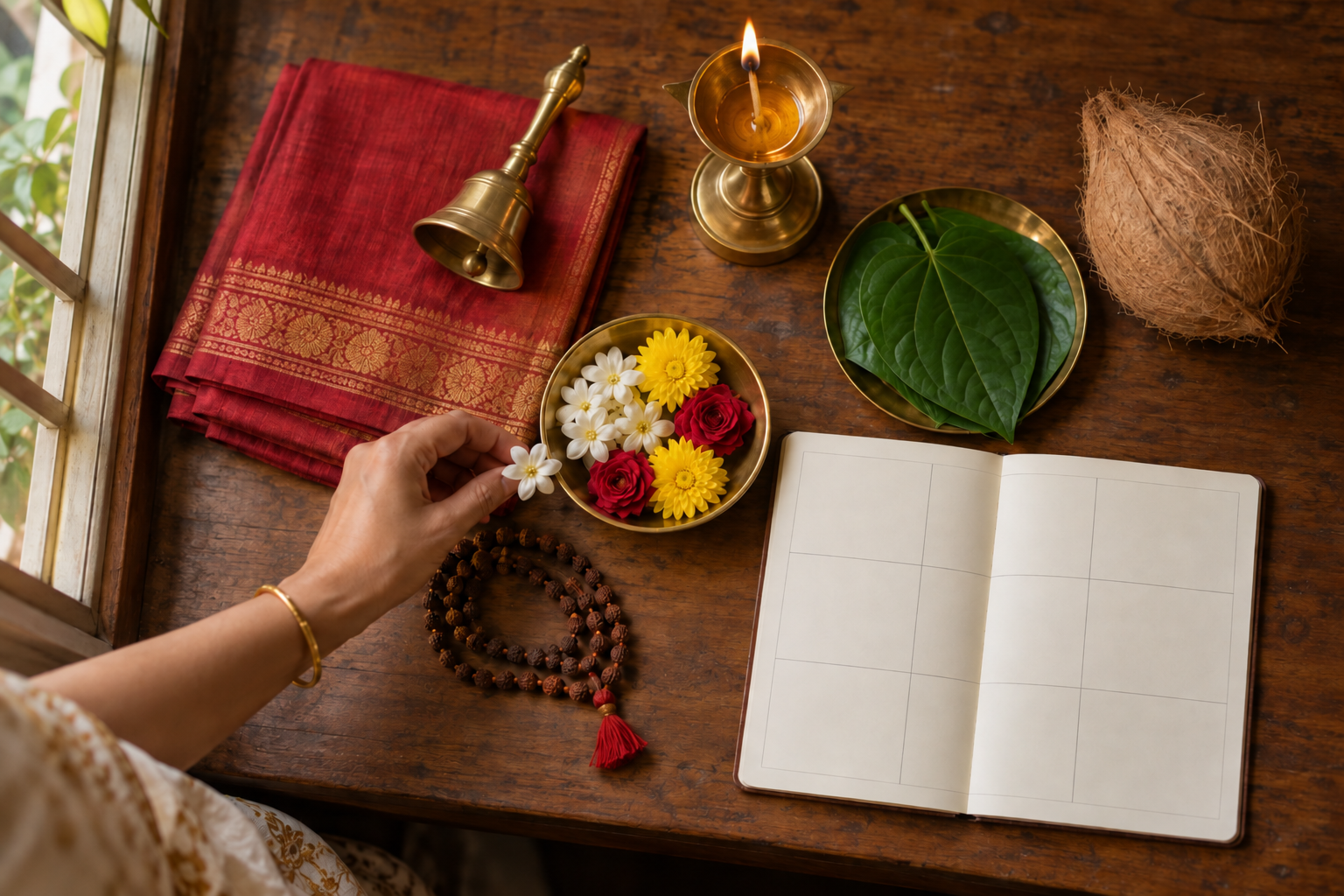
Navaratri is shared widely, but its daily forms and food offerings are not identical everywhere. The Goddesses worshipped can differ by place and state, and the corresponding naivedyam varies as well. A list followed in one South Indian household need not match a North Indian observance or even another custom within the same region.
This does not mean that every chart is unreliable. It means that each chart needs a context. If you take the deity from one lineage, the ritual name from a second, and the menu from a third, you may create a hybrid that matches none of them.
Choose your anchor in this order:
- Your established household practice: Use the sequence, recipes, and ritual order that your family has actually inherited.
- Your temple or sampradaya: If the household custom is incomplete, ask the temple or teacher whose form of worship you follow.
- Your local Hindu calendar: Use it to map tithi-based observances to civil dates in your location.
- A practical home plan: If you have no inherited list, keep the offering simple and consistent while avoiding claims that your personal menu is a canonical sequence.
Before buying ingredients, write one sentence at the top of your plan: “We are following the ______ tradition this Navaratri.” If you cannot fill that blank, resolve it before collecting nine recipes.
Build one working sheet for all nine days
For 2026, Navaratri begins on October 11 and ends on October 20. The second-day observance falls on October 12, while the third falls on October 13. Use those dates as calendar anchors, then confirm the complete local sequence before assigning the remaining days.
The table below is a planning model, not a claim that particular foods possess fixed day-by-day correspondences. Replace every sample offering with the customary naivedyam of your family, temple, or lineage when one is prescribed.
| Day | What to record | Practical offering plan | Preparation decision |
|---|---|---|---|
| Day 1: October 11 | Your tradition’s opening form and worship | A familiar fruit or the simplest permitted household offering | Set aside the puja vessels and confirm the following two days before beginning |
| Day 2: October 12 | Brahmacharini, Balatripura Sundari, or Tara, according to the system you follow | Your tradition’s prescribed preparation; otherwise, a simple family-approved sweet or fruit | Write down which worship system you are using so parallel names are not combined accidentally |
| Day 3: October 13 | Whether your family observes Sindoor Tritiya or a related regional custom | The customary family preparation; otherwise, repeat a suitable simple offering | Confirm the ritual procedure with someone who actually follows that custom |
| Day 4 | Local date, form of Devi, mantra or prayer, and any vrata rule | One reliable cooked preparation permitted by your practice | Choose a dish you can prepare without rushing the puja |
| Day 5 | Local date and form of Devi | Seasonal fruit or another customary naivedyam | Buy only the amount that can be offered and distributed promptly |
| Day 6 | Local date and form of Devi | A familiar savoury preparation allowed by the household discipline | Check every ingredient against the rules your family is observing |
| Day 7 | Local date and form of Devi | A familiar sweet preparation or the prescribed family recipe | Prepare shelf-stable ingredients in advance, but keep the actual offering fresh |
| Day 8 | Local date, form of Devi, and any expanded family worship | A celebration dish scaled to the number of people who will receive prasada | Decide portions and distribution before cooking |
| Day 9 | Local date, concluding form, and household completion practice | Your family’s concluding preparation or a simple offering made with full attention | Record what must be completed, retained, distributed, or cleaned afterward |
| Festival end: October 20 | The closing observance shown by your local calendar | Follow the household or temple custom | Treat this as a calendar checkpoint, not as a substitute for the local tithi sequence |
This sheet separates religious authority from household logistics. The deity and ritual come from your tradition; the shopping quantities, preparation time, and distribution plan come from your circumstances.
Offer naivedyam with consistency and without waste
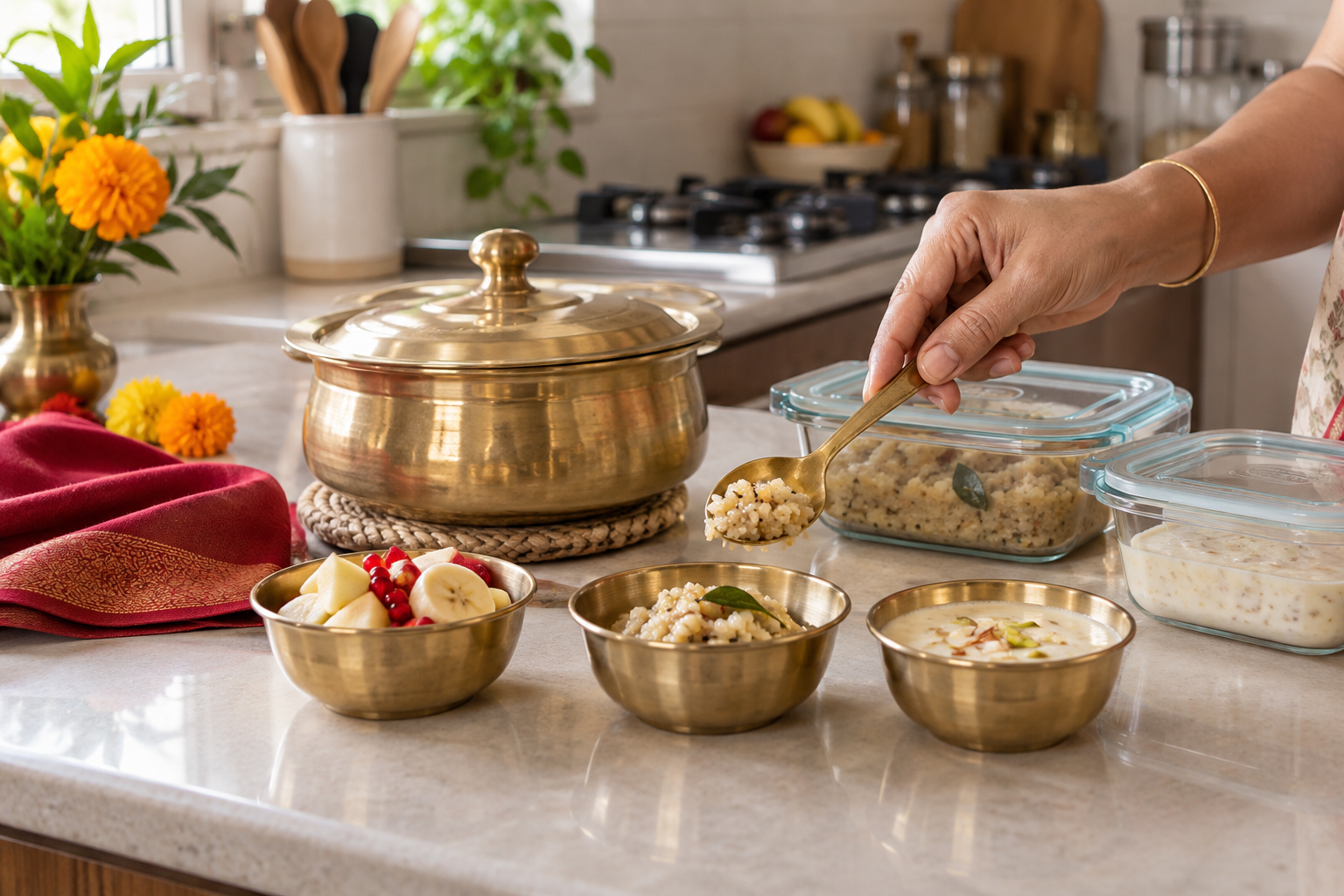
Nine offerings do not have to become nine cooking projects. Elaborateness is a poor measure of attention, especially when it leaves the cook hurried, the altar unattended, or excess food undistributed.
Use the same short process each day:
- Confirm the day’s rule before cooking. Check the permitted ingredients, the selected form of Devi, and the expected place of naivedyam in the puja.
- Choose a realistic quantity. Count the people who will receive prasada. A smaller fresh offering is more manageable than a large dish that may be wasted.
- Separate the offering as your custom requires. If your household reserves an untasted portion in a particular vessel, do that before serving the rest of the meal.
- Keep the sequence stable. Place the naivedyam before or after aarti according to your practice. Do not change the order merely because another chart uses a different one.
- Distribute the prasada promptly. Decide in advance whether it will remain within the household or be shared with relatives, neighbours, or visiting devotees.
- Record what worked. Note the recipe, quantity, and any correction needed. That one line becomes a dependable family guide for the next Navaratri.
Ingredient safety remains ordinary household responsibility. If anyone receiving prasada has an allergy or dietary restriction, choose a safe preparation and identify its ingredients clearly. Religious intent does not remove the practical consequences of an unsuitable ingredient.
Keep the second and third days in their proper context
The second day shows why labels must not be mixed casually. On Preeti Dwitiya in 2026, Brahmacharini is worshipped in the Navadurga framework, Balatripura Sundari in Navadevi Alankara Puja, and Tara in Mahavidya worship. These are parallel ritual frameworks. They are not a three-name checklist that every household must complete.
If your family follows Navadurga worship, write Brahmacharini in the Day 2 row. If it follows Navadevi Alankara, write Balatripura Sundari. If it follows a Mahavidya discipline, use the direction of that lineage. Once you have chosen the framework, take the offering and prayer from the same framework wherever possible.
The third day has a similar regional dimension. Sindoor Tritiya, also called Sindhur Teej, Sindhara Teej, Sowbhagya Teej, and Gauri Teej, is observed on the third day and is especially associated with Rajasthan, Gujarat, and Maharashtra. In the 2026 autumn Navaratri, it falls on October 13.
The festival name alone is not a complete ritual instruction. If this observance belongs to your family, ask an elder or priest exactly what is done, by whom, and in what order. If it does not belong to your practice, do not add an improvised sindoor rite merely because the name appears beside the date. Continue the third-day worship prescribed by your own tradition.
Questions to settle before Navaratri begins
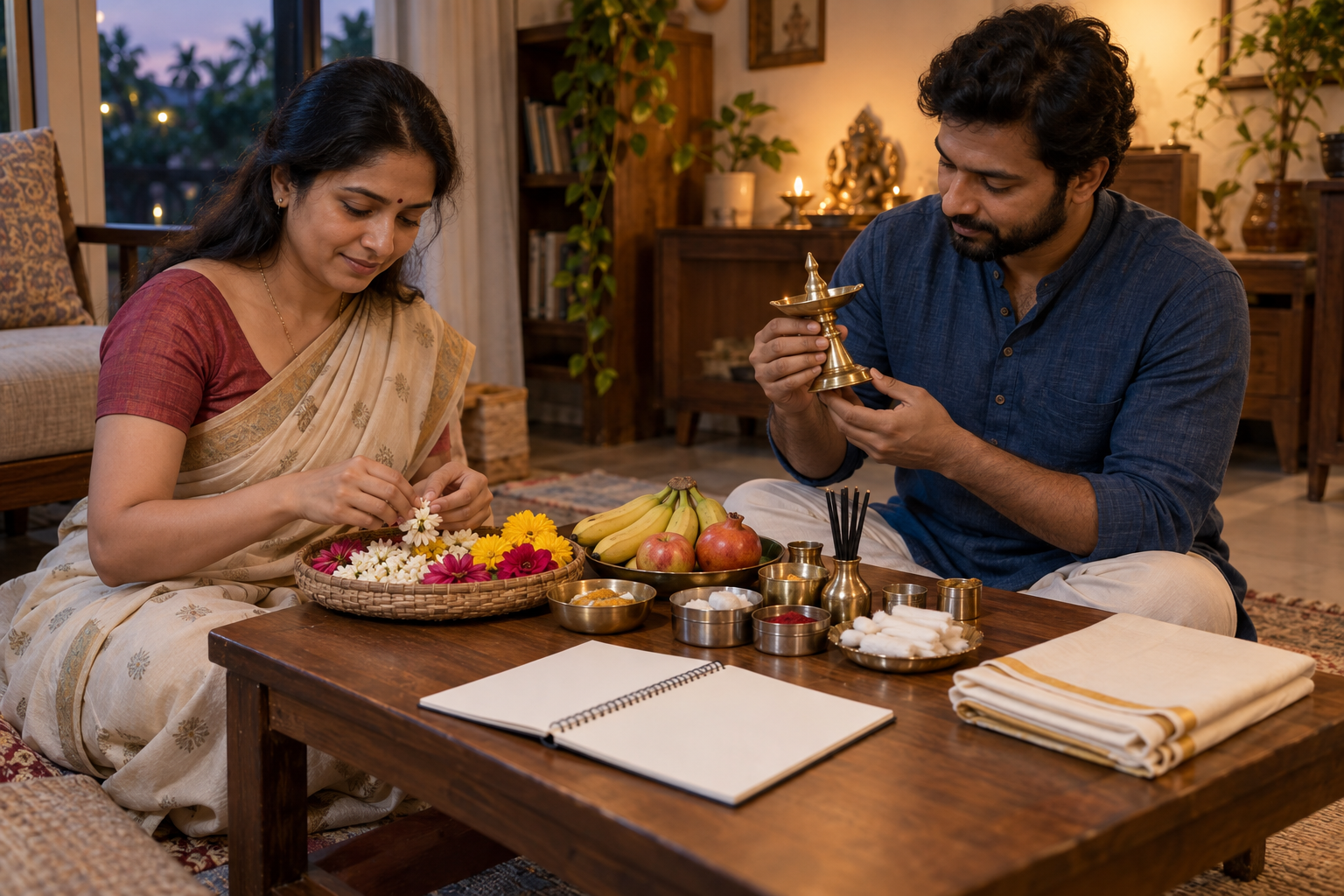
Is there one correct list of nine Navaratri offerings?
No single menu represents every region and lineage. Some South Indian practices use nine distinct types of naivedyam, but both the worshipped forms and the foods vary. Use a prescribed list when your tradition has one; otherwise, present a modest permitted offering without advertising your household plan as universal.
What should you do when a family custom and an online chart disagree?
If your purpose is to continue an inherited observance, begin with the family custom and verify it with the elder, temple, or teacher connected to that practice. Ask which calendar and worship system the online chart follows before borrowing anything from it. A difference may reflect region or lineage rather than an error.
Must every day’s naivedyam be different?
Follow a nine-item sequence when your household tradition prescribes one. If no such rule has been received, do not manufacture a theological correspondence just to avoid repetition. Repeating a suitable offering is more honest than attaching an invented religious meaning to nine unrelated recipes.
Can you plan all 2026 dates by counting forward from October 11?
Do not rely on arithmetic alone. Use October 11 as the stated beginning, October 12 for the second day, October 13 for the third, and October 20 as the stated end, but obtain the complete daily mapping from the local calendar your community follows. That prevents civil dates from replacing tithi-based guidance.
Start your plan with three calls or messages: one to the person who knows your family practice, one to the temple or teacher you follow, and one check of the local calendar. Then fill the nine rows, assign realistic quantities, and buy only what the household can prepare and distribute. Once those decisions are made, each day can remain centred on Devi rather than on the search for another chart.
References
- Hindu Pad — Nine Types of Naivedyam for Navaratri in South India, North India | Dasara Navratri Prasadams List
- Hindu Pad — Sindoor Tritiya 2026
- Hindu Pad — Preeti Dwitiya | Preethi Vidiya

Leave a Reply
You must be logged in to post a comment.