

If you are choosing self-defence training, or trying to turn a one-day camp into lasting habits, the useful question is not whether you can overpower an attacker. It is whether you can notice danger early, set a boundary, make a decision under pressure, create an opportunity to leave, and reach help.
That is also the right way to understand resilience. It is not fearlessness, toughness, or a promise that preparation will prevent every assault. It is a chain of awareness, response, escape, support, and recovery. Responsibility for violence always belongs to the person committing it; preparedness gives you more options and never transfers that blame to you.
Use observe-understand-act before danger becomes a confrontation

Situational awareness should help you move through ordinary life, not force you into permanent suspicion. Hypervigilance exhausts attention. Useful awareness is quieter: you notice the layout, identify what is unusual, and know what you will do if the situation changes.
Build the habit around three decisions:
- Observe: Notice lighting, exits, nearby people, staffed places, transport details, and anything that interrupts the normal pattern of the space.
- Understand: Ask whether the change is merely inconvenient or whether it reduces your freedom to leave. A blocked path, an unwanted approach, or ride details that do not match deserve action before you have complete certainty.
- Act: Reposition toward an exit, enter a populated or staffed place, contact a trusted person, reject the ride, or leave. You do not owe a stranger continued access to you while you investigate whether your concern is justified.
This is most effective when decided in advance. Before a regular commute, identify the route you prefer, an alternative route, places where you could ask for help, and the person who should notice if you miss a check-in. Before entering a vehicle, verify the identifying details available to you. Keep emergency contacts accessible and enough device charge for the journey. Avoid publicly broadcasting your live location; share it selectively with someone you trust when that improves safety.
A short mental prompt makes the habit easier: If this stops feeling ordinary, where do I go? Ask it at transport hubs, parking areas, unfamiliar buildings, ride pickups, and events. The purpose is not to predict every threat. It is to prevent surprise from consuming the first moments in which you could move.
A one-day initiative in Chhatrapati Sambhajinagar centred young women’s training on this combination of awareness and self-defence. That is the proper ambition for an introductory camp: establish a repeatable decision process, then give participants a path to continued practice.
Set the boundary early, then train physical skills for escape
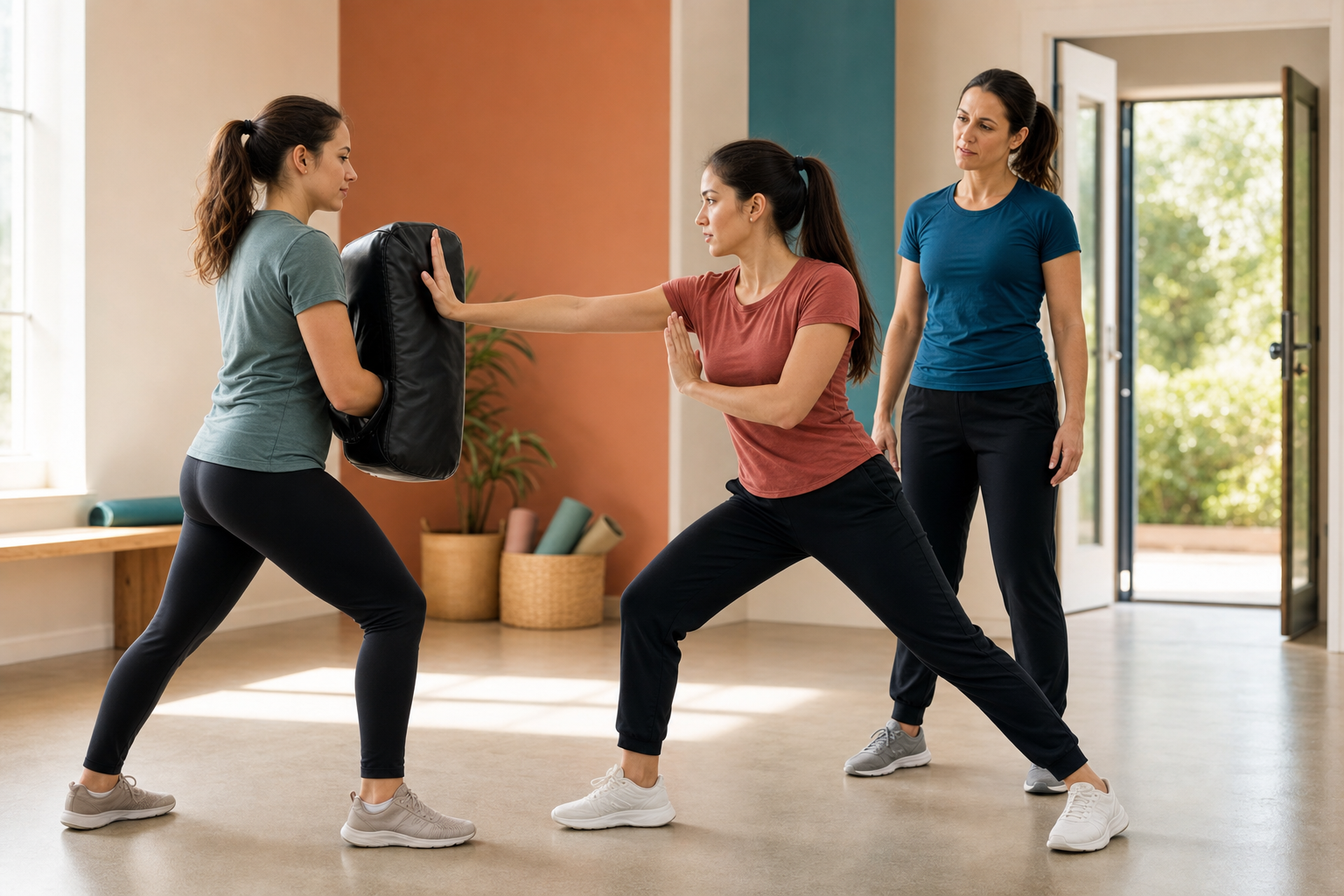
Many people imagine self-defence beginning with physical contact. In practice, the earlier tools are position, posture, voice, and movement. A clear boundary can interrupt escalating behaviour, alert bystanders, and remove any ambiguity about your non-consent.
Use short language that still works under stress: “Stop. Stay back.” or “Do not touch me.” If you need outside intervention, direct the request outward: “I need help. Call emergency services.” Lengthy explanations invite argument. Your boundary is not a debate, and politeness is not more important than distance.
Practise the words aloud with a trusted training partner. Begin from an ordinary posture, establish a stable base, bring your hands into a protective but non-provocative position, speak clearly, and move toward the exit. Rehearse different volumes and distances. If speaking would increase the danger, or if you can leave without engaging, leaving is the better response.
When contact cannot be avoided, a physical technique has one job: create enough opportunity to disengage. Choose one or two breakaways appropriate to your body, mobility, and likely circumstances. Complexity is a liability under adrenaline. Gross-motor movements, stable alignment, hip and bodyweight leverage, and a clear transition to escape are more useful than a long choreographed sequence.
Judge a course by what happens after each demonstrated movement. A sound drill should teach you to regain balance, create space, locate the exit, move, and seek help. A technique that ends with the participants standing beside each other on the mat has not rehearsed the most important part.
- Ask whether the movement depends on speed, flexibility, or arm strength that you may not have under pressure.
- Ask the instructor to explain the escape principle, not merely the sequence of hand positions.
- Practise with gradually increased resistance only under competent supervision.
- Insist on psychologically safe drills, clear stop signals, and the right to opt out of a scenario.
- Do not practise full-force attacks to the head, neck, joints, or other vulnerable areas. Pain or an existing injury warrants appropriate medical guidance before further physical training.
A one-day camp can introduce these principles; it cannot create mastery. If the camp leaves you with an impressive catalogue of techniques but no safe way to repeat them, regard it as a demonstration rather than completed preparation.
Train composure, lawful judgment, digital safety, and recovery together

Physical practice occupies only one layer of readiness. Your nervous system, legal judgment, daily planning, and access to support all affect whether a response protects you or creates another problem.
Use breath to regain a decision, not to suppress alarm
An adrenaline surge can narrow attention and produce hesitation, hurried movement, or a freeze response. That reaction is not a character defect. Train a simple reset such as diaphragmatic breathing, box breathing, or a brief grounding exercise. Use it during safe scenario practice so that the breath becomes connected to action rather than reserved for a quiet room.
The aim is not to become serene while danger continues. It is to recover enough attention to observe, orient, decide, and act. One regulated breath may help you see the open door, hear a bystander, remember your boundary, or choose not to enter a questionable vehicle.
Understand that defence ends when safe disengagement becomes possible
Lawful private defence is not retaliation. The practical principles are necessity, proportionality, and stopping once you can safely disengage. Pursuing someone after the immediate threat has ended can transform protection into punishment and create serious legal exposure.
This is general orientation, not legal advice. Laws and section numbers can change, and their application depends on the facts. Ask any instructor who teaches “legal self-defence” to identify the currently applicable law in your location, explain when force must cease, and distinguish immediate protection from later revenge. For advice about an actual incident, consult a qualified local lawyer or the appropriate authorities.
Reduce digital exposure without cutting yourself off from support
Digital safety is also layered. Review privacy settings, avoid real-time public posts that reveal where you are, verify ride information before entering, and share location only with trusted contacts when there is a clear safety purpose. Agree on what a missed check-in means and what the trusted person should do next. “Message me when you arrive” is weaker than a plan in which both people know how to respond when the message does not come.
Treat post-incident care as part of self-defence
After an incident, first get away from continuing danger. Move to a safer or staffed place, contact someone you trust, and seek emergency or medical assistance when needed. If you report, use the local pathway and preserve relevant information rather than editing it or posting it publicly. A legal adviser, support professional, or the investigating authority can tell you how potential evidence should be handled.
Psychological first aid begins with safety, calm, and connection. Confusion, shaking, numbness, anger, or delayed emotion after a frightening event does not mean you responded wrongly. Do not let pressure to produce a perfectly ordered account delay urgent care. Continued distress, difficulty functioning, or concern about personal safety warrants help from an appropriately qualified mental-health, medical, legal, or support professional.
Dharma makes courage accountable to restraint

Dharmic ethics do not require passive submission to violence. Ahimsa restrains cruelty and needless harm; it does not erase the duty to protect life and dignity. Kshatra Dharma places strength under responsibility. Buddhist mindfulness contributes clarity without panic, Jain ethics insist that force remain limited by necessity, and the Sikh ideals of seva and disciplined readiness place capability in the service of others.
Yoga and kalaripayattu also offer useful movement principles: breath, balance, alignment, and efficient use of the body. Gatka embodies disciplined martial readiness within a tradition of service. These traditions are distinct and should not be flattened into a single system, but they support a practical common standard: prepare seriously, respond without malice, and stop when protection no longer requires force.
This standard matters inside the training hall. An instructor who glorifies revenge, humiliation, or domination is not teaching responsible protection. Look instead for clear learning goals, enough supervision for individual correction, realistic but psychologically safe scenarios, lawful-response guidance, and resources for continued practice. Participants should be able to ask questions, decline unwanted contact, and report discomfort without being mocked.
Families and communities have responsibilities too. Do not punish a young woman for reporting an uncomfortable interaction early. Do not insist that avoiding embarrassment is more important than leaving. Respect a clear “no,” support sensible check-ins, learn how to act as a bystander, and know the local routes to medical, legal, and psychological help. A community that praises courage but silences disclosure leaves its young women to carry risk alone.
Resilience grows when preparedness is shared. A young woman should not have to choose between personal agency and community belonging. The healthier model gives her practical skills, believes her boundaries, and stands ready to help after a difficult event.
Key takeaways
- Plan before pressure: Know your preferred route, alternatives, exits, trusted check-in contact, and places where help is available.
- Use a simple decision loop: Observe the environment, understand what has changed, and act before uncertainty removes your options.
- Rehearse your voice: Practise a short boundary aloud while moving toward safety.
- Keep physical training simple: Learn one or two coached breakaways that rely on structure and leverage, then complete every drill by disengaging and exiting.
- Train composure: Pair a familiar breathing or grounding method with safe scenario practice so it supports decisions under stress.
- Know the ethical and legal limit: Protection is for ending an immediate threat, not pursuing revenge. Verify current local law with a qualified professional.
- Prepare for what follows: Know whom you will contact, where you can obtain urgent help, and how you will access medical, psychological, or legal support.
Your next step can be small and concrete. Choose a check-in routine, a boundary sentence, a breath drill, and one or two breakaways taught by a competent instructor. Rehearse the whole chain from noticing a problem to reaching safety. That is how courage becomes a habit rather than a slogan.