
If you have been told that Hanuman is an eternal brahmachari and also the father of Makaradhwaja, the apparent contradiction can be unsettling. You do not have to dismiss either Hanuman’s celibacy or the later story. You have to ask a better question: what kind of birth is being described, and in which layer of the Ramayana tradition does it appear?
Once those questions are separated, Makaradhwaja becomes more than a curiosity in Hanuman’s genealogy. His story shows you how a righteous deed can produce an unforeseen consequence, how that consequence can arrive as a duty rather than a punishment, and how dharma turns an unexpected bond into rightful order.
Begin with the right textual distinction
The shortest accurate answer to “Is Makaradhwaja in the Ramayana?” is this: he does not appear in the Valmiki Ramayana. His story belongs to later and regional Ramayana traditions, where it became connected with the Ahiravana cycle and was preserved through retelling and performance.
That distinction matters. Saying that an episode is absent from the Valmiki text does not prove that it has no devotional or philosophical value. Saying that it is beloved in later tradition does not place it retroactively inside Valmiki’s narration. Textual history and sacred meaning answer different questions, and neither is served by confusing them.
The Makaradhwaja motif is associated with later works and regional currents such as the Krittivasi Ramayan, Adbhuta Ramayana, and Ananda Ramayana, as well as popular oral and performance traditions. The precise details vary. That variation is normal within the larger Ramayana inheritance, in which subsidiary narratives extend familiar characters into new ethical situations.
When you explain the story to someone else, use three steps:
- Name the textual layer: this is a later or regional Ramayana episode.
- State the limit clearly: Makaradhwaja is not a character in the Valmiki Ramayana.
- Then interpret the episode on its own terms: ask what its birth, conflict, and resolution reveal about dharma.
This approach avoids two common errors. One error treats every inherited retelling as if it came from the earliest available text. The other treats anything outside that text as worthless. A living tradition can preserve distinctions without severing its branches from their civilizational root.
The sweat-born son does not undo Hanuman’s brahmacharya
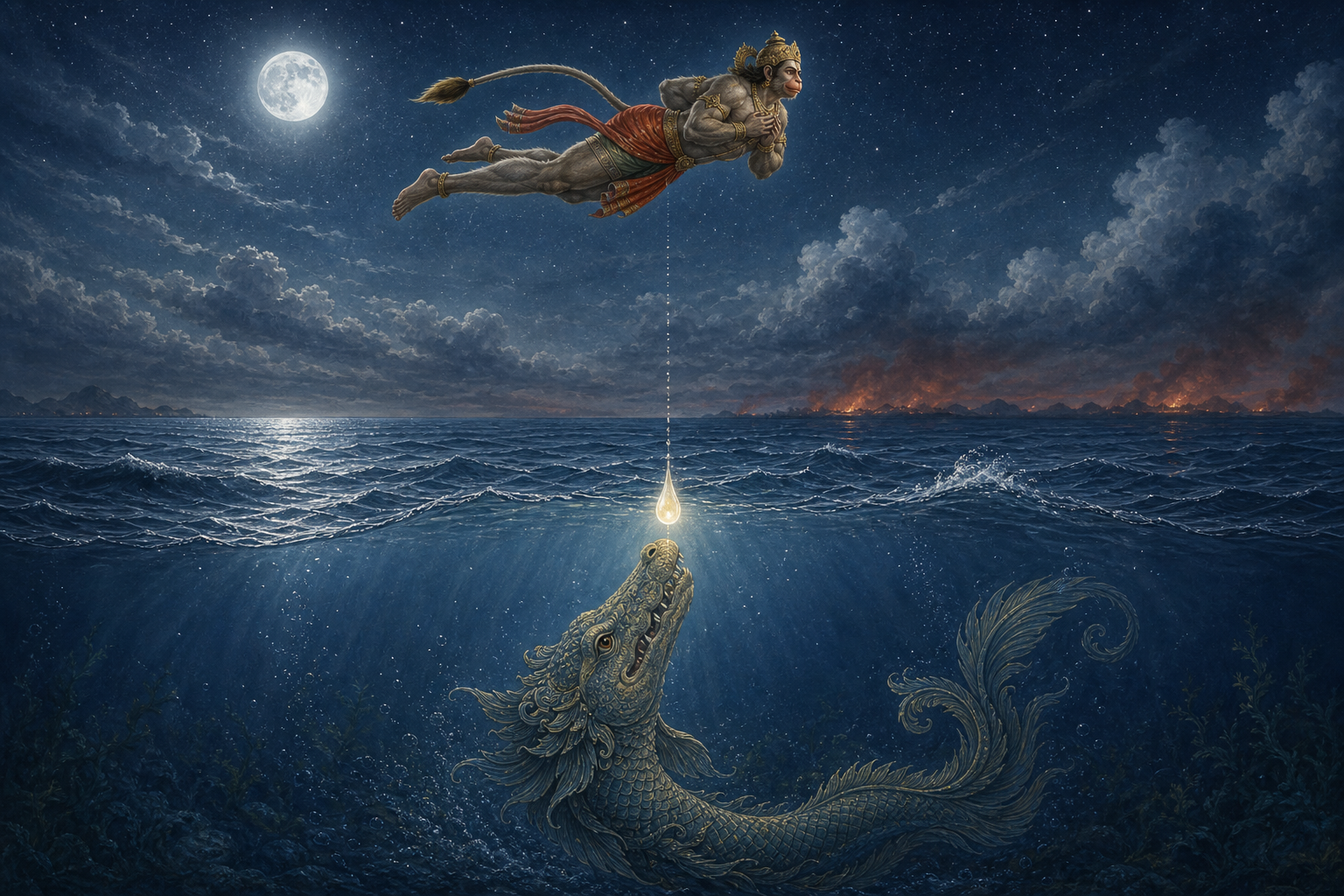
In the later narrative, Ravana’s forces set Hanuman’s tail ablaze during his mission to find Sita. Hanuman converts that intended humiliation into the Lanka Dahana, turning the enemy’s weapon against the seat of adharma. When he cools his burning tail in the ocean, a drop described in different tellings as sweat or subtle generative essence enters the waters and gives rise to Makaradhwaja.
This is not a story of ordinary sexual procreation. Its extraordinary mode of birth is precisely what allows Hanuman’s identity as a brahmachari to remain intact. The son proceeds from the heat and exertion of service, not from a breach of self-mastery.
The symbolism becomes clearer when you follow the elements. Agni exposes the character of Lanka’s adharma. Hanuman, son of Vayu, carries the fire and directs its force. Apas, the waters, receive the heat and transform what falls into them. Patala later becomes the hidden realm in which the consequence of that action waits to be encountered. Fire reveals, wind acts, water receives, and depth conceals until the proper moment of recognition.
The name also points beyond biological curiosity. Makara names an aquatic or composite being, while dhwaja means a banner or standard. The name evokes an identity raised from the waters and brought into visibility. Something generated at the edge of Hanuman’s awareness eventually stands before him with its own name, strength, and duty.
You do not have to choose between reverence for the wondrous event and attention to its symbolic function. Keep the questions distinct. The narrative question asks what happened within the inherited tale. The interpretive question asks why the tale gives the birth this particular form. The second question reveals its ethical force: intense action can generate results beyond the actor’s intention, yet those results still make a claim on the actor.
That is why reducing Makaradhwaja to a sensational claim about “Hanuman’s son” misses the heart of the episode. The miraculous birth preserves Hanuman’s theological character while giving visible form to the hidden fruit of his exertion.
At the gate of Patala, two legitimate roles collide
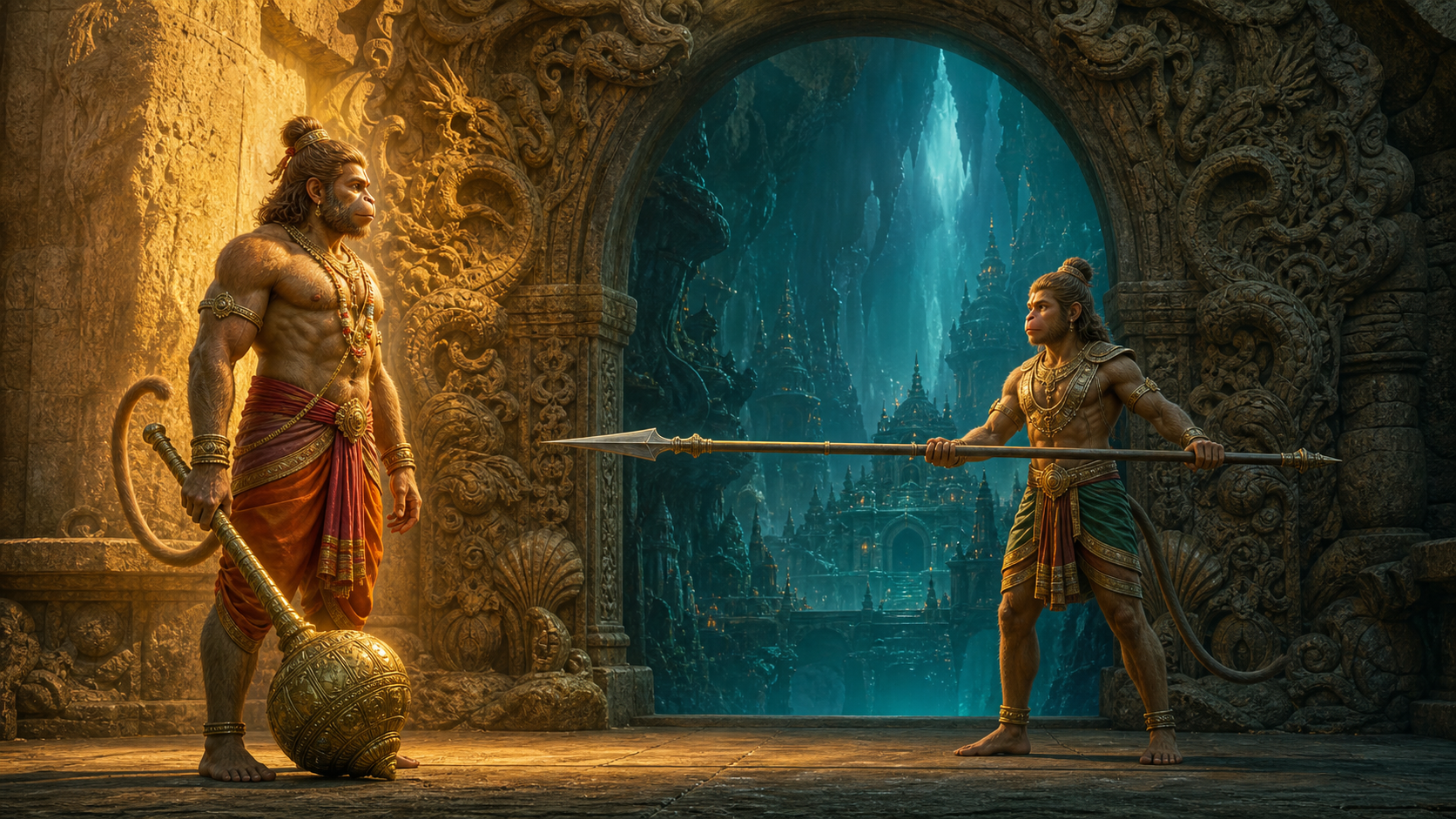
Makaradhwaja does not first appear as a child waiting to be embraced. In many tellings, he guards the entrance to Patala under Ahiravana or Mahiravana, who has abducted Rama and Lakshmana. Hanuman arrives to rescue them. Father and son meet as opponents before they understand their relationship.
This arrangement makes the encounter morally serious. Hanuman cannot abandon Rama merely because the guardian may be related to him. Makaradhwaja cannot discard his assigned post merely because a powerful stranger demands passage. Each initially acts from a recognizable commitment. The problem is that a role acquires moral worth only when it remains ordered toward dharma.
Makaradhwaja’s discipline as a guard may be admirable, but service to Ahiravana cannot make the abduction of Rama and Lakshmana righteous. Hanuman’s paternal connection may become important, but kinship cannot cancel his devotion to Rama or his obligation to confront adharma. Svadharma is not blind obedience to whoever gives an order. It is the responsible performance of one’s role within a larger moral order.
If you face a conflict between loyalty and principle, the episode gives you four questions to ask:
- What promise or role is each person trying to honor?
- Which course protects the highest legitimate good, rather than merely preserving status or attachment?
- Has a worthy quality such as courage, loyalty, or discipline been placed in the service of adharma?
- After the immediate conflict is resolved, what responsibility remains toward the person who stood on the other side?
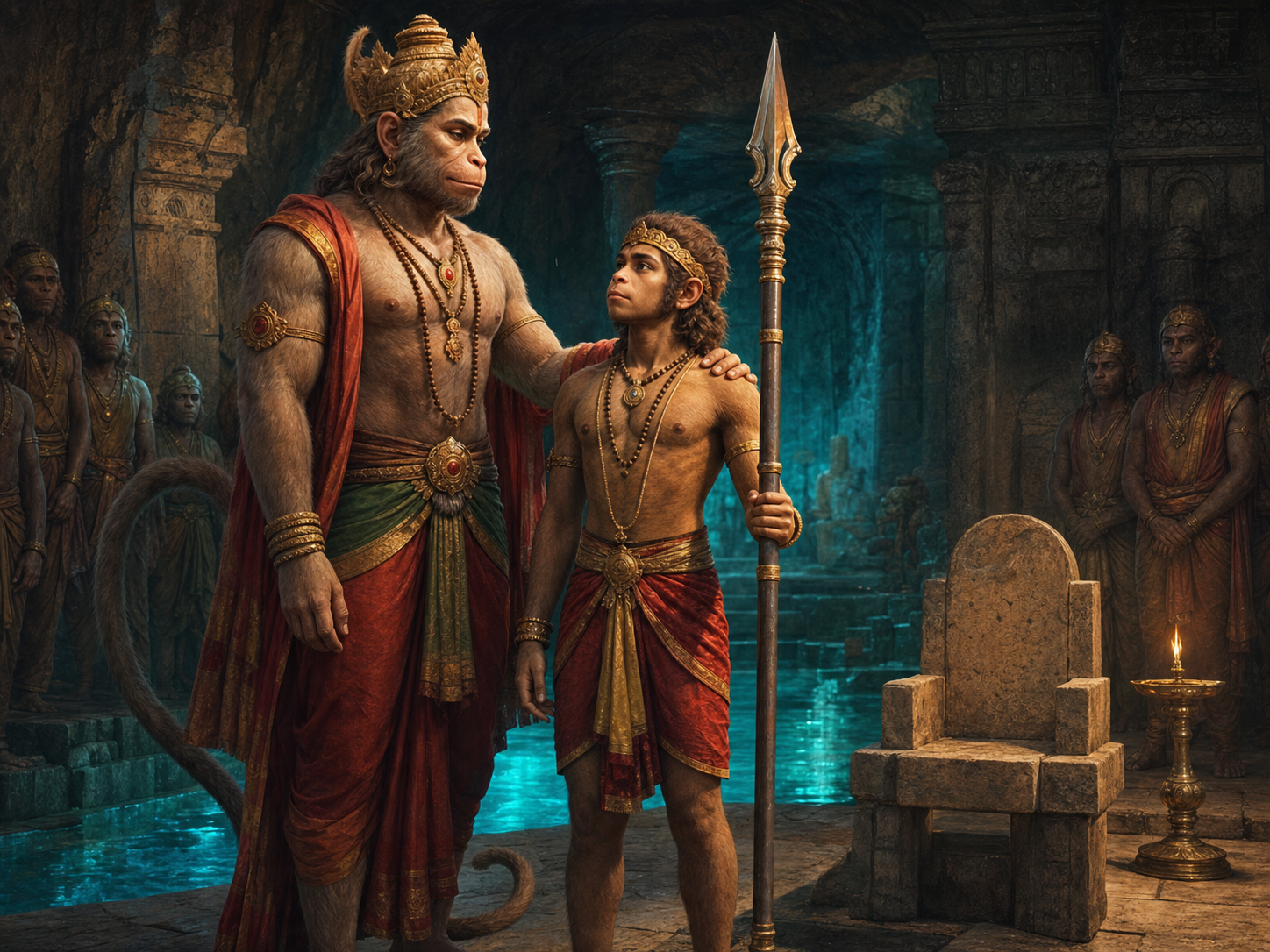
The fourth question is easy to neglect. Victory alone does not complete Hanuman’s task. Once the relationship is recognized, Makaradhwaja cannot be treated as disposable residue from the struggle. In different versions, he moves from obstacle to ally, and some tellings give him rulership or custodianship in Patala. The consequence is not erased; it is educated, situated, and entrusted with a dharmic function.
This is a demanding model of leadership. A lesser hero might defeat the guard and continue without looking back. Hanuman restores the primary order by rescuing Rama and Lakshmana, yet the later resolution also makes room for the person whose existence his earlier action set in motion. Power reaches its dharmic completion in guardianship.
Karmaphala is a responsibility, not merely a verdict
Karmaphala is often reduced to a cosmic system of prizes and punishments. Makaradhwaja complicates that picture. The Lanka Dahana is not recast as an evil act simply because it has an unforeseen fruit. Hanuman was acting in Rama’s service and against Ravana’s adharma. Yet the righteousness of the original purpose does not make every later consequence irrelevant.
Here, karmaphala arrives as a relationship. It has a face, a will, a history, and a claim to be acknowledged. Hanuman cannot say that he never intended Makaradhwaja’s birth and therefore owes him nothing. Intention remains morally important, but it does not exhaust responsibility once a real consequence exists.
This distinction is useful far beyond the narrative. A necessary intervention can create new dependencies. A successful community effort can leave behind an institution that requires stewardship. A courageous public stand can draw other people into risks and obligations they did not previously carry. A crisis decision can solve the urgent problem while generating a quieter duty that surfaces later.
When that happens, do not confuse responsibility with self-condemnation. Ask whether the original act was dharmic, but also examine what now exists because you acted. You can do this through a simple karmaphala audit:
- Name the act accurately. State what you did, why you did it, and what immediate wrong or need you were addressing. Do not rewrite the motive merely because later events became difficult.
- Trace the visible fruit. List the people, commitments, expectations, and structures that now exist because of the act. Include indirect consequences when the connection is clear, but do not claim responsibility for everything that followed.
- Separate guilt from duty. An unforeseen consequence does not automatically prove wrongdoing. It may still create an obligation to guide, repair, support, or establish boundaries.
- Give the consequence a dharmic place. Decide who should care for it, what authority it should have, what limits it needs, and how it can serve a rightful purpose rather than remain a source of disorder.
The tale also warns you against using karma to explain another person’s suffering from a comfortable distance. Its moral movement runs in the opposite direction. Karmaphala places a demand on the agent: recognize what your action has brought forth and respond without evasion. It is not permission for a spectator to blame someone who is already bearing pain.
Related insights appear across the Dharmic family, though their doctrines should not be collapsed into one formula. Buddhism gives close attention to intention, or cetana, and conditioned consequences. Jain thought describes karmic bondage to the jiva with its own precise metaphysics. Sikh teaching joins action to Naam and truthful living. The common ethical starting point is modest but important: deeds do not end when the actor stops moving, and spiritual clarity must become responsible conduct.
If you discuss Makaradhwaja across these traditions, begin with that shared question rather than pretending the doctrinal answers are identical: when an action produces an unforeseen moral claim, what does truthful responsibility now require?
Key takeaways
- Makaradhwaja is absent from the Valmiki Ramayana and belongs to later and regional Ramayana traditions. Textual accuracy does not require dismissing the episode’s devotional meaning.
- His extraordinary birth from Hanuman’s sweat or subtle essence preserves Hanuman’s brahmacharya. The birth expresses consequence without ordinary procreation.
- The father-son conflict at Patala is a conflict of duties, not simply a test of strength. Loyalty and discipline remain virtues only when ordered toward dharma.
- Karmaphala need not be a punishment. It can arrive as a relationship, responsibility, or institution that must be acknowledged and properly guided.
- A righteous original intention does not erase later obligations. Examine the fruit of your action without falsely turning every consequence into evidence of guilt.
- The dharmic completion of power is stewardship: after defeating an obstruction, establish the conditions in which the resulting person or responsibility can serve rightful order.
The next time an unexpected result confronts you, do not ask only whether your original action was justified. Ask what now has standing because you acted. Name the responsibility, test it against dharma, and give it an honorable form.
Hanuman’s greatness is not diminished when the fruit of his action meets him at the gate. It becomes more complete. He confronts the consequence without abandoning his highest duty, then turns an unforeseen bond toward guardianship. That is the practice Makaradhwaja leaves with you: act courageously, recognize honestly, and take responsibility for what your courage brings into the world.