
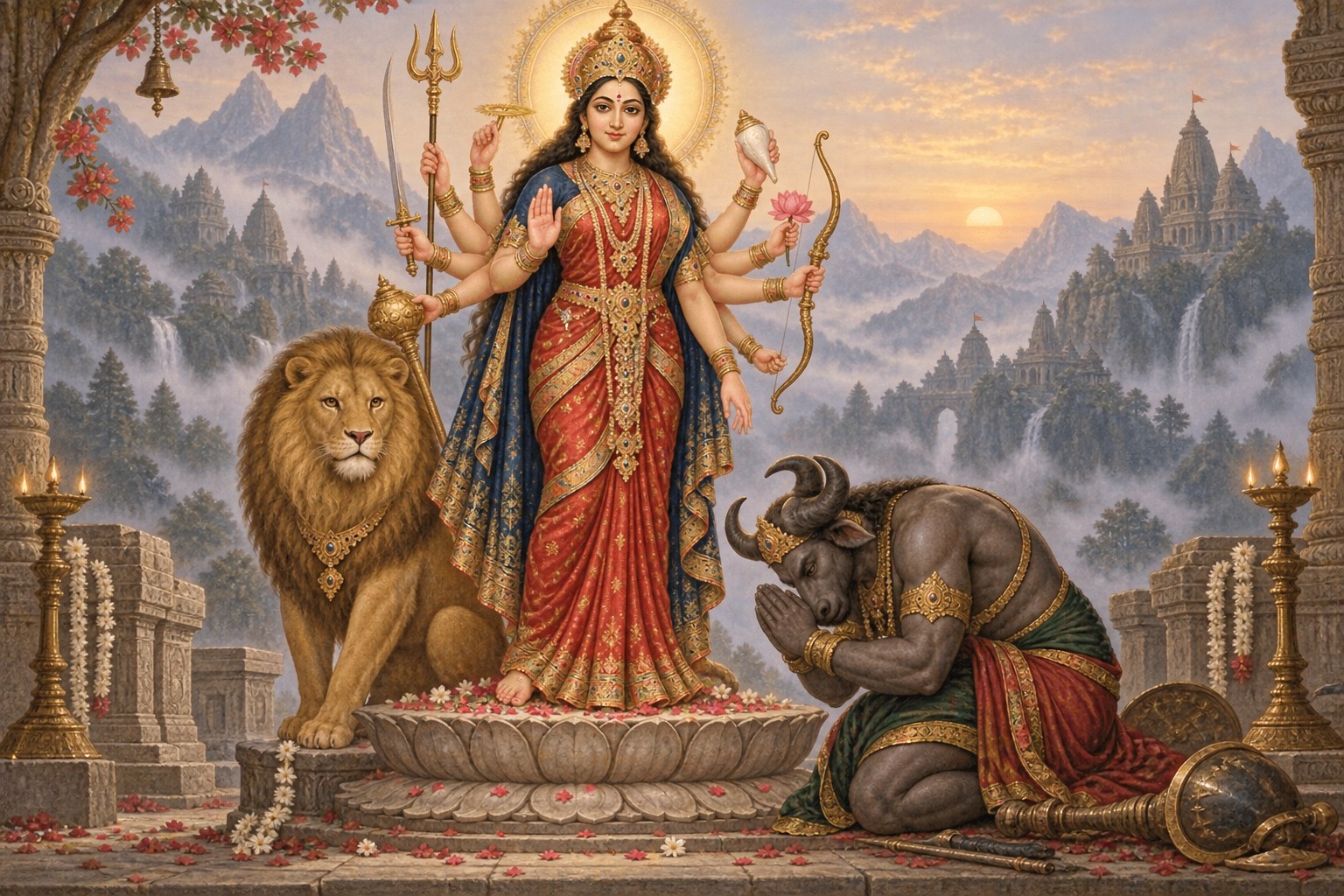
If you know Mahishasura only as the buffalo asura defeated by Durga, one detail can make the familiar image look different. In the Kalika Purana tradition, his devotion earns him an eternal place at the Goddess’s feet.
That does not reverse Durga’s victory or turn Mahishasura’s opposition into righteousness. It reveals a more demanding idea: the Divine Mother can defeat adharma without denying the spiritual significance of devotion. To understand the boon, you have to hold judgment, grace, surrender, and hierarchy together.
The boon is nearness to Durga, not victory over her
The first distinction is the most important. Mahishasura does not receive the outcome for which he fought. Durga remains victorious, while the asura remains the one she has overcome. His boon concerns his enduring place in relation to her: he is allowed to remain at her feet.
This is not an acquittal. It does not imply that his conduct was harmless, that Durga’s intervention was unnecessary, or that devotion converts adharma into dharma. The defeat and the boon answer different questions. The defeat answers what happens to power that sets itself against divine order. The boon answers whether devotion can retain spiritual meaning even when the devotee’s will must be broken.
Keep three boundaries clear when you explain the episode:
- Mahishasura is defeated. The boon does not rewrite the battle.
- His devotion matters. The Goddess does not treat it as spiritually empty.
- His place remains subordinate. He is at Durga’s feet, not on her throne or beside her as an equal sovereign.
Those boundaries prevent two opposite mistakes. One is to reduce Mahishasura to a disposable villain for whom no transformation or grace is possible. The other is to romanticise him until Durga’s victory becomes morally suspect. The Kalika Purana’s resolution requires neither distortion.
Why the Goddess’s feet carry the meaning of the boon
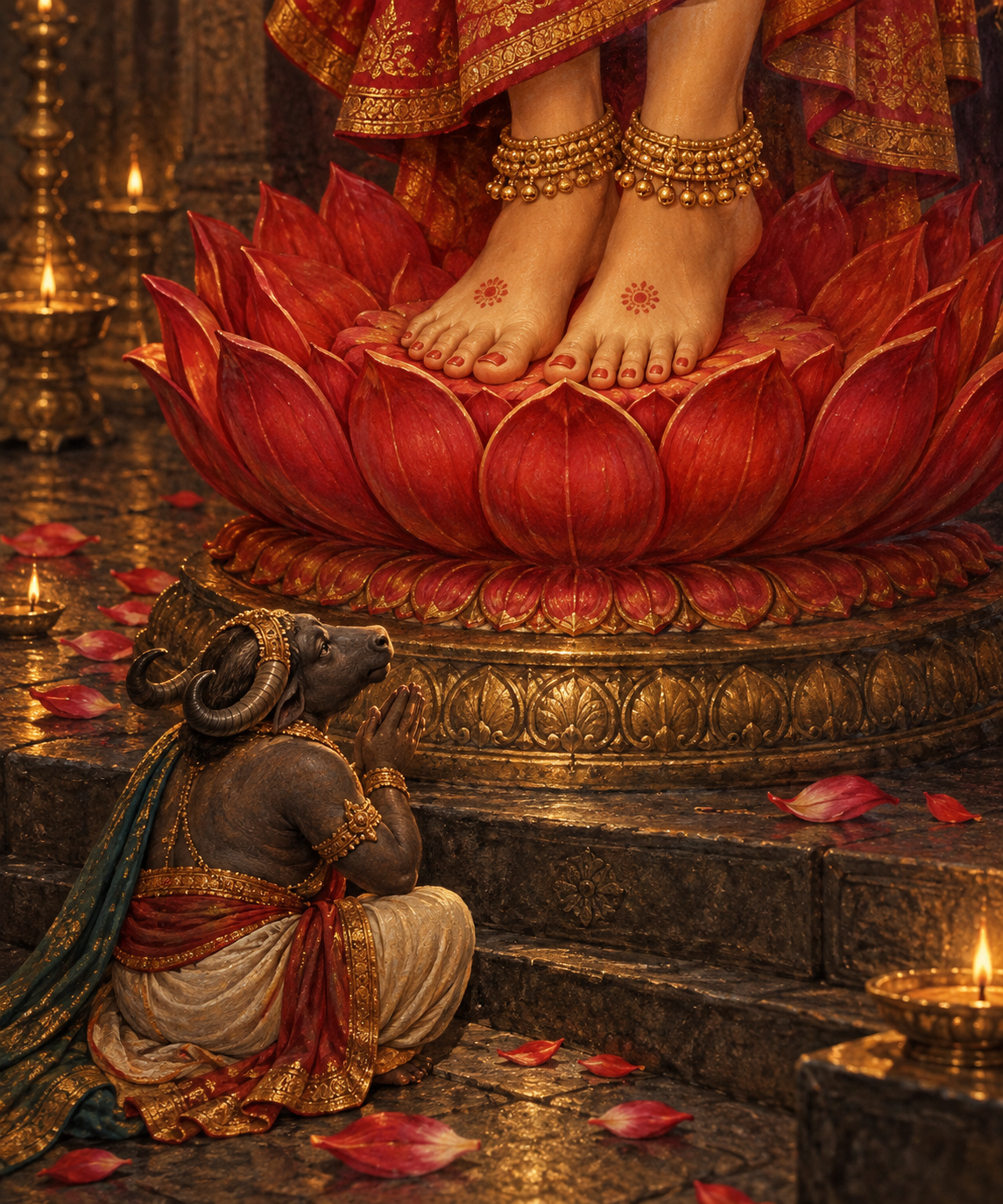
In Dharmic life, the feet are not merely a physical location. A devotee bows at a deity’s feet; a disciple approaches the guru’s feet; younger people may touch an elder’s feet to receive blessings. The gesture places reverence into bodily form. You lower the self that demands control and acknowledge an order greater than your own preference.
Being at Durga’s feet therefore holds two meanings at once. It is intimate because Mahishasura is not cast beyond her presence. It is humbling because he remains beneath the power he opposed. Nearness is granted, but mastery is not.
This is why the location cannot be replaced with the vague claim that Mahishasura was simply “honoured.” Honour by itself could imply vindication or equality. The feet preserve the moral structure of the encounter:
- Durga is sovereign.
- Mahishasura’s resistance is overcome.
- Devotion opens the possibility of nearness.
- Nearness takes the form of surrender, not self-assertion.
When you next look at an image of Mahishasuramardini, do not focus only on the dramatic instant of combat. Notice the vertical relationship. Who stands, who has been brought down, and whose presence contains the whole scene? The composition expresses what a short retelling can miss: Durga’s supremacy and Mahishasura’s continuing proximity are not contradictions.
Grace does not cancel accountability
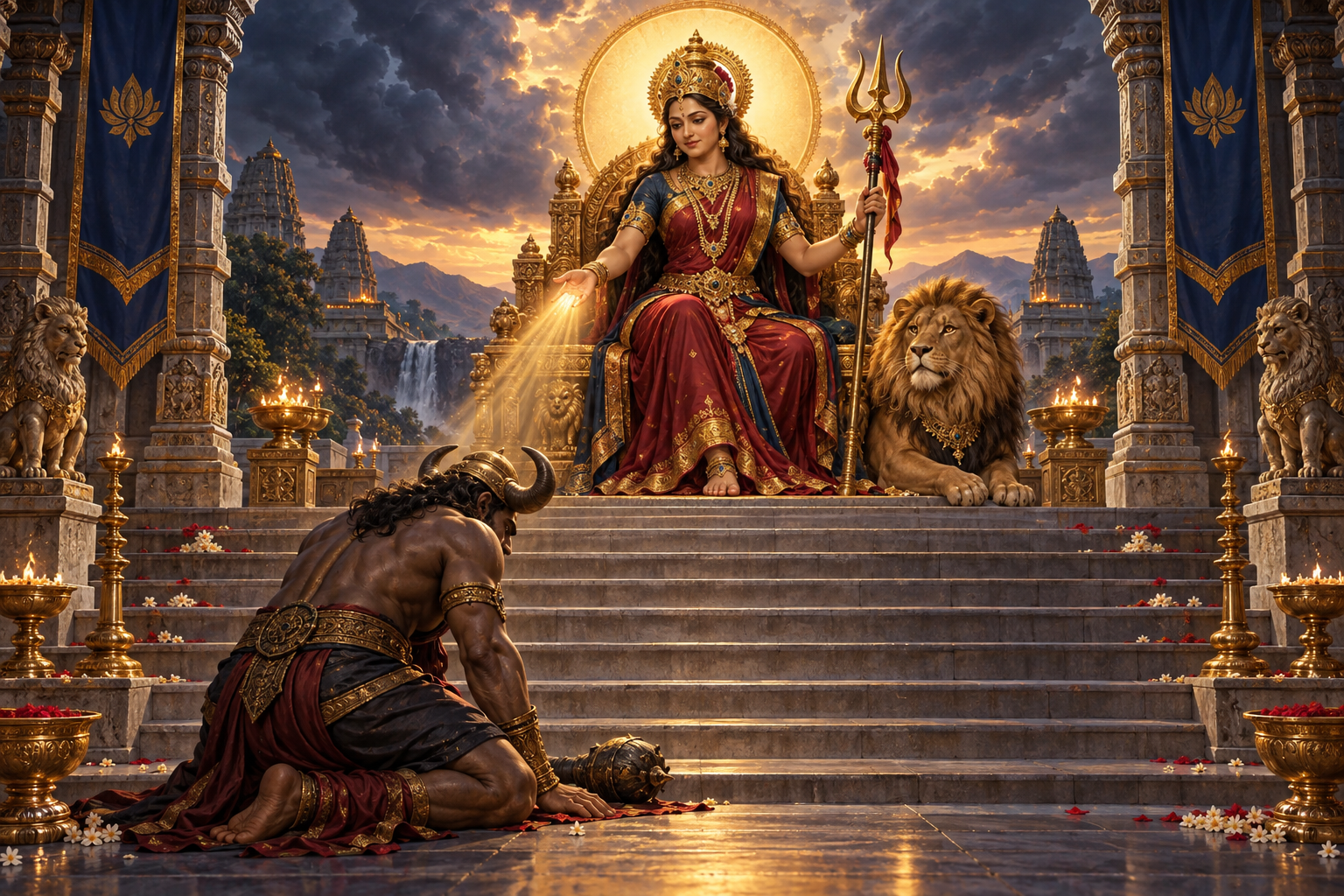
The episode becomes spiritually useful when you refuse to turn grace into indulgence. Mahishasura receives nearness to the Goddess, but only in a form that leaves her judgment intact. His devotion is recognised; his opposition is not endorsed.
This gives you a precise way to think about accountability. A person can possess a real devotional impulse and still act from arrogance, domination, anger, or attachment. The presence of devotion does not make every action performed by a devotee righteous. Conversely, serious error does not prove that every movement toward the Divine was false.
That distinction matters beyond this particular story. Religious identity is not a shield against correction. Prayer, ritual, learning, and declarations of faith cannot be used to demand that consequences disappear. If harm has been done, repair is still required. If pride has distorted judgment, surrender must include accepting that one’s preferred outcome was wrong.
Nor should the boon be turned into a transactional formula: oppose the Divine, display devotion, and expect a privileged reward. Bhakti is not a loophole through which the ego secures immortality on its own terms. Mahishasura’s place at Durga’s feet communicates precisely the opposite. What endures is not his claim to rule over her; it is the relationship that becomes possible when her sovereignty is no longer resisted.
Four questions that turn the episode into sadhana
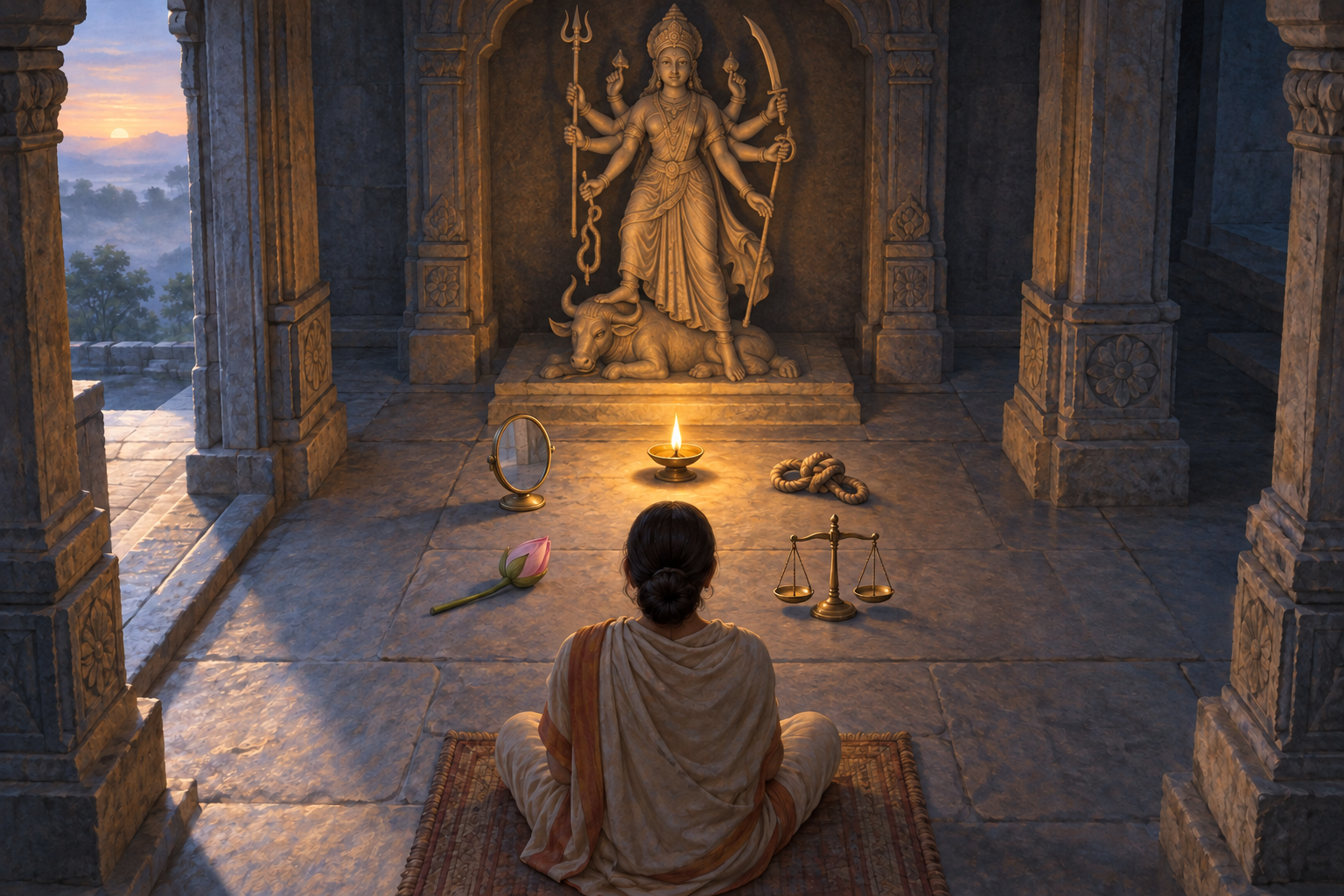
You can use the story for personal contemplation without pretending that your ordinary struggles are identical to a Puranic battle. This is not a prescribed ritual. It is a disciplined way to examine what surrender means in practice.
- What in you insists that only victory will count? Name one situation in which you are more concerned with being vindicated than with discovering what is dharmic. Avoid abstractions such as “my ego.” Identify the decision, quarrel, status, or attachment through which that ego is acting.
- What would have to be defeated rather than negotiated with? Some habits can be moderated, but dishonesty, deliberate cruelty, and the refusal to accept responsibility cannot be dressed up as spiritual complexity. Ask what you already know must stop.
- Can you accept correction without abandoning devotion? Many people pray confidently while events favour them and withdraw when their preferred outcome collapses. Mahishasura’s boon directs attention away from getting one’s way and toward remaining oriented to the Divine after self-will has failed.
- What would taking a place at the Goddess’s feet require today? Choose a concrete act: apologise without defending yourself, correct a false claim, return what is not yours, resume a neglected discipline, or bow before worship with no request except clearer discernment.
The order matters. Do not begin by claiming grace for yourself while bypassing the conduct that needs correction. First identify what must yield. Then ask how devotion can continue without becoming another instrument of self-justification.
How to retell the boon without distorting it
Puranic traditions preserve layered tellings, and details from one telling are easily blended into another. If you are discussing this episode in a class, satsang, family conversation, or online post, name the Kalika Purana tradition rather than presenting every detail as though it appeared identically in every account of Durga and Mahishasura.
A careful retelling can be very short: Durga defeats Mahishasura, yet his devotion earns him the boon of an eternal place at her feet. Then explain the theological tension instead of filling gaps with invented dialogue, motives, ritual instructions, or promises of liberation that have not been established.
Four common claims should be corrected when you encounter them:
- “The boon proves Mahishasura was right.” It does not. Durga’s victory remains decisive.
- “The defeat proves his devotion meant nothing.” His place at the Goddess’s feet shows otherwise.
- “Grace means consequences no longer matter.” The boon follows a relationship in which Mahishasura is conquered and subordinated, not vindicated.
- “At Durga’s feet means equal status beside her.” The symbolism expresses nearness under her sovereignty, not equality with it.
This careful wording protects the episode from being recruited into a simple political reversal, a sentimental defence of the asura, or a harsh theology in which divine victory requires permanent exclusion. Its force lies in refusing all three.
Key takeaways
- Mahishasura’s boon is an eternal place at Durga’s feet, not victory over her.
- The feet signify both nearness and surrender: grace is offered without erasing hierarchy.
- His devotion is recognised, but his opposition to the Goddess is not declared righteous.
- The episode separates accountability from abandonment. Defeat can correct adharma without making devotion meaningless.
- When retelling it, identify the Kalika Purana tradition and avoid adding unsupported promises, speeches, or ritual claims.
The next time you stand before Mahishasuramardini, let your attention remain on the whole image for a few moments after the victory is obvious. Then ask for the harder boon: not that every struggle end in your favour, but that whatever must be defeated in you leaves you closer to the Mother’s feet.
References

Leave a Reply
You must be logged in to post a comment.