

You have a decision that looks right in principle, but the people around you are divided. Supporters want immediate action. Critics question your motives. Someone vulnerable may bear the cost, while someone powerful can avoid it. If you lead a government, temple trust, community body, business, or family institution, this is where moral courage becomes harder than moral language.
The Mahabharata does not offer a slogan that makes such choices painless. It offers something more useful: a way to examine duty, doubt, power, protection, and consequence before you act. Its standard is demanding. You must hear serious objections without becoming paralysed, protect those who cannot safely protect themselves, and make a decision you are prepared to explain and correct.
Courage begins by taking doubt seriously
At Kurukshetra, Arjuna’s hesitation is not treated as an inconvenience to be silenced. Krishna listens to his doubts, understands his fears, challenges his assumptions, and places his duty in a wider frame before asking him to act. The sequence matters as much as the eventual decision.
A weak leader treats every doubt as disloyalty. An equally weak leader uses doubt to postpone responsibility indefinitely. Krishna’s method points between those failures: listen long enough to understand the conflict, distinguish attachment from principle, clarify the duty involved, and then decide.
You can turn that method into a practical discipline. Before approving a consequential decision, ask the strongest supporter to state the strongest good-faith objection to it. Then ask the most serious critic to state the legitimate public purpose behind it. If either person can only caricature the other side, you do not yet have deliberation. You have factions rehearsing their loyalties.
Next, reduce the argument to four short statements: the duty you believe the institution must perform, the harm you are trying to prevent, the people who will bear the burden, and the evidence that would make you revise your position. Do not accept words such as “interest,” “security,” “justice,” or “tradition” without an explanation of what they require in this case. A noble label cannot substitute for a defined responsibility.
This process needs an end point. Consultation without a decision can become a respectable form of fear. Set a point at which the responsible authority must either act, narrow the proposal, or explain why it is being withdrawn. Once the decision is made, publish the reasoning, the limits of the measure, and the route for correcting an error. Moral courage includes accepting that your judgement can be examined after the applause has faded.
Rajadharma is tested by the person least able to refuse
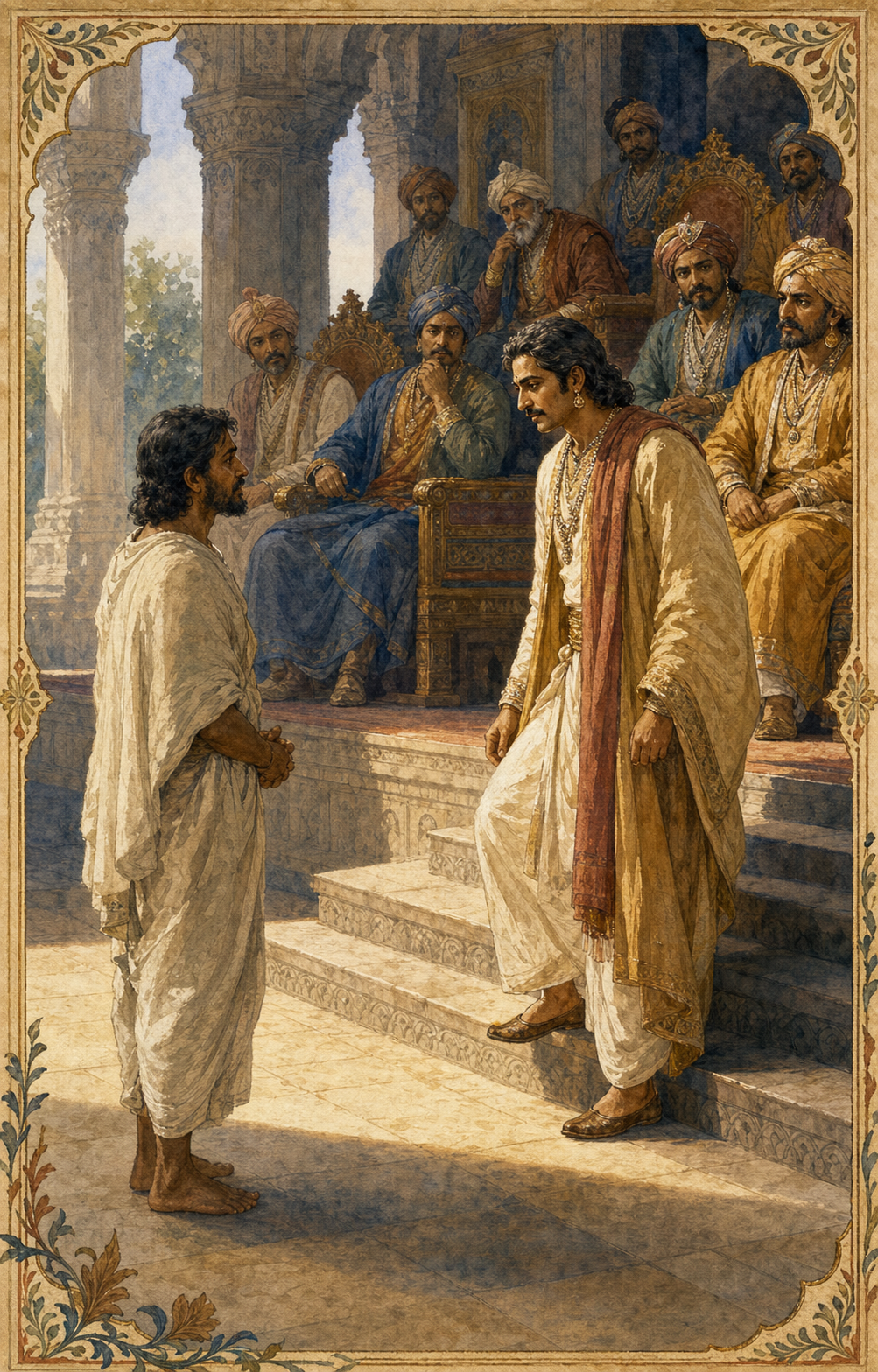
During the thirteenth year of exile, Draupadi lived incognito in King Virata’s kingdom as Sairandhri, serving Queen Sudeshna. The Sudeshna-Kichaka episode turns an ancient court into an enduring test of governance: what does an authority do when a dependent person’s safety collides with the convenience or influence of someone powerful?
The failure of protection rarely begins with a formal declaration that the vulnerable person does not matter. It usually begins with smaller evasions. A warning is treated as a personal disagreement. The person at risk is told to manage the situation quietly. The powerful insider retains access. The protector delays because intervention would be awkward. Each step preserves institutional comfort while transferring danger to the person with the least power.
If someone under your authority reports a threat from a powerful person, do not make continued exposure the price of being believed. Reduce the immediate risk first. Preserve relevant records. Move the assessment outside the alleged wrongdoer’s influence. Protect the complainant and witnesses from retaliation. Then determine responsibility through a fair process.
Interim protection is not a declaration of guilt, and due process is not permission to remain passive. A competent institution can protect someone from foreseeable harm while still examining the facts impartially. Leaders often create a false choice between those duties because the false choice excuses delay.
There is a simple question that exposes this kind of failure: who in your institution can say “no” without losing employment, access, reputation, security, or community standing? If the honest answer is “only the powerful,” the written rules are not describing the real system. Rajadharma begins by closing that gap.
Do not turn policy opposition into hostility toward a community
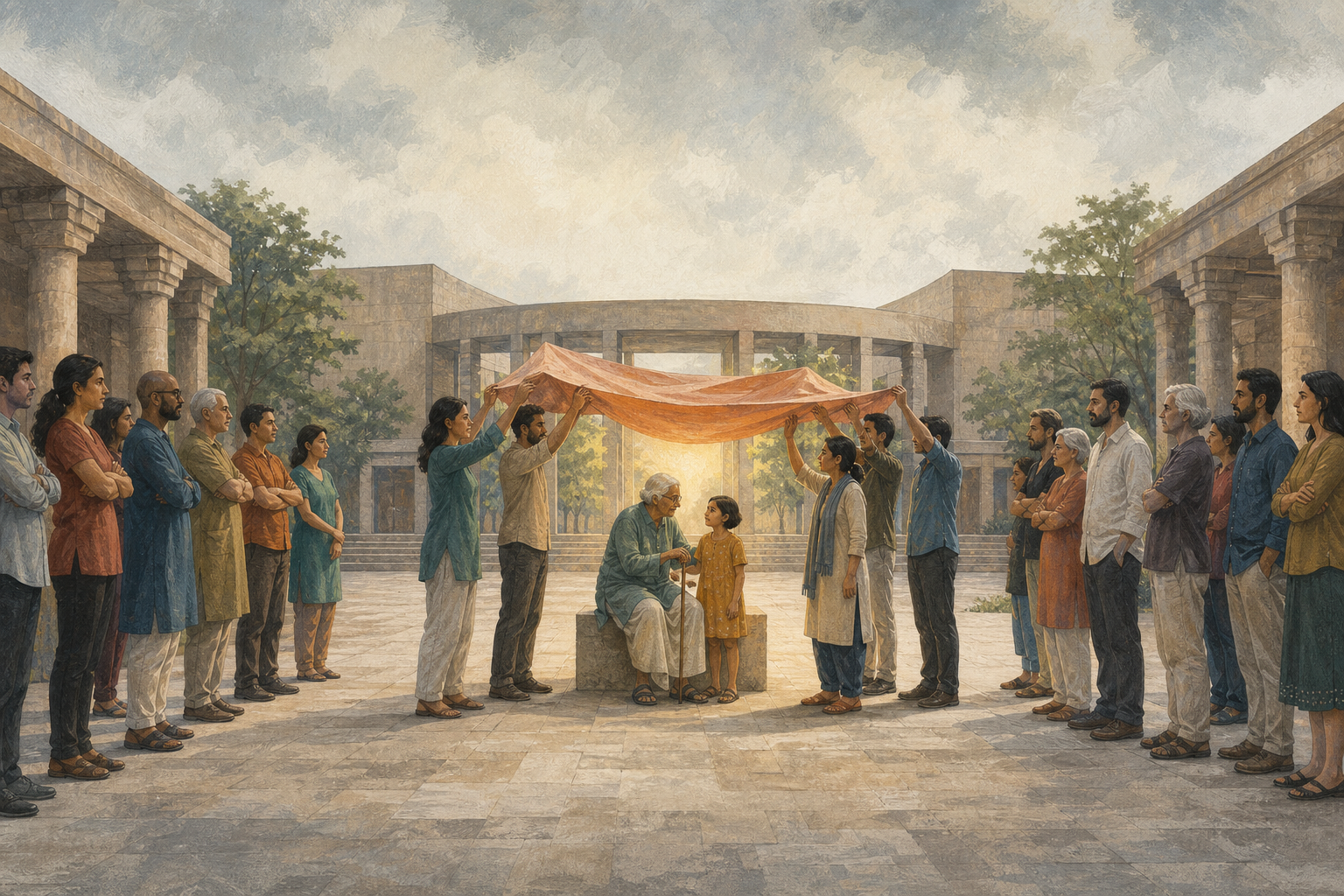
A leader can have a legitimate public purpose and still defend it in an adharmic way. This often happens when criticism of a policy is recast as hostility to the nation, while the conduct of particular organisations is blurred into suspicion of an entire religious or social community.
The dispute surrounding the FCRA 2026 amendments illustrates the danger. Some political and religious voices have framed the amendments as targeting Christians, even as national-security and financial-transparency concerns remain legitimate matters for the state to address. A responsible government should refuse the false choice between abandoning scrutiny and treating a community as suspect.
The first discipline is to define the concern in terms of conduct. Which transaction, disclosure failure, institutional relationship, or security risk is the rule intended to address? The same conduct should trigger the same scrutiny regardless of the organisation’s religious identity. If officials cannot describe the trigger without naming a community, the policy or its public explanation needs repair.
The second discipline is procedural visibility. Publish the criteria being applied, identify who makes the decision, record the reasons for adverse action, and provide a workable route for review or correction. Transparency does not require disclosing information that would create a genuine security risk, but “security” should not become a label that ends every question. The authority withholding information still owes a precise explanation of the legal and institutional basis for doing so.
The third discipline is linguistic restraint. Name the organisation or conduct at issue when evidence justifies it. Do not widen a case into a judgement on Christians, Hindus, Muslims, Sikhs, or any other community. Collective insinuation weakens a legitimate policy because citizens can no longer tell whether the state is regulating conduct or assigning inherited suspicion.
The fourth discipline is a real hearing. Listening does not mean granting every demand or allowing an interested party to veto regulation. It means answering the strongest objection rather than the easiest one. If an objection exposes an ambiguity, narrow the language. If it reveals a missing safeguard, add one. If it does not overturn the public case, explain why and proceed. Engagement has a purpose and an end point.
This moral framework cannot determine whether a particular statutory clause is constitutional, lawful, or proportionate. Those questions require examination of the actual text and the applicable law. What the framework can determine is whether the state is behaving like a trustee of public power: using neutral criteria, hearing affected parties, guarding against communal generalisation, and accepting review.
The Kurukshetra metaphor must be applied inward

Political actors are naturally tempted to cast themselves as the Pandavas, appoint their preferred adviser as Krishna, and place every opponent on the side of adharma. Once the roles are assigned that way, the Mahabharata no longer challenges the leader. It merely decorates a conclusion already reached.
Kurukshetra should first be an inward metaphor. Ask which attachment is clouding your judgement. Are you protecting a friend because admitting the truth would embarrass your institution? Are you avoiding a necessary decision because the criticism will be personal? Are you defending a measure because reversing it would look weak? Are you mistaking the humiliation of an opponent for the achievement of a public good?
These questions reveal why persistence and courage are not synonyms. Continuing with a flawed decision because your prestige is invested in it is obstinacy. Revising a clause after a genuine defect is demonstrated can require more courage than forcing it through. Conversely, withdrawing a sound decision merely because an organised campaign becomes noisy is not compassion. It can be an abandonment of duty.
To distinguish correction from surrender, identify exactly what has changed. If new facts undermine the purpose or reveal disproportionate harm, revise the decision. If the purpose remains valid but the procedure is unfair, repair the procedure. If both purpose and process remain sound after serious examination, act and explain. Do not let either pride or fear make the choice for you.
The same test applies to your choice of means. A legitimate objective does not make every method legitimate. Ask whether the measure is narrower than necessary, whether an independent check exists, whether innocent people can be separated from wrongdoers, whether mistakes can be corrected, and whether temporary powers have a defined route back to ordinary governance. Dharma concerns how power is used, not only the intention announced before using it.
Moral courage also has a quiet institutional form. It is the official who records a reason instead of passing an oral instruction, the trustee who recuses when a relationship compromises judgement, the leader who protects an internal dissenter from retaliation, and the majority that leaves a fair appeal open to the minority. These safeguards make courage repeatable after an unusually virtuous individual has left office.
Key takeaways: a six-question dharmic decision test

Use this test before the final meeting on a difficult policy, disciplinary matter, or institutional dispute. Write the answers rather than discussing them only in general terms. A written answer exposes gaps that confident speech can conceal.
- What is the duty? State the specific public or institutional good in one sentence. Remove slogans and partisan descriptions.
- Who bears the burden? Name the people who face the decision’s cost, especially those who cannot safely refuse, complain, leave, or appeal.
- What is the strongest good-faith objection? State it in terms its actual advocate would recognise. If you cannot do that, listen again before deciding.
- Is the rule about conduct or identity? Check whether the same behaviour would receive the same treatment if the person’s religion, caste, party, status, or affiliation changed.
- What restrains misuse? Identify the record, independent review, separation of authority, appeal, anti-retaliation measure, or other safeguard that prevents power from becoming personal.
- What will happen after the decision? Name who owns implementation, how harm or error will be noticed, what evidence would justify correction, and when the decision must be reviewed.
If the duty and burden cannot be stated clearly, pause and investigate. If the purpose is clear but neutrality or safeguards are weak, redesign the means. If the purpose, evidence, process, and protections survive serious objections, decide. At that point, further delay may be an evasion of responsibility rather than prudence.
At your next hard decision, bring one rigorous dissenting argument and one affected person’s perspective into the room, directly or through a safe written account. State the duty, test the means, record the reasons, and accept responsibility for the result. That discipline will bring governance closer to dharma than declaring yourself righteous ever can.
References
- Hindu Post – What Bhagwan Krishna Can Teach the Government About Facing the FCRA 2026 Battle
- Hindu Blog – Mahabharata – Sudeshna and the Sudeshnas of the Modern World – Betrayal
