

If you encountered Jishnu in a list of divine names, a prayer, or a discussion of Sri Krishna, the usual translation – “victorious” or “ever-victorious” – may leave you with a question. Is this simply a celebration of power, or does the name tell you how a victory becomes worthy of Bhagavan?
The distinction matters whenever you face conflict, disappointment, or a difficult decision. Jishnu does not give every personal preference the sanction of dharma. It asks you to conquer the confusion, ego, and fear that can corrupt your judgement before you try to prevail in the world.
Key takeaways
- Jishnu is rooted in the Sanskrit verbal root √ji, “to conquer,” and signifies one who is victorious.
- The Vishnu Sahasranama includes Jishnu among the names of Vishnu; the epithet is therefore honored in Vaishnava traditions that revere Krishna as an avatara of Vishnu.
- Krishna’s victory is not brute domination or automatic success for anyone invoking his name. It is victory ordered toward dharma.
- The Bhagavad Gita gives the epithet an ethical shape: overcome bewilderment, steady your resolve, discern your duty, and act without surrendering truth.
- You can use Jishnu in japa or reflection as a checkpoint before action: identify the inner obstacle, establish the limit you will not violate, and choose the next dharmic step.
The victory contained in the name Jishnu

The meaning begins with the Sanskrit root √ji, “to conquer”. Jishnu can therefore be understood as the victorious or conquering one. In the Vishnu Sahasranama, it identifies victory as a divine attribute rather than a fortunate event that happens once.
That grammatical starting point is important, but it is not the whole spiritual meaning. Conquest can serve greed, anger, vanity, or fear. Such conquest may secure an immediate advantage while deepening bondage within the person who achieves it. The divine name directs the idea of victory away from possession and toward the preservation of dharma, truth, dignity, and right order.
This is why “ever-victorious” should not be read as “always getting the result I want.” A divine name is not a prediction that every plan formed by a devotee will succeed. Nor is it a slogan by which a community can declare that its own side must be righteous because it expects to win. Jishnu describes Bhagavan’s unconquered alignment with dharma. It does not make human motives infallible.
When you invoke Krishna as Jishnu, the first question is therefore not, “How do I defeat the person opposing me?” It is, “What must be conquered in me so that my response does not become adharma?” The answer may be moha, the bewilderment that prevents clear sight. It may be ahankara, the ego that treats correction as humiliation. It may be fear, resentment, or the desire to punish after justice has already been served.
This inner reading does not require withdrawal from outward responsibility. It prepares you to meet responsibility without letting the conflict reproduce itself inside you. Jishnu joins inner mastery to effective action: clarity must shape intention, and intention must become conduct.
Kurukshetra gives victory an ethical test
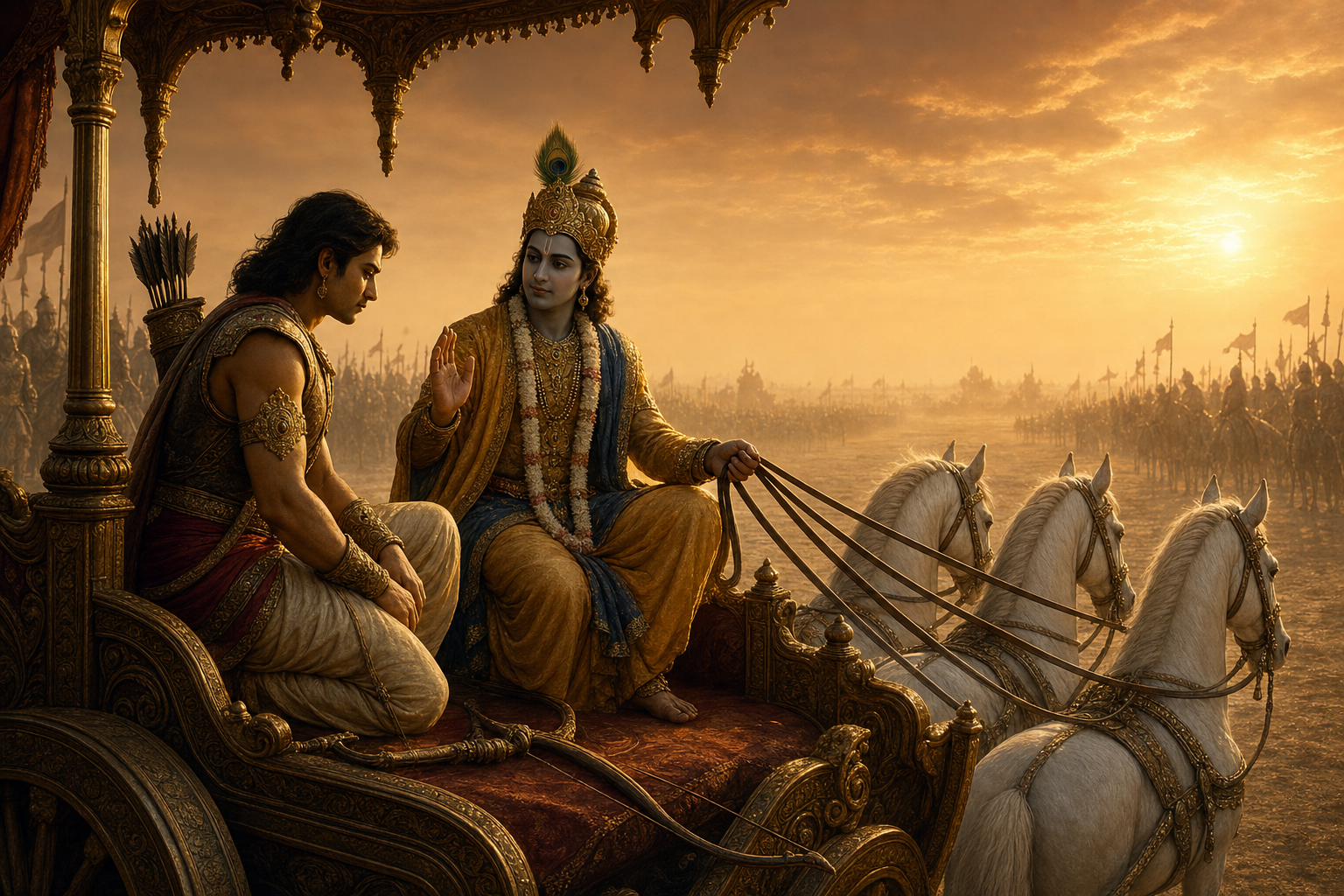
The setting of the Bhagavad Gita prevents a vague or sentimental interpretation. Krishna’s guidance is given amid an unavoidable crisis of action. Arjuna does not merely need encouragement to fight, nor permission to escape. He needs his bewilderment dispelled so that he can distinguish duty from impulse, compassion from paralysis, and principled action from attachment to an outcome.
That setting clarifies what victory under Krishna’s guidance requires. A dharma-yuddha is not made righteous merely by calling it one. Its purpose, means, limits, and the state of mind of those acting all matter. Outward success separated from truth and ethical restraint cannot express the victory signified by Jishnu.
You can apply that standard to an argument in your family, a dispute at work, a public controversy, or a struggle within your own habits. Before you decide what “winning” means, test the conflict in four places:
- The truth test: Have you named the situation as it is, including facts that weaken your preferred position?
- The motive test: Are you trying to correct a wrong, or are you trying to humiliate the person associated with it?
- The means test: Would your method still appear dharmic if an opponent used it against you?
- The consequence test: Will the proposed action protect what ought to be protected, or merely transfer anger to a new target?
These questions do not guarantee an easy answer. They do prevent a common mistake: treating strong emotion as proof of moral clarity. The fiercer your certainty becomes, the more useful it is to examine whether moha or ahankara has taken the language of dharma for itself.
What the epithet does not promise
Jishnu does not mean that a sincere devotee will never suffer a setback. Immediate outcomes are affected by many conditions, including other people’s choices. A person can lose status, comfort, an argument, or an opportunity without losing integrity. Conversely, a person can obtain the desired result while damaging truth, compassion, and self-command.
The useful distinction is between an outcome and a victory. An outcome tells you what happened. A dharmic victory also asks what your action preserved, what it corrected, and what it made of you. This is why restraint can sometimes be victorious, why an apology can defeat ahankara, and why refusing an unjust advantage can be stronger than taking it.
Turn Jishnu from an epithet into a daily practice

The name can be included in nama-japa, remembered during kirtan, or contemplated while reciting the Vishnu Sahasranama. Its practical force becomes especially clear when you bring it to a real decision rather than leaving it as an abstract description of divine greatness.
The following reflection is a simple way to do that. It is not a replacement for the established discipline of your sampradaya or guidance received from your guru.
- Name the actual conflict. State it without exaggeration. Separate what happened from what you fear may happen.
- Repeat “Jishnu” with attention. Let the name interrupt the momentum of anger or anxiety. The purpose is not to suppress the problem but to recover enough steadiness to see it clearly.
- Identify the first conquest. Ask what presently obstructs dharmic action: confusion, ego, fear, attachment to approval, or the wish to retaliate.
- Set a boundary for your own conduct. Decide which dishonest, cruel, or reckless method you will not use, even if it promises a quicker result.
- Choose one truthful and compassionate action. It may be speaking plainly, correcting an error, refusing cooperation with wrongdoing, apologising, seeking counsel, or waiting until you can respond without malice.
- Examine the result without rewriting your motive. If the outcome disappoints you, do not immediately assume that dharma failed. Ask whether your understanding was incomplete, whether your method needs correction, and whether your integrity remained intact.
This practice changes the question from “Will Krishna make me win?” to “Can I act in a way that belongs under the name Jishnu?” That shift is small enough to use before a conversation and demanding enough to reshape a life.
Japa also needs a corresponding action. If you repeatedly invoke the conqueror of adharma while protecting a convenient falsehood, the contradiction is the point you need to notice. The name is not an escape from accountability. It is a call to bring speech, intention, and conduct into the same alignment.
A shared Dharmic language of inner conquest

Jishnu also helps you recognize a family resemblance across Dharmic traditions without pretending that their teachings are identical. Jain thought venerates the Jina, the conqueror who overcomes the inner passions. Buddhist narratives present the overcoming of Mara. Sikh teachings unite spiritual sovereignty with ethical courage. Each tradition preserves its own theology, discipline, and vocabulary, yet all refuse to reduce victory to domination over someone else.
The shared insight is practical: an unmastered mind can turn even a worthy cause into another vehicle for ego, fear, or hostility. Outer courage therefore needs inner discipline. Otherwise, a person may oppose injustice while becoming unjust, defend truth while speaking falsely, or protect a community while abandoning the dignity that makes community worth protecting.
This is a better basis for Dharmic solidarity than flattening every path into a single doctrine. When speaking with a Jain, Buddhist, or Sikh, you need not claim that Jishnu, Jina, the conquest of Mara, and spiritual sovereignty are synonyms. You can notice the ethical kinship: each asks whether the practitioner has overcome the forces that make outward power spiritually dangerous.
The next time you say Jishnu, do not ask Krishna to make your side prevail before examining your side, your means, and your mind. Name the inner obstruction, establish the limit you will not cross, and take the next clear action. That is how an epithet becomes sadhana.
References
